炼焦及核燃料加工业

Search documents
恒力石化: 恒力石化独立董事工作制度(2025年修订)
Zheng Quan Zhi Xing· 2025-08-05 16:09
Core Points - The document outlines the revised Independent Director Work System of Hengli Petrochemical Co., Ltd. to enhance corporate governance and protect the rights of minority shareholders [1][2] Group 1: General Principles - The purpose of the Independent Director Work System is to improve the corporate governance structure and ensure independent directors can effectively supervise and constrain internal directors and management [1] - Independent directors must not hold any other positions within the company and should have no direct or indirect interests that could affect their independent judgment [1][2] Group 2: Independence Requirements - Independent directors must be independent and impartial, free from influence by the company or major shareholders [2][5] - The proportion of independent directors on the board must not be less than one-third, including at least one accounting professional [2][5] Group 3: Appointment and Termination - Independent directors can be nominated by the board or shareholders holding more than 1% of the company's shares, and must be elected by the shareholders' meeting [5][6] - Independent directors serve a term aligned with other board members, with a maximum continuous term of six years [6][7] Group 4: Responsibilities and Duties - Independent directors are responsible for participating in board decisions, supervising potential conflicts of interest, and providing professional advice to enhance decision-making [17][18] - They have the authority to independently hire external consultants for audits or consultations [18] Group 5: Reporting and Evaluation - Independent directors must conduct annual self-assessments of their independence and submit reports to the board [3][4] - They are required to submit an annual performance report detailing their attendance, participation in committees, and communication with shareholders [29][12] Group 6: Support and Resources - The company must provide necessary working conditions and support for independent directors to fulfill their duties effectively [30][31] - Independent directors should have equal access to information and resources as other board members [31][32]

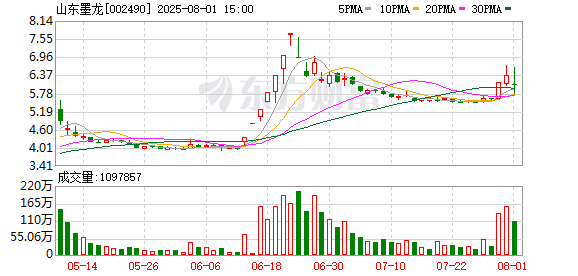
山东墨龙振幅15.51%,机构净卖出860.64万元,深股通净卖出1757.28万元
Zheng Quan Shi Bao Wang· 2025-08-01 09:23
Core Viewpoint - Shandong Molong's stock experienced a decline of 4.40% with a trading volume of 667 million yuan and a volatility of 15.51% on the day, indicating significant market activity and investor sentiment shifts [2][3]. Trading Activity - The stock had a turnover rate of 20.27%, with institutional investors net selling 8.61 million yuan and the Shenzhen Stock Connect net selling 17.57 million yuan [2]. - The top five trading departments accounted for a total transaction of 131 million yuan, with a net sell of 42.83 million yuan [2]. - Specific trading details show that one institutional seat was involved, net selling 8.61 million yuan, while the Shenzhen Stock Connect was both the fourth largest buyer and the largest seller [2][3]. Fund Flow - The stock saw a net outflow of 38.16 million yuan in principal funds, with large orders contributing to a significant portion of this outflow [3]. - Over the past five days, the net outflow of principal funds totaled 18.49 million yuan [3]. Historical Performance - In the last six months, the stock has appeared on the trading leaderboard 14 times, with an average price increase of 1.74% the day after being listed and an average increase of 2.15% over the following five days [2].


重要数据发布→
新华网财经· 2025-06-09 08:28
Group 1 - The core viewpoint of the article highlights the decline in the Consumer Price Index (CPI) and the increase in the core CPI, indicating a mixed economic environment with ongoing adjustments in consumer prices [2][4]. - In May, the CPI decreased by 0.2% month-on-month and 0.1% year-on-year, while the core CPI, excluding food and energy, rose by 0.6% year-on-year, an increase of 0.1 percentage points from the previous month [1][4]. - The Producer Price Index (PPI) also saw a month-on-month decline of 0.4% and a year-on-year decrease of 3.3%, with the decline in PPI year-on-year widening by 0.6 percentage points compared to the previous month [1][5]. Group 2 - The decrease in CPI was primarily influenced by a 1.7% drop in energy prices, which accounted for approximately 70% of the total decline in CPI [3][4]. - Food prices saw a slight decrease of 0.2%, with seasonal factors affecting the prices of fresh vegetables, eggs, and meat, while some fruits and fish experienced price increases due to supply constraints [3][4]. - The increase in consumer demand, driven by holiday activities and entertainment, led to a rise in hotel accommodation and tourism prices, with hotel prices reaching a near ten-year high [3][4]. Group 3 - The PPI's decline was significantly impacted by international factors, particularly the decrease in global oil prices, which affected domestic oil-related industries [6]. - Domestic energy and raw material prices also saw a seasonal decline, with coal prices dropping due to sufficient supply and low demand [6]. - Despite the overall decline in PPI, some sectors showed signs of improvement, with macroeconomic policies enhancing supply-demand relationships in certain industries [5][6]. Group 4 - The article notes that new consumption drivers are emerging, leading to a recovery in prices for daily necessities, with life goods prices stabilizing after a previous decline [7]. - High-end manufacturing and technological advancements are contributing to price increases in related industries, with significant growth in sectors like integrated circuits and aerospace manufacturing [7][8]. - The renewable energy sector, including solar and lithium battery industries, is experiencing improved supply-demand dynamics, resulting in a narrowing of price declines [8].