
居民消费价格指数(CPI)

Search documents
2月CPI环比同比涨幅均创新高,释放什么信号?
券商中国· 2026-03-09 10:20
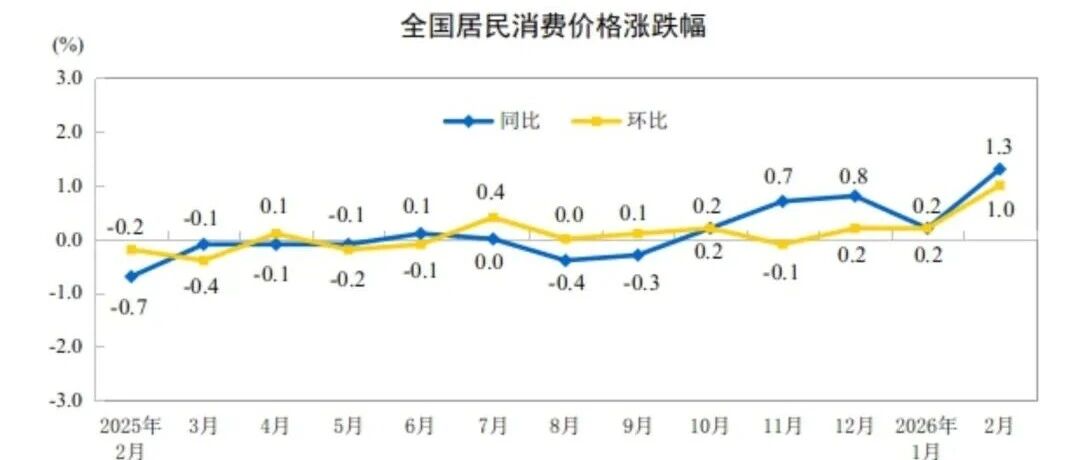
Core Viewpoint - The article highlights a significant increase in the Consumer Price Index (CPI) and Producer Price Index (PPI) in February, indicating a recovery in the domestic economy driven by various factors, including seasonal consumption patterns and international commodity price trends [1][4][5]. CPI Analysis - The CPI increased by 1.0% month-on-month and 1.3% year-on-year, marking the highest growth in nearly three years [1][3]. - The core CPI, excluding food and energy, rose by 1.8% year-on-year [3]. - Service prices were a major contributor to the CPI increase, with notable rises in airfare (31.1%), vehicle rental (24.7%), travel agency fees (15.8%), and hotel accommodation (7.3%), collectively accounting for over 30% of the CPI's total increase [3][4]. - The average CPI for January and February was up 0.8% year-on-year, indicating a continuation of the recovery trend observed since the second half of 2022 [4]. PPI Analysis - The PPI rose by 0.4% month-on-month, marking the fifth consecutive month of increase, while the year-on-year decline narrowed to 0.9% [1][7]. - Factors contributing to the PPI increase include rising international oil prices and a strong upward trend in the semiconductor industry, with specific price increases in electronic components and materials [7][8]. - The article anticipates that the PPI may turn positive year-on-year in March due to ongoing international tensions affecting oil prices, which could lead to increased domestic inflationary pressures [5][7]. Economic Outlook - Analysts expect the upward trend in CPI to continue, supported by government initiatives aimed at boosting consumer spending and addressing supply chain issues [5]. - The article suggests that while current prices are low, there is potential for further increases as consumer demand strengthens post-holiday [4][5].


2月CPI涨幅创近三年新高
21世纪经济报道· 2026-03-09 06:43
Group 1 - In February 2026, the national consumer price index (CPI) increased by 1.3% year-on-year and 1.0% month-on-month, influenced by the Spring Festival and recovering consumer demand [1][3] - The core CPI, excluding food and energy prices, rose by 1.8% year-on-year, indicating a steady inflation trend [3] - The producer price index (PPI) saw a month-on-month increase of 0.4%, remaining stable for five consecutive months, while the year-on-year decline narrowed to 0.9% [4] Group 2 - The rise in service prices, which increased by 1.1% month-on-month and 1.6% year-on-year, significantly impacted the CPI, contributing approximately 0.54 percentage points to the month-on-month increase and 0.75 percentage points to the year-on-year increase [3][4] - The PPI's month-on-month performance was driven by rising international prices of non-ferrous metals and crude oil, alongside increased demand in certain sectors due to growth in computing power [4] - Specific industries such as electronic components and materials manufacturing saw price increases, with electronic semiconductor materials rising by 2.8% and integrated circuit packaging testing prices increasing by 1.1% [4][5] Group 3 - The construction of a modern industrial system is accelerating, with prices in related industries rising year-on-year, such as a 4.9% increase in electronic components and a 7.7% increase in aircraft manufacturing [5] - Market competition is improving, leading to price stabilization in some sectors, with photovoltaic equipment manufacturing prices rising by 3.2% and lithium-ion battery manufacturing prices experiencing their first increase after 33 months of decline [5]

【数据发布】2026年2月份居民消费价格同比上涨1.3%
中汽协会数据· 2026-03-09 03:06
Core Viewpoint - The article discusses the changes in the Consumer Price Index (CPI) in February 2026, highlighting a year-on-year increase of 1.3% for national residents, with specific contributions from various categories of goods and services [1][3]. Price Changes Year-on-Year - In February, the CPI increased by 1.3% year-on-year, with urban areas rising by 1.4% and rural areas by 0.9% [1]. - Food prices rose by 1.7%, while non-food prices increased by 1.3% [1]. - The average CPI for January-February was up by 0.8% compared to the same period last year [1]. Price Changes Month-on-Month - The CPI increased by 1.0% month-on-month in February, with urban areas also rising by 1.0% and rural areas by 0.7% [1]. - Food prices saw a month-on-month increase of 1.9%, while non-food prices rose by 0.8% [1]. Contribution to CPI from Food and Beverages - In February, food, tobacco, and restaurant prices increased by 1.4% year-on-year, contributing approximately 0.41 percentage points to the CPI [3]. - Specific food items such as fresh vegetables, seafood, and fresh fruits saw significant price increases of 10.9%, 6.1%, and 5.9% respectively, contributing 0.19, 0.11, and 0.12 percentage points to the CPI [3]. Price Changes by Category - Among the eight major categories, five experienced price increases while two saw declines [3]. - Categories with notable increases included other goods and services (15.4%), and education, culture, and entertainment (2.0%) [3]. - Clothing and healthcare prices both rose by 1.9%, while transportation and housing prices decreased by 0.7% and 0.2% respectively [3]. Month-on-Month Price Changes by Category - In February, food, tobacco, and restaurant prices increased by 1.4% month-on-month, contributing about 0.40 percentage points to the CPI [6]. - Water product prices rose by 6.9%, fresh fruit prices by 4.0%, and livestock prices by 2.6%, with pork prices specifically increasing by 4.0% [6]. - Other categories such as other goods and services, transportation, and education also saw month-on-month increases of 2.3%, 2.2%, and 1.6% respectively [6].
2026年1月份居民消费价格同比上涨0.2% 猪肉价格下降13.7%
Guo Jia Tong Ji Ju· 2026-02-24 08:31
Core Insights - In January 2026, the national consumer price index (CPI) increased by 0.2% year-on-year, with urban areas rising by 0.2% and rural areas by 0.1% [1] - Food prices decreased by 0.7%, while non-food prices increased by 0.4% [1] - Month-on-month, the CPI also rose by 0.2%, with both urban and rural areas showing a 0.2% increase [1] Year-on-Year Price Changes - In January, the prices of food, tobacco, alcohol, and dining out decreased by 0.2%, contributing to a 0.06 percentage point decline in CPI [2] - Specific food items saw significant price changes: egg prices fell by 9.2% (impacting CPI by -0.05 percentage points), and pork prices dropped by 13.7% (impacting CPI by -0.28 percentage points) [2] - Fresh vegetables increased by 6.9% (impacting CPI by +0.12 percentage points), while fresh fruits rose by 3.2% (impacting CPI by +0.06 percentage points) [2] - Other categories showed mixed results, with prices for other goods and services rising by 13.2% and 2.6%, while transportation and housing prices fell by 3.4% and 0.1% respectively [2] Month-on-Month Price Changes - In January, the prices of food, tobacco, alcohol, and dining out remained stable [3] - Notable month-on-month changes included a 2.7% increase in egg prices (impacting CPI by +0.01 percentage points) and a 2.0% rise in both fresh fruit and seafood prices (each impacting CPI by +0.04 percentage points) [3] - Conversely, fresh vegetable prices decreased by 4.8% (impacting CPI by -0.10 percentage points) [3] - Other categories experienced price increases, with other goods and services rising by 2.7% and living goods and services by 0.9% [3]
原木:低到港低库存,震荡偏强
Guo Tai Jun An Qi Huo· 2026-02-24 01:19
Report Summary 1. Investment Rating - No investment rating for the industry is provided in the report. 2. Core View - The log market is characterized by low arrivals and low inventories, showing a volatile and slightly upward trend [1]. 3. Summary by Directory 3.1 Fundamental Tracking - **Futures Contracts**: For the 2603 contract, the closing price on February 13, 2026, was 787.5, with a daily increase of 1.0% and a weekly increase of 1.6%. The trading volume was 2277, down 40.0% daily and 70% weekly. The open interest was 2449, down 22.1% daily and 54% weekly. Similar data is presented for the 2605 and 2607 contracts [1]. - **Price Spreads**: The spreads between different contracts and between spot and futures contracts are provided, such as the spot - 2603 spread being -37.5 on February 13, 2026, with a daily increase of 27.1% and a weekly increase of 50% [1]. - **Spot Market**: The prices of various types of logs and wood squares in different markets (Shandong and Jiangsu) remained stable with 0.0% daily and weekly changes, including 3.9 - meter and 5.9 - meter radiation pine, 11.8 - meter spruce, 4 - meter K - material, etc. [1]. 3.2 Macro and Industry News - In January, the consumer price index (CPI) rose 0.2% month - on - month and 0.2% year - on - year. The core CPI excluding food and energy prices rose 0.8% year - on - year. The producer price index (PPI) rose 0.4% month - on - month and fell 1.4% year - on - year [3]. - China's RatingDog manufacturing PMI in January was 50.3, in line with expectations and up from the previous value of 50.1 [3]. 3.3 Trend Intensity - The log trend intensity is 0, indicating a neutral trend, with the range of trend intensity being [-2, 2] [3].
去年贵阳CPI 温和回升
Xin Lang Cai Jing· 2026-02-23 22:46
Core Viewpoint - The consumer price index (CPI) in Guiyang is projected to increase by 0.5% year-on-year in 2025, which is 0.2 percentage points higher than the previous year, with the core CPI (excluding food and energy) rising by 1.0% [1] Group 1: Price Changes - Food prices are expected to rise by 0.1%, while non-food prices are projected to increase by 0.5% [1] - Consumer goods prices are anticipated to increase by 0.2%, and service prices are expected to rise by 0.9% [1] Group 2: Price Structure - Among the eight categories of goods and services, six are expected to see price increases, one remains stable, and one is projected to decline [1] - The price of other goods and services is expected to rise by 7.4%, while daily necessities and services are projected to increase by 1.8% [1] - Education, culture, and entertainment prices are expected to rise by 1.7%, clothing prices by 0.6%, and food, tobacco, and alcohol prices by 0.5% [1] - Housing prices are projected to increase by 0.3%, while medical care prices are expected to remain stable, and transportation and communication prices are anticipated to decline by 2.0% [1]
过去这五年,江苏的CPI涨幅出炉
Sou Hu Cai Jing· 2026-02-21 01:29
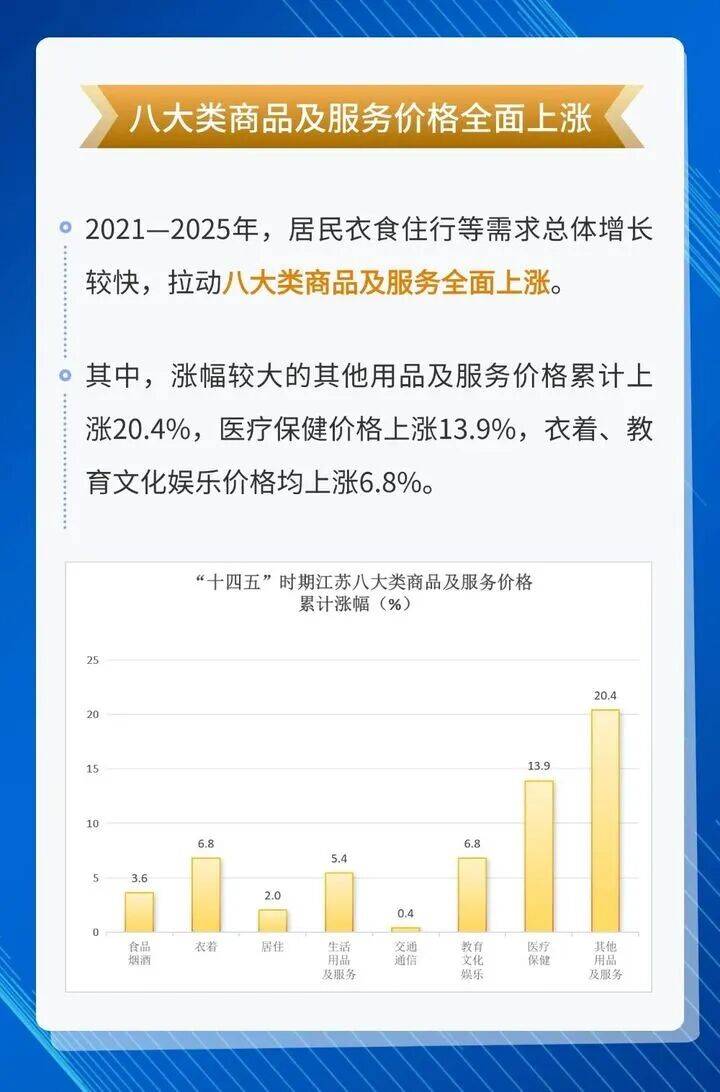
Core Insights - The Consumer Price Index (CPI) serves as a "barometer" for the economic situation and directly impacts the public's financial well-being [1] - During the "14th Five-Year Plan" period, Jiangsu has effectively combined improving people's livelihoods with promoting consumption, leading to a stable and resilient economic performance [1] Price Trends - Overall, the consumer prices in Jiangsu have maintained a moderate upward trend, with core consumer prices showing a mild increase [3] - From 2021 to 2025, the core consumer price index, excluding food and energy, is projected to rise between 0.5% and 1.3%, with a cumulative increase of 4.4% [3] - Industrial consumer goods prices (excluding energy) have experienced three increases and two decreases over the five years, with the highest increase in 2022 and the largest decrease in 2023 [3] - Service prices are expected to rise annually between 0.4% and 1.4% during this period [3]
1月份辽宁CPI上涨0.8
Liao Ning Ri Bao· 2026-02-16 02:10
Group 1 - The core viewpoint of the articles indicates that the Consumer Price Index (CPI) in Liaoning province increased by 0.8% year-on-year in January 2026, surpassing the national average by 0.6 percentage points [1] - The core CPI, excluding food and energy prices, rose by 1.4% year-on-year, with an increase of 0.1 percentage points compared to the previous month [1] - Month-on-month, the CPI increased by 0.6%, which is higher than the national average increase of 0.4%, with urban areas rising by 0.7% and rural areas by 0.6% [1] Group 2 - In terms of year-on-year changes, prices in eight major categories showed a trend of "six increases and two decreases," with other goods and services rising by 18.5%, and food, tobacco, and dining out increasing by 1.7% [1] - Month-on-month, the prices in eight major categories exhibited a trend of "six increases, one decrease, and one stable," with other goods and services increasing by 3.1% and healthcare prices rising by 1.4% [2] - The transportation and communication category saw a significant decrease of 4.1% year-on-year, while clothing prices decreased by 0.1% month-on-month [1][2]
这两个0.2%,传递什么信号?
Xin Lang Cai Jing· 2026-02-14 01:55
Group 1 - The Consumer Price Index (CPI) in January showed a month-on-month increase of 0.2% and a year-on-year increase of 0.2%, indicating a continuous recovery in consumer demand and the steady release of market potential [1] - The core CPI rose by 0.3% month-on-month, marking the highest increase in six months, reflecting a positive trend in the domestic consumption market [1] - The year-on-year increase in CPI is attributed to multiple positive factors, showcasing an optimized consumption structure and stable prices for essential goods, alongside a boost in service consumption and upgraded product spending [1] Group 2 - The stable performance of core CPI serves as a "barometer" for the recovery of consumption, with expectations of improved employment and income further releasing domestic demand potential [2]
1月广州CPI环比上涨0.1%
Guang Zhou Ri Bao· 2026-02-13 07:34
Core Insights - In January, Guangzhou's Consumer Price Index (CPI) increased by 0.1% month-on-month and remained flat year-on-year, indicating stable consumer prices in the region [1] Group 1: Price Changes - Food prices decreased by 0.8%, with 9 out of 14 food categories showing a decline, influenced by favorable weather conditions leading to a 7.7% drop in fresh vegetable prices and a 1.1% decrease in pork prices [1] - Prices in the category of other goods and services rose by 2.4%, driven by fluctuations in international precious metal prices, with jewelry and watches increasing by 13.0%, and specific items like gold jewelry rising by 7.7% [1] - The education, culture, and entertainment category saw a price increase of 0.4%, attributed to a rise in online audio-visual services by 4.6% and increased travel demand leading to a 2.8% rise in other travel prices [1] Group 2: Minor Price Influences - Prices for daily necessities and services increased by 0.6%, while healthcare prices rose by 0.3% and transportation and communication prices went up by 0.2% [2] - Housing prices remained stable, and clothing prices experienced a slight decrease of 0.1% [2]