
疫苗行业

Search documents
康希诺跌2.56% 2020年上市募52亿元中信证券保荐
Zhong Guo Jing Ji Wang· 2025-12-16 09:02
Group 1 - The stock price of CanSino Biologics (688185.SH) fell by 2.56% to 62.84 yuan, indicating it is currently in a state of decline since its IPO [1] - CanSino was listed on the Shanghai Stock Exchange's STAR Market on August 13, 2020, with an initial issuance of 24.8 million shares at a price of 209.71 yuan per share [1] - The total funds raised from the IPO amounted to 5.201 billion yuan, with a net amount of 4.979 billion yuan after deducting issuance costs, which was 3.979 billion yuan more than the original plan of 1 billion yuan [1] Group 2 - The issuance costs for CanSino's IPO were 221 million yuan, with underwriting and sponsorship fees accounting for 205 million yuan [2] - CITIC Securities, as the lead underwriter, received an allocation of 496,000 shares, representing 2% of the total shares issued, with an investment amount of 104 million yuan [2]


寒潮下慢病隐患凸显,如何破解防控难题?
2 1 Shi Ji Jing Ji Bao Dao· 2025-12-12 09:02
Core Viewpoint - A new wave of cold weather is impacting China, leading to significant temperature drops and increased health risks for chronic disease patients, particularly those with diabetes, who are more susceptible to complications such as shingles due to weakened immune systems [1][2]. Group 1: Health Risks and Challenges - The average daily temperature in most regions of China is expected to drop by 6 to 10 degrees Celsius, with some areas experiencing drops exceeding 14 degrees Celsius [1]. - Diabetes patients face heightened risks during cold weather, as low temperatures can cause blood vessel constriction, leading to blood sugar fluctuations and decreased immunity [1]. - The risk of shingles is 60% higher in diabetes patients compared to the general population, creating a dangerous cycle of pain and elevated blood sugar levels [2]. Group 2: Vaccination and Awareness - Despite high awareness of shingles (80%-90%) and vaccine knowledge (60%-80%), the vaccination rate in China remains low at only 1%-2% [3]. - Community health initiatives, such as personalized vaccine education prescriptions, are being implemented to encourage proactive health measures among chronic disease patients [3]. Group 3: Market Potential and Industry Growth - The domestic shingles vaccine market was valued at 3.73 billion yuan in 2022 and is projected to reach 5.63 billion yuan by the end of 2025, with a compound annual growth rate of 16.4% [4]. - The approval of new shingles vaccines, including one specifically for high-risk groups, indicates a growing market and increasing competition among pharmaceutical companies [4][5]. - Local governments are introducing policies to reduce vaccination costs, further promoting vaccine uptake and addressing the "knowledge-action gap" in vaccination [5].
2025年10月中国人用疫苗进出口数量分别为9吨和37.97吨
Chan Ye Xin Xi Wang· 2025-12-12 03:20
Core Insights - In October 2025, China's import of human vaccines amounted to 9 tons, representing a year-on-year decrease of 85.9%, with an import value of 0.22 million USD, down 89.2% [1] - Conversely, in the same month, China's export of human vaccines reached 37.97 tons, showing a significant year-on-year increase of 1089.8%, with an export value of 0.24 million USD, up 195.7% [1] Import Data - The import quantity of human vaccines in October 2025 was 9 tons, a substantial decline of 85.9% compared to the previous year [1] - The import value for the same period was 0.22 million USD, reflecting a decrease of 89.2% year-on-year [1] Export Data - The export quantity of human vaccines in October 2025 was 37.97 tons, marking an impressive increase of 1089.8% year-on-year [1] - The export value for this period was 0.24 million USD, which is a year-on-year increase of 195.7% [1]


三价流感疫苗中标价低至5.5元,多款疫苗卷入价格战
Cai Jing Wang· 2025-12-08 05:09
Group 1 - The core point of the article highlights the significant price drop in various vaccines in the domestic market, with the three-valent flu vaccine priced at only 5.5 yuan, marking a new low for public flu vaccines [1] - The price of the two-valent HPV vaccine from Watson Bio has plummeted from 245 yuan per dose in 2022 to 27.5 yuan per dose in 2025, a decrease of nearly 90% [1] - The nine-valent HPV vaccine from Wantai Bio is priced at 499 yuan per dose, significantly lower than imported products, prompting the latter to engage in promotional activities to lower prices [1] Group 2 - The sharp decline in vaccine prices is expected to reduce public vaccination costs, theoretically improving vaccine accessibility and uptake [2] - Concerns have been raised regarding the potential impact of such low prices on public trust in vaccine quality, with fears that low-cost vaccines may compromise safety and effectiveness [2] - The public's skepticism may lead to a mindset of avoiding vaccinations altogether due to perceived risks associated with low-priced vaccines [2]


张靓颖等明星也怕的带状疱疹,疫苗半价都卖不动
Jing Ji Guan Cha Wang· 2025-12-01 05:21
Core Insights - The article discusses the rising concern over shingles (herpes zoster) in China, particularly among younger individuals in high-stress professions, and highlights the low vaccination rates for shingles vaccines in the country [2][3][5] Group 1: Shingles and Its Impact - Shingles is known as one of the most painful skin diseases, primarily affecting individuals over 50, but recent cases among younger celebrities indicate a shift in its demographic [2][5] - The prevalence of postherpetic neuralgia, a severe complication of shingles, affects 9% to 34% of patients, emphasizing the importance of prevention over treatment [2][8] Group 2: Vaccination Challenges - The vaccination rate for shingles in China is alarmingly low, with only 0.79% of eligible adults vaccinated, compared to 26.8% in the U.S. for those over 50 [8][10] - The high cost of vaccines, with imported vaccines priced at 3,260 yuan and domestic ones around 1,400 yuan, poses a significant barrier to vaccination, especially for retirees whose average monthly pension is about 3,200 yuan [10][11] Group 3: Market Dynamics - The vaccine market has seen a price war since 2025 due to lower-than-expected sales, with prices for imported vaccines dropping significantly [3][11] - Companies are struggling with inventory issues, particularly for domestic vaccines, leading to promotional activities like "buy one, get one free" to boost sales [11][12] Group 4: Public Awareness and Education - There is a general lack of public awareness regarding shingles and its associated pain, which hinders vaccination efforts [8][12] - Companies are utilizing social media and other platforms for education and marketing, but face restrictions on direct advertising, leading to creative strategies for outreach [12][14][15]


纳入国家免疫规划 国产九价HPV疫苗在多地接种占比持续走高
Jing Ji Guan Cha Wang· 2025-12-01 03:02
Core Insights - The inclusion of the HPV vaccine in the national immunization program starting November 10, 2025, aims to provide free vaccinations to girls born after November 10, 2011, who are at least 13 years old [1] Group 1: HPV Vaccine Market Dynamics - The launch of the domestic nine-valent HPV vaccine offers a comprehensive and accessible option for cervical cancer prevention among eligible women [2] - There has been a notable increase in both consultation and vaccination rates for the domestic nine-valent HPV vaccine across various provinces, indicating growing acceptance and demand [2][4] - The domestic nine-valent HPV vaccine is perceived to have comparable efficacy and safety to imported versions, supported by large-scale clinical trials [2][3] Group 2: Factors Influencing Vaccine Uptake - The affordability of the domestic nine-valent HPV vaccine has significantly influenced the willingness of individuals to choose it over more expensive alternatives [3] - Public trust in domestic vaccines is increasing due to their proven safety, effectiveness, and established technology, leading to a shift in preference towards domestic options [3][4] - Government initiatives, including the "Accelerating the Elimination of Cervical Cancer Action Plan (2023-2030)," are promoting HPV vaccination and providing practical support for eligible girls [3] Group 3: Future Outlook - With ongoing policy support and increasing public acceptance, the domestic nine-valent HPV vaccine is expected to see rising consultation and vaccination rates, enhancing its reputation [4] - The expansion of supply, coverage areas, and improvement of grassroots vaccination services will further enhance accessibility and affordability for eligible women [4]
张靓颖等明星也怕的带状疱疹,疫苗半价都卖不动
经济观察报· 2025-11-30 06:39
Core Viewpoint - The article highlights the increasing incidence of shingles among younger individuals, particularly in high-stress professions, and emphasizes the low vaccination rates in China, which poses a significant public health risk [1][2][3]. Group 1: Shingles Incidence and Impact - Shingles, caused by the varicella-zoster virus, is commonly associated with individuals over 50, but recent cases among younger celebrities indicate a rising trend in younger populations, particularly those with high-stress jobs [2][5]. - The pain associated with shingles is severe, with reports indicating that it can reach levels comparable to childbirth, leading to a lack of public awareness regarding its severity and the importance of vaccination [7][9]. Group 2: Vaccination Rates and Challenges - The vaccination rate for shingles in China is alarmingly low, with only 0.79% of adults aged 40 and above vaccinated as of September 2024, compared to higher rates in the U.S. [6]. - The high cost of vaccines, with imported vaccines priced at 3,260 yuan and domestic vaccines around 1,400 yuan, significantly hinders vaccination efforts, especially among retirees with limited income [9][10]. Group 3: Market Dynamics and Pricing Strategies - The vaccine market has seen a price war since 2025, with prices for imported vaccines dropping from 3,260 yuan to 1,652 yuan, and domestic vaccines being offered at half price, which may lead to long-term sustainability issues for vaccine manufacturers [3][11]. - Companies are facing inventory challenges, with a significant drop in vaccine issuance in 2025, indicating a mismatch between supply and demand [11]. Group 4: Public Awareness and Marketing Strategies - There is a notable gap in public awareness regarding shingles and its vaccine, particularly among older adults who are the primary target demographic [13]. - Vaccine companies are utilizing social media and other platforms for marketing, focusing on educating the public about the disease and the availability of vaccines, despite regulatory restrictions on direct advertising [12][14].
明星也怕的带状疱疹疫苗为啥打不动?
Jing Ji Guan Cha Wang· 2025-11-29 08:35
Core Viewpoint - The article highlights the rising concern over shingles (herpes zoster) among younger individuals, particularly in high-stress professions, and the low vaccination rates in China, which pose challenges for the shingles vaccine market. Group 1: Shingles and Its Impact - Shingles is known as one of the most painful skin diseases, primarily affecting individuals over 50, but recent cases among younger celebrities indicate a shift in its prevalence [1][4] - Approximately 9%-34% of shingles patients may experience postherpetic neuralgia, leading to severe pain, which is often underestimated by the public [4][5] Group 2: Vaccination Challenges - The vaccination rate for shingles in China is alarmingly low, with only 0.79% of individuals aged 40 and above vaccinated, compared to 26.8% in the U.S. for those aged 50 and above [5] - High vaccine prices are a significant barrier, with imported vaccines costing around 3,260 yuan and domestic vaccines approximately 1,400 yuan, making them unaffordable for many retirees [7][8] Group 3: Market Dynamics - The vaccine market has faced challenges due to declining birth rates and increased competition, leading to price wars among over 30 companies involved in shingles vaccine development [2][8] - Recent promotional activities, such as "buy one get one free," have temporarily boosted vaccination rates but may lead to long-term declines in overall vaccination enthusiasm due to price sensitivity [7][8] Group 4: Public Awareness and Education - There is a significant lack of public awareness regarding shingles and its associated pain, which hinders vaccination efforts [3][4] - Companies are utilizing social media and other platforms to promote shingles awareness and vaccination, but the effectiveness of these campaigns varies [9][10][11]
疫苗龙头定增刚终止,急赴港“补血”
Shen Zhen Shang Bao· 2025-11-27 10:23
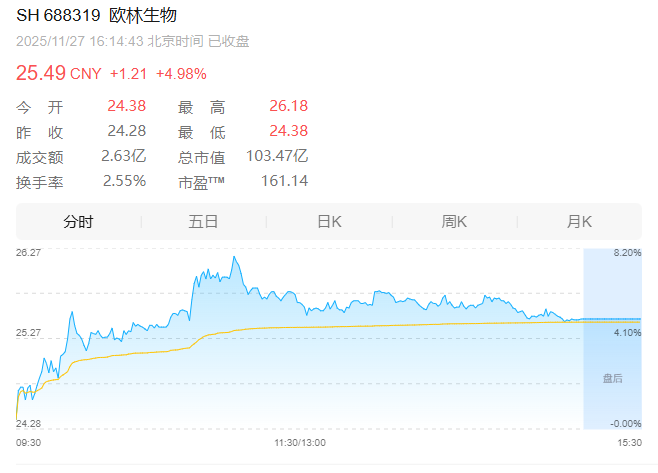
Core Viewpoint - Oulin Biotech (688319) has submitted an application for overseas public offering of H-shares on the Hong Kong Stock Exchange, following a significant stock price increase of over 140% this year, despite previously terminating a 175 million yuan private placement plan [1][3]. Financial Performance - In 2022, Oulin Biotech experienced a 75.38% decline in net profit, with 2023 revenue at 496 million yuan, down 9.38% year-on-year, and a net profit of 17.56 million yuan, a decrease of 33.94% [4]. - The company is projected to recover in 2024, with expected revenue of 589 million yuan, an 18.69% increase, and a net profit of 20.76 million yuan, up 18.24% [6]. - By Q3 2025, revenue reached 507 million yuan, a 31.1% increase, and net profit surged to 47.48 million yuan, a 1079.4% increase [6]. Accounts Receivable - As of the end of 2024, accounts receivable stood at 566 million yuan, representing 62.37% of current assets, indicating a significant portion of revenue is tied up in receivables [6]. - By Q3 2025, accounts receivable further increased to 665 million yuan, a 25.84% rise year-on-year, with an average collection period of 385 days [7]. Market Position - Oulin Biotech holds over 80% market share in its main product, the adsorbed tetanus vaccine, which has consistently contributed a significant portion of the company's revenue [8]. - The adsorbed tetanus vaccine accounted for 80.1% of revenue in 2022, increasing to 87.9% in the first half of 2025, with a gross margin around 95% [8][9]. Research and Development Expenses - R&D expenses from 2022 to the first half of 2025 were approximately 122 million yuan, 114.7 million yuan, 134.2 million yuan, and 58.8 million yuan, respectively, constituting around 22.3% to 19.3% of total revenue [10]. - Sales and distribution expenses exceeded 50% of revenue in 2024, indicating high operational costs [10]. Financial Health - As of Q3 2025, total liabilities were 977 million yuan, with a debt-to-asset ratio of 50.21%, and cash reserves of 170 million yuan, suggesting a tight financial situation [11].

康希诺:拟注销406,098股A股股份并减少注册资本
Xin Lang Cai Jing· 2025-11-26 08:33
Core Viewpoint - The company has decided to cancel 406,098 shares of A-shares from its repurchase account, which will reduce the total share capital from 247,449,899 shares to 247,043,801 shares, with A-shares decreasing from 114,778,999 shares to 114,372,901 shares, while H-shares remain unchanged [1] Summary by Sections - **Share Cancellation Details** - The cancellation date is set for 2025, although the specific date is not confirmed [1] - The company has completed the creditor notification process and has not received any objections or related requests [1] - **Impact on Company** - The share cancellation complies with regulations and is not expected to have a significant impact on the company [1] - The company will proceed with the necessary business registration changes and related procedures following the cancellation [1]