
野生动物保护

Search documents
涉案金额3900余万元,一张快递单引出野生鸟类盗猎案
Xin Hua She· 2025-12-31 01:11
Core Viewpoint - The successful crackdown on a major illegal wildlife trafficking case in Dalian, Liaoning, has led to the rescue of a significant number of the national first-class protected species, the Yellow-breasted Bunting, highlighting the ongoing efforts to protect migratory birds and combat wildlife crime [1][5]. Group 1: Case Discovery and Investigation - The investigation began when a suspicious delivery slip was found abandoned in a rice field, leading police to suspect illegal hunting activities [2]. - Following tips from bird protection volunteers, police discovered multiple bird nets set up in a remote area, indicating ongoing illegal trapping of Yellow-breasted Buntings [2][3]. - The investigation revealed a network involving multiple individuals, including those capturing, fattening, and selling the birds, forming a "capture-acquisition-distribution" profit chain [4]. Group 2: Criminal Operations and Impact - The criminal group utilized the migratory patterns of the Yellow-breasted Bunting, setting traps in remote areas and frequently changing locations to evade detection, complicating evidence collection [5]. - The total value of the seized wild birds in this case was assessed to exceed 39 million yuan [4]. Group 3: Legal and Social Response - The successful resolution of this case serves as a strong deterrent against illegal wildlife trafficking, reinforcing the protective measures for migratory birds [5]. - Collaborative efforts among various departments, including law enforcement and wildlife protection organizations, have been intensified to enhance the detection and prosecution of wildlife crimes [7]. - The establishment of a comprehensive wildlife protection system in Dalian, combining legal regulations, strict enforcement, public awareness campaigns, and volunteer efforts, has contributed to a decrease in illegal bird capture cases [7].
一虎带五崽 这里的东北虎为何如此“多产”?
Yang Shi Xin Wen· 2025-12-28 07:39
Core Viewpoint - The Northeast Tiger and Leopard National Park has recorded rare instances of a tiger with four and five cubs, highlighting the successful conservation efforts in the region [1][4][12]. Group 1: Rare Tiger Sightings - The park has captured images of a tiger with four cubs and another with five cubs, the latter being a first in recorded history in China and rare internationally [1]. - The monitoring was conducted using advanced infrared warning cameras that can capture continuous footage for over five minutes, allowing for comprehensive documentation of wildlife [2]. Group 2: Habitat and Population - In a 20 square kilometer area in the southern mountains of Hunchun, at least five adult tigers and nine cubs are known to be active, indicating a healthy population density [6]. - The region is characterized by its proximity to human settlements, with tiger habitats located just one to two kilometers from villages, creating a unique coexistence scenario [6][10]. Group 3: Conservation Strategies - The park's management has implemented strategies to mitigate human-wildlife conflict, including adjusting local agricultural practices to reduce encounters with tigers [12][14]. - Physical barriers, such as wire fences, are being constructed around villages to prevent tigers from entering human habitats, thereby enhancing safety for both wildlife and residents [15][17]. Group 4: Monitoring and Data Collection - A comprehensive monitoring system utilizing infrared cameras has been established, allowing for real-time data collection and surveillance across the park's 14,100 square kilometers [19]. - Since 2024, the monitoring system has reported 40 instances of tigers and leopards approaching villages, with timely interventions preventing potential conflicts [19].

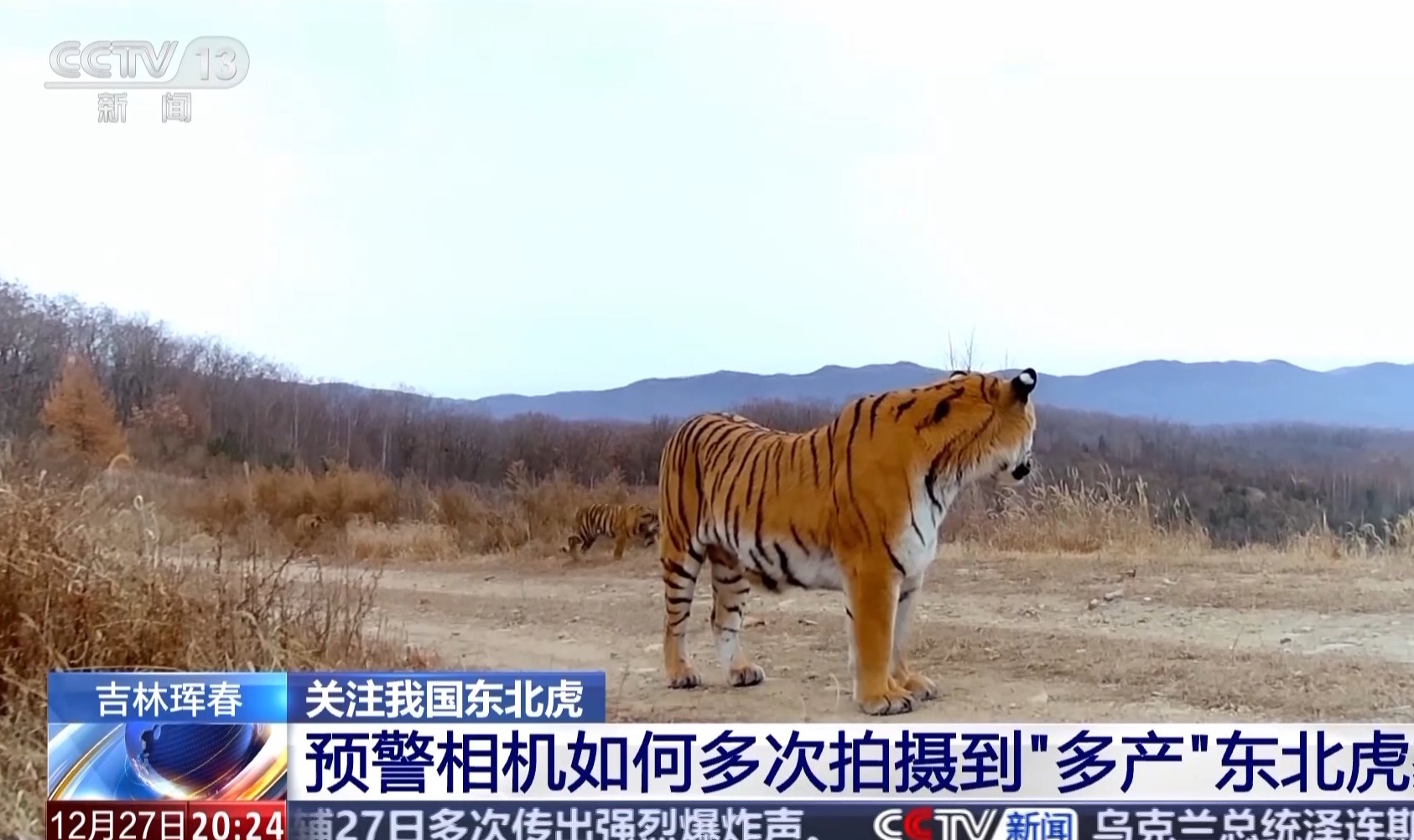
六虎同框!野生东北虎母虎带五崽罕见亮相东北虎豹国家公园
Yang Shi Wang· 2025-12-26 03:49
Core Insights - The article highlights the significant conservation success in the Northeast Tiger and Leopard National Park, where a wild female Siberian tiger was recorded with five cubs, marking the first instance of "six tigers in one frame" globally [1][4]. Group 1: Conservation Success - The footage of the six tigers indicates a positive trend in the recovery of the wild Siberian tiger population in China, with the presence of five cubs being a rare occurrence even in areas with abundant prey [4]. - The park has recorded multiple tiger families, including another mother tiger with four cubs, showcasing the health and reproductive success of the tiger population [4][5]. - The increase in the wild tiger population in the park to approximately 70, compared to about 20 in 2010, reflects the effectiveness of conservation efforts [6]. Group 2: Conservation Efforts - Stuart Chapman from WWF emphasized that sustained conservation efforts are crucial for the recovery of tiger populations and habitat protection, highlighting China's commitment to habitat restoration and anti-poaching measures [5]. - The successful documentation of the "six tigers in one frame" reinforces the importance of the Northeast Tiger and Leopard National Park in enhancing conservation capabilities and promoting the growth of wild tiger and leopard populations [5][6]. - The ongoing conservation work in China serves as a beacon of hope for the recovery of other endangered species and their habitats amid global biodiversity loss [6].

广东发布2025年第3号总林长令 全面加强鸟类保护工作
Nan Fang Ri Bao Wang Luo Ban· 2025-12-18 07:44
Core Viewpoint - Guangdong has issued the 2025 No. 3 General Forest Chief Order, focusing on comprehensive bird protection and combating illegal hunting and trading of birds over a three-year period, aiming to establish a new ecological civilization that promotes harmony between humans and nature [1] Group 1: Implementation and Responsibilities - The order emphasizes the need to enhance political awareness and establish a responsibility system, with strict implementation of the bird protection action plan during the key migratory period from September to April [1] - A work mechanism involving "Forest Chief leadership, departmental collaboration, and local responsibility" will be established to ensure regulatory responsibilities are met in key periods, areas, and aspects [1] Group 2: Source Governance and Protection Measures - The order highlights the importance of source governance to ensure the safety of migratory birds, mandating the removal of illegal bird-catching tools as the first line of defense [2] - It calls for the comprehensive elimination of prohibited hunting tools and a strict crackdown on activities threatening bird survival, while balancing bird protection with agricultural needs [2] Group 3: Law Enforcement and Public Awareness - Strict law enforcement and regulatory measures will be implemented to create a comprehensive protection effort, focusing on monitoring the entire chain from hunting to trading [3] - The order encourages public education and awareness campaigns to promote bird protection, including monitoring public sentiment and exposing typical cases to create a strong deterrent [3] - As part of the bird protection initiative, Guangdong's forestry department has initiated actions resulting in 305 joint law enforcement operations and the removal of 3,262 bird-catching nets [3]
河北张家口筑牢野生动物保护屏障
Zhong Guo Zi Ran Zi Yuan Bao· 2025-12-10 10:57
Core Insights - Zhangjiakou City in Hebei Province has established a comprehensive wildlife and ecosystem protection system, effectively safeguarding its rich wildlife resources and advancing conservation efforts [1][2] - The city has identified 417 species of terrestrial wild vertebrates, including 25 species under first-class national protection and 61 species under second-class national protection [1] Group 1: Wildlife Protection Measures - The city has designated wildlife hunting prohibition zones and established clear hunting seasons, creating a coordinated working framework involving 17 departments and units [1] - Zhangjiakou has built 10 provincial-level terrestrial wildlife disease monitoring stations, forming an effective monitoring network to detect and control wildlife disease outbreaks [1] - The city has established 8 wildlife rescue and rehabilitation stations, successfully rescuing and releasing hundreds of injured, sick, or trapped wild animals [1] Group 2: Law Enforcement Actions - Zhangjiakou maintains a high-pressure stance against illegal activities, organizing large-scale "Migratory Bird Protection" actions during spring and autumn migration seasons [2] - The city has conducted various special law enforcement actions, such as "Net Clearing," "Clean Wind," and "Golden Net," to inspect and patrol wildlife breeding and processing sites, successfully cracking down on illegal hunting and trading [2] - A three-year joint initiative involving 17 departments to protect birds and combat illegal bird hunting and trading began in September 2025, further consolidating bird protection achievements [2]
深圳启动野生动物保护宣传月
Zhong Guo Zi Ran Zi Yuan Bao· 2025-11-28 06:06
Group 1 - The 35th Wildlife Protection Awareness Month in Shenzhen was launched on November 15, with the theme "Green and Beautiful Guangdong, Everyone Protects Birds" [1] - The event was organized by the Shenzhen Planning and Natural Resources Bureau and included various interactive activities to engage the public [1] - Shenzhen is one of the regions in Guangdong with the richest biodiversity, recording 551 species of terrestrial vertebrates, including 15 species of national first-class protected birds and 76 species of national second-class protected birds [1] Group 2 - The Shenzhen Planning and Natural Resources Bureau will continue regular monitoring of wild animals, focusing on the Shenzhen River Delta mangrove wetland restoration area [2] - Ongoing monitoring will include waterbirds and key species such as pangolins to better understand their distribution in Shenzhen [2]
珍爱“国宝” 写好大熊猫保护故事
Ren Min Ri Bao· 2025-11-26 06:02
Core Viewpoint - The article highlights the comprehensive efforts made in China for the protection and sustainable development of giant pandas, showcasing significant advancements in breeding, habitat optimization, and international collaboration [2][4][7]. Group 1: Breeding and Health Management - The breeding rate of giant pandas has increased from 20% to 67% due to advancements in reproductive hormone monitoring and artificial insemination techniques [4]. - A full-cycle management system has been established to ensure the health of giant pandas, including regular health check-ups every quarter to half a year [4][6]. - The unique case of "Qizai," a brown giant panda, has drawn public attention and highlighted the conservation efforts at the Qinling Giant Panda Research Center [3][4]. Group 2: Habitat and Environmental Optimization - The Beijing Zoo has a long history of giant panda care, with approximately 4.8 million visitors in the past year, indicating strong public interest [5]. - Each giant panda at the Beijing Zoo receives a diet of 50 to 70 kilograms of fresh bamboo daily, along with other food items, to meet their nutritional needs [6]. - Enrichment projects have been implemented to simulate the pandas' natural behaviors and improve their physical and psychological well-being [6]. Group 3: International Collaboration and Wild Population - The China Giant Panda Protection and Research Center has five bases focusing on breeding, rewilding, and international exchanges, ensuring a comprehensive approach to panda conservation [7]. - In the Sichuan area of the Giant Panda National Park, 1,227 wild giant pandas, accounting for 91.6% of the park's population, have seen habitat restoration efforts covering 33,140 acres [8]. - Monitoring indicates that the number of wild giant pandas in the Sichuan area is expected to increase to 185 by 2024, reflecting a stable recovery of the population [8].

多地开展科学保护,我国大熊猫种群数量稳定发展
Ren Min Ri Bao· 2025-11-24 00:57
Core Viewpoint - The article emphasizes the successful conservation efforts for the giant panda in China, highlighting the stable growth of the panda population through scientific protection measures and international collaboration [1]. Group 1: Conservation Efforts - Various regions in China are implementing scientific measures to protect giant pandas, ensuring their sustainable development [1]. - The Qinling Panda Research Center has achieved a breeding success rate increase from 20% to 67% through advancements in reproductive hormone monitoring and artificial insemination techniques [3]. - The establishment of a comprehensive management system for panda care includes regular health check-ups and strict epidemic prevention protocols [3]. Group 2: Habitat and Behavioral Enrichment - Beijing Zoo has a long history of giant panda care, with approximately 4.8 million visitors in the previous year, showcasing the popularity of the panda exhibit [4]. - Each panda at Beijing Zoo receives a diet of 50 to 70 kilograms of fresh bamboo daily, along with other food items to meet their nutritional needs [4]. - The zoo has developed enrichment projects to simulate the pandas' natural behaviors, enhancing their physical and psychological well-being [4]. Group 3: International Collaboration and Population Monitoring - The China Giant Panda Protection Research Center has five bases focusing on breeding, rewilding, and international exchanges, ensuring comprehensive protection for giant pandas [6]. - The Sichuan area of the Giant Panda National Park is home to 1,227 wild pandas, accounting for 91.6% of the population within the park, with habitat restoration efforts covering 33,140 acres [6]. - Monitoring indicates an increase in the wild panda population, with 185 sightings recorded in 2024, reflecting a stable recovery of the species [6].
江西省联合执法打击涉鸟违法犯罪
Zhong Guo Zi Ran Zi Yuan Bao· 2025-11-14 06:22
Group 1 - The core viewpoint of the articles highlights the significant efforts made by Jiangxi Province in wildlife protection, particularly focusing on bird conservation through various initiatives since February this year [1][2] Group 2 - The "Clear Net and Protect Birds" campaign has led to a high-pressure crackdown on illegal bird trapping, with over 1.118 million personnel involved, resulting in the removal of 4,157 bird nets and the investigation of 139 cases [1] - The campaign has successfully apprehended 178 suspects, demonstrating a strong deterrent effect against wildlife crimes [1] - Collaborative efforts with the National Forestry and Grassland Administration have strengthened the protection of migratory bird habitats in Poyang Lake, with over 9,700 law enforcement personnel deployed and 200 birds rescued [1] Group 3 - The preparation for the "Fourth Poyang Lake International Bird Watching Season" is underway, aiming to integrate ecological and cultural aspects, with 22 bird watching points being planned and enhanced services being developed [2]
我国再添一座大熊猫基地
Ren Min Ri Bao Hai Wai Ban· 2025-11-10 02:02
Core Points - The relocation of 13 giant pandas to the newly opened Mianyang base marks the trial operation of the panda center after three years of construction [1] - The Mianyang base is located in the ecological park of Mianyang Science and Technology City, covering an area of approximately 120 hectares [1] - The pandas include lively young ones, adults, and elderly pandas, indicating a diverse population [1] Group 1 - A well-planned transportation and epidemic prevention scheme was implemented to ensure the safe relocation of the pandas [3] - The Mianyang base is equipped with over 50 panda enclosures that meet the breeding requirements, and preparations were made in terms of facilities, environment, food supply, and staffing [3] - The pandas showed slight nervousness upon entering the new environment but are generally adapting well, with experienced staff monitoring their health and behavior [4] Group 2 - The panda center is responsible for various tasks including ecological research, artificial breeding, wild release, international cooperation, and technological support for the national panda park [4] - By the end of 2024, the panda population at the center is expected to reach 387, with a shift in focus from quantity to quality in breeding efforts [4] - The Mianyang base is expected to open to the public next year after the pandas have adjusted to their new environment [4]