
钛产业

Search documents
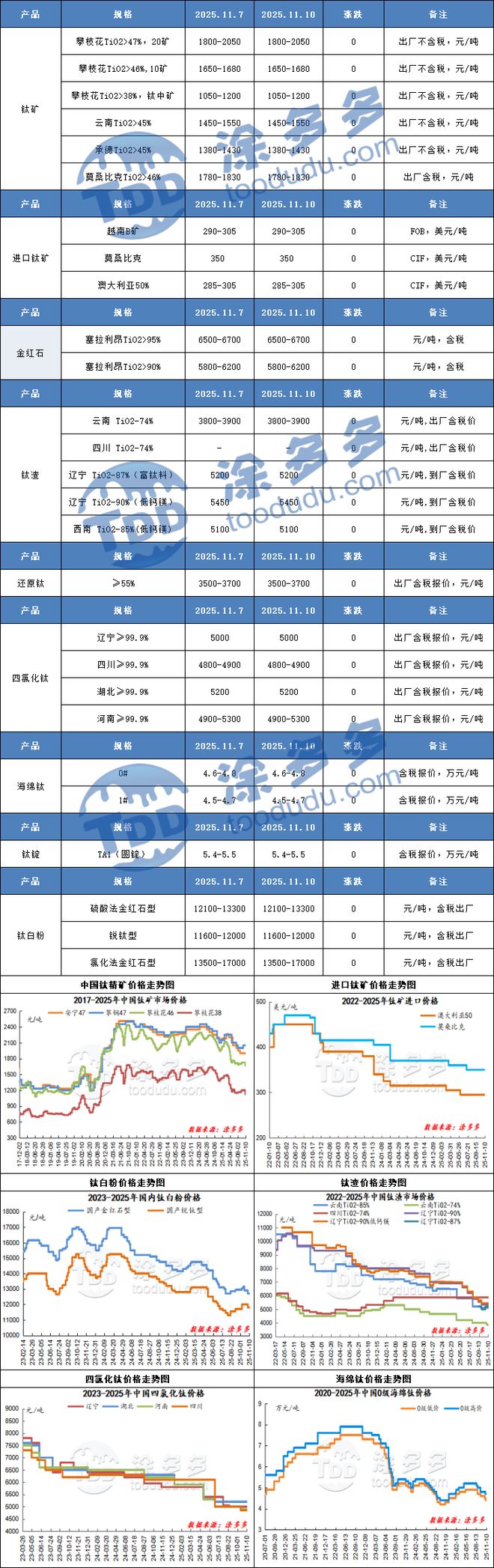
11月10日钛系产品市场报价
Xin Lang Cai Jing· 2025-11-10 09:32
Group 1: Titanium Market Overview - The titanium ore price index in Panzhihua remains stable at 1853.75, with no change from the previous working day, indicating a weak trend in the titanium ore market [1] - The high titanium slag bidding price in northern enterprises is 5450 CNY/ton, reflecting a slight increase of 10 CNY/ton from October, while the market sentiment remains firm despite low slag prices [2] - The market price for titanium tetrachloride is stable at 4800-5300 CNY/ton, with production and sales balanced, maintaining a steady market operation [3] Group 2: Titanium Products Pricing - The price for first-grade sponge titanium is around 45,000-47,000 CNY/ton, with a price increase of 2000 CNY/ton from major producers like Guotai and Panzhihua [4] - The titanium dioxide price index is at 13339.79, remaining unchanged, with low demand affecting the market, leading to expectations of price adjustments by some companies [5] - The pricing summary for various titanium products shows stability, with no significant changes in prices for titanium ore and imported titanium ore [6][7] Group 3: Industry Operations - The supply of raw materials for titanium ore remains tight, leading to insufficient operating rates in selection plants [9] - The overall operating rate for titanium dioxide remains high, although some companies are undergoing maintenance [9] - Sponge titanium enterprises are operating at high levels, indicating strong production activity in this segment [9]

陕西宝鸡以质量强企强链强县引领优势产业集群升级纪实
Zhong Guo Zhi Liang Xin Wen Wang· 2025-10-11 02:36
Core Viewpoint - The article emphasizes the importance of quality in driving the development of industries in Baoji, Shaanxi Province, highlighting initiatives to strengthen quality standards and enhance the competitiveness of local enterprises [1][9][10]. Group 1: Quality Strengthening Initiatives - Baoji has transformed into a modern equipment manufacturing base, with its titanium industry being the largest in China and second globally [2][3]. - The automotive industry contributes over one-third of Shaanxi Province's output, with several local companies ranking among the top 100 in China's automotive supply chain [2][3]. - Baoji Petroleum Machinery Co., Ltd. has developed advanced drilling equipment, filling several domestic gaps in technology [2][3]. Group 2: Industry Clusters and Economic Development - Baoji has established four major industrial clusters: titanium and new materials, automotive and parts, advantageous equipment, and specialty food [5][12]. - The city has been recognized as a national advanced manufacturing city and has received multiple honors for its industrial achievements [4][7]. - The industrial output value of Baoji reached 210 billion yuan, with a significant increase in the number of enterprises and production capabilities [7][12]. Group 3: Quality Standards and Certifications - Baoji has implemented a comprehensive quality management system, including the establishment of a quality consulting expert team and standardization services for local enterprises [11][13]. - The city has developed a policy framework to support quality improvement, including financial allocations for industrial development [10][12]. - Local enterprises have achieved significant advancements in product quality and innovation, with a notable increase in patent applications [12][13]. Group 4: Agricultural and Food Industry Standards - The "billion-level goat milk industry chain" project aims to enhance quality standards in agriculture, with significant investments in breeding and quality control [8]. - The kiwifruit industry in Meixian has established local standards and achieved national recognition for quality [8]. - The apple industry in Qian County has implemented comprehensive standards, contributing to significant economic output [8]. Group 5: Future Development and Strategic Goals - Baoji aims to continue enhancing its industrial ecosystem through quality-driven initiatives, focusing on technological innovation and industry upgrades [9][10]. - The city has set ambitious goals for quality improvement and industrial transformation, aligning with national strategies [10][13]. - Baoji's commitment to quality is seen as a key driver for sustainable economic growth and competitiveness in various sectors [9][13].
新华财经丨滇中“钛谷”重构产业经纬——云南楚雄打造千亿级钛产业集群的探索与实践
Xin Hua She· 2025-06-11 06:26
Core Viewpoint - Yunnan Province, known as the "Kingdom of Nonferrous Metals," is leveraging its rich titanium resources to develop a robust titanium industry cluster in Chuxiong Prefecture, aiming for a trillion-yuan industry scale through resource utilization, industrial agglomeration, and technological innovation [1][2]. Industry Overview - Chuxiong Prefecture has established a complete titanium industry chain, from titanium ore mining and high-titanium slag smelting to the production of titanium dioxide, sponge titanium, and titanium materials, benefiting from favorable transportation and location conditions that reduce logistics costs [2]. - The region has over 30 titanium enterprises, with capacities of 500,000 tons for high-titanium slag, 300,000 tons for chlorination titanium dioxide, 50,000 tons for sponge titanium, and 20,000 tons for titanium materials [3]. Technological Advancements - The titanium industry in Chuxiong faced challenges such as outdated production processes and low efficiency, but significant improvements have been made since the restructuring initiated in 2019, which included the introduction of Longbai Group's advanced technology [4]. - Longbai Group invested 774 million yuan to upgrade production lines, achieving full production recovery within 180 days, with significant increases in output and revenue from 40,000 tons and 1 billion yuan in 2020 to 121,000 tons and 2.44 billion yuan by 2024 [4]. Environmental Initiatives - Chuxiong's titanium industry is committed to ecological sustainability, implementing measures to ensure pollution control and exploring resource recycling paths, with a focus on reducing energy consumption and increasing resource utilization rates [8][9]. - The introduction of advanced technologies, such as the MVR evaporation system, has led to a 60% reduction in energy consumption per ton of titanium liquid, while the comprehensive utilization rate of industrial solid waste has reached 85% [8]. Economic Impact - The restructuring and technological upgrades have revitalized the titanium industry in Chuxiong, attracting innovative and growth-oriented enterprises, thereby injecting vitality into industrial upgrades and economic development [3][4].

强化协同创新 我国钛产业向高端化突围
Zhong Guo Chan Ye Jing Ji Xin Xi Wang· 2025-05-29 22:40
Core Viewpoint - The titanium industry in China is experiencing stable growth, with a focus on high-quality development and overcoming existing shortcomings to enhance its global competitiveness [1][2][3]. Industry Overview - In 2024, China's titanium industry is expected to maintain a steady development trend, with continuous growth in titanium product output [2]. - The total titanium concentrate production in the first two months of 2024 reached 1.887 million tons, with imports at 879,000 tons and consumption at 2.165 million tons, reflecting year-on-year increases of 3.6%, 26.2%, and 4.5% respectively [2]. - The sponge titanium production was 41,000 tons, with an export volume of 1,000 tons and a consumption of 40,900 tons, showing year-on-year growth of 12.8%, 28.6%, and 11.7% respectively [2]. Regional Insights - Shaanxi Province is identified as a major hub for titanium production in China, with a significant influence on the international market [2][3]. - The city of Baoji is highlighted as the largest titanium and rare metal materials research and production base in China, with over 700 titanium enterprises producing more than 300 varieties and 5,000 specifications of titanium products [3]. Production and Consumption Trends - The titanium material production in Baoji is projected to be approximately 75,000 tons in 2024, accounting for 65% of China's total and over 33% of the global output [3]. - The titanium and new materials industry cluster in Baoji is expected to achieve an output value of 56 billion yuan [3]. Technological Advancements - The titanium industry is accelerating the localization and modernization of large equipment, with significant advancements in smelting, forging, and rolling technologies [4][5]. - The production of sponge titanium is projected to reach 256,000 tons in 2024, with a year-on-year growth of 17.6%, achieving nearly 100% self-sufficiency [4]. Market Dynamics - The compound annual growth rate (CAGR) for sponge titanium production since the 14th Five-Year Plan is approximately 22%, while titanium processing material production has a CAGR of 7.7% [4]. - The consumption of titanium materials is expected to reach around 150,000 tons in 2024, with a CAGR of about 7.5% since the 14th Five-Year Plan [4]. Strategic Initiatives - The industry is urged to enhance collaboration and reduce internal competition, focusing on vertical integration and resource optimization to improve overall efficiency [6][7]. - The need for innovation and the development of new products to meet high-performance titanium alloy demands in high-end manufacturing is emphasized [4][7]. Future Outlook - The industry is encouraged to actively participate in the formulation of relevant standards and to strategically plan for the 15th Five-Year Plan to achieve higher levels of high-end, intelligent, and green development [8].
阔步新征程 建功新时代 ——习近平总书记在河南考察时的重要讲话在全省各地干部群众中引发热烈反响
He Nan Ri Bao· 2025-05-22 23:55
Group 1: High-Quality Development and Governance - The core message emphasizes the need for high-quality development and efficient governance in Henan, aligning with the central government's strategic directives for the central region and ecological protection [2][3][4] - Local officials express commitment to implementing the spirit of Xi Jinping's speech, focusing on high-quality development and governance as a priority [2][3] Group 2: Social Governance and Community Engagement - There is a strong emphasis on enhancing social governance, particularly in areas with complex social issues due to high population density and mobility [3][4] - Initiatives include strengthening grassroots governance through community engagement and innovative social service models, such as the "three-level linkage and multi-party co-governance" model [4][5] Group 3: Technological Innovation and Industrial Development - The importance of technological innovation as a driver for economic growth is highlighted, with a focus on developing new productive forces tailored to local conditions [7][8] - Educational institutions and companies are encouraged to enhance collaboration to foster talent and support the manufacturing sector through innovation [7][9] Group 4: Cultural and Tourism Integration - The integration of culture and tourism is identified as a key area for high-quality development, with local leaders aiming to enhance tourism experiences and cultural offerings [12][13] - Efforts are being made to leverage local cultural heritage and natural resources to boost tourism and community well-being [12][13]

我国已构建完整钛产业链体系
Jing Ji Ri Bao· 2025-05-08 21:44
Core Viewpoint - The titanium industry in China is experiencing stable development in 2024, with continuous growth in titanium product output and trade, while facing challenges in market segmentation and competition [1][2]. Group 1: Industry Performance - From January to February 2024, titanium concentrate production reached 1.887 million tons, with imports at 879,000 tons and consumption at 2.165 million tons, reflecting year-on-year increases of 3.6%, 26.2%, and 4.5% respectively [1]. - Sponge titanium production is projected to be 256,000 tons in 2024, a year-on-year increase of 17.6%, with a self-sufficiency rate approaching 100% [1]. - China's titanium material production is estimated at 170,000 tons in 2024, representing a 7% increase and accounting for 65% of global output, solidifying its position as the largest producer and consumer of titanium materials [1]. Group 2: Technological and Market Challenges - The titanium industry is urged to upgrade melting and processing technologies to enhance the quality and performance of titanium alloys for high-end applications [2]. - There is a noted disparity in operational stability between large enterprises and small to medium-sized enterprises, with the latter facing challenges in profitability [2]. - Increased production capacity of sponge titanium and titanium processing materials has led to intensified competition and a decrease in finished titanium product prices [2]. Group 3: Innovation and Application Expansion - Collaboration between upstream and downstream enterprises is essential to foster innovation in titanium applications across various sectors, including construction, automotive, and energy [3]. - The promotion of titanium materials in construction, such as titanium alloy roofs and facades, is expected to enhance quality and durability [3]. - The establishment of standards is critical for the high-quality development of the titanium industry, with 161 industry-related standards published by the end of 2024, including 84 national standards [3].