
钛白粉

Search documents
钛白粉概念持续走强,金浦钛业涨停
2 1 Shi Ji Jing Ji Bao Dao· 2026-02-24 02:03
Group 1 - The titanium dioxide sector is experiencing a strong upward trend, with Jinpu Titanium Industries hitting the daily limit increase [1] - Other companies in the sector, such as Anada, Titan Chemical, and Longbai Group, are also seeing significant gains [1]

十大券商一周策略:A股将迎“春季躁动”胜率最高阶段,涨价仍是核心配置线索,重视关税税率下降后出口链修复机会
Jin Rong Jie· 2026-02-24 00:10
Group 1 - The core investment theme post-Spring Festival revolves around "price increases" and "revaluation of physical assets," particularly in resource, chemical, and midstream manufacturing sectors, leveraging China's pricing power amid global uncertainties [1][2] - The technology sector, particularly driven by AI, remains a key focus, with sub-sectors like computing power, applications, and robotics expected to remain active due to industrial catalysts [1][2] - The recovery of export chains, non-bank financials, and certain consumer and real estate chains are seen as important supplements to market trends under the backdrop of internal and external demand recovery [1] Group 2 - CITIC Securities emphasizes that price increases are a core configuration clue for Q1, with a focus on sectors like chemicals, non-ferrous metals, power equipment, and new energy, while also increasing exposure to undervalued insurance and brokerage stocks [2] - Historical data indicates that February and the period around the Spring Festival are strong for market movements, with small-cap stocks showing a 100% probability of rising from the Spring Festival to the Two Sessions [3] - Guojin Securities highlights the importance of balancing global physical assets against Chinese assets, recommending commodities like copper, aluminum, and oil, as well as sectors with global comparative advantages like equipment exports and domestic manufacturing [4] Group 3 - Industrial sectors experiencing structural price increases due to supply-demand gaps are primarily in midstream materials and manufacturing, with a focus on chemicals, steel, and high-end manufacturing [5] - The potential for recovery in the export chain is noted, particularly in industries with significant exposure to the U.S. market that will benefit from reduced tariffs [5] - The policy uncertainty surrounding tariffs and trade is expected to favor gold as a risk hedge, with market participants anticipating potential shifts in U.S. trade policy [6] Group 4 - Attention is drawn to the post-holiday inventory replenishment in commodities, with a continued positive outlook on technology applications, particularly in semiconductors and AI [7] - Quantum technology is highlighted as a sector receiving dual catalysts from policy and technological advancements, with significant developments in quantum key distribution networks [8] - The AI industry revolution is identified as a key investment theme, focusing on computing power, storage, and applications, with a strong emphasis on the performance of high-growth sectors [9] Group 5 - Localized opportunities are expected in AI applications linked to overseas trends and robotics associated with the Spring Festival, with a cautious approach to market movements anticipated [10] - The current bull market logic remains intact, with a recommendation for investors to maintain confidence despite short-term volatility, focusing on sectors with high securities ratios [11]
国金证券:把握全球实物资产VS中国资产这一重要主线
智通财经网· 2026-02-24 00:07
Group 1 - The investment activities are shifting from being solely AI-driven to a broader spectrum of real sectors, indicating a recovery in global manufacturing cycles supported by a smoother path for U.S. interest rate cuts [1][4] - The revaluation of Chinese assets is expected as capital flows back, promoting internal consumption and inflation cycles [1][4] - The report suggests specific asset allocation strategies, including physical assets like copper, aluminum, and oil, as well as sectors with global comparative advantages such as Chinese equipment exports and domestic manufacturing [1][4] Group 2 - The U.S. GDP growth for Q4 2025 was below expectations, primarily due to government spending disruptions, but investment in AI and non-AI sectors is showing signs of recovery [2] - The manufacturing PMI data indicates a global manufacturing recovery, with Europe exceeding expectations and the U.S. maintaining expansion, suggesting a positive outlook for the manufacturing sector [2] - The recent U.S. Supreme Court ruling on tariffs may ease domestic inflation pressures and support global export recovery, shifting the burden of inflation control from the Federal Reserve to other sectors [2] Group 3 - Commodity prices, particularly for industrial and precious metals, are experiencing high volatility, but there is a shift towards real industrial pricing rather than financial speculation [3] - The geopolitical risks and supply disruptions are expected to maintain a premium on industrial metals, while demand from tech giants for AI investments remains strong [3] - The focus on inflation control is shifting from the Federal Reserve to government actions, which may benefit commodities like gold as a hedge against economic uncertainty [3] Group 4 - The core of market style rebalancing is not about the existence of an AI bubble but rather the macroeconomic impacts of AI combined with monetary policy and major country policy choices [4] - The report emphasizes the importance of physical asset revaluation based on low inventory and stable demand, highlighting sectors such as oil, rare earths, and various manufacturing industries [4] - The report identifies opportunities in sectors benefiting from capital market expansion and a bottoming out of long-term asset returns, particularly in non-bank financials [4]

A股策略周报:节后主线将更加清晰-20260223
SINOLINK SECURITIES· 2026-02-23 13:49
Global Assets: Rebalancing Continues - The current market rebalancing is based on internal and external recovery, with AI trading entering its second phase, leading to a focus on the actual impact of AI on various industries [3][13] - From February 16 to February 20, 2026, global risk assets showed an overall upward trend, but internal performance was mixed, with industrial, financial, and energy sectors gaining favor [3][13] - The focus has shifted from whether AI is a bubble to identifying the real industrial impacts and critical supply-demand issues as AI transitions from a thematic to a macro factor [3][13] Manufacturing Cycle Further Rising - The U.S. GDP data for Q4 2025 showed slower growth primarily due to government spending disruptions, while AI-related investments remained strong [4][25] - Non-AI and residential investment growth is showing signs of bottoming out, indicating a broader recovery in investment activities beyond just AI [4][25] - The February manufacturing PMI data indicated a recovery in global manufacturing, with Europe exceeding expectations and the U.S. maintaining expansion, suggesting a positive trend in manufacturing cycles [4][25][34] Commodities: Transitioning from Financial Overtrading to Industrial Pricing - Recent fluctuations in industrial and precious metals prices are attributed to macro and industrial events, with a return to real supply-demand signals expected [5][44] - Geopolitical risks continue to support industrial metal prices, while demand from tech giants for AI investments remains robust, indicating a potential new support for demand [5][44] - Historical data suggests that current copper and aluminum price ratios are low compared to historical manufacturing PMI levels, indicating potential for price recovery [5][44][45] Focus on Global Physical Assets vs. Chinese Assets - The core of market rebalancing is not about the existence of an AI bubble but rather the macro impacts of AI combined with monetary and major country policy choices [6][56] - The relative smooth path for future U.S. interest rate cuts is expected to support the recovery of the global manufacturing cycle, which may lead to a revaluation of Chinese asset capacity [6][56] - Specific investment recommendations include physical assets like copper, aluminum, and oil, as well as sectors benefiting from capital inflows and consumption recovery in China [6][56]
河南连续两年举办高规格餐叙,释放什么信号
He Nan Ri Bao· 2026-02-21 22:43
Core Viewpoint - The article highlights the significance of the annual "破五" gathering in Henan, where provincial leaders engage with private enterprise representatives, signaling strong governmental support for the private sector and the commitment to high-quality economic development in the province [2][4]. Group 1: Event Overview - On February 21, the provincial leaders hosted a high-profile dinner with 17 representatives from prominent private enterprises in Henan, emphasizing the importance of this traditional event [2][3]. - The participating companies include major players such as Muyuan Foods, Luoyang Molybdenum, and Mijia Ice City, showcasing a diverse range of industries from agriculture to technology [3]. Group 2: Government Support and Policies - The provincial government has implemented a series of measures to promote high-quality development of the private economy, including the release of the "Henan Province Action Plan for Promoting High-Quality Development of the Private Economy" [5]. - The establishment of a leadership group co-chaired by the provincial governor and secretary aims to ensure the effective implementation of these policies [5][6]. Group 3: Economic Contributions - The private sector in Henan contributes over 55% of the province's GDP, approximately 65% of tax revenue, and 70% of total imports and exports, highlighting its critical role in the local economy [6]. - In 2025, Henan's GDP is projected to exceed 6.66 trillion yuan, with a year-on-year growth rate of 5.6%, indicating robust economic performance compared to other major provinces [6]. Group 4: Future Outlook - The gathering is expected to bolster the confidence of private entrepreneurs in Henan, providing them with the motivation to innovate and expand their market presence [6].
Tronox(TROX) - 2025 Q4 - Earnings Call Transcript
2026-02-19 15:00
Financial Data and Key Metrics Changes - For the full year 2025, the company generated revenue of $2.9 billion, reflecting a year-over-year decline driven by unfavorable pricing and mix, and lower volumes in both TiO2 and zircon [10] - Loss from operations was $253 million, and net loss attributable to Tronox was $470 million, including $233 million of restructuring and other charges [10] - Adjusted EBITDA was $336 million, with an adjusted EBITDA margin of 11.6% [10] Business Line Data and Key Metrics Changes - TiO2 volumes in Q4 reached their highest point of the year, with a 9% increase in volumes, although prices declined by 4% [11] - Zircon revenues increased 32% sequentially, driven by a 42% increase in volumes, despite a 7% decline in price [12] - Revenue from other products increased 10% compared to the prior year, mainly due to higher pig iron volumes [12] Market Data and Key Metrics Changes - The company experienced market share gains in India, Latin America, and the Middle East, supported by anti-dumping measures [11] - North America and Europe saw lower volumes consistent with normal fourth quarter demand patterns [11] - Early indications show positive momentum in TiO2 pricing, with expectations of a 2%-4% sequential increase in Q1 2026 [19] Company Strategy and Development Direction - The company announced the closure of two pigment plants to streamline operations and improve cost structure [7] - A sustainable cost improvement program is in place, with over $90 million in run rate savings achieved, significantly exceeding the original target [8] - The company is advancing its rare earth strategy, focusing on building out a cracking and leaching facility in Australia [9] Management's Comments on Operating Environment and Future Outlook - Management expressed cautious optimism about market dynamics improving, with TiO2 prices expected to rise due to recent price increase announcements [9] - The company anticipates positive free cash flow in 2026, supported by actions on inventory, cost, and portfolio rationalization [10] - Management highlighted the importance of maintaining a disciplined approach to cash preservation and inventory management [6] Other Important Information - The company ended the year with total debt of $3.2 billion and net debt of $3 billion, with a liquidity increase to $674 million [15] - Capital expenditures for the year totaled $341 million, with a focus on maintenance and safety [16] - The company returned $48 million to shareholders in the form of dividends paid in 2025 [16] Q&A Session Summary Question: Free cash flow guidance and EBITDA expectations - Management indicated that achieving breakeven would require approximately $350 million in EBITDA, with a focus on cash generation and cost control [26][30] Question: Production cost dynamics and expectations - Management expects production costs to improve sequentially, driven by operational efficiencies and the sustainable cost improvement program [35][66] Question: Market dynamics and pricing for TiO2 and zircon - Management noted that the industry is seeing price increases and that there is a resolve among competitors to improve pricing discipline [81][83]

金浦钛业2026年初面临经营挑战,子公司停产与业绩亏损引关注
Jing Ji Guan Cha Wang· 2026-02-14 05:31
Group 1: Core Insights - Company faces multiple operational challenges and plan adjustments in early 2026, including temporary production halts at subsidiaries due to market demand and financial conditions [1] - The company anticipates a significant decline in net profit for 2025, projecting a loss between 420 million to 489 million yuan, a year-on-year decrease of 75% to 100% [2] - Legal risks, including frozen funds and asset seizures, may continue to impact the company's cash flow and operations [3] Group 2: Subsidiary Developments - Fully-owned subsidiary Nanjing Titanium White Chemical Co., Ltd. will temporarily halt production starting February 10, 2026, with plans to gradually resume by late February [1] - Controlling subsidiary Anhui Jinpu New Energy Technology Co., Ltd. will also temporarily stop production due to reduced sulfuric acid demand, with a planned resumption in early March 2026 [1] - Fully-owned subsidiary Xuzhou Titanium White, which accounts for 50% of the company's total capacity, announced a complete production halt on January 16, 2026, to reduce losses, which may significantly impact 2026 revenue [1] Group 3: Business and Strategic Developments - The company has terminated its major asset restructuring plan and investment in lithium iron phosphate projects but remains open to strategic transformation opportunities [3] - Future focus will be on cost reduction, efficiency improvement, product upgrading, and breakthroughs in new business areas to alleviate current challenges [3]
溴素价格上涨,鲁北化工股价震荡,机构对化工行业展望分化
Jing Ji Guan Cha Wang· 2026-02-13 09:19
Group 1: Industry Overview - Bromine prices have significantly increased recently, drawing attention to the chemical industry, with the escalating geopolitical situation in the Middle East potentially impacting the energy and chemical sectors in the short term [1] Group 2: Stock Performance - Lubao Chemical (600727) has shown a fluctuating stock price over the past seven trading days, with a range of 9.18% and significant volatility in trading volume. The main funds have shown a net outflow, indicating weak short-term momentum in the stock price [2] Group 3: Financial Analysis - Lubao Chemical has issued a profit warning, projecting a substantial decline in net profit attributable to shareholders for the year 2025, primarily due to weak demand for titanium dioxide and a cyclical downturn in basic chemical product prices. This downward trend in performance may continue to affect market sentiment in the near term [3] Group 4: Institutional Perspectives - There is a divergence in institutional outlooks on the chemical industry, with some believing that a cyclical turning point may occur in 2026, while others emphasize that the lack of demand remains a core issue, indicating that recovery will take time. Analysts suggest that the valuation recovery in the chemical sector may exhibit a rotational characteristic, but the titanium dioxide segment, to which Lubao Chemical belongs, still faces pressure from overcapacity [4]

A股收评:三大指数集体下挫!全市场成交额不足2万亿,商业航天逆市走高
Ge Long Hui· 2026-02-13 07:07
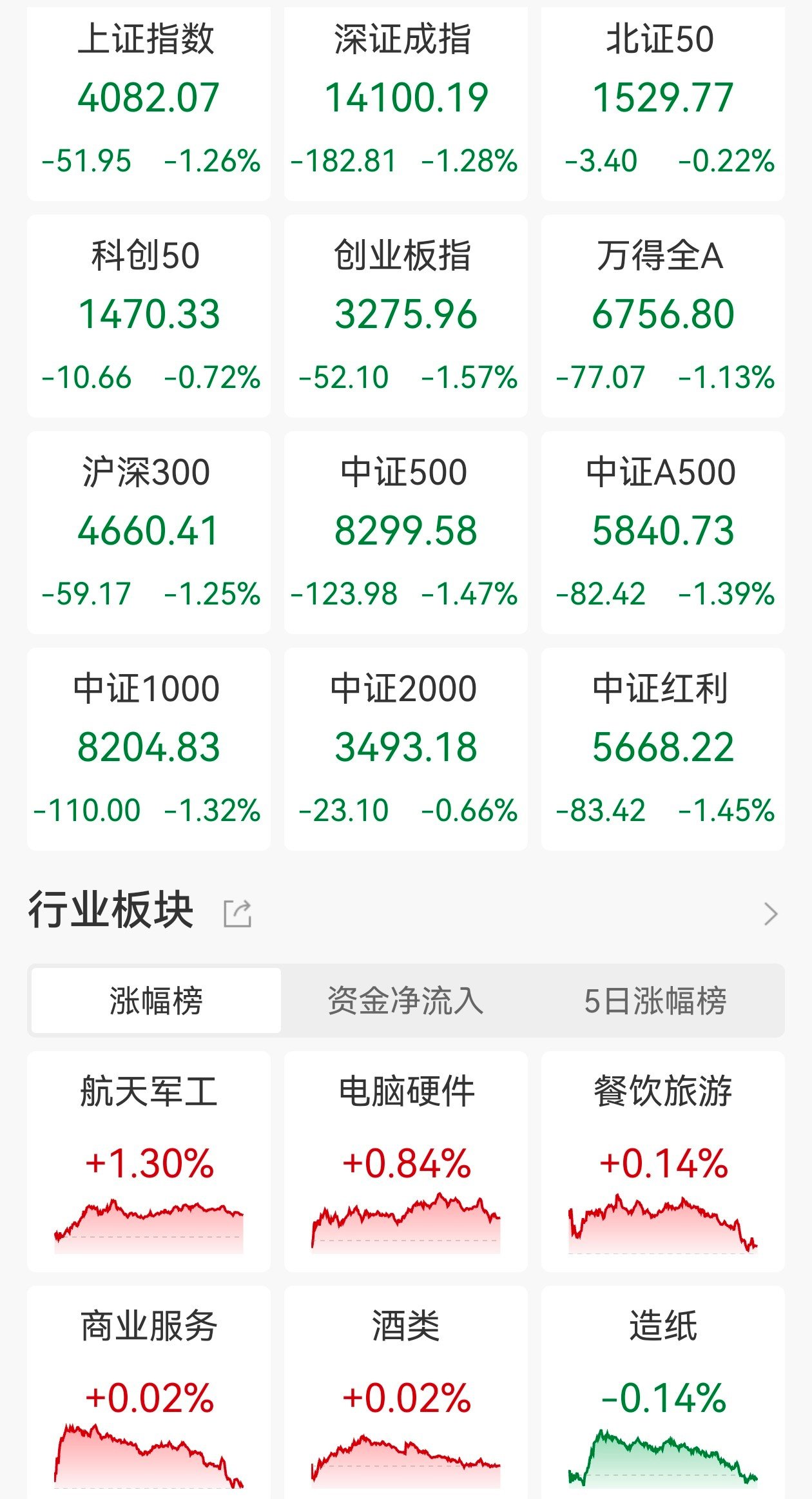
Market Performance - On the last trading day before the holiday, all three major A-share indices fell collectively, with the Shanghai Composite Index down 1.26% to 4082 points, the Shenzhen Component Index down 1.28%, and the ChiNext Index down 1.57% [1] - The total market turnover approached 2 trillion yuan, a decrease of 161.8 billion yuan compared to the previous trading day, with over 3800 stocks declining [1] Sector Performance - The CPO concept saw a significant decline, with Changxin Bochuang dropping over 11% [1] - The photovoltaic equipment sector weakened, with Shuangliang Energy hitting the daily limit down [1] - The small metals sector experienced widespread declines, with Yunlu Co. and Longci Technology both falling over 5% [1] - The glass and fiberglass sector also weakened, led by Shandong Pharmaceutical Glass [1] - The shipping and port, F5G concept, titanium dioxide, and Kimi concept sectors had notable declines [1] - Conversely, the shipbuilding sector rose, with Yaxing Anchor Chain hitting the daily limit up [1] - The commercial aerospace sector surged following the successful completion of China's first rocket first-stage body sea recovery mission, with Hangfa Power hitting the daily limit up [1] - The robotics sector was active, led by Wuzhou New Spring [1] - The aquaculture, motor, and reducer sectors showed notable gains [1] Index Performance - Shanghai Composite Index: 4082.07, down 51.95 points (-1.26%) [1] - Shenzhen Component Index: 14100.19, down 182.81 points (-1.28%) [1] - ChiNext Index: 3275.96, down 52.10 points (-1.57%) [1] - Other indices such as the CSI 300, CSI 500, and others also reported declines [1]

再再推大化工-双登共振系列
2026-02-11 15:40
Summary of Key Points from the Conference Call Industry Overview - The chemical industry is benefiting from capital inflows and carbon emission policies, with a potential reshaping of valuation systems for leading companies [1] - The 2026 carbon peak assessment will accelerate industry consolidation, enhancing profitability for leading firms and creating investment opportunities for licensed companies [1] Key Insights and Arguments - The potassium fertilizer market is stable with limited price correction potential; the government's ability to control prices is relatively weak, and import companies are less affected by policies [1][6] - Imported methanol is performing strongly in the domestic market, with prices following market trends and leading companies' quotes; companies like Baofeng and Hualu have strong competitive advantages and solid growth expectations [1][7][8] - The refrigerant industry shows clear upward price trends and optimistic valuation sentiment, suggesting it is a sector worth monitoring [1][9] - Wanhua Chemical is a benchmark in the chemical sector, with a projected net profit of approximately 16 billion in 2026, corresponding to a valuation of about 17 times its current market value [1][10] Cash Flow and Valuation Changes - Recent capital flows are increasingly directed towards cyclical sectors, including non-ferrous metals and chemicals, leading to a change in overall cash flow structures [3] - The rubber industry is experiencing short-term supply tightness, but long-term supply issues are manageable; demand is supported by the growth of all-steel tires [3][11] Impact of Carbon Emission Policies - The 2026 carbon peak assessment year will have multiple impacts on high-energy-consuming industries, including the exit of outdated capacities and the steepening of cost curves, which will widen the profitability gap between leading and lagging companies [5] Market Dynamics for Specific Products - The organic silicon market is expected to see price increases due to the exit of overseas capacities and support from carbon policies, with companies like Dongyue and Xin'an showing good elasticity [3][12] - The titanium dioxide and PVC industries are at cyclical bottoms, with potential for improvement in supply-demand relationships, although many companies are currently facing profitability pressures [13][18] Future Capacity and Demand Trends - Future capacity additions in the PVC industry are limited, indicating that capital expenditures are nearing the end of the cycle [15] - The demand for titanium dioxide is expected to stabilize, with exports potentially recovering after the removal of anti-dumping duties by India [17] Industry Outlook - The spandex industry is showing significant improvement in fundamentals, with leading companies like Huafeng Chemical and Xinjiang Chemical Fiber expected to benefit from cost advantages and price increases [19]