
Liquor

Search documents
88-year-old vodka, whiskey brand navigates Chapter 7 liquidation
Yahoo Finance· 2026-01-24 21:07
Core Insights - Stoli vodka has transitioned from Chapter 11 bankruptcy reorganization to Chapter 7 bankruptcy liquidation, indicating a significant decline in its operational viability [1][2][4]. Company Situation - Creditors no longer believe Stoli can successfully reorganize under Chapter 11, leading to a liquidation process [2]. - The inability to secure approval from secured creditors for a restructuring plan was a critical factor in Stoli's bankruptcy transition [4][5]. - Stoli has opted for Chapter 7 liquidation, which will involve appointing a trustee to sell the brand [6]. Industry Trends - There is a notable decline in liquor sales, attributed to younger generations consuming less alcohol and the impact of GLP-1 drugs on reducing alcohol consumption [8]. - NielsenIQ reported a 3% year-over-year decrease in total beverage alcohol sales, amounting to $53 billion for the 26 weeks ending July 5 [9].
中国消费策略:马年股票投资思路-China Consumer Strategy_ Stock Ideas for the Year of the Horse
2026-01-23 15:35
Summary of the Conference Call Industry Overview - **Sector**: China Consumer Sector - **Key Themes for 2026**: 1. **Lukewarm Demand**: Overall retail sales growth slowed to 1.3% YoY in November 2025, down from 2.9% in October 2025, with forecasts of 2.6% growth in 2026 and 2.5% in 2027, reflecting a deceleration in GDP growth to 4.5% in 2026 and 4.1% in 2027 [10][10] 2. **Price Deflation**: Persistent price deflation in consumer products, with significant price drops in categories like apparel and catering, impacting overall industry profitability [10][10] 3. **Consumer Preferences**: Young adults are prioritizing differentiated design, experience, and social value in their purchases [2][2] 4. **Overseas Expansion**: Companies are expected to expand internationally to counteract slow domestic growth, facing operational risks such as tariffs and supply chain management [10][10] 5. **Aging Demographics**: Challenges and opportunities arise from an aging population, with a decline in birth rates and a growing proportion of individuals over 65 years old [10][10] Financial Projections - **Earnings Growth**: Sector sales and earnings are projected to grow by 7.1% and 12.2% YoY in 2026, respectively, with a projected earnings CAGR of 10.3% from 2025 to 2027 [6][6] - **Valuation**: China consumer stocks are trading at 17x 2026E P/E, compared to ASEAN's 19x, Japan's 28x, and India's 54x, with a dividend yield of 4.2% [6][6] Investment Recommendations - **Top Picks**: - **Laopu**: Expected to benefit from experience-led growth with a disciplined store count and strong earnings growth of 40% in 2026 [20][20] - **Luckin**: Forecasted to achieve a 28% increase in net profit, driven by a consumer-centered vision and strong digitalization [20][20] - **Guming**: Anticipated to net add 3.3k stores in 2026, with a 20% YoY increase in core net profit [20][20] - **Mao Ge Ping (MGP)**: Positioned to benefit from experience-driven consumption trends, expecting 30% earnings growth in 2026 [20][20] - **YUMC**: Strong growth expected from KFC and a turnaround for Pizza Hut, with a target of 30K stores by 2030 [20][20] - **Pop Mart**: Despite recent stock price declines, expected to maintain strong earnings with a focus on new product launches [20][20] - **Top Avoids**: - **Bud APAC**: Concerns over weak consumption sentiment and high-end market exposure, with forecasts of declining sales and EBITDA [27][27] - **Yanghe**: Risks associated with channel inventory build-up and rising competition [27][27] Additional Insights - **Consumer Behavior**: Consumers are expected to continue spending on affordable treats and differentiated products, with a focus on experiences rather than price [10][10] - **Market Dynamics**: Increased competition is leading to accelerated consolidation within the industry, with leaders expected to gain market share through cost-saving initiatives and digital technologies [10][10] - **Demographic Trends**: Marriage registrations dropped significantly, indicating a shrinking young population and potential further declines in birth rates [12][12] This summary encapsulates the key points from the conference call, highlighting the current state and future outlook of the China consumer sector, along with specific investment recommendations and potential risks.



白酒何时能重回巅峰?
Sou Hu Cai Jing· 2026-01-20 14:08
Core Viewpoint - The Chinese liquor industry, particularly the baijiu sector, is facing significant challenges that have led to a decline from its previous peak, raising questions about its future recovery and potential for regaining prominence in the market [1][3]. Group 1: Historical Context and Current Challenges - The baijiu industry once thrived during a period of rapid economic growth and consumer upgrading, with high-end brands enjoying increased demand and rising prices, particularly in business and gifting contexts [3]. - Recent shifts in consumer demographics have posed a major challenge, as younger consumers prefer healthier, fashionable, and personalized beverages over traditional baijiu, leading to a loss of market share [3][5]. - Policy changes, such as restrictions on government consumption, have significantly reduced sales for mid-range baijiu brands that relied on this segment, while stricter environmental regulations have pressured production capabilities, especially for smaller enterprises [5]. Group 2: Market Competition and Emerging Trends - The competitive landscape has intensified, with domestic brands facing fierce rivalry and an influx of imported wines and spirits, which appeal to consumers through modern branding and diverse flavors [5]. - The rise of low-alcohol beverages has captured the attention of younger consumers, further fragmenting the market and challenging traditional baijiu sales [5]. Group 3: Opportunities for Recovery - Despite the challenges, there are opportunities for the baijiu industry to rebound by focusing on health-conscious product development, such as low-alcohol options enriched with beneficial ingredients [5]. - Embracing modern marketing strategies tailored to younger demographics, including social media engagement and cross-industry collaborations, can enhance brand recognition and appeal [7]. - Industry consolidation through mergers and acquisitions can strengthen competitive positioning and resource sharing, enabling larger companies to support smaller brands and foster a healthier industry ecosystem [7].

贵州茅台:公布更市场化的运营计划,预计建议零售价及均价调整以支持渠道
2026-01-14 05:05
Kweichow Moutai (600519.SS) Conference Call Summary Company Overview - **Company**: Kweichow Moutai - **Stock Code**: 600519.SS - **Industry**: Spirits Key Points Market-Oriented Operation Plan - Kweichow Moutai announced a shift to a more market-driven pricing framework to optimize channel investments and safeguard profitability, focusing on demand dynamics [1] - The new strategy includes: 1. Adjusting product portfolio to a pyramid structure by pricing tier 2. Transitioning from a traditional sales model to a multi-dimensional model including direct sales, distribution, agency, and consignment 3. Expanding sales channels to include online, offline retail, restaurants, and private VIP clients 4. Implementing a market-oriented pricing system for various sales models [1] Pricing Adjustments - Suggested retail prices (RSP) for key SKUs: - Feitian Moutai vintage (2019-2024): Rmb1,909 to Rmb2,659 per bottle - Feitian Moutai 2026: Rmb1,499 per bottle - Non-standard Moutai SKUs: RSP cut by approximately 20-30% [1] - Ex-factory prices for distributors of key non-standard Moutai products reduced by 7-37% [1] Impact on Channel Profitability - Price adjustments are expected to stabilize the wholesale price system, boost distributor confidence, and improve market supply/demand dynamics [2] - Estimated channel margins for Jingpin Moutai and Moutai 15-Year now approach 20% following the adjustments [2] - The adjustments are anticipated to expand market share and consumer base for strategic SKUs, solidifying flagship products' market status [2] Sales Volume and Earnings Revisions - Sales estimates revised down by 5-9% for 2025-2027, primarily due to lower Moutai spirits volume and softer ASP trends [7] - Expected sales/NP decline of -1%/-2% in 2025 and -1%/-1% in 2026 [7] - The 12-month price target is revised down to Rmb1,553 from Rmb1,691, maintaining a "Buy" rating [7] Theoretical Sales Impact Analysis - The pricing and volume quota adjustments could imply up to Rmb30 billion sales reduction in 2026 [6][12] - Improved supply/demand dynamics and better product affordability are expected to create favorable conditions for wholesale price recovery and retail sales rebound in the second half of 2026 [6] Product Matrix Strategy - Moutai is restructuring its product offerings into a pyramid structure: 1. Base tier: Feitian Moutai 500ml 2. Mid tier: Jingpin and Zodiac 3. Apex tier: Vintage spirits with controlled shipments to enhance value [17] Channel Strategy - Moutai is developing five parallel sales channels: wholesale, offline retail, online retail, catering, and private traffic, focusing on an integrated online and offline transformation [21] Risks and Challenges - Key risks include potential regulatory changes, environmental concerns, slower macroeconomic recovery, capacity constraints, and volatility in US interest rates [37] Conclusion - Kweichow Moutai's strategic shift towards a market-oriented pricing model and channel expansion aims to enhance profitability and market share amidst changing consumer dynamics and industry cycles [2][20]

*ST岩石:预计去年收入低于3亿元,净利润为负值,或将被终止上市
Cai Jing Wang· 2026-01-13 06:10
Group 1 - The company *ST Rock has announced a preliminary estimate indicating a projected revenue of less than 300 million yuan for the fiscal year 2025, with total profit, net profit, or net profit after deducting non-recurring gains and losses expected to be negative [1] - According to the Shanghai Stock Exchange listing rules, if the audited revenue for 2025 is below 300 million yuan and the lowest of total profit, net profit, or net profit after deducting non-recurring gains and losses is negative, the company's stock may be delisted due to financial criteria [1] - Additionally, Shanghai Guijiu has recently launched a clearance live broadcast with a significant discount, selling its 2023 53-degree 500ml product at 67 yuan per bottle [1]


酒价内参1月13日价格发布,习酒君品上涨11元反弹力度较大
Xin Lang Cai Jing· 2026-01-13 01:32
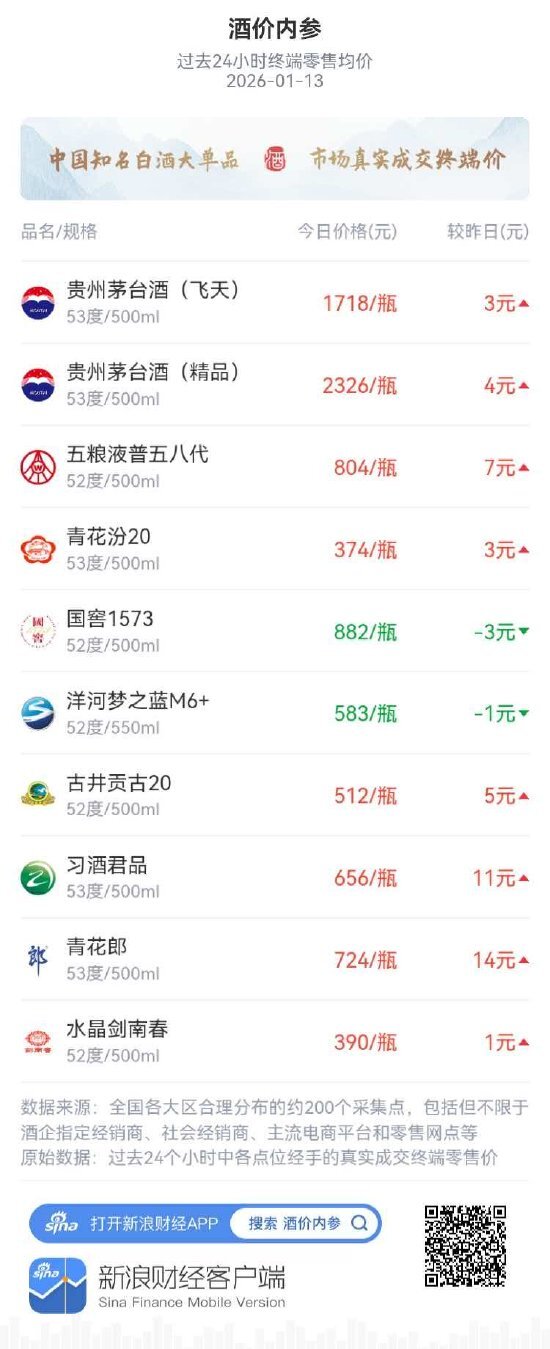
Core Viewpoint - The Chinese liquor market has seen a significant rebound in retail prices for the top ten products, indicating a recovery in market sentiment after a period of decline [1]. Price Trends - The overall retail price for the top ten liquor products reached 8969 yuan, an increase of 44 yuan from the previous day [1]. - The market exhibited a broad upward trend, with notable increases in prices for several key products, including: - Qinghua Lang: up 14 yuan per bottle - Xijiu Junpin: up 11 yuan per bottle - Wuliangye Pu Wu Eight Generation: up 7 yuan per bottle - Gujing Gonggu 20: up 5 yuan per bottle - Premium Moutai: up 4 yuan per bottle - Feitian Moutai and Qinghua Fen 20: up 3 yuan per bottle - Shuijing Jian Nan Chun: up 1 yuan per bottle [1]. Price Adjustments - Kweichow Moutai has reduced the factory contract prices for several products, with some reductions exceeding 1000 yuan: - Chen Nian Guizhou Moutai (15): reduced from 5399 yuan to 3409 yuan (a decrease of 1990 yuan) - Premium Moutai: reduced from 2969 yuan to 1859 yuan (a decrease of 1110 yuan) - Moutai 1935: adjusted from 798 yuan to 668 yuan (a decrease of 130 yuan) [3]. - Following these adjustments, the average selling price by distributors has decreased by approximately 200 yuan, leading to a reported increase in consumer purchases by at least 15% [3].
茅台1935降出厂价至668元/瓶,曾炒至近2000元|公司舆情哨
Sou Hu Cai Jing· 2026-01-12 10:18
Core Viewpoint - The price of Moutai 1935 has been significantly reduced, reflecting a strategic adjustment by the company in response to market conditions and to stabilize sales and channel profits [1][5]. Group 1: Pricing and Sales Performance - Moutai 1935's factory price has been lowered to 668 yuan per bottle, with a contract price of 798 yuan per bottle set for 2025, indicating a price drop of 130 yuan [1]. - The product's market price has fluctuated dramatically, initially reaching over 1800 yuan per bottle at launch, but has since fallen below 600 yuan on e-commerce platforms, with some prices as low as 519 yuan, representing a 56.31% decrease from the retail guide price of 1188 yuan [3]. - Moutai 1935 achieved sales of over 50 billion yuan in its first year, with projections of 110 billion yuan in 2023 and approximately 120 billion yuan in 2024, contributing nearly 50% to the revenue of Moutai's series of liquors [3]. Group 2: Market Dynamics and Company Strategy - The growth rate of the Moutai sauce-flavored liquor segment has slowed, with a revenue of 137.63 billion yuan in the first half of 2025, reflecting only a 4.69% increase, significantly lower than the previous years' growth rates of over 25% [4]. - In response to declining prices, the company attempted to stabilize prices by suspending shipments of Moutai 1935 in July 2024, which temporarily raised wholesale prices to 850 yuan per bottle before they fell again [3]. - The introduction of a "high-end version" of Moutai 1935 at a pre-sale price of 998 yuan per bottle is seen as a strategy to anchor the product within the sub-thousand yuan price range [3].

贵州茅台_2026 年目标推进更市场化定价体系,通过产品配额调整保障供应稳定
2025-12-30 14:41
Summary of Kweichow Moutai Conference Call Company Overview - **Company**: Kweichow Moutai (600519.SS) - **Industry**: China Consumer Staples Key Points and Arguments 1. Market Adaptation and Pricing Strategy - Kweichow Moutai aims to implement a more commercialized pricing system by adapting to market conditions and prioritizing market-oriented transformation, including pricing adjustments for 2026 [1] - The company plans to maintain stable overall supply to match demand, avoiding high price fluctuations, and will reduce allocation of higher-priced non-standard SKUs [1] 2. Product Supply and Quota Adjustments - Overall supply will remain stable in 2026, with dynamic adjustments to the product mix based on market conditions [1] - Specific strategies include: - Reducing non-standard Feitian SKUs (100ml/200ml/1000ml) to increase market share of standard Feitian - Upgrading Jingpin Moutai quality to strengthen its position as the second major SKU - Decreasing quotas for Zodiac and Vintage Moutai, and discontinuing Caiyou Zhenpin supply [1] 3. Pricing Expectations - Management emphasized the need for reasonable and stable price expectations to avoid high fluctuations in wholesale prices of Feitian and other Moutai products [1] - The company will promote "price marketization reform" focusing on market conditions and volume-price balance [1] 4. Channel Development - Moutai will enhance channel diversity and expand its customer base by monitoring market and channel capacity to reduce inventory pressure [1] - The company plans to build integrated online-offline and traditional-modern complementary channel networks, leveraging the i-Moutai platform [1] 5. Consumer Experience and Service Enhancement - Focus on enhancing consumer experience and strengthening the channel ecosystem resilience [1] - Plans to deploy "three stores and one center" (flagship stores, image stores, specialty stores, and cultural experience centers) and build a comprehensive anti-counterfeiting system [1] 6. Financial Performance and Price Target - Recent improvements in wholesale prices for various Moutai products, with Original case Feitian Moutai's price rising to Rmb1,560 per bottle from Rmb1,495 [6] - The company maintains a Buy rating with expected sales and net profit growth of 4% and 3% for 2025 and 2026, respectively, with a target price of Rmb1,691 based on a 23.4x 2026E P/E [6][10] 7. Risks and Challenges - Key downside risks include potential regulatory changes, environmental pollution, slower macroeconomic recovery, capacity constraints, and volatility in US rate hikes [9] Additional Important Information - The company is focusing on long-term value creation through reasonable profit distribution and healthy channel development [5] - Moutai is establishing professional teams to enhance service quality, including training specialists in various roles [5] This summary encapsulates the essential insights from Kweichow Moutai's conference call, highlighting the company's strategic direction, market adaptation, and financial outlook.
Another U.S. liquor brand files Chapter 11 bankruptcy
Yahoo Finance· 2025-12-23 18:17
Industry Overview - The U.S. liquor industry is experiencing significant challenges, including a decline in alcohol consumption among Americans, with only 54% of U.S. adults reporting they consume alcohol, marking the lowest level in Gallup's nearly 90-year trend [1][2] - There is a growing perception that moderate alcohol consumption is detrimental to health, which has become the majority view for the first time [1] Consumption Trends - Historical data shows that from 1997 to 2023, at least 60% of Americans reported drinking alcohol, but this figure has decreased to 62% in 2023 and further to 58% in 2024, ultimately reaching 54% [2] - The rate of alcohol consumption has been below 60% fewer than 10 times since 1939, with notable lows recorded in 1939 and 1958 [2] Export Challenges - U.S. distilled spirits exports fell by 9% year-over-year in the second quarter of 2025, attributed to ongoing trade tensions, particularly following President Trump's tariffs [3] - Exports to Canada saw a dramatic decline of 85%, dropping below $10 million, while U.S. spirits sales in Canada decreased by 68% in April 2025 [4] - Exports to the EU, the largest market for U.S. spirits, fell by 12% to $290.3 million, with exports to the UK and Japan also experiencing significant declines of 29% and 23%, respectively [4] Company-Specific Issues - The combination of declining consumption and export challenges has led to multiple bankruptcies within the U.S. liquor industry, including A.M. Scott Distillery, which has filed for Chapter 11 bankruptcy protection [5] - A.M. Scott Distillery has faced additional difficulties due to legal issues involving its founder, Anthony Michael Scott, who is facing felony charges [6][7]