白酒行业周期调整

Search documents
洋河的2025:筑底蓄力,洋河的2026:静水流深,蓄力风起时
Xin Lang Cai Jing· 2026-01-24 05:12
Core Insights - The Chinese liquor industry is entering a deep adjustment phase in 2025, characterized by multiple pressures including policy constraints, weak consumption, high inventory, and price inversion [1] - Yanghe Co. is proactively addressing these challenges with a comprehensive adjustment strategy focused on stabilizing prices, reducing inventory, and promoting sales, with expected results to be seen in 2026 [1] Group 1: Strategic Adjustments - In 2025, Yanghe has adopted a dual-track strategy of "deepening the home market and nationwide expansion," shifting resources towards its core market in Jiangsu to counteract declining market share [2] - The company has implemented a "regional network penetration" model to strengthen coverage in county and township markets, achieving recognition as the "most favored wedding wine" by the Jiangsu Wedding Industry Association [2] - This strategic focus has led to a significant reduction in inventory turnover in Jiangsu, decreasing from 3 months to 2.5 months, and a 12% quarter-on-quarter increase in contract liabilities, restoring channel confidence [2] Group 2: Inventory and Channel Management - Yanghe's core strategy for 2025 centers on "inventory reduction and profit stabilization," reforming its channel system to eliminate previous inventory pressure and establish a win-win profit structure [3] - The company has shifted to a consumer-driven approach for inventory management, utilizing digital marketing strategies to stimulate sales and reduce channel stockpiling [3] - Yanghe's product strategy for 2025 includes a comprehensive product matrix across all price ranges, with high-end products like Dream Blue M6+ implementing a "controlled quantity and stable price" strategy to alleviate inventory pressure [3][4] Group 3: Product Development and Market Positioning - Yanghe's diverse product offerings, including high-end and mid-range products, are designed to mitigate risks from market fluctuations while maintaining a long-term focus on premiumization [4] - The introduction of high-line bottled liquor has achieved impressive sales, demonstrating the effectiveness of a full-price range strategy in maintaining competitiveness in various consumption scenarios [4] - The company's strong production capabilities, including 70,000 premium fermentation pits and 1 million tons of storage capacity, ensure product quality and support innovation, even amidst industry-wide investment reductions [4] Group 4: Future Outlook - The liquor industry is expected to enter the final phase of adjustment in 2026, with positive signals from policy and a recovery in consumption, setting the stage for overall industry revival [5] - Yanghe's adjustments in 2025 are anticipated to translate into growth momentum in 2026, with a stabilized core market and improved product structure contributing to revenue recovery [5][6] - The revitalization of channel dynamics, driven by reduced inventory pressure and improved profitability expectations, is expected to enhance sales activity in 2026 [6][7]

12月酒类股热点研报追踪 | 磨底收官,曙光初现2026
Xin Lang Cai Jing· 2026-01-06 12:03
Core Viewpoint - The Chinese liquor industry is entering a critical phase of bottoming out after experiencing policy shocks and rapid price adjustments in 2025, with market consensus indicating that while terminal demand remains weak, channel inventory and corporate report pressures are accelerating towards resolution, led by market-driven adjustments from leading liquor companies [2][11]. Market Dynamics - The focus is shifting from "when will it bottom out" to "how to recover," with differentiation and structural optimization becoming the main themes for the next phase [3][12]. - Multiple institutions believe the most intense adjustment phase for the industry may have passed, and the current period is one of building a new equilibrium [4][12]. - Initial signs of price and inventory stabilization are emerging, with major product prices showing a slowing decline after a general downturn [4][12]. - Channel inventory pressure has peaked, with a noted reduction in inventory levels after reaching a high point in Q3 2025, indicating a self-regulating market [4][12]. - The performance pressure on liquor companies is being released, creating conditions for recovery, as the third quarter has become a concentrated period for performance release [4][12]. Valuation Insights - The valuation of the liquor sector is at historical lows, with market expectations significantly compressed, indicating that after a prolonged adjustment, the sector's valuation attractiveness is becoming evident [4][13]. - Current market conditions reflect a pessimistic outlook, with both valuation and holdings at historical lows, suggesting a solid safety margin for the sector [13]. Leadership and Transformation - Leading companies are demonstrating stronger strategic determination and adaptability during this adjustment, indicating a clear transformation path for the industry [5][14]. - Key initiatives include deepening market-oriented reforms in marketing systems, as exemplified by Kweichow Moutai's consumer-centric approach to stabilize pricing and enhance channel health [5][14]. - Product matrix optimization is being pursued to enhance operational resilience, with Moutai establishing a mature product structure to match precise demand [5][14]. - The competitive focus is shifting towards comprehensive capability comparisons, with an emphasis on brand, organization, channel, and marketing competition [5][14]. Future Outlook for 2026 - Brokerages are cautiously optimistic about 2026, anticipating a weak recovery from a low base, though the process will not be immediate [6][15]. - The upcoming Spring Festival is seen as a critical test for market demand, with expectations of resilience in sales during this period [6][15]. - Systemic recovery in the industry will require support from macroeconomic conditions and consumer confidence, with a gradual restoration of demand anticipated [6][15]. - A "V-shaped" rebound is unlikely, with increasing internal structural differentiation expected, as leading companies with comprehensive advantages are projected to perform significantly better than those still in adjustment [6][15].


飞天茅台首破1499元指导价
Guo Ji Jin Rong Bao· 2025-12-12 07:48
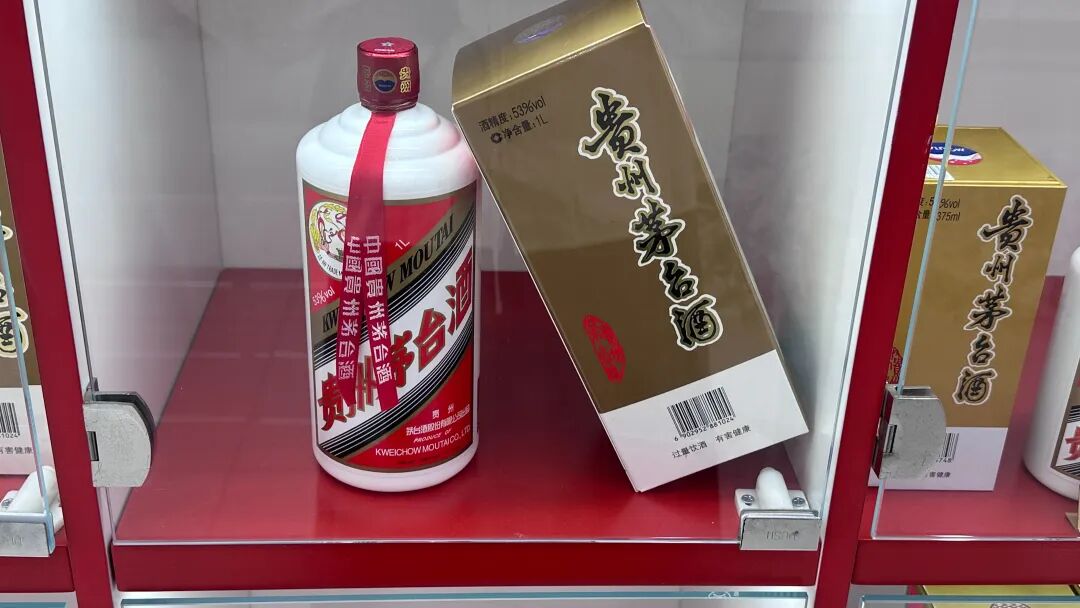
Core Viewpoint - The price of Feitian Moutai has significantly declined, with wholesale prices dropping below the official guidance price for the first time since 2018, raising concerns about the brand's market position and the overall health of the liquor industry [1][3]. Group 1: Price Decline - As of December 12, the wholesale price of 53-degree 500ml Feitian Moutai fell to 1485 yuan per bottle, down 15 yuan from the previous day, marking a decline of over 30% from around 2200 yuan at the beginning of the year [1]. - The price has consistently dropped throughout the year, with significant breaches of key price thresholds, including 2000 yuan, 1900 yuan, 1800 yuan, and recently 1700 yuan and 1600 yuan [4]. Group 2: Market Challenges - The liquor industry is facing multiple challenges, including cyclical adjustments, policy impacts, and weak consumer demand, contributing to the downward price trend of Feitian Moutai [3]. - The recent price drops have been exacerbated by promotional activities during major e-commerce events, such as "Double Eleven," where prices fell below the official guidance price [5][6]. Group 3: Company Performance - In the first three quarters of the year, the company reported revenue of 130.9 billion yuan, a year-on-year increase of 6.32%, and a net profit of 64.63 billion yuan, also up 6.25%, marking the lowest growth rates in nearly 11 years and falling short of the 9% annual growth target [6]. Group 4: Strategic Responses - To boost investor confidence, the company has initiated share buybacks, announcing a plan to spend 1.5 billion to 3 billion yuan on repurchasing shares, and declared a mid-term dividend exceeding 30 billion yuan, with a payout of 23.957 yuan per share [8]. - Industry experts suggest that the price decline may help eliminate speculative bubbles and lower consumption barriers, potentially expanding the consumer base for Moutai [8].

飞天茅台跌至1580元,新掌门人发声
2 1 Shi Ji Jing Ji Bao Dao· 2025-11-29 09:00
Core Viewpoint - The recent fluctuations in the price of Moutai liquor reflect broader challenges and opportunities within the Chinese liquor industry, particularly as the new chairman, Chen Hua, outlines strategies for navigating these changes and maintaining growth amidst market adjustments [1][3][4]. Price Movement - On November 29, the wholesale reference price for 25-year Moutai increased by 15 yuan, reaching 1595 yuan per bottle for original boxes and 1580 yuan for loose bottles, following a previous drop to 1565 yuan [1][2]. Leadership and Strategy - Chen Hua, newly appointed chairman, presented a detailed analysis of the current liquor industry landscape and Moutai's future direction during the recent shareholders' meeting, receiving overwhelming support from shareholders [3][4]. - The management emphasizes Moutai's resilience and ability to navigate cyclical challenges, asserting that the brand is better positioned than ever to adapt and seize new opportunities [3][11]. Industry Challenges - The liquor industry is currently facing high inventory levels, price inversions, and slowing growth rates, indicating a shift towards a "stock competition" era [9][10]. - Chen Hua acknowledges the ongoing challenges but believes that Moutai's opportunities outweigh these difficulties, supported by a strong domestic market and the cultural significance of liquor [9][10]. Future Outlook - Moutai aims to leverage its brand strength, quality, and cultural heritage to adapt to market changes and pursue innovation and transformation [4][10]. - The company plans to maintain a focus on quality over quantity, adhering to the principle of prioritizing quality in production and sales strategies [13][14]. Stakeholder Engagement - The recent shareholders' meeting addressed various stakeholder concerns, including a commitment to share buybacks and profit distribution, with plans to repurchase shares worth between 1.5 billion and 3 billion yuan [15]. - Moutai's management is committed to achieving a "Pareto optimal" state, ensuring that the interests of consumers, employees, investors, and partners are balanced and aligned [13][15]. Production and Sales Strategy - The company is cautious about its production capacity and sales rhythm, emphasizing the importance of ecological sustainability and skilled craftsmanship in its production processes [17][19]. - Moutai's management is open to e-commerce channels but aims to maintain price stability and brand integrity while fostering communication with these platforms [21]. Youth Engagement - Moutai recognizes the importance of engaging younger consumers but emphasizes a nuanced approach, distinguishing between different age groups and their unique consumption characteristics [23][24]. - The company aims to innovate its brand messaging and content to resonate with younger audiences while respecting their diverse values and lifestyles [24].

洋河股份:行业调整中积极蓄势长期发展潜力获券商看好
Xin Lang Cai Jing· 2025-11-18 07:38
Core Viewpoint - The article highlights the strong performance of Yanghe Co., Ltd. in the first half of the year, despite the challenges faced by the liquor industry, emphasizing the company's focus on quality and brand strength [1] Financial Performance - Yanghe Co., Ltd. reported a revenue of 14.796 billion yuan and a net profit of 4.344 billion yuan for the first half of the year [1] - The company achieved a gross margin of 76.2%, an increase of 1.1 percentage points year-on-year [1] Market Strategy - The company is focusing on its core products and key markets, particularly in Jiangsu province, where it generated 7.121 billion yuan in revenue [1] - Yanghe has increased its number of distributors in the domestic market to 3,010, up from the beginning of the year, while the number of distributors outside the province stands at 5,599 [1] Marketing and Product Development - Yanghe launched the seventh generation of its "Sea Blue" product and introduced a high-value "Yanghe Daqu" light bottle wine, achieving over 10,000 pre-sales within 48 hours [1] - The company is leveraging "sports marketing + cultural IP" collaborations to enhance brand recognition [1] Industry Outlook - Analysts believe that while the liquor industry is undergoing a cyclical adjustment, the long-term value of Yanghe Co., Ltd. remains intact [2] - The company is expected to stabilize its operations in the domestic market while gradually improving its performance in the provincial markets [2] - Yanghe's strong brand and channel network, along with its production capacity, are seen as key competitive advantages for future growth [2]
经销商打款意愿降低?年度目标如何完成?电商低价促销如何应对?贵州茅台回应多个热点
YOUNG财经 漾财经· 2025-11-06 11:29
Core Viewpoint - The company acknowledges that the liquor industry is undergoing a significant adjustment, facing challenges such as changing consumer habits and an unsuitable business model, leading to pressure on all liquor enterprises [2][3]. Industry and Company Performance - The liquor industry is in a period of cyclical adjustment, with channel inventory under pressure and growth rates significantly slowing down, indicating a shift to a stock competition era [3]. - The company's third-quarter revenue and net profit growth rates are the lowest since 2015, with both metrics showing less than 1% growth in the third quarter [3][4]. - The company has reduced market supply to maintain market resilience and stability, resulting in a noticeable recovery in terminal sales since August [4]. Channel Management and Inventory - The company is actively working to alleviate pressure on channel partners to maintain a healthy channel ecosystem, which is crucial for market development [3][4]. - The channel inventory ratio for the flagship product, Feitian Moutai, is currently at a healthy level, while other series products are also showing a declining inventory ratio [6]. E-commerce and Pricing Strategy - The company is addressing low-price promotions on e-commerce platforms, which have led to concerns about brand reputation and pricing integrity [5]. - Efforts are being made to establish a green disposal channel for counterfeit and infringement information with major online platforms [5]. Market Strategy and Internationalization - The company is committed to a three-step internationalization strategy, focusing on maintaining market health and stability while expanding its international presence [4][9]. - A significant investment of approximately 15.516 billion yuan is planned for the "14th Five-Year" technical transformation project to enhance production capacity [9]. Shareholder Value and Market Management - The company is transitioning from high-speed growth to high-quality development, emphasizing value management through cash dividends, share buybacks, and enhanced information disclosure [7][8]. - A share buyback plan has been announced, with a total amount between 1.5 billion and 3 billion yuan, aimed at enhancing shareholder value [8]. Industry Outlook - The current industry adjustment presents both challenges and opportunities for innovation and transformation, with the company aiming to adapt to market demands and promote higher quality development [10].

茅台三季报保持正增长 张坤逆势加仓
2 1 Shi Ji Jing Ji Bao Dao· 2025-10-29 12:55
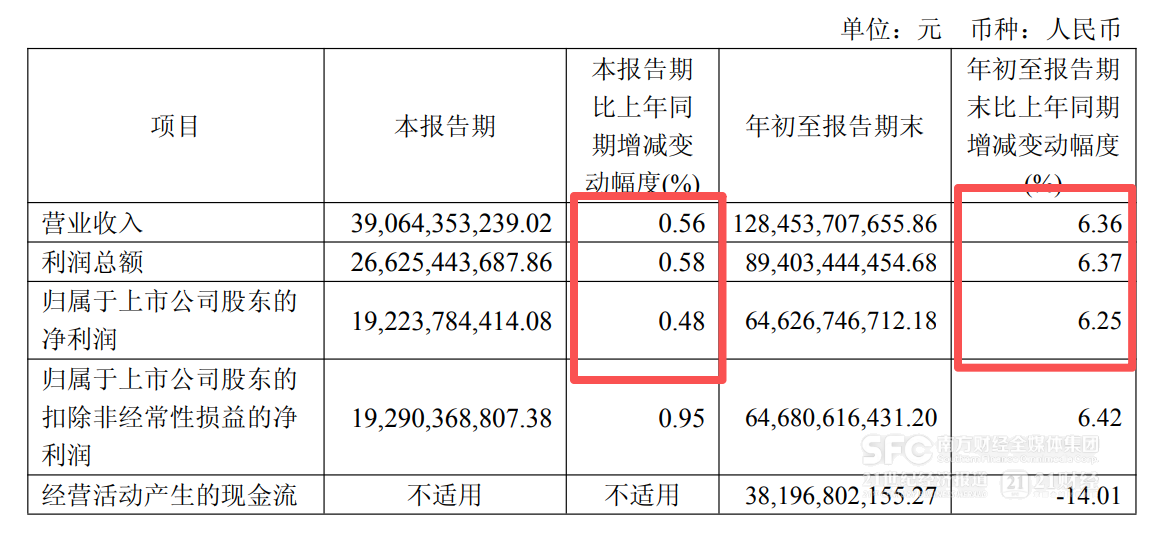
Core Insights - Guizhou Moutai reported its Q3 2025 results, showing a revenue of 39.064 billion yuan, a year-on-year increase of 0.56%, and a net profit of 19.224 billion yuan, up 0.48% year-on-year [1][2] - For the first three quarters, the company achieved a total revenue of 128.454 billion yuan, reflecting a growth of 6.36%, and a net profit attributable to shareholders of 64.627 billion yuan, which is a 6.25% increase year-on-year [1][2] Financial Performance - Q3 revenue: 39.064 billion yuan, up 0.56% year-on-year [2] - Q3 net profit: 19.224 billion yuan, up 0.48% year-on-year [2] - Year-to-date revenue: 128.454 billion yuan, up 6.36% year-on-year [2] - Year-to-date net profit: 64.627 billion yuan, up 6.25% year-on-year [2] - Revenue from Moutai liquor for the first three quarters: 110.514 billion yuan; revenue from series liquor: 17.884 billion yuan [2] Industry Context - Compared to other liquor companies that reported declines in Q3, Moutai is one of the few maintaining positive growth [4] - Historical performance shows that Moutai's current results are better than during the last industry downturn in 2014, when revenues and net profits fell [4] Management Insights - Moutai's management emphasizes the company's ability to navigate through industry cycles, supported by market research conducted across 16 provinces [5] - The management believes that the market for Moutai liquor is showing stable and positive growth, with improved sales performance since September [5] Investment Perspective - Fund manager Zhang Kun has increased holdings in Moutai, citing the long-term potential of China's consumer market and the current low valuation as providing a safety margin [6]
贵州省能源局局长陈华空降茅台集团 新帅如何应对新周期?
2 1 Shi Ji Jing Ji Bao Dao· 2025-10-27 23:06
Core Viewpoint - The sudden resignation of Zhang Deqin as chairman of Kweichow Moutai and the appointment of Chen Hua as his successor highlight ongoing leadership changes within the company, raising questions about the company's strategic direction amid economic adjustments in the liquor industry [1][2][3]. Company Leadership Changes - Zhang Deqin submitted his resignation on October 27, 2025, after a brief tenure of approximately one and a half years since his return in April 2024 [1][3]. - Chen Hua, previously involved in the energy sector, has been appointed as the new chairman, indicating a shift in leadership style and potential strategic focus [1][2]. Industry Context - The liquor industry is currently facing significant challenges, including a slowdown in growth and declining terminal prices, which complicates the task for the new leadership to maintain performance and stability [5][6]. - The market is observing how Chen Hua will navigate the balance between Moutai's internal development and the expectations from the Guizhou government [5][6]. Recent Performance and Strategies - Under Zhang Deqin's leadership, Moutai emphasized a multi-channel distribution strategy, with wholesale and agency channels generating significant revenue, surpassing direct sales [4]. - Moutai has also engaged in cultural initiatives and collaborations to enhance brand image and connect with younger consumers, although some of these efforts faced internal resistance [4][5]. Market Position - Despite recent price declines, Moutai's flagship product, Feitian Moutai, remains a leading high-end liquor, with a stable dealer network that could attract new investments if adjustments are made [6]. - The company has a history of successfully navigating market adjustments, suggesting a strong capacity for self-regulation and adaptation in challenging economic environments [7].
营利双降后,迎驾贡酒年度目标有点“悬”
Guo Ji Jin Rong Bao· 2025-09-19 11:12
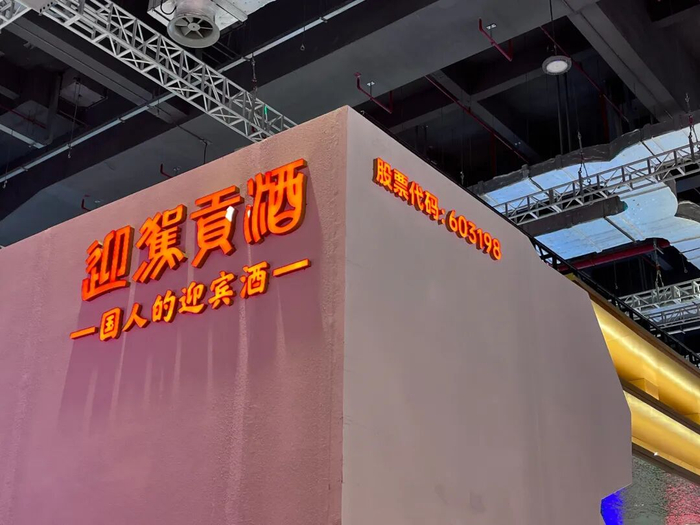
Core Viewpoint - The company, Yingjia Gongjiu, reported a significant decline in both revenue and net profit for the first half of 2025, marking the first time in five years that both metrics have decreased, primarily due to the impact of new alcohol consumption restrictions and an industry-wide cyclical adjustment [1][3]. Financial Performance - Revenue for the first half of 2025 was 3.16 billion yuan, a year-on-year decrease of 16.89% - Net profit attributable to shareholders was 1.13 billion yuan, down 18.19% year-on-year [1][3]. Market Challenges - The company faces challenges in both domestic and external markets, with a notable decline in performance in its primary market of Anhui, which accounts for over 60% of total revenue [3][4]. - Domestic revenue decreased by 12% to 2.364 billion yuan, raising concerns among investors [3][4]. - Revenue from external markets fell by 30% to 625 million yuan, with its share of total revenue dropping to less than 20% [6]. Strategic Plans - The company aims to achieve a revenue target of 7.6 billion yuan for the year, representing a growth of approximately 3.49%, and a net profit target of 2.62 billion yuan, with a growth of about 1% [3]. - Management plans to stabilize prices, optimize the distributor structure, innovate products, expand market reach, and enhance digital marketing and channel transformation to drive high-quality marketing development [3][6]. Sales and Marketing - Despite an increase in sales expenses to 307 million yuan, up 1.39% year-on-year, this did not translate into improved performance, leading to a rise in the sales expense ratio [7]. - The management indicated a focus on refined operations and efficiency improvements to enhance profitability moving forward [7].

名酒保住增长 白酒业即将穿越周期?
2 1 Shi Ji Jing Ji Bao Dao· 2025-09-05 23:12
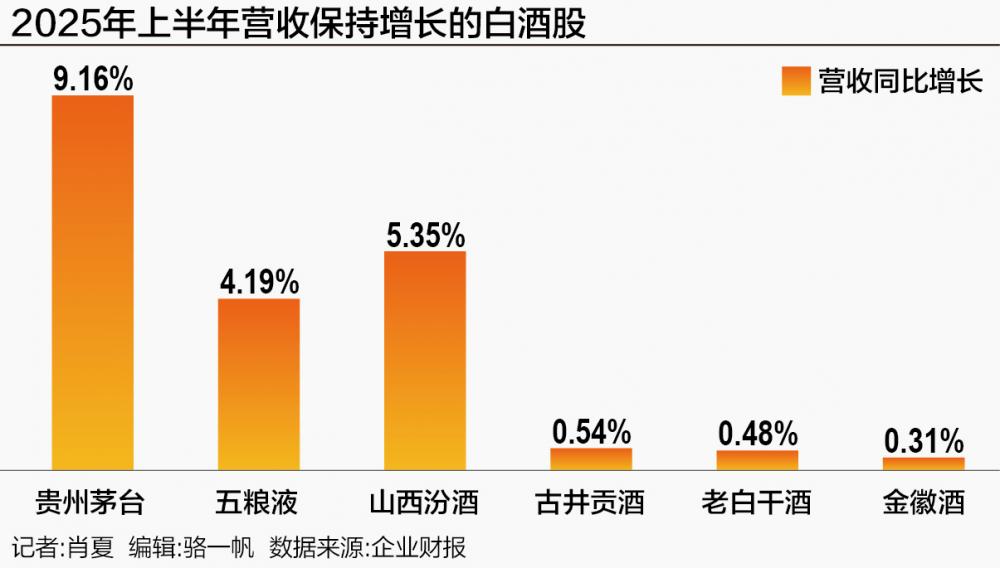
Core Viewpoint - The Chinese liquor industry, particularly the baijiu sector, is currently experiencing a downturn, with many companies facing declining performance and a challenging market environment [1][2][3]. Industry Performance - In the first half of the year, 15 out of 21 listed baijiu companies reported declining performance, with only 6 companies, including Kweichow Moutai and Wuliangye, showing positive growth [1][8]. - The overall market is under pressure, with many companies returning to industry averages after years of high growth, indicating a significant adjustment phase [9][10]. Market Dynamics - The baijiu sector is witnessing a consolidation of competitive advantages, with leading brands like Moutai and Wuliangye maintaining their positions despite a slowdown in growth [12][15]. - There is a notable divergence in performance among companies, with some experiencing significant declines, while a few manage to maintain or slightly grow their revenues [5][10]. Future Outlook - Analysts suggest that the second half of the year may see a potential rebound, particularly during the Mid-Autumn and National Day holidays, which could provide a window for price stabilization and recovery [17][22]. - However, many believe that a broader recovery for the industry may take longer, with some predicting that the sector may not fully stabilize until late 2025 or mid-2026 [20][19]. Investment Sentiment - Recent market activity indicates a cautious optimism, with some investors betting on a rebound in baijiu stocks, as the sector's overall valuation has reached historically low levels [24][23]. - The current environment is seen as an opportunity for stronger companies to emerge from the downturn, potentially leading to a more concentrated market with fewer but stronger players [24][25].