
金融科技服务

Search documents
股价暴跌95%与平安依赖症:金融壹账通私有化背后的双重溃败
Xin Lang Cai Jing· 2025-11-20 14:37
Core Viewpoint - The privatization of Fintech One Account marks the end of its tumultuous journey in the capital market, reflecting its long-term stock price decline, single business structure, and weak third-party market expansion [2][5] Group 1: Stock Price Decline and Market Confidence Erosion - The privatization offer price was HKD 2.068 per share, showing a significant premium over the stock price prior to the announcement, yet this premium does not mask the company's poor performance since its 2019 listing, with a cumulative decline of over 95% in its American Depositary Shares [2] - The persistent stock price drop is a rational market response to the company's business model and development prospects, indicating investor skepticism about its long-term value [2][3] - Privatization may relieve disclosure pressures but also eliminates opportunities for public market financing and brand endorsement, representing a retreat rather than a victory [2] Group 2: Single Business Structure and Dependency on Ping An - The company's deeper issue lies in its single business structure, with third-party income failing to break through since 2021, heavily relying on the Ping An Group for revenue [2][3] - The company acknowledged its inability to effectively expand third-party business income, continuing to operate as a "dedicated company" for Ping An, which limits its independent development and marginalizes it in market competition [2][3] Group 3: Strategic Missteps and Capital Drain - The company's challenges stem from a series of poor investment decisions, such as acquiring a loss-making asset management platform, leading to reduced revenue and negative operating cash flow [3][4] - Efforts to restructure through the sale of its Hong Kong virtual banking business yielded limited results, highlighting deficiencies in strategic planning and risk management [3][4] Group 4: Privatization as a Strategic Shift or Reluctant Retreat - The trajectory of Fintech One Account, from its 2019 NYSE listing to its current privatization, reflects the common challenges faced by Chinese concept stocks in overseas markets [5] - Analysts suggest that privatization is a strategic adjustment in response to performance pressures, business structure bottlenecks, and changes in the overseas regulatory environment, but it appears more as a passive response than an active innovation [5] Group 5: Industry Warning on B-end Financial Technology Services - The case of Fintech One Account serves as a warning for the financial technology industry regarding the profitability challenges of B-end services and the trend of industry differentiation [6] - Leading institutions are rapidly capturing market share through resource integration, while smaller players face elimination due to homogenized competition and capital pressures [6] - The retreat of Fintech One Account may be part of a broader trend of Chinese concept stocks returning home, exposing vulnerabilities in business models and strategic direction that warrant reflection across the industry [6] Conclusion - The privatization of Fintech One Account is superficially a completion of capital operations but fundamentally represents a failure of its business model, with ongoing issues of low stock prices, single business structure, and strategic missteps [7] - Without fundamentally reshaping its competitiveness, breaking dependency, and optimizing strategic layout, this "turn" may mark a turning point from prosperity to decline [7] - The case emphasizes that the essence of financial technology lies in innovation and efficiency, rather than capital packaging or ecosystem dependency, highlighting the need for companies to return to their technological roots and build independent value for long-term competitiveness [7]

解读深港金融科技三年行动方案:联手打造全球级中心路径
Nan Fang Du Shi Bao· 2025-11-20 10:20
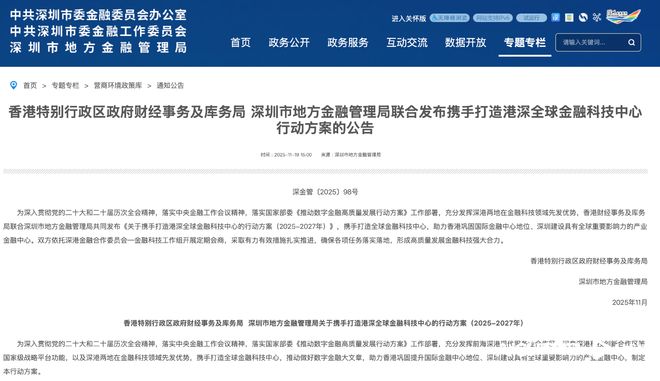
11月19日,香港特别行政区政府财经事务及库务局与深圳市地方金融管理局联合发布《关于携手打造港 深全球金融科技中心的行动方案(2025-2027年)》(以下简称《行动方案》),明确未来三年将围绕 六大方面推出20项重点任务,并提出"到2027年底,落地20个以上深港跨境数据验证平台金融领域应用 场景"等具体目标。这份首次由深港两地联合发布的金融科技专项行动方案,被视为两地携手打造全球 金融科技中心的"施工图"和"任务书"。 从"要素流动"迈向"制度型开放" 《行动方案》开宗明义,旨在"充分发挥深港两地在金融科技领域先发优势,携手打造全球金融科技中 心,助力香港巩固提升国际金融中心地位、深圳建设具有全球重要影响力的产业金融中心"。 "印象中,这是深港联合发文的第一个《行动方案》,标志着深港合作进入到一个新阶段。"广东省体制 改革研究会执行会长彭澎在接受南都·湾财社记者采访时指出。 南开大学金融学教授田利辉认为,这一合作具有深远的战略意义。"相较于新加坡、伦敦等其他国际金 融科技中心,深港合作的战略意义在于助推人民币国际化、抢占全球金融科技规则话语权。"田利辉进 一步分析称,"深港的优势是'科创+金融+政策'协同 ...
宇信科技入选“十四五”金融创新优秀案例:“零成本启动+轻资产投入”破解中小银行转型难题
Zheng Quan Shi Bao Wang· 2025-11-20 06:25
11月18日,第二十届中国经济论坛平行论坛——2025大湾区科技与金融创新发展大会在广州南沙隆重举 行。宇信科技"零售信贷(包括普惠和消费信贷)自营业务转型合作运营模式——区域性银行数字化普 惠金融新范式"凭借突出的创新性、显著的实践成效与广泛的行业示范意义,成功斩获"十四五"金融创 新优秀案例奖项。宇信科技数字金融产研融合业务部总经理李安东受邀出席大会并上台领奖。 作为国内科技与金融领域的重要交流平台,本次大会由证券时报社主办,汇聚了来自多个国家部委及广 东省领导、知名经济学家、科技金融企业代表等重量级嘉宾,共同探讨"十四五"后期科技与金融深度融 合的新路径、新模式。此次获奖,不仅是对宇信科技在金融科技领域技术实力与创新能力的权威认可, 更彰显了公司在助力区域性中小银行数字化转型、推动普惠金融落地方面的实践价值。 该项目的成功缘于在模式、风控、技术与体系四个维度的全面创新:1. 服务模式创新:"联合运营+效 果付费"破解合作困局;2. 风控机制创新:量化风控与传统风控的有机融合;3. 科技应用创新:微服务 架构支撑全流程数字化;4. 体系协同创新:五大体系联动实现全域高效运营。 成效显著:数据印证价值,示范 ...

RockFlow获蚂蚁集团领投数千万美元融资,深耕「AI Agent+金融」
IPO早知道· 2025-11-20 05:45
Core Viewpoint - RockFlow, a Singapore-based AI-native fintech company, has recently completed a multi-million dollar funding round led by Ant Group, aiming to build a global multi-asset "All-in-One" AI-native financial technology platform [2][5]. Group 1: Funding and Market Position - The recent funding round was part of the excitement surrounding RockFlow's "RockAlpha AI Model US Stock Trading Competition," showcasing the potential of AI models in real trading environments [2]. - RockFlow has received licenses from the Hong Kong Securities and Futures Commission (SFC) for securities trading, advisory, and asset management, establishing a solid foundation for regulated financial operations in Hong Kong [4]. Group 2: AI Agent Development - Bobby AI is positioned as a 24/7 "AI investment partner," capable of understanding personalized investment intentions through natural language and autonomously performing data analysis, strategy modeling, backtesting, and real-time trading [3]. - The evolution of Bobby AI indicates a shift in AI applications in finance from being "auxiliary tools" to becoming "core decision-making" components [4]. Group 3: Future Vision and Innovation - RockFlow plans to integrate various asset classes, including digital assets, real-world assets (RWA), event contracts, and private company equity, into its platform in the coming months [4]. - The company aims to simplify complex financial services through AI, making them more user-friendly and personalized, while prioritizing user asset security and data privacy [5].

领创集团依托Agentic AI,为原有业务流程注入新动力
Sou Hu Cai Jing· 2025-11-20 01:44
Core Insights - The rapid development of Agentic AI is transforming business processes by shifting from "human-driven automation" to a model where AI acts as an "executor" or "assistant" that understands goals and autonomously executes tasks within predefined rules and boundaries [1][4] Group 1: Integration of Agentic AI in Business - LingChuang Group is leveraging Agentic AI to reshape existing business models, aiming to create a financial and data platform that provides equitable access to quality financial products and services [3][4] - The company has developed innovative solutions, such as ADVANCE.AI for risk management and Atome Financial for digital financial services, enhancing value for businesses and users in Southeast Asia and globally [3][4] Group 2: Operational Efficiency and Customer Service - Agentic AI is being integrated into various operational scenarios to improve efficiency, including internal knowledge management, operational support, and customer service [4][5] - The implementation of a QA Robot has streamlined HR inquiries by utilizing an updated knowledge base, significantly reducing inefficiencies caused by manual communication [4] - Atome's customer service team is set to launch the Atome CX Bot in 2024, which will utilize Agentic AI to handle high-frequency inquiries, optimizing resource allocation and enhancing customer satisfaction [4][5] Group 3: Engineering and Development Efficiency - Over 80% of engineers at LingChuang Group are using AI tools, resulting in a saving of 20,000 man-hours and a 30% increase in engineering productivity, with test automation rates reaching 95% [5] - The integration of Agentic AI is expected to transform talent requirements and organizational structures, emphasizing the need for operational staff to understand AI models and their applications [5] Group 4: Cloud Technology and Infrastructure - LingChuang Group relies on Amazon Web Services (AWS) for a robust cloud infrastructure, which enhances the reliability and security of their operations, crucial for their global expansion [6][7] - AWS provides essential services like Amazon EMR and Amazon EKS, enabling efficient data processing and disaster recovery, which supports the scalability and stability of LingChuang Group's operations [6][7] Group 5: Future Directions and Applications - The company plans to deepen the integration of Agentic AI across various business scenarios, requiring comprehensive support from infrastructure, models, and applications [7] - AWS's full-stack AI solutions will facilitate the rapid development and deployment of various AI models, enhancing the application of Agentic AI in diverse business contexts [7][8]


Square Stock Pops On Three-Year Financial Outlook, $5 Billion Buyback
Investors· 2025-11-19 20:53
Group 1 - Square-parent Block (XYZ) will authorize a new $5 billion repurchase plan for its own stock ahead of its investor day on Wednesday [1] - Square stock has declined 33% in 2025 and retreated after the company reported some financial metrics that lagged Wall Street targets in third-quarter earnings [1] - In Q3, Square repurchased $403 million of its own stock [1] Group 2 - Stocks closed mixed on Friday but ended at the day's highs, with Palantir and Nvidia closing higher [2]
奇富科技2025年第三季度财报:累计服务167家金融机构
Zheng Quan Ri Bao· 2025-11-19 12:15
Core Insights - Qifu Technology reported a revenue of 5.21 billion yuan for Q3 2025, representing a year-on-year increase of 19.1% but a quarter-on-quarter decrease of 0.2% [1] - The non-GAAP net profit for the same quarter was 1.51 billion yuan [1] - As of September 30, 2025, the platform served 167 financial institutions and had 284 million registered users, a year-on-year growth of 11.6% [1] Financial Performance - Q3 revenue: 5.21 billion yuan, up 19.1% year-on-year, down 0.2% quarter-on-quarter [1] - Non-GAAP net profit: 1.51 billion yuan [1] - Loan facilitation in Q3 reached 83.3 billion yuan, a year-on-year increase of 1.0% [1] - Ending loan balance for the quarter was 138.1 billion yuan [1] User Metrics - Registered users: 284 million, up 11.6% year-on-year [1] - Cumulative credit users: 62.1 million, up 12.6% year-on-year [1] - Cumulative borrowing users: 38.1 million, up 15.1% year-on-year [1] - New credit users in Q3: 1.95 million, a quarter-on-quarter increase of 9% [1] - New borrowing users in Q3: 1.35 million, a quarter-on-quarter increase of 10% [1] Strategic Initiatives - The company is continuously adjusting its business structure in response to industry dynamics [2] - Future quarters will focus on optimizing business structure to enhance core business resilience [2] - The rapid changes in the industry present opportunities for operational optimization and resource allocation [2]
金融壹账通陈当阳:推动AI Agent体系化落地
2 1 Shi Ji Jing Ji Bao Dao· 2025-11-19 10:05
Core Insights - The article discusses the transformation of Chinese fintech companies, particularly Ping An Technology, from a "single technology output" model to becoming "industry standard setters" in overseas markets [1][4][6]. Group 1: Company Positioning and Strategy - Ping An Technology serves as the core platform for technology output from the Ping An Group, embodying the "AI in ALL" strategy through the integration of AI capabilities into financial services [2][11]. - The company aims to deepen its application of AI and SaaS subscription models to help financial institutions achieve cost reduction and efficiency improvements [4][12]. Group 2: International Expansion and Market Focus - The company has expanded its overseas business to 20 countries and regions, serving 214 clients, with a focus on Southeast Asia and South Africa as key strategic markets [1][6][7]. - In Vietnam, the company has partnered with major banks to implement core system projects capable of processing up to 10 billion transactions daily [7]. Group 3: Technological Innovations and Applications - The company has developed an "AI Agent" digital employee to enhance efficiency in customer service, marketing, and credit risk management within the banking sector [3][9]. - The "Intelligent Visual Anti-Fraud Strategy Platform" has been launched to combat fraud using AI, achieving a detection rate of over 99% in various applications [10]. Group 4: Future Goals and Development - Over the next 3-5 years, the company aims to solidify its position as a leader in fintech and AI, focusing on sustainable technology development and deep integration of AI into financial processes [11][12]. - The company plans to enhance its global presence by establishing standardized technology and service outputs, contributing to the international competitiveness of the Ping An Group [12].

21专访|金融壹账通陈当阳:推动AI Agent体系化落地
2 1 Shi Ji Jing Ji Bao Dao· 2025-11-19 09:51
Core Insights - The article discusses the transformation of China's financial technology sector from a "single technology output" model to becoming "industry standard setters" in the context of international expansion [1] - Financial institutions overseas are increasingly seeking compliance, security, and sustainability, with a preference for mature SaaS models to quickly deploy systems while meeting regulatory requirements and enhancing business efficiency [1][7] Group 1: Company Positioning and Strategy - Financial One Account is positioned as the core platform for technology output of Ping An Group, embodying the "AI in ALL" strategy by productizing and platforming AI capabilities accumulated over 30 years [2] - The company implements a "Five Intelligences" strategy, integrating AI into marketing, service, operations, management, and business processes to achieve comprehensive intelligent upgrades [2][3] - The company aims to deepen the application of AI agents and SaaS subscription models to help financial institutions reduce costs and improve efficiency [4] Group 2: Domestic Market Focus - In the domestic market, the company emphasizes precision and practicality, focusing on the core financial business and leveraging data ecosystems to provide sustainable digital empowerment [4][5] - The data ecosystem integrates internal and external data resources to create comprehensive data services, enhancing risk control and marketing capabilities for financial institutions [4] - The vehicle ecosystem supports small and micro-enterprises in the automotive aftermarket by providing insurance services and digital operations [5] Group 3: International Expansion - The company is intensifying its overseas expansion, with Hong Kong serving as a key international entry point and Southeast Asia as a strategic market [6] - The company has established partnerships in Vietnam and other Southeast Asian countries, focusing on digital banking, insurance system construction, and compliance management [6][7] - By June 30, 2025, the company plans to expand its overseas business to 20 countries and regions, serving 214 clients [1][6] Group 4: AI Integration and Innovation - The company is committed to embedding AI capabilities into business processes, transforming AI from a tool into a productive partner [8][10] - The "Intelligent Visual Anti-Fraud Strategy Platform" has been developed to enhance fraud detection and compliance, achieving a detection rate of over 99% [10] - The company aims to create a closed-loop structure of "data-model-intelligent agent-application" to make AI a true productivity tool for financial institutions [11] Group 5: Future Goals - In the next 3-5 years, the company aims to lead the financial technology and AI industry, focusing on core technologies like AI, big data, and intelligent risk control [11] - The company plans to build a new financial technology landscape that supports both domestic and international development, leveraging its SaaS and service output model [11] - The company will promote the internationalization of Chinese financial technology standards through standardized technology and service output [11]
校企协同,产教融合:副院长高维和一行参访东融科技集团
Jiang Nan Shi Bao· 2025-11-19 06:51
Core Insights - The visit by Shanghai University of Finance and Economics (SUFE) to Dongrong Technology Group focused on discussions around financial technology development, talent cultivation, and industry-academia collaboration [1][2] - Dongrong Technology Group showcased its innovative practices in financial technology, particularly through its Dongrong APP and the Dongrong Smart Loan platform [1][2] Company Overview - Dongrong Technology Group's chairman, Hu Yujian, provided an overview of the company's development history, regional layout, and service models during the visit [1] - The Smart Loan platform utilizes advanced technologies such as the internet, big data, and artificial intelligence to offer a comprehensive service for lending institutions [1] Industry Context - Hu Yujian reflected on the evolution of the financial industry from the rise of internet finance to the current phase of robust development, emphasizing the importance of technology-driven and compliant growth [2] - The collaboration aims to leverage SUFE's academic resources to enhance marketing innovation and the Smart Loan project [2] Collaboration Initiatives - Both parties discussed the establishment of a research institute and the integration of practical projects, marking a significant step in their partnership [2] - Hu Yujian was appointed as an MBA practice mentor at SUFE, indicating a commitment to deepening cooperation in talent development and research [2]