
私募基金

Search documents
因管理部分基金存在违规行为,德裕嘉鸿私募及相关责任人被监管警示
Bei Jing Shang Bao· 2025-12-15 11:54
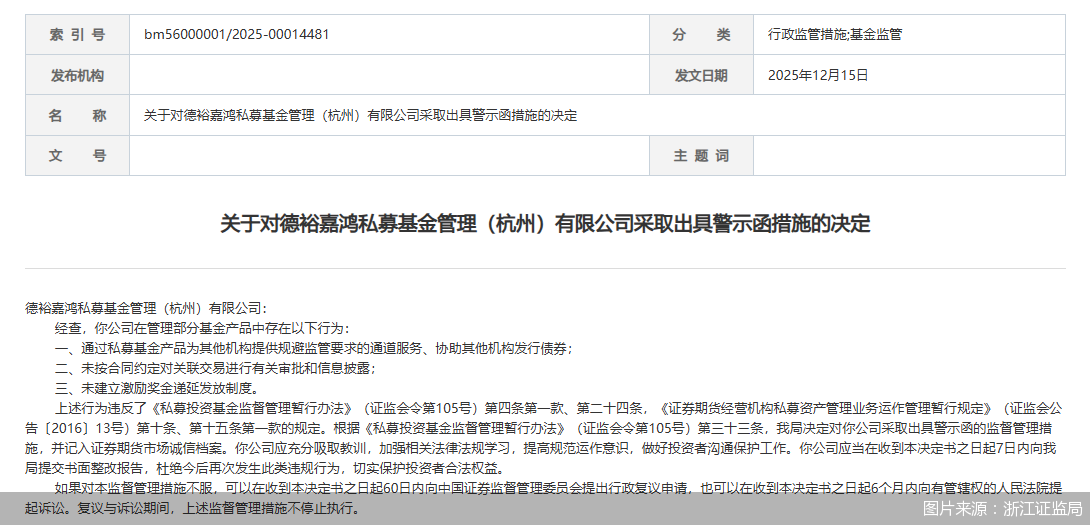
北京商报讯(记者 刘宇阳)12月15日,浙江证监局发布公告表示,经查,德裕嘉鸿私募基金管理(杭州)有限公司(以下简称"德裕嘉鸿私募")在管理部 分基金产品中存在通过私募基金产品为其他机构提供规避监管要求的通道服务、协助其他机构发行债券;未按合同约定对关联交易进行有关审批和信息披 露;未建立激励奖金递延发放制度的行为。 浙江证监局指出,上述行为违反了相关规定,决定对德裕嘉鸿私募采取出具警示函的监督管理措施,并记入证券期货市场诚信档案。同时,周升宇作为德 裕嘉鸿私募的法定代表人、执行董事和总经理,未勤勉谨慎履行相关职责与义务,对公司上述问题负有主要责任,被浙江证监局采取出具警示函的监督管 理措施,并记入证券期货市场诚信档案。 ...

因合格投资者和适当性管理不规范等问题,嘉兴得时私募被监管警示
Bei Jing Shang Bao· 2025-12-15 11:48
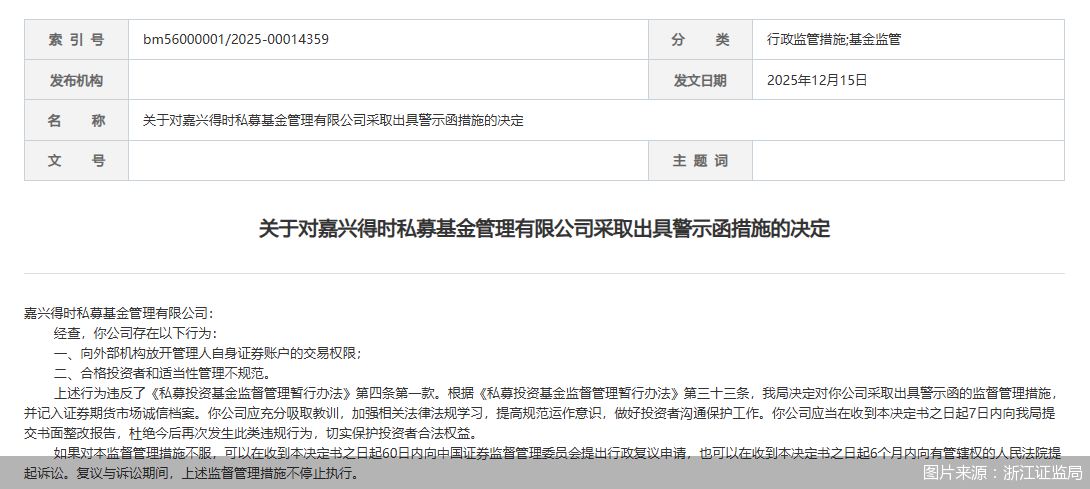
北京商报讯(记者 刘宇阳)12月15日,浙江证监局发布公告表示,经查,嘉兴得时私募基金管理有限公司(以下简称"嘉兴得时私募")存在向外部机构放 开管理人自身证券账户的交易权限;合格投资者和适当性管理不规范的行为。上述行为违反了相关规定,浙江证监局决定对嘉兴得时私募采取出具警示函 的监督管理措施,并记入证券期货市场诚信档案。 | 索 引 号 | bm56000001/2025-00014359 | से | 崇 | 行政监管措施;基金监管 | | --- | --- | --- | --- | --- | | 发布机构 | | 发文日期 | | 2025年12月15日 | | ਉ 称 | 关于对嘉兴得时私募基金管理有限公司采取出具警示函措施的决定 | | | | | 文 号 | | 主题词 | | | ...
平安证券私募生态合作峰会盛大开启!超300家机构齐聚,共话22万亿市场机遇
Zheng Quan Shi Bao Wang· 2025-12-15 10:16
Core Insights - The summit "Empowerment and Win-Win, Intelligence Leading the Future" aims to explore the evolution of China's private equity industry under the dual drivers of regulation and innovation, as well as new investment paradigms and ecological cooperation opportunities [1][2] - The private equity industry in China is undergoing a profound transformation, focusing on building core competencies centered around investor trust, integration of research and technology, and adherence to compliance and fiduciary responsibilities [3][4][5] Group 1: Industry Trends - As of the end of October, the total scale of private equity funds reached 22.05 trillion yuan, setting a new historical high and surpassing the previous peak of 20.81 trillion yuan in September 2023 [3] - The number of billion-level private equity institutions has exceeded 100, with quantitative strategy institutions accounting for nearly half, indicating a significant shift in the industry landscape [3] - The private equity sector is transitioning from "opportunity-driven" to "capability-driven," emphasizing quality over mere scale expansion [3][4] Group 2: Company Initiatives - Ping An Securities is committed to supporting outstanding private equity funds to grow stronger, continuously optimizing its service ecosystem to meet the core demands of private equity management institutions [2][11] - The company has established a comprehensive service platform that focuses on funding, trading, and value-added services, aiming to empower the growth and development of private equity funds [6][11] - Ping An Securities has launched a new quantitative trading service platform designed to meet the increasing demands for trading efficiency and stability among professional investors [8] Group 3: Investment Opportunities - The Chinese stock market has long-term development potential due to its market scale, human capital advantages, and strong policy support [7] - The summit featured discussions on asset allocation prospects in the A-share market and the importance of risk management in investment strategies [10] - Experts emphasized the need for private equity funds to embrace AI and innovative investment logic to capture sustainable alpha in the evolving market landscape [10]
持仓信息成“人情礼”?私募泄密套路多:从微信传达到账户共享,监管已出手
Mei Ri Jing Ji Xin Wen· 2025-12-15 10:09
机构资金的持仓与交易信息,向来被A股市场各方紧盯。 某私募证券投资基金管理有限公司投资经理龚某某,在任职期间负责5只私募基金的投资决策工作,掌 握着这些产品的未公开投资信息。为了向他人输送利益,他竟通过当面告知、微信传递,甚至直接提供 私募基金产品证券账户账号密码的方式,向赵某全面泄露相关信息。 这种"毫无底线"的泄密行为,最终让龚某某付出了代价——上海证监局对其作出责令改正、给予警告, 并处以20万元罚款的行政处罚。 此事并非个例,今年7月14日,上海证监局曾一次性下发三则行政处罚决定书,剑指私募机构投研人员 泄密问题。 其中,上海某资产管理合伙企业(有限合伙)投资经理陈某,向徐某泄露所管理私募基金的投资决策信 息,被处以50万元罚款;曾担任两家机构投资负责人的徐某,双向泄露两只产品的未公开信息,同样被 罚50万元;上海某资产管理合伙企业(有限合伙)另一位投资经理张某帆,向潘某泄露产品核心信息, 也领到了50万元罚单。短时间内多名投研人员因同类问题被处罚,凸显出该领域泄密风险的集中性。 如果说投研人员泄密是"主动输送",那么IT岗位人员的违规操作则是"精准窃取"。作为掌握公司系统权 限的核心岗位,部分私募关 ...
因内幕交易 一私募基金投资经理被浙江证监局出具警示函
Di Yi Cai Jing· 2025-12-15 09:20
(文章来源:第一财经) 浙江证监局发布关于对纪云涛采取出具警示函措施的决定。经查,根据中国证券监督管理委员会行政处 罚决定书,纪云涛在担任台州沃源私募基金管理有限公司基金投资经理期间,存在利用基金产品参与内 幕交易的行为。上述行为违反了《私募投资基金监督管理暂行办法》第二十三条第八项的规定,根据 《私募投资基金监督管理暂行办法》第三十三条的规定,浙江证监局决定对纪云涛采取出具警示函的监 督管理措施,并记入证券期货市场诚信档案。 ...
量化基金超额收益TOP10揭晓!幻方、明汯、蒙玺、翰荣居前!
Sou Hu Cai Jing· 2025-12-15 03:22
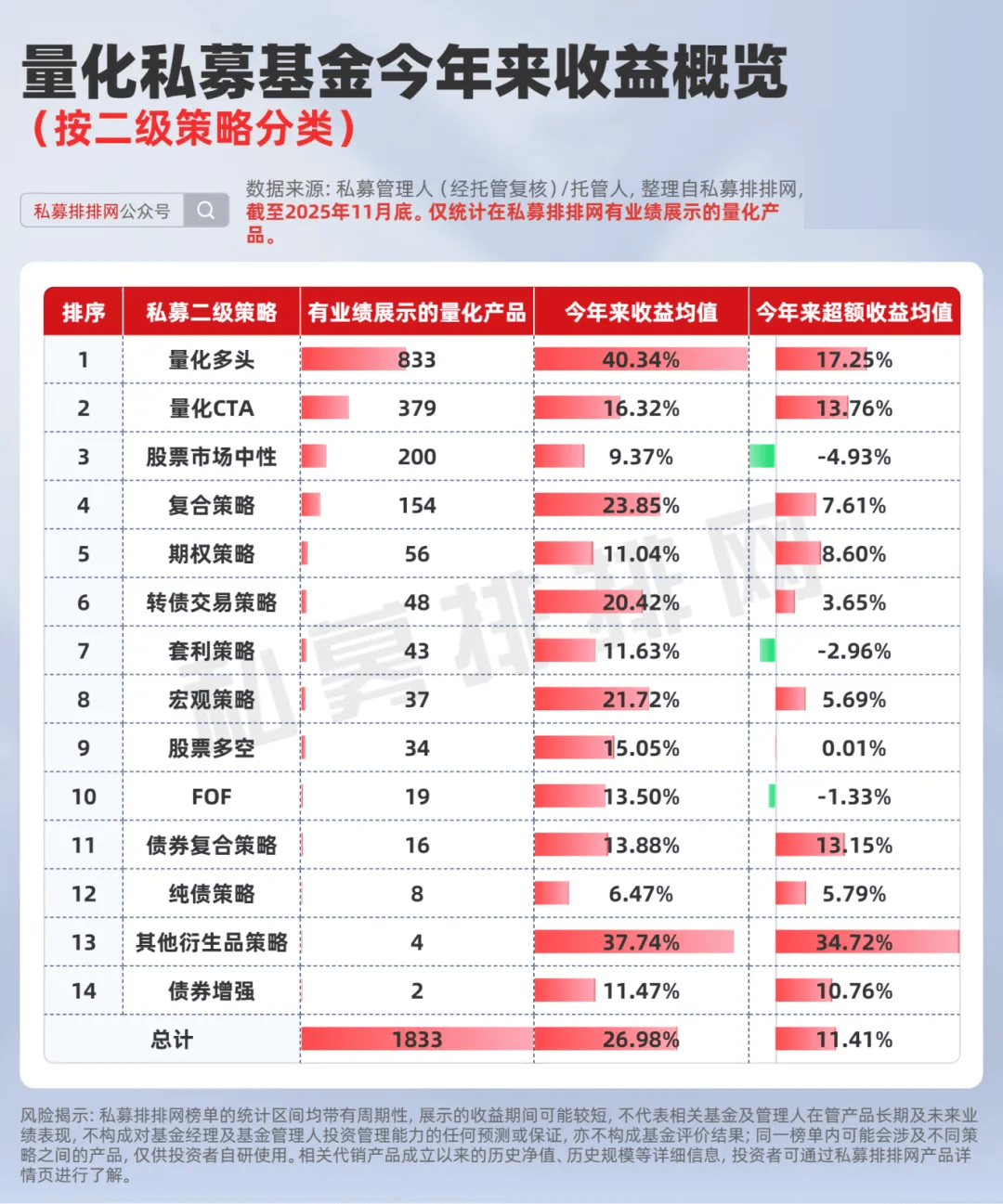
Core Insights - Deepseek has emerged in the AI sector, revitalizing quantitative investment, particularly in a market favoring small and mid-cap stocks [1] - Despite a general adjustment in the A-share market in November, many quantitative products from large private equity firms achieved historical highs, with over 80% being quantitative products [1] - The average return for 1,833 quantitative products this year is 26.98%, with an excess return of 11.41% [2] Quantitative Investment Performance - The top-performing quantitative long strategy products (833 in total) achieved returns of 40.34% and excess returns of 17.25% [2] - Other quantitative strategies include: - Quantitative CTA: 379 products with average returns of 16.32% and excess returns of 13.76% [2] - Stock market neutral: 200 products with average returns of 9.37% and excess returns of -4.93% [2] - Composite strategy: 154 products with average returns of 23.85% and excess returns of 7.61% [2] - Options strategy: 56 products with average returns of 11.04% and excess returns of 8.60% [2] Top Quantitative Stock Selection Products - As of November 2025, there are 331 quantitative stock selection products with an average return of 39.40% and an average excess return of 19.14% [3] - The top three products in excess returns are from Zhuhai Zhengfeng Private Equity, Shui Zhuo Quan Asset, and Jiuming Investment [3] Performance of Specific Strategies - The "CSI 500 Index Enhanced" products have 197 products with average returns of 40.17% and excess returns of 14.14% [8] - The top three products in this category are from Zhaoxin Private Fund, Guobiao Asset, and Zhaoyue Private Fund [8] - The "CSI 1000 Index Enhanced" products have 167 products with average returns of 44.68% and excess returns of 17.53% [14] - The top three products in this category are from Jintong Investment, Luxiu Investment, and Mengxi Investment [14] Notable Fund Managers and Products - The "Hanhong Ansheng Progress No. 1 B Class" product managed by Hanhong Investment has outstanding performance with excess returns of ***% [6] - The "Longqi Technology Innovation Selected No. 1 C Class" product managed by Zhu Xiaokang has also shown impressive returns [7] - The "Zhaoxin CSI 500 Index Enhanced No. 1 A Class" managed by Tang Yue and Hu Chenhang has the highest excess returns in its category [12]
优化配置赋能创新私募继续锚定长期主义
Zhong Guo Zheng Quan Bao· 2025-12-14 20:19
Group 1 - The Central Economic Work Conference emphasizes the need for a systematic approach to economic work, aiming to ensure a strong start for the "14th Five-Year Plan" [1] - Private equity institutions believe that under the policy framework of stability and progress, the financial market is expected to continue a structural trend, making Chinese assets a necessary allocation [1] - The focus on long-termism and innovation-driven strategies will help cultivate and strengthen strategic emerging industries in China [1][2] Group 2 - The new wave of technological innovation positions China as a leader in sectors such as robotics, innovative pharmaceuticals, and electric vehicles, signaling to global institutional investors that Chinese financial assets are core investment options [2] - Private equity and venture capital institutions are encouraged to support national innovation strategies and explore innovative financial mechanisms to enhance the synergy between technology, industry, and finance [2] - The Central Economic Work Conference identifies the "strong supply and weak demand" contradiction as a key issue in economic structural transformation, highlighting the role of merger and acquisition funds in optimizing resource allocation and enhancing supply quality and efficiency [3]
私募行业“扶优限劣”成效持续显现
Zheng Quan Ri Bao· 2025-12-14 15:40
Core Viewpoint - The private equity fund management industry in China is undergoing significant changes, with a notable number of firms exiting the market due to stricter regulations and a focus on compliance, leading to a more stable industry landscape. Group 1: Industry Exit and Regulation - As of December 14, 2023, a total of 1,155 private equity fund managers have completed deregistration this year, reflecting a 20.12% year-on-year decrease in deregistrations [3] - The number of private equity fund managers has decreased from over 24,000 at the end of 2019 to 19,367 by October 2025, indicating a significant reduction in the industry [2] - The trend of deregistration is slowing down, suggesting that high-risk institutions have largely been cleared out, and the remaining firms are stabilizing [3] Group 2: Industry Growth and Fund Performance - The total assets under management for private equity funds reached a historical high of 22.05 trillion yuan by October 2025, an increase of 1.31 trillion yuan from the previous period [4] - The private equity fund industry has seen a significant increase in dividend distributions, with a total of 1,658 dividends amounting to 17.338 billion yuan distributed in 2025, a 236.59% increase compared to the previous year [4] - The growth in fund size and increased dividend payouts reflect a shift towards higher quality development within the private equity sector [4] Group 3: Future Outlook and Trends - The tightening of regulations is expected to continue, leading to further specialization and compliance among private equity firms, with a focus on innovative investment strategies [6] - The introduction of regular dividend clauses by more private equity firms aims to enhance product attractiveness and meet investor demands for realized returns [6] - The industry is anticipated to expand steadily, with a concentration of resources towards compliant leading firms, driven by advancements in quantitative investment and AI technologies [6]
股票策略私募业绩领跑年末布局瞄准成长方向
Shang Hai Zheng Quan Bao· 2025-12-14 15:30
Group 1 - The average return of private equity securities investment funds with performance records has exceeded 20% this year, with a positive return ratio of 90.66% as of November 30 [1][2] - Among various strategies, stock strategies lead with an average return of 27.07%, and 91.78% of products have achieved positive returns [2] - Multi-asset strategies follow with an 18.78% return, while bond strategies lag behind with an average return of 7.75% [2] Group 2 - The total amount of dividends distributed by private equity funds has reached 173.38 billion yuan this year, a significant increase of 236.59% compared to the same period last year [3] - Stock strategies are the main contributors to dividends, accounting for 76.24% of the total amount distributed [3] - The increase in dividends is attributed to strong fund performance, a high proportion of positive return products, and a surge in funds flowing into stock strategy private equity funds [3] Group 3 - The growth sectors, including technology and innovative pharmaceuticals, are expected to provide significant investment opportunities in the coming year [4] - Continued policy support is anticipated to drive economic recovery, enhancing the fundamental factors that influence the stock market [4] - The technology sector, particularly AI, is seen as a key driver for domestic industrial upgrades, with expected increases in capital expenditure [4]
私募分红,激增超230%
Zhong Guo Ji Jin Bao· 2025-12-14 14:33
Core Insights - The private equity dividend has seen a dramatic increase of 236.59% year-on-year, reaching a total of 17.338 billion yuan by November 30, 2025, compared to 5.151 billion yuan in the same period last year [1][2][3] - Stock strategy products have emerged as the primary contributors to this dividend surge, accounting for 76.24% of the total dividends distributed [2][4] - The differentiation in dividend distribution between subjective and quantitative private equity firms is notable, with subjective firms showing a higher propensity to distribute dividends [4][5] Dividend Performance - A total of 1,658 dividend distributions were recorded this year, with stock strategy products contributing 984 distributions amounting to 13.219 billion yuan [2][3] - Among the 29 private equity managers that distributed over 100 million yuan, nearly half managed assets exceeding 5 billion yuan, indicating a concentration of dividend activity among larger firms [2][3] Factors Influencing Dividend Growth - The growth in dividends is attributed to structural opportunities in the capital market and the professional development of the private equity industry [3][4] - Key factors for firms achieving high dividend distributions include sustained performance, with over 80% of products meeting dividend standards, and a focus on enhancing investor experience through flexible dividend options [3][4] Differentiation Between Strategies - Subjective private equity firms have distributed 1,101 dividends totaling 11.469 billion yuan, while quantitative firms distributed only 586.9 million yuan, reflecting a strategic difference in their approach to dividends [4][5] - Subjective firms prioritize investor trust and experience, often opting for dividends to lock in profits, while quantitative firms focus on strategy optimization and may retain earnings for future growth [5][6] Industry Evolution - The current "dividend wave" is reshaping the competitive landscape of the private equity industry, pushing firms to enhance communication with investors and improve management standards [6] - The trend towards increased dividends is expected to lead to a more stratified industry, where firms capable of delivering stable excess returns will leverage dividends to strengthen their strategies and attract long-term capital [6]