量子科技

Search documents
AI沦为暗线?从商业航天入手“十五五”投资机会!
Ge Long Hui A P P· 2025-12-16 10:24
Core Viewpoint - The article discusses the ongoing AI bubble concerns and the impact of various negative news on the AI technology sector, while emphasizing that the fundamental logic and trends of the global AI industry remain unchanged in the long term [2][5]. Group 1: Investment Opportunities in Key Technology Directions - Commercial Space: The "strong nation in space" goal in the 14th Five-Year Plan, along with policies, demand, and technology, creates a robust investment opportunity in commercial space [2][3]. - Demand for low-orbit satellite resources is urgent, with China's GW and Qianfan constellations planning over 10,000 satellites, of which less than 1% are currently in orbit [3]. - The successful launch of the Zhuque-3 and the upcoming Long March 12 rocket are expected to significantly reduce launch costs, which is crucial for satellite networking [3]. Group 2: Specific Technology Areas - Autonomous Driving: The recent approval of L3 autonomous vehicle licenses marks a critical transition from testing to commercialization, with a projected market size of 270 billion for Robotaxi by 2030 [5]. - Nuclear Fusion: While still in the experimental phase, nuclear fusion is recognized as a future key industry, with significant investment opportunities tied to technological breakthroughs [6]. - Artificial Intelligence: The focus has shifted from speculative investments to practical applications, with the 14th Five-Year Plan promoting AI integration across various industries [6][7]. Group 3: Market Dynamics and Trends - The commercial space sector has shown resilience despite recent launch delays, indicating strong market recognition and investment potential [9][11]. - The core logic of commercial space revolves around the urgent need for satellite networking and decreasing costs, with various companies positioned to benefit from this trend [11]. - The article highlights the importance of selecting the right sectors and companies for sustained investment, particularly in the context of the 14th Five-Year Plan's long-term technological focus [15].




AI沦为暗线?从商业航天入手“十五五”投资机会!
格隆汇APP· 2025-12-16 09:44
Core Viewpoint - The article discusses the ongoing trends in various technology sectors, particularly focusing on the AI industry, commercial aerospace, autonomous driving, nuclear fusion, and quantum technology, emphasizing the long-term potential despite short-term market fluctuations [5][6][10][13][16]. Group 1: Commercial Aerospace - The Chinese government has prioritized commercial aerospace in its strategic goals, establishing a dedicated department and action plans, indicating strong policy support [8]. - The demand for low-orbit satellite resources is urgent, with plans for thousands of satellites, and recent technological advancements in reusable rockets are expected to significantly reduce launch costs [8][20]. - Key players in the commercial aerospace sector include China Satellite, which leads in satellite manufacturing, and various companies involved in rocket manufacturing and satellite components [20][22]. Group 2: Autonomous Driving - The autonomous driving sector is entering a critical commercialization phase, supported by government policies and technological advancements, with a projected market size of 2.7 trillion by 2030 for Robotaxi services [10]. - The recent approval of L3 autonomous vehicle models marks a significant step towards commercial deployment [10]. Group 3: Nuclear Fusion - Nuclear fusion is recognized as a future clean energy source, but it remains in the experimental stage, with significant breakthroughs needed before commercialization [11][12]. - Current investments are focused on technological milestones, making it a long-term investment opportunity [12]. Group 4: Artificial Intelligence - The AI sector is transitioning from speculative investments to practical applications, with a focus on real-world implementations that enhance efficiency and reduce costs [13]. - The emphasis is on AI applications across various industries, including manufacturing and healthcare, rather than on speculative infrastructure investments [13]. Group 5: Robotics - The development of embodied intelligence and humanoid robots is a key focus area, with increasing demand in manufacturing due to labor shortages and rising costs [14]. - Companies like Tesla are advancing humanoid robot production, while domestic firms are achieving significant progress in core components [14]. Group 6: Semiconductor Industry - The semiconductor sector is a priority for domestic self-sufficiency, with a focus on overcoming key technological challenges [15]. - Domestic wafer manufacturers are expanding production, and there is a growing demand for domestic semiconductor components [15]. Group 7: Quantum Technology - Quantum communication is positioned as a strategic priority for national security, with ongoing efforts in standardization and pilot projects in financial and governmental applications [16]. - Companies in the quantum sector are beginning to secure significant contracts, indicating a move towards commercialization [16][24]. Group 8: Market Trends and Investment Strategy - The article suggests that commercial aerospace is currently the most promising sector for investment, driven by policy, demand, and technological advancements [26]. - It also highlights the importance of focusing on sectors with clear policy support and performance validation, such as AI applications and robotics, while recognizing the long-term potential of quantum technology and semiconductor advancements [26].

星华新材:与国腾公司达成战略合作,推动量子技术产业化
Bei Ke Cai Jing· 2025-12-16 02:37
Core Viewpoint - Xinghua New Materials has signed a strategic cooperation agreement with Guangdong Guoteng Quantum Technology Co., Ltd. to establish a long-term partnership in the field of quantum technology and its applications [1] Group 1: Strategic Cooperation - The agreement aims to leverage Xinghua's extensive experience in the reflective materials industry to assist Guoteng in the industrialization of quantum technology [1] - The collaboration will focus on exploring quantum functional materials and quantum security applications [1] - The strategic cooperation agreement is a framework agreement, indicating that there may be uncertainties in the specific implementation process [1] Group 2: Impact on Business Performance - The announcement states that the strategic cooperation will not have a significant impact on the company's operating performance for the current year [1]
星华新材与国腾量子达成战略合作 加速量子技术产业化应用落地
Zheng Quan Shi Bao Wang· 2025-12-15 14:56
Core Viewpoint - Xinghua New Materials (301077) has signed a strategic cooperation agreement with Guangdong Guoteng Quantum Technology Co., Ltd. to establish a long-term partnership in quantum technology and related applications [1][2] Group 1: Strategic Cooperation - The agreement aims to leverage Xinghua's extensive experience in reflective materials to support the industrialization of Guoteng's quantum technology [1] - Both companies will explore quantum functional materials and quantum security applications, achieving complementary advantages and value co-creation [1] Group 2: Guoteng Company Overview - Guoteng Company possesses a complete set of proprietary intellectual property rights in the quantum communication network industry and has made significant achievements in this field [2] - The company has developed a high-performance quantum key distribution device recognized as the first of its kind in Guangzhou and a quantum security service platform for end-to-end quantum data encryption and identity authentication [1][2] Group 3: Collaboration Details - Xinghua New Materials seeks to make strategic investments in Guoteng at the appropriate time, based on its understanding of quantum technology and regulatory policies [1] - The collaboration will enhance Guoteng's production line optimization, yield improvement, and large-scale industrialization [1] - The agreement is a framework document for strategic cooperation and does not involve specific projects or transaction amounts, thus not significantly impacting the financial status or operational performance of Xinghua [2]
星华新材(301077.SZ):拟与国腾公司联合开展量子功能材料、量子安全应用探索
Ge Long Hui A P P· 2025-12-15 12:24
Core Viewpoint - Xinghua New Materials (301077.SZ) has signed a strategic cooperation agreement with Guangdong Guoteng Quantum Technology Co., Ltd. to establish a long-term and stable partnership in the field of quantum technology and its related applications [1] Group 1 - The cooperation aims to leverage Xinghua's extensive industrial experience in reflective materials to assist Guoteng in the industrialization of quantum technology [1] - Both companies will jointly explore quantum functional materials and quantum security applications, aiming for complementary advantages and value co-creation [1]
星华新材与广东国腾量子达成战略合作
Zhi Tong Cai Jing· 2025-12-15 12:23
Core Viewpoint - The company Xinghua New Materials (301077.SZ) has signed a strategic cooperation agreement with Guangdong Guoteng Quantum Technology Co., Ltd. to establish a long-term and stable partnership in the field of quantum technology and its related applications [1] Group 1: Strategic Cooperation - The cooperation aims to leverage the company's extensive industrial experience in reflective materials to assist Guoteng in the industrialization of quantum technology [1] - The partnership will involve joint exploration of quantum functional materials and quantum security applications [1] Group 2: Guoteng Company Overview - Guoteng Company possesses multiple core patents related to key technologies for quantum communication and complete equipment for quantum key distribution [1] - The company is focused on research and development in areas such as the integration of quantum and classical communication networks, quantum systems, quantum chips, and the overall architecture of quantum computers, as well as their operation and application systems [1]
星华新材(301077.SZ)与广东国腾量子达成战略合作
智通财经网· 2025-12-15 12:17
Core Viewpoint - The company Xinghua New Materials (301077.SZ) has signed a strategic cooperation agreement with Guangdong Guoteng Quantum Technology Co., Ltd. to establish a long-term and stable partnership in the field of quantum technology and its related applications [1] Group 1: Strategic Cooperation - The cooperation aims to leverage the company's extensive industrial experience in reflective materials to assist Guoteng in the industrialization of quantum technology [1] - Both parties will jointly explore quantum functional materials and quantum security applications [1] Group 2: Guoteng Company Overview - Guoteng Company possesses multiple core patents related to key technologies for quantum communication and quantum key distribution equipment for multi-user networking [1] - The company is focused on the research and development of technologies that integrate quantum and classical communication networks, quantum systems, quantum chips, and overall architecture for quantum computers, as well as operational and application systems [1]
星华新材:与广东国腾量子科技有限公司签署《战略合作协议》
Mei Ri Jing Ji Xin Wen· 2025-12-15 11:18
Group 1 - The core viewpoint of the article is that Xinghua New Materials has signed a strategic cooperation agreement with Guangdong Guoteng Quantum Technology to establish a long-term partnership in the field of quantum technology and its applications [1] - The company will leverage its extensive industrial experience in reflective materials to assist Guoteng in the commercialization of quantum technology and explore quantum functional materials and quantum security applications [1] - As of the report, Xinghua New Materials has a market capitalization of 4.7 billion yuan [1] Group 2 - For the fiscal year 2024, the revenue composition of Xinghua New Materials is as follows: 98.26% from the manufacturing of chemical raw materials and chemical products, and 1.74% from other businesses [1]
星华新材:与国腾公司签署战略合作协议 将在量子科技领域展开合作
Xin Lang Cai Jing· 2025-12-15 11:17
星华新材(301077)12月15日公告,公司与广东国腾量子科技有限公司(简称"国腾公司")签署《战略合 作协议》,双方将在量子科技及相关应用领域建立长期、稳定的战略合作关系。公司将依托在反光材料 行业丰富的产业化经验,助力国腾公司的量子技术产业化落地,并联合开展量子功能材料、量子安全应 用探索,实现双方优势互补与价值共创。国腾公司是拥有量子通信网络全产业链自主知识产权的前沿科 技企业。 ...
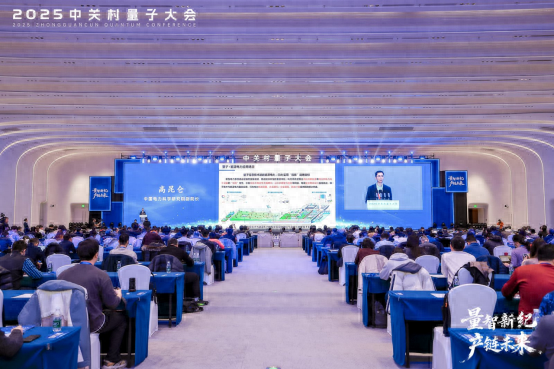
量智新纪·产链未来 2025中关村量子大会开幕
Huan Qiu Wang· 2025-12-15 08:09
Core Insights - The 2025 Zhongguancun Quantum Conference, themed "Quantum Intelligence New Era, Future of Production Chain," showcased significant advancements in quantum technology, including the release of 16 key achievements and a 500 million yuan investment fund for quantum startups in Beijing [1][6] - The conference highlighted the collaborative efforts of government, industry, academia, and research institutions to promote the commercialization of quantum technology and establish a robust industrial ecosystem [3][4] Group 1: Conference Highlights - The event attracted nearly 800 experts and representatives from leading quantum companies and investment institutions, emphasizing the importance of collaboration in the quantum sector [1][3] - Key topics included breakthroughs in quantum theory, core technology challenges, application scenarios, and the construction of an industrial ecosystem [3][4] - The conference featured the release of 16 significant quantum technology achievements, with many technologies reaching international leading levels [6][10] Group 2: Investment and Funding - The newly established Beijing Future Open Source Quantum Entrepreneurship Investment Fund, with a scale of 500 million yuan, aims to support early-stage and growth-stage hard-tech companies in the quantum information sector [6][8] - The fund will provide comprehensive support from research and development to market entry, linking incubators and industrial parks to foster the quantum industry [6][8] Group 3: Strategic Initiatives - Beijing is committed to implementing national strategic deployments, focusing on key quantum technology breakthroughs and creating new applications in the "quantum + AI" integration [4][5] - The Haidian District has over 50 quantum-related enterprises and research institutions, forming a complete industrial chain covering quantum computing, communication, and precision measurement [5][6] - The conference underscored Beijing's ambition to become a leading hub for quantum technology innovation and application, contributing to the country's goal of achieving high-level technological self-reliance [10]