
Electronics

Search documents
行业聚焦:全球录音卡行业头部生产商市场份额及排名调查(附核心企业名单)
QYResearch· 2026-02-05 07:59
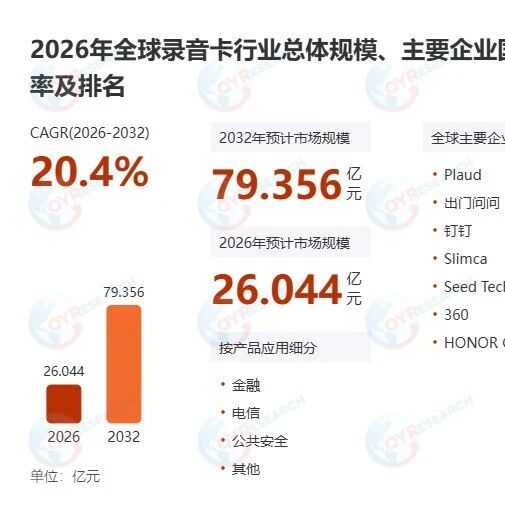
Core Viewpoint - The recording card market is experiencing stable growth driven by increasing demand in professional audio recording, judicial evidence collection, corporate meetings, and educational information technology. The market is transitioning from traditional TDM interfaces to IP-based and hybrid architectures, emphasizing high-fidelity recording, multi-channel synchronization, and data security. Domestic manufacturers are accelerating localization and enhancing market share through cost-effective solutions and compliance features. The global recording card market is projected to reach $320 million by 2025 and $1.17 billion by 2032, with a compound annual growth rate (CAGR) of 20.4% from 2026 to 2032 [4]. Industry Development Trends - AI-driven intelligent transformation is evolving recording cards from mere recording tools to smart terminals with real-time transcription, speaker recognition, and multilingual translation capabilities, integrating edge computing for data processing and privacy protection [9]. - The upgrade to IP and cloud-integrated architectures is replacing traditional analog/TDM interfaces, enabling remote management, centralized storage, and seamless cloud synchronization to meet the needs of mobile and distributed work environments [9]. - Enhanced security and compliance features are being integrated into products, including hardware-level encryption, national encryption algorithms, and immutable audit trails to meet stringent data security and regulatory requirements in sectors like finance, justice, and healthcare [9]. Industry Opportunities - Strong demand in vertical industries such as education (smart classrooms), corporate (meeting efficiency), and justice (court recording) is driving the adoption of specialized recording cards with high fidelity and compliance features [10]. - Accelerated localization is encouraged by policies promoting self-controlled technology, enhancing domestic manufacturers' market share through localized supply chains, cost advantages, and customized solutions for regional needs [10]. - Emerging scenarios such as mobile and remote work trends, disaster relief, and industrial monitoring are creating new application opportunities for miniaturized, low-power, networked recording cards with rapid deployment capabilities [10]. Industry Challenges - High technical and research barriers exist as the integration of AI, encryption, and networking technologies requires advanced R&D capabilities, increasing entry barriers and cost pressures for small and medium enterprises [11]. - Supply chain fluctuations and reliance on core components like storage chips, microphones, and digital signal processors (DSP) affect production costs and supply stability [11]. - Intense competition and product homogeneity in the mid-to-low-end market face price competition, while differentiation in the high-end market is challenging without a strong software ecosystem and industry-specific customization [11]. Industry Chain Analysis - Core component suppliers provide key components that determine the recording quality and performance of recording cards, such as storage chips, DSP chips, and microphones [12]. - Upstream raw material suppliers deliver electronic materials, circuit board substrates, and casing materials necessary for the production and assembly of recording cards [12]. - Technical research institutions focus on audio encoding, data encryption, and chip integration technologies to support upstream product upgrades [12]. - Product manufacturing enterprises integrate upstream components to produce various specifications of recording cards, emphasizing functional integration and miniaturization [12]. - Quality testing institutions conduct compliance testing based on industry standards for audio fidelity, data security, and durability of recording cards [12]. - Downstream application institutions include businesses, judicial departments, and educational institutions that utilize recording cards for meetings, evidence collection, and content creation [12].

松下与庆大推进移动中微波供电实用化
日经中文网· 2026-02-05 07:55
Core Viewpoint - Panasonic Holdings is developing a microwave power supply system aimed at charging devices wirelessly, with initial applications expected for sensors in robots and potential future applications for smartphones, drones, and electric vehicles (EVs) by 2028 [2][5]. Group 1: Technology Overview - The technology utilizes microwave waves, similar to those used in microwave ovens, to charge devices. The power received decreases with distance due to the dispersion of waves in space [4]. - To enhance charging efficiency, Panasonic employs a method that allows microwave waves from multiple antennas to interfere with each other, creating stronger signals at the device's location [4]. - The system can charge devices up to 10 meters away and can simultaneously charge multiple devices, making it suitable for use in populated areas due to the lower frequency of the waves [5]. Group 2: Initial Applications and Testing - The initial focus will be on sensors installed on factory robotic arms, which will be tested starting in March to monitor operational status continuously [5]. - Due to the lower efficiency of power transmission, the technology is expected to be primarily used for low-power devices like sensors in the short term. More efficient power transmission methods will be needed for charging larger devices like drones or EVs [5].

Sony profit jumps 22% in December quarter, beating expectations and lifting full-year outlook
CNBC· 2026-02-05 03:31
Core Insights - Sony reported a 22% increase in operating profit year-on-year, surpassing expectations, despite challenges from foreign exchange volatility and rising memory costs [1] - The company raised its full-year operating profit forecast to 1.54 trillion yen, an increase of 110 billion yen or 8% from the previous estimate [2] - Annual revenue projection was also increased by 300 billion yen to 12.3 trillion yen, reflecting a 3% rise [2] Financial Performance - Revenue for the December quarter was reported at 3.71 trillion yen ($23.68 billion), slightly above the previous estimate of 3.69 trillion yen [4] - Operating profit for the same quarter reached 515 billion yen, compared to 468.9 billion yen in the prior year [4] Segment Performance - Sales in the game and network services division totaled 1.613 trillion yen, a decrease of 68.7 billion yen from the previous year [3] - Despite a decline in hardware shipments, the division has seen growth in digital game purchases and the PlayStation Plus subscription service [3]


四川落子“一廊两带”
Xin Lang Cai Jing· 2026-02-04 22:38
Group 1 - The core idea is to enhance the development capability of the Chengdu-Chongqing economic circle by establishing the Chengdu main axis economic corridor, the Cheng (Mian) Nan Da Wan economic belt, and the Minjiang-Changjiang upstream economic belt [1][2] - The government report emphasizes the importance of improving the comprehensive transportation system between Chengdu and Chongqing, and advancing the construction of the Chengdu-Chongqing high-speed rail and highway expansion projects [1][2] - The establishment of a regional technology innovation center in the Chengdu-Chongqing area aims to strengthen advanced manufacturing clusters in electronics and biomedicine [1][2] Group 2 - The discussion among representatives highlights the need to amplify Chengdu's radiating and driving role, which is seen as a crucial step in constructing a new pattern of regional coordinated development [2][3] - Collaboration between Chengdu and other cities, such as Mianyang and Nanchong, is essential for strengthening industrial cooperation and leveraging local resources [2][3] - The focus on infrastructure connectivity is underscored, with plans to enhance waterway transport and other major infrastructure projects to improve regional integration [3][4]
Bel Fuse Schedules Fourth Quarter 2025 Financial Results Conference Call
Globenewswire· 2026-02-04 21:05
Core Viewpoint - Bel Fuse Inc. is set to release preliminary financial results for the fourth quarter on February 17, 2026, with a conference call scheduled for February 18, 2026, at 8:30 a.m. ET [1] Company Overview - Bel Fuse Inc. designs, manufactures, and markets a wide range of products that power, protect, and connect electronic circuits [2] - The company's products are utilized in various industries, including defense, commercial aerospace, networking, telecommunications, computing, general industrial, high-speed data transmission, transportation, and eMobility [2] - Bel's product categories include Power Solutions and Protection, Connectivity Solutions, and Magnetic Solutions, with operations in facilities worldwide [2]


关键经济指标以绝对优势领跑 龙华街道今年向“兴”提速
Nan Fang Du Shi Bao· 2026-02-04 15:31
作为龙华区都市核心区核心街道,龙华街道2025 年发展实绩彰显硬核担当。规上工业总产值超2200亿 元,居全区第一;社会消费品零售总额及增速均排名全区第一;其他营利性服务业营收增速居全区第 一;固定资产投资工作成效显著,部门任务完成率与辖区任务完成率实现全区"双第一"。街道连续两年 获评"活力街道500强"全国第三,龙华国际商圈入选《2025年度中国商圈商业力指数榜单》全国 TOP100,其中壹方天地荣登《2025年度人气购物中心TOP100》华南区榜首,新天影院以4099.5万元的 年度总票房,连续四年稳居广东省票房冠军,跻身全国票房前五强。 深化"政府+园区"以商引商模式,参与服务项目年度总产值超70亿元;成功引入区重大产业项目华为超 级用户中心,建成后年销售额可达15—20亿元。加强优质企业梯度培育,丰润达科技成功入选第二批深 作为龙华区都市核心区核心街道,龙华街道2025 年发展实绩彰显硬核担当。全年规上工业总产值突破 2200 亿元,以绝对优势位居全区首位。在多项关键经济指标上,龙华街道实现全域领跑,社会消费品 零售总额及增速、其他营利性服务业营收增速均居全区第一。龙华街道刚召开的2026年党工委工 ...

Benchmark Electronics signals strong 2026 semi-cap recovery and double-digit medical growth while expanding Penang capacity (NYSE:BHE)
Seeking Alpha· 2026-02-04 04:31
Group 1 - The article does not provide any relevant content regarding company or industry insights [1]


未知机构:DW电子每日复盘每日新电子23CPOAYZ-20260204
未知机构· 2026-02-04 02:00
Summary of Key Points from Conference Call Records Industry Overview - The records pertain to the **electronic industry**, specifically focusing on **CPO (Chip-on-Board)**, **PCB (Printed Circuit Board)**, and **storage sectors**. Core Insights and Arguments - **CPO Developments**: AYZ has updated the RubinUltra CPO Scale-up plan, resulting in significant stock price increases for several companies: - 罗博特科 (Robotech) +20% - 炬光科技 (Juguang Technology) +18.06% - 致尚科技 (Zhishang Technology) +15.56% - 天孚通信 (Tianfu Communication) +13.21% [1] - **PCB Orders**: 威尔高 (Weilgao) has secured a primary power order from Google, with a secondary power connection in progress, leading to a stock increase of +18.23% [1]. - **Domestic Computing Power**: There is a notable divergence in the market for GPUs and ASICs, with changes in the trading landscape for computing power chips. - 芯原 (Xinyuan) +9.11% - 灿芯 (Canxin) +5.59% - 寒武纪 (Cambricon) -9.18% - 沐曦 (Muxi) -3.08% - 摩尔 (Moore) -2.65% [1] - **Storage Sector**: - 普冉 (Purang) +8% - 恒烁 (Hengshuo) +6% - There is a recovery trend in storage prices [1]. - **Profit Expectations**: - The GPU company 寒武纪 (Cambricon) is expected to report Q4 profits slightly below expectations, while 海光信息 (Haiguang Information) has not released performance forecasts. - The ASIC company 芯原股份 (Xinyuan Co.) is seeing project implementations that may lead to improved performance trends, maintaining a bullish outlook [1]. - **Key Recommendations**: - 芯碁微装 (Xinqi Micro) is strongly recommended, with a projected market cap exceeding 450 million, and expected monthly deliveries of 2E equipment in Q1, indicating high growth potential [1]. - 佰维存储 (Baiwei Storage) is anticipated to see significant growth in 2026, with Q1 performance expected to double sequentially [1]. Additional Important Insights - **Advanced Packaging**: The advanced packaging sector is expected to see shipments double annually, indicating robust growth prospects [1]. - **Flash Memory Prices**: Overseas institutions predict that the price of SanDisk NAND used for enterprise SSDs may increase by over 100% quarter-on-quarter in March [2]. - **AI Chip Demand**: 菲利华 (Feilihua) is positioned to benefit from explosive demand for AI chip products from Nvidia and Google, with expectations of becoming a global leader in Q fabric, targeting a market cap of 100 billion [2].



金元证券每日晨报-20260204
Jinyuan Securities· 2026-02-04 01:52
Core Insights - The report highlights that 2025 is a pivotal year for China's low-altitude economy, transitioning from pilot exploration to systematic implementation and large-scale commercial use, with significant achievements across various industry segments [17] - It outlines five major trends expected in the low-altitude industry for 2026, including more refined airspace management, rapid development of low-altitude infrastructure, and continuous upgrades in technical capabilities [17] - The investment focus for 2026 is suggested to be on three main areas: domestic substitution and production capacity in core manufacturing, new infrastructure and operational services in low-altitude sectors, and automation and supply chain upgrades [17] Summary by Sections 1. Industry Overview - The low-altitude economy is expected to see breakthroughs in policy frameworks, airspace management, standard systems, infrastructure construction, and technological advancements, particularly in eVTOL and drone technologies [17] - The report emphasizes the importance of collaboration among various stakeholders, including government and enterprises, to support infrastructure and service development [17] 2. Investment Opportunities - Key investment areas include manufacturers capable of obtaining airworthiness certification for eVTOLs and suppliers of high-barrier components like solid-state batteries and flight control systems [17] - The report suggests focusing on low-altitude new infrastructure, such as vertical take-off and landing sites and energy supply stations, as well as stable cash flow operational platforms in logistics and tourism [17] - Automation equipment companies with flexible production lines and efficient assembly capabilities are identified as critical enablers for cost reduction and capacity expansion in the industry [17]
中信证券:电子元件涨价浪潮有望不断蔓延 推荐关注存储等在涨价趋势中受益确定性最高的环节
智通财经网· 2026-02-04 00:33
Core Viewpoint - The electronic components industry is experiencing a price increase across various segments, driven by strong downstream demand and rising upstream metal prices, with a recommendation to focus on segments like storage, CCL, BT substrates, wafer foundry, and packaging that are likely to benefit from this trend [1][2]. Downstream Demand - Downstream customer inventory replenishment is stronger than expected, with AI and automotive sectors driving demand despite pressures on automotive sales. The localization of upstream components is accelerating, and low inventory levels among downstream customers are contributing to strong replenishment motivation [2][3]. - Advanced packaging and storage expansions are occupying mature process capacities, leading to increased demand for replenishment from downstream customers [2]. Upstream Costs - Key raw materials for electronic manufacturing, including gold, silver, and copper, are experiencing significant price increases, with futures prices expected to rise by over 50% for gold, 150% for silver, and 50% for copper by 2025 [2]. Midstream Components - Since the downturn in 2022, many segments within the electronic components industry have maintained relatively low profit margins, creating a strong demand for price increases amid tight supply and rising costs [3]. - Price increase notices have been observed across various segments, including storage, CCL, BT substrates, wafer foundry, packaging testing, LED, power devices, analog chips, and passive components, with some segments experiencing multiple rounds of price hikes [3]. Specific Segment Insights - **Storage**: The AI supercycle is causing ongoing shortages, with TrendForce predicting a 55%-60% increase in traditional DRAM contract prices and a 33%-38% increase in NAND Flash contract prices by Q1 2026, with some NAND modules already increasing by over 40% this year [4]. - **CCL**: The latest round of price increases is expected to take effect by December 2025, supported by low industry inventory levels [4]. - **Wafer Foundry**: High utilization rates are reported, with some categories already seeing price increases, and the trend of advanced packaging and storage expansions affecting mature process capacities is beneficial for domestic supply-demand dynamics [4]. - **Packaging Testing**: High utilization rates (80%-90%) are noted among major companies, with some clients actively requesting price increases to secure capacity [4]. - **Analog Chips**: Strong demand from automotive and industrial sectors is driving price increases, with domestic design companies also showing willingness to raise prices [5]. - **Power Devices**: Strong price increase momentum is observed for mid-low voltage products, with extended delivery times reported [5]. - **SoC**: Initial price increases for internal storage SoC products are expected to enhance market share and profitability for leading manufacturers [5]. - **MCU**: A price increase of 15%-50% for MCU and Nor Flash products is set to take effect on January 27, 2026 [5].
