
互联网平台

Search documents
彪马将再裁员900人;“绝味鸭脖们”越来越难卖了
Mei Ri Jing Ji Xin Wen· 2025-10-30 23:14
Group 1: Puma - Puma reported a 10.4% decline in sales to €1.9557 billion for Q3 2025, with a net loss of €62.3 million and earnings per share of -€0.42 [1] - The company plans to cut approximately 900 white-collar jobs globally by the end of 2026 due to anticipated significant sales declines and high operational costs [1] - Puma is facing challenges such as weak brand momentum, high inventory levels across channels, and low distribution quality, but still has potential to rank among the top three global sports brands if reforms are successful [1] Group 2: Douyin - Douyin announced ongoing efforts to combat the improper use of minors' images for profit, highlighting the need for continuous protection of minors online [2] - The platform has removed 37,000 videos and penalized 3,651 accounts for violations related to the exploitation of minors in the past month [2] - Douyin emphasizes the importance of cultivating a healthy online ecosystem through legal, technological, and familial support [2] Group 3: Snack Industry - The snack industry, particularly the braised food segment, is experiencing a slowdown in growth and significant adjustments, with major players like ST Juewei and Huangshanghuang reporting revenue declines [3] - Experts indicate that high prices and insufficient value-for-money in the braised food sector are facing substantial challenges amid changing consumer willingness [3] Group 4: Starbucks - Starbucks reported a revenue of $3.105 billion in China for the full fiscal year 2025, marking a 5% year-over-year increase [4] - The company has achieved continuous revenue growth for the fourth consecutive quarter and positive same-store sales growth for the second consecutive quarter [4] - Starbucks' performance indicates that it has successfully built a competitive advantage through product differentiation in a highly competitive coffee market [4]


快手发布2025新银发人群洞察报告,活力、得劲、悦己成为新银发关键词
Sou Hu Wang· 2025-10-28 13:37
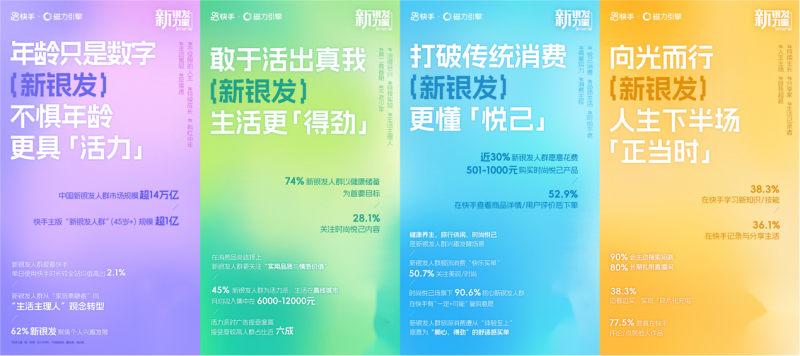
Core Insights - The report reveals the emergence of the "new silver-haired" demographic, defined as individuals aged 45 and above, who are reshaping a trillion-dollar consumer market with a focus on a lifestyle philosophy termed "得劲" [1][2] Group 1: Demographic Characteristics - The new silver-haired group is characterized by a youthful mindset, emphasizing health, personal interests, and self-reliance, breaking traditional stereotypes associated with older adults [2][3] - This demographic is transitioning from being "family contributors" to "life managers," with 74% prioritizing health reserves and 62% actively pursuing personal interests [2][3] Group 2: Consumer Segmentation - The new silver-haired population is categorized into four distinct groups: Practical, Vitality, Composed, and Zen, each creating their unique "得劲 life" [2][3] - The Practical group focuses on family responsibilities and rational consumption, while the Vitality group seeks enjoyment through social interactions and self-investment [3] Group 3: Consumption Trends - The new silver-haired demographic is increasingly concerned with content attraction, decision safety, cost-effectiveness, and quality experience in their purchasing decisions [4] - Key consumption categories include health and wellness, travel and leisure, fashion, home improvement, interest-based learning, and technology, indicating high potential market segments [4][6] Group 4: Market Potential - The health and wellness sector is identified as the most urgent demand area, with 50.1% of users frequently engaging with health-related content [6] - The overall silver-haired economy in China exceeds 14 trillion yuan, showcasing significant market value and influence within family consumption dynamics [3][6] Group 5: Digital Engagement - Kuaishou has established a robust online community for the new silver-haired demographic, with over 100 million users aged 45 and above, representing about 25% of total users [7] - The platform's users exhibit high engagement, with nearly 70% using Kuaishou for over 22 days a month, indicating strong user retention [7] Group 6: Brand Opportunities - Brands are increasingly targeting the new silver-haired demographic through tailored content and products, with notable success stories highlighting significant sales growth [9][11] - Kuaishou facilitates a commercial ecosystem that transforms advertising from a disruption into a solution, enhancing consumer engagement and investment in lifestyle [9][11]


6500多家平台企业报送相关涉税信息
Qi Lu Wan Bao· 2025-10-28 07:36
Core Insights - Over 6,500 platform enterprises have reported relevant tax information, exceeding 95% of the total number of enterprises required to report [1] - The overall compliance rate of internet platform enterprises and related entities is relatively high [1] - As of October 1, 2023, platform enterprises are required to formally report the identity and income information of operators and employees to tax authorities [1]
数据对不上,税务部门提醒部分平台商户更正错误涉税申报
经济观察报· 2025-10-27 08:16
Core Points - The tax authorities have issued reminders to platform operators regarding compliance with tax declarations, urging them to verify their income and correct any underreporting to avoid penalties [2][3] Group 1: Tax Compliance and Reporting - As of now, over 6,500 platforms have submitted relevant tax information, exceeding 95% of the total platforms required to report [2] - The tax department is focusing on a small number of platform operators whose self-reported income is significantly lower than the income reported by the platforms, providing compliance reminders to mitigate tax risks [2] - More than 90% of operators on these platforms are small and micro enterprises, which benefit from various tax incentives, resulting in minimal or no tax liabilities [2] Group 2: Regulatory Framework - Starting from October 1, platforms are required to report the identity and income information of their operators and employees to the tax authorities, as mandated by the State Council's regulations issued in June [3] - According to tax law, the VAT liability arises on the day the payment is received or when the invoice is issued, and platform operators must accurately report all taxable transactions [3]

数据对不上,税务部门提醒部分平台商户更正错误涉税申报
Jing Ji Guan Cha Bao· 2025-10-27 06:28
Core Points - The tax authority has reported that over 6,500 platforms have submitted relevant tax information, exceeding 95% of the total platforms required to report [1] - The tax department is reminding platform operators to verify their reported income, especially those whose self-reported income is significantly lower than the income reported by the platform [1] - The majority of platform operators are small and micro enterprises, which are largely unaffected by the tax reminders due to existing tax incentives [1] Summary by Sections - **Tax Reporting Compliance** - The tax authority has initiated compliance reminders for platform operators to correct any discrepancies in their tax declarations [1] - Operators are advised to verify their income from both online and offline sources to ensure accurate reporting [2] - **Impact on Small and Micro Enterprises** - More than 90% of platform operators are small and micro enterprises, which benefit from various tax incentives, resulting in minimal tax liabilities [1] - The reminders primarily target a small number of operators with significant discrepancies in reported income [1] - **Regulatory Framework** - The reminders are in accordance with the "Regulations on Tax Information Reporting by Internet Platform Enterprises" issued by the State Council, effective from October 1 [1]
6500多家互联网平台企业已报送相关涉税信息
Zhong Guo Xin Wen Wang· 2025-10-27 06:19
Core Points - Over 6,500 internet platform enterprises have submitted relevant tax information, exceeding 95% of the total number of platforms required to report [1] - The tax authority is providing compliance reminders to platform operators whose self-reported income is significantly lower than the income reported by the platforms [1] - More than 90% of platform operators are small and micro enterprises, which benefit from various tax incentives, resulting in minimal or no tax payments [1] Summary by Categories Tax Reporting - The first submission of identity and income information by platform enterprises to tax authorities began on October 1 [1] - As of now, over 6,500 platforms have reported their tax information [1] Compliance and Risk Management - The tax department is reminding a small number of platform operators to verify their reported income to avoid underreporting [1] - Operators receiving compliance reminders should check their income from all platforms and correct any errors promptly to avoid late fees [1] Impact on Small and Micro Enterprises - The majority of platform operators are small and micro enterprises, which are largely unaffected by the compliance reminders due to existing tax incentives [1]
前三季度北京新设机构27.81万户 同比增21%
Zhong Guo Xin Wen Wang· 2025-10-27 05:52
Group 1 - In the first three quarters of this year, Beijing established 278,100 new institutions, representing a year-on-year increase of 21% [1] - The central urban areas accounted for 115,200 new institutions, a growth of 42.42%, making up 41.43% of the total [1] - The digital economy sector saw the establishment of 18,100 new institutions, with a significant growth of 46.97%, particularly in software development which grew by 135.28% [1] Group 2 - The cultural and related industries in Beijing continued to show recovery growth, with 33,600 new institutions established in the first three quarters, marking a 17.57% increase [2] - The content creation and production sector contributed 23,500 new institutions, growing by 19.42% [2] - Cultural investment and operation institutions surged by 111.3%, driven by the integration of cultural tourism funds and performing arts investment platforms [2]
超95%平台已报送涉税信息 少数平台内经营者收合规申报提醒
Bei Ke Cai Jing· 2025-10-27 05:41
Core Points - The State Council's regulations require platform enterprises to report identity and income information of operators and employees starting from October 1 [1] - Over 6,500 platform enterprises have reported tax-related information, exceeding 95% compliance of the total platforms required to report [1] - The majority of operators on these platforms are small and micro enterprises, benefiting from tax incentives that reduce their tax liabilities [1] Group 1 - The tax authority is providing compliance reminders to a small number of platform operators whose self-reported income is significantly lower than the income reported by the platform [1] - Operators receiving compliance reminders should verify their income from various platforms and correct any underreporting to avoid penalties [1] - The tax authority aims to enhance the regulatory framework for the platform economy to promote fair competition and support the construction of a unified national market [2]
北京前三季度新设机构27.81万户,同比增长21%
Xin Jing Bao· 2025-10-27 04:41
Core Insights - The number of newly established institutions in Beijing reached 278,100 in the first three quarters of 2025, representing a year-on-year growth of 21%, indicating a strong upward trend in both quantity and quality [1] Group 1: Institutional Growth - The central urban areas (Dongcheng, Xicheng, Chaoyang, Haidian, Fengtai, and Shijingshan) accounted for 115,200 new institutions, a year-on-year increase of 42.42%, making up 41.43% of the total [1] - The Plain New Town (Fangshan, Shunyi, Changping, Daxing, and Beijing Economic-Technological Development Area) saw 107,900 new institutions, with a year-on-year growth of 34.12%, representing 38.8% of the total [1] Group 2: Sector Performance - The digital economy and elderly care industries are expanding, with the digital economy seeing 18,100 new institutions, a year-on-year increase of 46.97% [2] - Within the digital economy, the software development sector grew by 135.28%, while information technology services increased by 23.14%, together contributing 61.92% of the city's digital economy growth [2] - The elderly care industry established 138,600 new institutions, growing by 30.54%, surpassing the city's average growth rate by 9.54 percentage points [2] - The cultural and related industries also showed recovery, with 33,600 new institutions established, reflecting a year-on-year growth of 17.57% [2]
国家税务总局:已有超过6500家平台企业报送相关涉税信息
Xin Hua Wang· 2025-10-27 04:05
Core Points - Over 6,500 platform enterprises have reported tax-related information, exceeding 95% of the total number of enterprises required to report [1] - The overall compliance rate of internet platform enterprises and related entities is high [1] - Starting from October 1, platform enterprises are required to report identity and income information of operators and employees to tax authorities [1] Group 1 - The tax authorities are providing compliance reminders to a small number of platform operators whose self-reported income is significantly lower than the income reported by the platform [1] - This initiative aims to help platform operators mitigate tax-related risks and encourages them to verify and correct any discrepancies in their reported income [1] - More than 90% of operators on these platforms are small and micro enterprises, which benefit from various tax incentives, resulting in minimal or no tax liabilities [1] Group 2 - The reminders are primarily targeted at platform operators whose self-reported income for the third quarter shows a significant discrepancy compared to the platform-reported income [1] - The tax authorities emphasize that these reminders do not significantly impact small and micro enterprises [1] - Operators receiving compliance reminders should promptly verify their income from all platforms and correct any underreporting to avoid penalties [1]