网约车

Search documents
李书福自愿延长股份禁售,彰显吉利控股对曹操出行的发展信心
Zhi Tong Cai Jing· 2025-12-31 13:53
Core Viewpoint - The company demonstrates strong confidence in its long-term value and future development prospects through voluntary share lock-up commitments from major stakeholders and management, signaling a commitment to sustainable growth and stability in the capital market [1][2]. Group 1: Share Lock-up Commitments - The controlling shareholder, Li Shufu, and his wholly-owned Ugo Investment Limited have voluntarily committed to a share lock-up until September 30, 2026, for 73.35% of the company's shares [1]. - Following this, 19 members of the management team have also committed not to sell their shares obtained from the pre-IPO incentive plan until June 24, 2026 [1]. - These commitments reflect the confidence of core stakeholders in the company's long-term value and are expected to contribute to the company's stable and healthy development [1]. Group 2: Strategic Acquisitions - On December 30, 2025, the company announced two significant strategic acquisitions: 100% equity of Yao Travel and a proposed acquisition of 100% equity of Geely Business Travel [1]. - Upon completion, these acquisitions will enhance the company's product matrix and establish a one-stop technology travel platform [1]. - The acquisitions will also support the company's international expansion, as Yao Travel has a service network covering 12 international cities, including Paris, Tokyo, and Seoul [2]. Group 3: Robotaxi Development - The company has established a comprehensive development model for Robotaxi, integrating smart customized vehicles, intelligent driving technology, and smart operations, making it a unique player in the market [2]. - The company is accelerating the deployment of its second-generation Robotaxi vehicles and collaborating with Geely and partners to develop fully customized Robotaxi models with proprietary autonomous driving components [2]. - The company has outlined a "three-step" strategy for Robotaxi and set an ambitious goal of "ten years, one hundred cities, and one hundred billion" [3].
美股盘前要点 | 美联储会议纪要显示内部分歧严重,“大空头”否认做空特斯拉
Ge Long Hui· 2025-12-31 12:37
4. 英伟达拟以最高30亿美元的价格收购以色列AI初创公司AI21 Labs。 5. 亚马逊AWS将为美国政府机构AI系统投资高达500亿美元。 6. Uber、Lyft宣布与百度达成合作,计划明年在英国推Robotaxi试点。 7. 美属维尔京群岛司法部长起诉Meta,指控其故意从诈骗广告中获利。 8. "大空头"Michael Burry否认做空特斯拉,他在本月初曾称其"估值高得离谱"。 9. 特斯拉在韩国开启降价促销,Model 3最多降价940万韩元(约合4.55万元)。 10. 华纳兄弟探索据报计划再次拒绝派拉蒙修改后的收购要约。 11. 芝商所在一周内第二次上调贵金属期货保证金。 12. 迪士尼同意支付1000万美元结束有关违反儿童隐私法的指控。 13. 沃尔玛App周二一度出现服务中断,部分用户无法使用手机下单。 14. 洛克希德马丁获约5亿美元国防合约,涵盖海军作战系统、飞弹防御与海外军售相关支援。 15. 美国制药商Vanda Pharmaceuticals的晕动症药物获美国FDA批准。 16. 微博拟在未来一年内回购不超过2亿美元的股份(包括美国存托股份)。 美股时段值得关注的事件: 21 ...
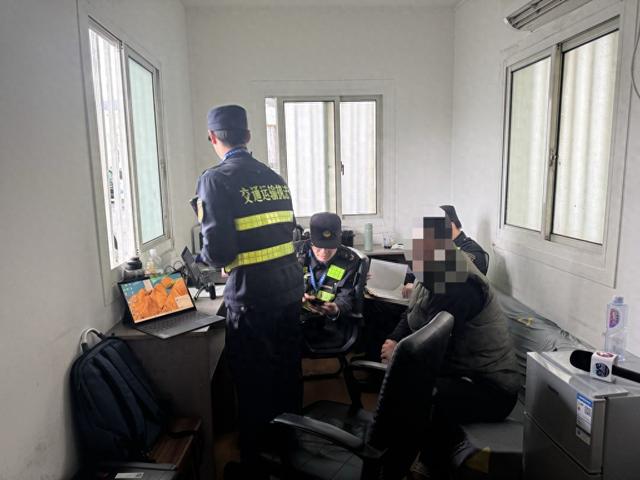
上海网约车专项整治持续高压:违法犯罪方面已刑事打击120余人
Xin Lang Cai Jing· 2025-12-31 11:44
Core Viewpoint - Shanghai's transportation authority and police have launched a special crackdown on ride-hailing services to purify the market environment and protect public travel rights, particularly ahead of the New Year holiday [1]. Group 1: Enforcement Actions - As of December 31, 2023, a total of 32 joint inspection points were established across the city, resulting in 55 illegal passenger transport cases being investigated [3]. - During inspections, a vehicle was found operating without a legal operating certificate, leading to potential fines ranging from 10,000 to 50,000 yuan for the driver [3][6]. - A car rental company was found to be operating without the necessary registration, leading to an investigation and potential fines of 3,000 to 10,000 yuan for the company [6][8]. Group 2: Focus Areas of the Crackdown - The special operation, named "Feng Mang 2025," targets key illegal activities such as "scam rentals," "forged documents," and "illegal ride-hailing apps," with over 40 cases successfully resolved and more than 120 individuals criminally charged [8]. - A total of 10,241 traffic enforcement personnel were deployed, resulting in 3,186 various illegal cases being addressed, including unlicensed vehicles and personnel [8][11]. - The police have also focused on traffic hubs and popular areas, ensuring that over 4,300 uninsured vehicles were prompted to restore insurance and 2,800 vehicles completed annual inspections [11]. Group 3: Compliance and Governance - During the enforcement period, 17 ride-hailing platforms were interviewed to clarify requirements for removing non-compliant vehicles and personnel [12]. - Over 50,000 ride-hailing drivers received legal compliance messages, with nearly 3,000 drivers voluntarily rectifying their compliance issues [12]. - Future efforts will include maintaining a high-pressure stance on illegal activities, promoting compliance, and enhancing regulatory oversight to ensure the sustainable and orderly development of the ride-hailing industry [12].

花旗重申曹操出行(02643)“买入”评级,解禁后股价稳健,积极战略并购增强竞争力
智通财经网· 2025-12-31 11:18
Core Viewpoint - Caocao Travel announced two significant strategic acquisitions: 100% stake in Yao Travel Technology Co., Ltd. and a proposed acquisition of 100% stake in Zhejiang Geely Business Services Co., Ltd. [1] Group 1: Strategic Acquisitions - The acquisitions aim to create a comprehensive technology travel platform covering personal and corporate travel, standard and high-end services, integrating "travel + business travel" [1] - Citigroup maintains a "Buy" rating for Caocao Travel with a target price of 70 HKD, highlighting the potential for enhanced market competitiveness and ecosystem integration [1] Group 2: Market Expansion and Client Base - Caocao Travel has served over 13,500 corporate clients since launching its corporate services in 2016, indicating a strong foothold in the corporate travel sector [2] - Yao Travel has a mature service network in 12 global cities, while Geely Business Services offers comprehensive travel solutions, which will enhance service quality for existing clients post-integration [2] Group 3: Future Growth and Market Confidence - The integration is expected to leverage internal resources, creating synergies and positioning Caocao Travel as the core platform for Geely Holding Group's mobility business [2] - Recent stock performance remains stable following the expiration of the lock-up period for cornerstone investors, with institutions like Citigroup optimistic about Caocao Travel's long-term prospects [2]
花旗重申曹操出行“买入”评级,解禁后股价稳健,积极战略并购增强竞争力
Zhi Tong Cai Jing· 2025-12-31 11:14
Core Viewpoint - Caocao Travel announced two strategic acquisitions: 100% stake in Yao Travel Technology Co., Ltd. and a proposed acquisition of 100% stake in Zhejiang Geely Business Services Co., Ltd. [1] Group 1: Strategic Acquisitions - The acquisitions aim to build a comprehensive technology travel platform covering personal and corporate travel, standard and high-end services, integrating "travel + business travel" [1] - Citigroup maintains a "Buy" rating for Caocao Travel with a target price of 70 HKD, highlighting the potential for enhanced market competitiveness and ecosystem integration [1] Group 2: Market Expansion and Customer Base - Caocao Travel has served over 13,500 corporate clients since launching its corporate services in 2016, indicating a strong foothold in the corporate travel sector [2] - Yao Travel offers mature services in corporate meetings, daily transportation, and high-end ride-hailing, while Geely Business Services provides comprehensive travel solutions and event services [2] Group 3: Future Growth and Integration - The integration of Yao Travel and Geely Business Services is expected to leverage Caocao Travel's platform to enhance service quality for existing clients [2] - As a key commercial vehicle for Geely Holding Group's Robotaxi initiative, Caocao Travel aims to become a leading global technology travel platform, driving growth in the business travel market [2] - Following the expiration of the lock-up period for cornerstone investors and public offering shareholders, Caocao Travel's stock price has remained stable, with institutions like Citigroup optimistic about its long-term development [2]
吉利出行业务大整合:曹操出行收购耀出行及吉利商旅
经济观察报· 2025-12-31 09:41
Core Viewpoint - The acquisition of high-end travel brand Yao Travel and Geely Business Travel by Cao Cao Travel is a strategic move to build a "one-stop technology travel platform" that integrates various travel services for different customer needs [2][3]. Group 1: Acquisition Details - On December 30, Cao Cao Travel announced the acquisition of 50% equity in Yao Travel for 225 million yuan and the full acquisition of Geely Business Travel for 65 million yuan, making both companies wholly-owned subsidiaries [2]. - This acquisition marks Cao Cao Travel's first major strategic acquisition since its listing on the Hong Kong Stock Exchange [2]. Group 2: Market Context - The high-end travel market in China has faced significant challenges, with a notable decline in business travelers and a drop in high-end hotel prices since the second half of 2024 [3]. - Yao Travel, established in May 2019 as a joint venture between Daimler Group and Geely, has struggled in recent years, including a CEO departure and significant layoffs [3]. Group 3: Financial Performance - Geely Business Travel reported a post-tax profit of 23.3 million yuan for 2024, a decrease of approximately 48% compared to 2023 [4]. - Despite achieving an EBITDA of 260 million yuan over the past 12 months, Geely Business Travel's valuation is only about 75.32 million yuan, reflecting market skepticism about its future [4]. Group 4: Strategic Integration - The integration of Yao Travel and Geely Business Travel into Cao Cao Travel is expected to create significant synergies, enhancing service offerings for both individual and corporate clients [4]. - The company aims to leverage its platform to provide seamless travel and business services, targeting the B2B travel market [4][5]. Group 5: Industry Outlook - The Global Business Travel Association (GBTA) projects that global business travel spending will reach $1.57 trillion in 2025, with China contributing approximately $373.1 billion [5]. - The demand for corporate services is stable, with high average prices and margins, making it a competitive area for travel and hospitality platforms [5].
吉利出行业务大整合:曹操出行收购耀出行及吉利商旅
Jing Ji Guan Cha Wang· 2025-12-31 09:04
Core Viewpoint - Cao Cao Mobility (02643.HK) announced the acquisition of 50% stake in Yao Chuxing (a high-end travel brand) for 225 million yuan and the full acquisition of Geely Business Travel for 65 million yuan, marking its first major strategic acquisition post-IPO [2] Group 1: Company Strategy and Acquisitions - The acquisitions of Yao Chuxing and Geely Business Travel are key strategic moves for Cao Cao Mobility to build a "one-stop technology travel platform" [2] - The integration aims to provide seamless and standardized travel experiences across various customer needs, from daily commuting to business travel management [2] - The acquisitions are part of Geely Holding Group's broader strategy to transition from traditional automotive manufacturing to a green intelligent travel ecosystem, as outlined in the "Taizhou Declaration" [2] Group 2: Performance and Challenges of Acquired Companies - Yao Chuxing has faced challenges in recent years, including a significant decline in the high-end consumer market and a lack of public visibility following management changes and layoffs [3] - Geely Business Travel reported a post-tax profit of 23.3 million yuan for 2024, a 48% decrease from 2023, and its valuation is only 75.32 million yuan despite an EBITDA of 260 million yuan [4] - Over 50% of Geely Business Travel's revenue comes from travel agency and ticketing services, indicating a need for better service diversification [4] Group 3: Market Outlook and Financial Performance - The global business travel market is projected to reach $1.57 trillion by 2025, with China contributing $373.1 billion, highlighting a growing opportunity for corporate travel services [5] - Cao Cao Mobility is currently in a loss-making state, with a loss of 468 million yuan in the first half of 2025, although this represents a 39.8% improvement from the previous year [5]
T3出行|写入《2025 汽车行业影响力年鉴》
Jing Ji Guan Cha Bao· 2025-12-31 07:06
Core Insights - The Chinese automotive industry is entering a new development stage as the "14th Five-Year Plan" concludes, focusing on operational quality, technological depth, and sustainable business models [1] - T3 Mobility is highlighted as a significant player in the smart mobility sector, emphasizing technological innovation and service upgrades to create a unique development system [1] Industry Impact - T3 Mobility aims to build a smart mobility ecosystem connecting "people, vehicles, roads, and cloud," enhancing vehicle design and development through deep collaboration with manufacturers [1] - The company is exploring future mobility service forms through the operation of autonomous vehicle fleets, providing a comprehensive smart mobility solution from capital integration to regulatory compliance [1] Technological Advancements - T3 Mobility has established barriers in vehicle customization and operational precision, accelerating breakthroughs in autonomous driving technology and the commercialization of Robotaxi services [2] - The potential of autonomous driving technology to reshape the mobility industry is being realized, with T3 Mobility leading the exploration of integrating autonomous driving with mobility services [2] Recognition and Compliance - T3 Mobility is recognized in the "2025 Automotive Industry Influence Yearbook" as a representative enterprise for high-quality development in the smart mobility sector, due to its stable scale and sustainable operational capabilities [2]
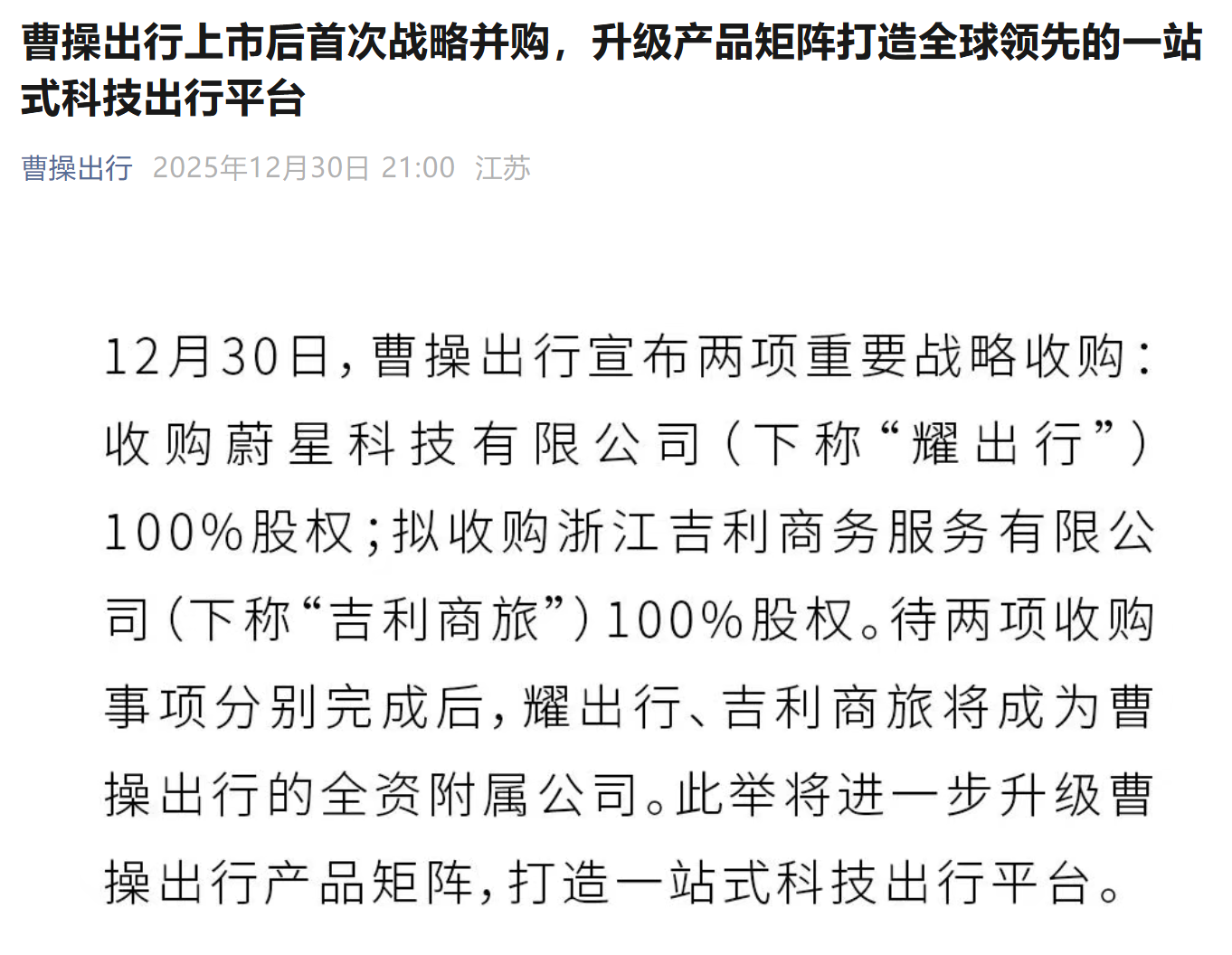
曹操出行战略并购耀出行、吉利商旅,打造一站式科技出行平台
Zhong Guo Jing Ying Bao· 2025-12-31 03:01
Core Insights - Cao Cao Mobility announced two strategic acquisitions: 100% stake in Yao Travel Technology and 100% stake in Geely Business Travel, aiming to enhance its product matrix and create a one-stop technology travel platform [1][2] Group 1: Strategic Acquisitions - The acquisitions will allow Yao Travel and Geely Business Travel to become wholly-owned subsidiaries of Cao Cao Mobility, further integrating their services into the company's offerings [1] - Yao Travel specializes in corporate meetings, daily transportation, and high-end ride-hailing services, while Geely Business Travel provides comprehensive travel solutions and event management services [1] Group 2: Market Expansion and Synergies - The integration of these companies is expected to create significant synergies in corporate services, covering both personal and business travel, and enhancing the overall service experience [1][2] - Yao Travel's service network extends to 12 international cities, including Paris, Tokyo, and Seoul, which will support Cao Cao Mobility's international expansion efforts [2] Group 3: Long-term Vision - The CEO of Cao Cao Mobility emphasized that these acquisitions are crucial for building a one-stop technology travel platform, aiming to streamline services from daily commuting to business travel management [2] - The company aims to strengthen its competitiveness in the corporate travel market and create greater value in the global smart travel sector [2]

曹操出行宣布收购耀出行和吉利商旅
Mei Ri Jing Ji Xin Wen· 2025-12-31 02:29
Core Viewpoint - Cao Cao Mobility announced two significant strategic acquisitions: the acquisition of 100% equity in Yao Travel and the proposed acquisition of 100% equity in Geely Business Travel, which will become wholly-owned subsidiaries of Cao Cao Mobility upon completion [1] Group 1 - The acquisitions aim to leverage Cao Cao Mobility's platform capabilities to continuously provide high-quality services to existing customers [1] - After integration, Yao Travel and Geely Business Travel will create a one-stop technology travel platform covering both personal and corporate travel, enhancing the synergy in corporate services [1] - The new platform will offer comprehensive travel and business travel services to corporate clients, emphasizing the "Travel + Business Travel" model [1]