智能穿戴设备

Search documents
Rokid乐奇亮相数贸会,以“带显示的AI眼镜”革新AI交互
Jing Ji Wang· 2025-09-28 09:19
Core Insights - The fourth Global Digital Trade Expo was held in Hangzhou, Zhejiang, showcasing Rokid's five AR glasses products, including Rokid Glasses, Rokid AR Lite, Rokid AR Studio, Rokid X-Craft, and Rokid Glass 3 [1] Group 1 - Rokid's highlight at the expo was the "AI glasses with display," emphasizing the display technology advantages in AI interaction [3] - The Rokid Glasses feature an integrated design that combines core components like chips, batteries, cameras, and microphones into a lightweight frame, resembling everyday glasses while balancing fashion and practicality [3] - Users can utilize voice or touch controls on the glasses' arms for functions such as prompting, translation, navigation, photography, payment, and AI Q&A, allowing information to overlay in their field of vision for an integrated audio-visual interaction experience [3] Group 2 - As a representative of a new form of AI interaction, Rokid's glasses embody the concept of "technology integrated into scenarios," aiming to provide seamless intelligent services [5] - The booth featured a scaled-up "big glasses" installation to dynamically showcase the display effects, attracting many visitors and becoming a popular photo spot [5] - An interactive experience area called "Cross-National Café" allowed visitors to wear Rokid glasses and engage in real-time multilingual conversations with foreign staff, demonstrating the application of AR translation in real-life scenarios [5] Group 3 - In addition to Rokid Glasses, attendees could experience other four AR products, with Rokid AR Lite offering an immersive viewing experience on a 300-inch virtual screen [7] - The industry application area displayed the deep applications of Rokid Glass 3, Rokid AR Studio, and Rokid X-Craft in sectors such as healthcare, electricity, and oil [7]

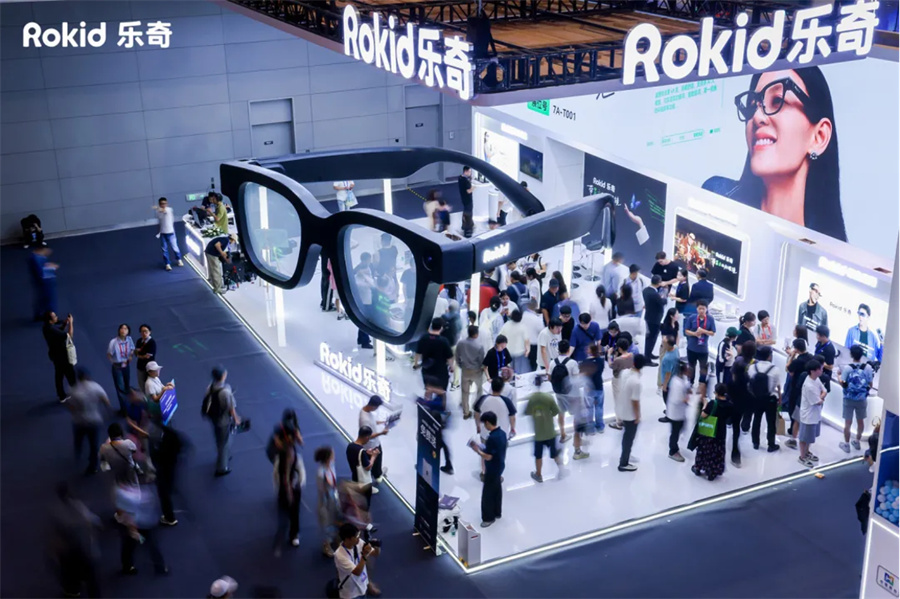
多款智能眼镜亮相 行业驶入发展快车道
Zhong Guo Zheng Quan Bao· 2025-09-26 22:43
Core Insights - The emergence of AI and AR glasses is transforming human-computer interaction, with products like the Rokid and Wigain Omnision XR glasses showcasing real-time information display and multi-modal AI capabilities [1][2][3] Company Highlights - Qiu Guo Plan Technology Co., established in 2021, showcased its first AI-integrated XR glasses at the expo, featuring a field of view increased from 30° to 50° and independent functionality without a smartphone [2] - Rokid presented multiple products at the expo, including various models of smart glasses that support photography, recording, AI recognition, and navigation, with collaborations established with over 200 museums nationwide [3] Industry Trends - The AI and AR glasses sector is expected to see significant product launches and technological advancements in 2025, marking a pivotal year for the industry [4] - Major companies like DPVR and Meta are actively releasing innovative AI and AR glasses, targeting diverse use cases from outdoor activities to everyday applications [4] Market Growth - According to WellsennXR, global sales of AI smart glasses are projected to reach 870,000 units by Q2 2025, reflecting a substantial year-on-year increase of 222% [5] - The market for AI/AR glasses is anticipated to exceed 35 million units by 2028, driven by the natural advantages of glasses as wearable devices closely linked to human sensory perception [5] Challenges - The widespread adoption of AR glasses faces challenges, particularly due to high production costs associated with MicroLED and waveguide technologies, which can account for 50% of the total cost [5] - Current AR glasses are limited in application, primarily serving basic functions like translation and notifications, with more advanced immersive interactions yet to be fully realized [5]
多款智能眼镜亮相行业驶入发展快车道
Zhong Guo Zheng Quan Bao· 2025-09-26 20:48
Core Insights - The emergence of AI and AR glasses is transforming human-computer interaction, with products like the Leqi AI+AR glasses and Wigain Omnision XR glasses showcasing real-time information display and translation capabilities [1][2] - The integration of multi-modal AI technologies, such as ChatGPT-4o and Doubao visual models, is expected to enhance market perceptions of AI capabilities [1] - The industry is poised for significant growth, with projections indicating a substantial increase in global AI smart glasses sales by 2025 [4] Company Developments - Qiuguo Plan showcased its first AI-integrated XR glasses at the Global Digital Trade Expo, featuring a field of view increased from 30° to 50° and independent functionality without a smartphone [1][2] - The CEO of Qiuguo Plan emphasized the company's competitive edge lies in its innovative optical design, enhancing comfort and usability compared to traditional bulky devices [2] - Leqi has introduced multiple products, including Rokid glasses, which have partnered with over 200 museums across the country [2] Industry Trends - The AI and AR glasses sector is expected to see a "product boom" in 2025, with numerous manufacturers launching innovative products [3] - Major companies like DPVR and Kangguan Technology are releasing new AI smart glasses, focusing on outdoor recording and AI interaction capabilities [3] - Meta has launched a new line of AI+AR glasses, targeting various daily and sports applications [4] Market Growth - According to WellsennXR, global AI smart glasses sales are projected to reach 870,000 units by Q2 2025, marking a 222% year-on-year increase [4] - Optimistic forecasts suggest that global AI/AR glasses shipments could exceed 35 million units by 2028, highlighting the potential for significant market expansion [4] - Despite the growth potential, challenges remain in the widespread adoption of AR glasses due to high production costs and technical issues related to MicroLED and waveguide technologies [4]
小学生口述:家长看不到的小天才社交圈
虎嗅APP· 2025-09-26 14:56
Core Viewpoint - The article discusses the rise of the "Little Genius" smartwatch among children, highlighting its social features that have created a unique social circle for kids, which operates largely outside parental supervision [5][10][17]. Group 1: Product Features and Market Position - The "Little Genius" smartwatch has become a popular choice for children due to its social functionalities, which are seen as more appealing than traditional features like calling and location tracking [10][19]. - As of the first half of 2025, "Little Genius" smartwatches are projected to capture 35.3% of the Chinese children's smartwatch market, significantly ahead of competitors like Huawei, which holds only 12.2% [29]. Group 2: Social Dynamics and User Behavior - The social aspect of the "Little Genius" watch allows children to create private circles, where they can interact and compete for social status through likes and followers, similar to social media dynamics [11][12][19]. - Children are reportedly spending significant time on these devices, with some dedicating 5-7 hours daily to engage in social activities, indicating a shift in how children perceive and use technology [13][20]. Group 3: Risks and Concerns - The article raises concerns about the safety of children in these social circles, as there are reports of inappropriate behavior and exploitation within the "Little Genius" community [21][27]. - There is an emerging gray market around the "Little Genius" ecosystem, where children are targeted for scams related to buying likes and followers, indicating a lack of oversight and potential for exploitation [32][35][40].

华为,重磅新品发布
Zhong Guo Ji Jin Bao· 2025-09-24 10:57
Group 1 - Huawei held an online launch event for its new wearable audio products, including the HUAWEI WATCH GT 6 series and FreeClip 2 earphones, showcasing its commitment to the wearable technology market [1] - The HUAWEI WATCH GT 6 series features significant improvements, including a 65% increase in battery capacity compared to the previous generation, with the GT 6 Pro and GT 6 46mm versions offering up to 21 days of battery life in light usage scenarios [2][3] - The GT 6 series has achieved cumulative global shipments of over 54 million units since its inception in 2018, maintaining a focus on long battery life, health monitoring, and advanced sports features [3] Group 2 - The HUAWEI FreeClip 2 earphones were introduced with a starting price of 1299 yuan, featuring advanced AI capabilities and improved call quality due to a tenfold increase in processing power compared to the previous generation [4] - The HUAWEI Vision Smart Screen 5 Pro was also launched, with prices starting at 6499 yuan for the 65-inch version, indicating Huawei's expansion into smart home devices [5] - The global wearable device market is experiencing rapid growth, with IDC forecasting a 12.3% year-on-year increase in shipments by Q2 2025, and Huawei holding a 20.2% share of the global market, leading in both global and domestic markets [6][7] Group 3 - The wearable device market is expected to continue expanding, with projections indicating that the global market will surpass $100 billion by 2025, and the Chinese market will exceed 100 billion yuan [7] - Medical-grade wearable devices are anticipated to grow at a compound annual growth rate of over 40%, significantly outpacing consumer-grade products [7] - The development of AI technology and increasing consumer demand for health monitoring are driving the evolution of wearable devices from single-function products to comprehensive health management solutions [7]
华为,重磅新品发布
中国基金报· 2025-09-24 10:53
Core Viewpoint - Huawei continues to lead the global wearable device market with innovative products and a comprehensive product line, as evidenced by the recent launch of the HUAWEI WATCH GT 6 series and other devices [1][9]. Summary by Sections HUAWEI WATCH GT 6 Series - The HUAWEI WATCH GT 6 series includes two models: 41mm and 46mm, with the GT 6 Pro available only in 46mm [4]. - The series features a significant battery capacity increase of 65% compared to the previous generation, with the GT 6 Pro and 46mm version offering up to 21 days of battery life under light usage, and the 41mm version up to 14 days [4][5]. - The GT 6 series incorporates an upgraded sensing system and supports cycling simulation power and automatic cycling recognition [4]. Pricing and Sales - The starting prices for the GT 6 series are 1588 CNY for the 46mm model and 1488 CNY for the 41mm model, with pre-sales starting on September 29 [5]. - The GT 6 Pro starts at 2488 CNY, with pre-sales beginning on October 14 [5]. - Cumulative global shipments of the WATCH GT series have exceeded 54 million units since its launch in 2018, maintaining Huawei's leadership in the wearable market [5]. HUAWEI FreeClip 2 Earphones - The HUAWEI FreeClip 2 earphones were also launched, featuring a starting price of 1299 CNY and available in three colors [6][7]. - The earphones utilize Huawei's third-generation audio chip and NPU AI processor, enhancing call quality and supporting various smart features [7]. Market Growth and Position - The global wearable device market is experiencing rapid growth, with IDC forecasting a 12.3% year-on-year increase in wrist-worn device shipments by Q2 2025 [9]. - Huawei holds a 20.2% share of the global market and has been the top seller for two consecutive quarters, while in China, it maintains a 33.4% market share [9]. - Since 2015, Huawei has shipped a total of 200 million wearable devices, showcasing its strong brand appeal and ecosystem integration [10]. Future Outlook - The wearable device market is expected to continue expanding, with the global market projected to exceed $100 billion by 2025, and the Chinese market surpassing 100 billion CNY [10]. - The growth of medical-grade wearable devices is particularly notable, with a compound annual growth rate exceeding 40% [10]. - Advances in AI technology and increasing consumer demand for health monitoring are driving the evolution of wearable devices from single-function products to comprehensive health management solutions [10].

电子行业点评报告:Meta发布三款智能眼镜新品,AI+AR眼镜有望加速渗透
Mai Gao Zheng Quan· 2025-09-23 11:28
Investment Rating - Industry Rating: Outperform the market [6] - Rating Change: Maintain [6] Core Insights - On September 18, 2025, Meta announced the launch of three new AI smart glasses at the Meta Connect 2025 event, including Meta Ray-Ban Display, Oakley Meta Vanguard, and Ray-Ban Meta Gen 2 [1][11] - Meta Ray-Ban Display is the first AI smart glasses with high-resolution full-color display, featuring a 600x600 pixel right-eye display, 90Hz refresh rate, and peak brightness of 5000 nits, priced at $799 and set to launch on September 30, 2025 [2][12] - The new generation Ray-Ban Meta and Oakley Meta Vanguard smart glasses have upgraded hardware and software, with Ray-Ban Meta offering 8 hours of mixed-use battery life and 3K video recording capabilities, priced at $379 [3][20] - Oakley Meta Vanguard features a 12MP camera, 3K video recording, and IP67 waterproof rating, priced at $499 and launching on October 21, 2025 [3][19] Summary by Sections Section 1: New Product Launch - Meta Ray-Ban Display is equipped with a right-eye full-color display, capable of showing notifications, navigation translations, and supporting real-time video calls [2][13] - The Meta Neural Band allows advanced gesture control by detecting muscle signals from the user's forearm [2][13] - The new generation Ray-Ban Meta offers enhanced battery life and video recording capabilities, while Oakley Meta Vanguard is designed for sports with integrated fitness platform support [3][19][20] Section 2: Market Trends and Projections - The AI+AR smart glasses market is expected to grow significantly, with a projected CAGR of over 60% from 2025 to 2029 [20] - In the first half of 2025, the domestic smart glasses market saw a retail volume of 468,000 units, a 148% year-on-year increase, with AR smart glasses retail volume reaching 195,000 units, up 77% [21] - Meta's AI smart glasses are positioned to lead the market, with expectations of over 10 million units shipped in 2026 [4][21]

利亚德AR眼镜锚定B端市场 预计10月份正式上市
Zheng Quan Ri Bao Wang· 2025-09-23 08:47
Core Insights - The core focus of the article is on the introduction of AR glasses by Leyard, highlighting their features and potential applications in business and tourism sectors [1] Group 1: Product Features - Leyard's AR glasses are designed for business scenarios, integrating real-time multilingual translation, voice prompting, smart navigation, and AI assistant functionalities [1] - The product utilizes dual-eye waveguide technology combined with a two-dimensional mixed grating design, ensuring high transparency and anti-glare properties [1] - The glasses weigh 49 grams and support personalized prescription lenses, catering to users' needs for all-day wear [1] Group 2: Market Applications - In the context of cultural tourism and exhibitions, Leyard has collaborated with Rokid to create a co-branded AR glasses model that supports display, photography, amplification, and AI-guided tours [1] - This new AR glasses model is expected to replace traditional audio guides and headphones, enhancing the operational service experience in the tourism sector [1] Group 3: Product Launch Timeline - Leyard's AR glasses are currently in the final validation stage, with an expected official launch in October 2025 [1] - The initial market focus will be on providing customized solutions for B-end industry clients [1]

小学生口述:家长看不到的小天才社交圈
Hu Xiu· 2025-09-23 04:50
Core Insights - The article discusses the rise of the "Little Genius" smartwatch among children, highlighting its social features that have created a private social network for students, allowing them to engage in various activities, including socializing and even online dating [3][8][18]. Group 1: Product Features and Market Position - The "Little Genius" smartwatch has evolved from a basic communication device to a social platform, with its primary appeal being its social functionalities that attract a majority of its middle school users [8][18]. - As of the first half of 2025, "Little Genius" smartwatches hold a 35.3% market share in China's children's smartwatch market, significantly ahead of competitors like Huawei, which has only 12.2% [37]. Group 2: User Behavior and Social Dynamics - Children use the smartwatch to create a private social circle, where they can add friends and engage in activities like "liking" each other's profiles, which has become a status symbol within their peer group [9][14][22]. - The social dynamics within the "Little Genius" circle are heavily influenced by the number of likes a profile receives, with children spending significant time trying to increase their social standing through likes [16][21]. Group 3: Parental Perception and Concerns - Parents often purchase these smartwatches for their children under the assumption that they are safe and limit exposure to games and social media, not realizing the extent of the social interactions occurring within the "Little Genius" network [23][24]. - The article suggests that while parents believe they are protecting their children from online dangers, the reality is that the social behaviors facilitated by the smartwatch can lead to risky situations [24][39]. Group 4: Emerging Risks and Market Challenges - The article highlights the emergence of a gray market around the "Little Genius" circle, where children are targeted for scams related to buying likes and other virtual goods, indicating a lack of oversight and potential exploitation [40][44][56]. - There are reports of children being scammed out of money through deceptive practices related to the social features of the smartwatch, raising concerns about the safety and security of young users [50][56].
扎克伯格聊新款智能眼镜:干掉手机?神经腕带才是真的「疯狂」
36氪· 2025-09-23 00:12
Core Viewpoint - The integration of glasses and AI is seen as a natural evolution, with Meta's new smart glasses and neural band representing a significant step towards a future where AI is an omnipresent assistant [2][14]. Group 1: Product Launch and Features - Meta unveiled three new smart glasses and a neural band at the Meta Connect 2025 event, with the Ray-Ban Display smart glasses being the highlight, featuring navigation, real-time translation, photography, and voice calls [3][4]. - The starting price for the Ray-Ban Display is set at $799, with availability in the U.S. starting September 30 [4]. - Despite technical difficulties during the live demonstration, the overall industry response to the Ray-Ban Display has been positive, with some media outlets calling it the best smart glasses they have experienced [6][8]. Group 2: Future Vision and AI Integration - Mark Zuckerberg emphasized that glasses are the ideal form for AI, allowing for continuous interaction and contextual awareness, which is crucial for the development of personal super intelligences [14][17]. - The neural band is designed to support the glasses but has potential applications beyond that, indicating a broader vision for its use in various contexts [11]. - The concept of "live AI vision" is introduced, where users can interact with AI seamlessly during conversations, enhancing multitasking capabilities without interruptions [17][18]. Group 3: Market Position and Long-term Strategy - The company believes that glasses will become a primary computing platform due to their unique advantages in maintaining presence and integrating digital and physical worlds [14][15]. - The future of augmented reality (AR) and virtual reality (VR) is discussed, with AR being likened to the future of mobile devices and VR to traditional television, highlighting the different use cases and experiences each technology offers [20][21].