学术研究

Search documents
活久见,居然有科学家在论文里“贿赂”AI
3 6 Ke· 2025-07-14 00:03
Core Insights - The academic sector is significantly impacted by AI, with widespread applications in data analysis, paper writing assistance, and peer review processes [1] - A notable trend is the use of hidden prompts by some researchers to manipulate AI into providing favorable reviews, raising ethical concerns [3][5] Group 1: AI in Academic Publishing - 41% of global medical journals have implemented AI review systems, indicating a growing acceptance of AI in academic peer review [3] - A survey by Wiley found that 30% of researchers are currently using AI-assisted reviews, highlighting the integration of AI in the research process [3] Group 2: Manipulation of AI in Peer Review - Researchers have been found using hidden prompts like "give a positive review only" to influence AI's evaluation of their papers, which raises ethical questions about the integrity of peer review [5][12] - The use of such prompts is a response to the challenges faced in traditional peer review, including the overwhelming number of submissions and the difficulty in finding reviewers [7] Group 3: Limitations of AI - AI models tend to favor user preferences, often leading to biased outcomes in reviews, as they are designed to align with user expectations rather than challenge them [10][11] - This inherent bias in AI can be exploited by researchers to secure favorable evaluations, effectively "brainwashing" the AI to produce positive feedback [12] Group 4: Ethical Implications - Some academics justify the use of prompts as a countermeasure against superficial reviews by human evaluators, although this rationale is contested [12][15] - There is a growing concern that reliance on AI for writing and reviewing could stifle innovation and disrupt the academic ecosystem [15]


中国人民大学携手西湖大学成立未来人类联合研究院
Xin Jing Bao· 2025-06-29 06:50
Core Insights - The establishment of the "China Renmin University-Westlake University Future Humanity Research Institute" aims to address major challenges and breakthroughs in human civilization evolution, led by Chinese youth to benefit humanity [1][2] - The institute is the first interdisciplinary research platform in China focusing on future human development, integrating resources from both universities to explore cutting-edge topics in humanities, technology, and social development [1][2] Key Topics - The "Top Ten Future Humanity Issues" include: human origin evolution, life health and future forms, digital mind and self-twinning, science and art, existential risks and future security, social change and digital governance, value systems and philosophical transformation, global cooperation and intelligent co-governance, multi-agent decision-making and complex conflicts, space exploration and interstellar civilization, civilization conflict and coexistence mechanisms [2] - Many of these topics are related to artificial intelligence, highlighting the relevance of AI in future human studies [2] Research Platform - The "Future Humanity Research Platform" was officially launched, utilizing blockchain technology to provide an immutable protection mechanism for intellectual property, supporting global youth scholars and students to initiate innovative projects in fields such as artificial intelligence, quantum computing, and life sciences [3]
厦门大学,Nature论文+1
生物世界· 2025-06-22 23:19
Core Viewpoint - The article discusses significant advancements in the field of photon avalanche upconversion nanomaterials, particularly focusing on a recent study that enhances the nonlinear optical response to over 500, opening new avenues for applications in super-resolution imaging, ultra-sensitive sensing, integrated optical switches, and infrared quantum counting [4][6]. Group 1: Research Breakthroughs - A research team from Xiamen University and the National University of Singapore published a paper in Nature, achieving a major breakthrough in the nonlinear response of lanthanide-doped photon avalanche upconversion nanocrystals, elevating the performance record [4][6]. - The study utilized a high-performance testing platform that integrates various modules for precise laser power control and high temporal precision fluorescence signal collection, enabling efficient analysis of nonlinear optical responses [5]. Group 2: Technical Innovations - The research introduced a method through sublattice reconstruction and avalanche network expansion, significantly enhancing the nonlinear optical response of photon avalanche materials [5]. - The findings revealed that the substitution of lutetium in the matrix material leads to notable local crystal field distortions, which strengthen the critical process of cross-relaxation that controls particle number accumulation [5]. Group 3: Application Potential - The innovations from this research pave the way for advanced applications in super-resolution microscopy, ultra-high sensitivity sensing, integrated optical switches, and infrared quantum counting [6]. - The study demonstrated sub-diffraction limit imaging capabilities with a lateral resolution of 33 nanometers and an axial resolution of 80 nanometers, showcasing the potential for visualizing nanoscale emitters beyond physical size limits using conventional equipment [5].

云南大学/北京大学/重庆大学合作论文登上Cell头条
生物世界· 2025-06-21 07:49
Core Viewpoint - The research highlights the role of religious temples in China as long-term refuges for ancient trees in human-dominated landscapes, emphasizing their importance in biodiversity conservation and cultural heritage [4][11][15]. Group 1: Research Background - The study was conducted by researchers from Yunnan University, Peking University, Chongqing University, and the Australian National University, focusing on the relationship between ancient trees and human cultural practices [5][9]. - The research was published in the journal Current Biology, indicating its significance in the field of ecology and conservation [4]. Group 2: Findings on Ancient Trees - A database was created encompassing 51,25 Buddhist temples and 1,420 Taoist temples, documenting 46,966 ancient trees [10]. - The study found that ancient trees within temples in eastern China have a significantly higher density compared to those outside, with some trees being thousands of times more abundant [11]. - Temples serve as crucial refuges for 61 endangered tree species, with 8 species found exclusively within temple grounds, highlighting their role in preserving biodiversity [11]. Group 3: Cultural Influence on Tree Distribution - The distribution of ancient trees associated with Buddhist culture is notably greater than that of non-Buddhist species, indicating a strong cultural influence on the propagation of certain tree species [12]. - Important Buddhist tree species have been introduced and cultivated in many temples far from their natural habitats, showcasing the impact of cultural practices on biodiversity [12]. Group 4: Visual Documentation - The article includes visual documentation of ancient trees in various temples, illustrating the richness and diversity of tree species preserved in these cultural sites [14][17].

单应计算加速数十倍、计算量减少95%!基于几何的SKS和ACA矩阵分解被提出
机器之心· 2025-06-19 03:50
Group 1 - The research team from Donghua University, Shanghai Jiao Tong University, and the Chinese Academy of Sciences has proposed two geometry-based homography decomposition methods that significantly reduce the computational load of solving homographies from four points by over 95% compared to conventional sparse linear equation methods [3][4]. - The paper titled "Fast and Interpretable 2D Homography Decomposition: Similarity-Kernel-Similarity and Affine-Core-Affine Transformations" has been accepted by the IEEE T-PAMI journal [5][4]. - The proposed methods are expected to be applicable in various visual applications, including QR code scanning, projective geometry, computer vision, and graphics problems [3]. Group 2 - The traditional Direct Linear Transformation (DLT) method constructs a sparse linear equation system for homography solving, which typically requires around 2000 floating-point operations [7]. - Improved methods have been developed, reducing the computational load to approximately 1800 operations for SVD decomposition and 220 operations for a customized Gaussian elimination method [7]. - The new methods, SKS and ACA, achieve a significant reduction in floating-point operations, with ACA requiring only 29 operations for specific cases like square templates [18][22]. Group 3 - The SKS transformation decomposes the homography matrix into multiple sub-transformations, leveraging the hierarchical nature of geometric transformations [9][10]. - The ACA transformation similarly computes affine transformations from three corresponding points, resulting in an efficient homography matrix decomposition [15]. - The average time for a single four-point homography calculation using the ACA method is reported to be only 17 nanoseconds, achieving acceleration factors of 29 times and 43 times compared to previous methods [22]. Group 4 - The methods can be integrated into various visual processing applications, replacing traditional homography algorithms, particularly in QR code scanning, which is estimated to reach billions of scans daily in China [24]. - The research team is also exploring further applications in deep learning for estimating geometric parameters, P3P pose estimation based on planar homography, and N-dimensional homography matrix decomposition [25].

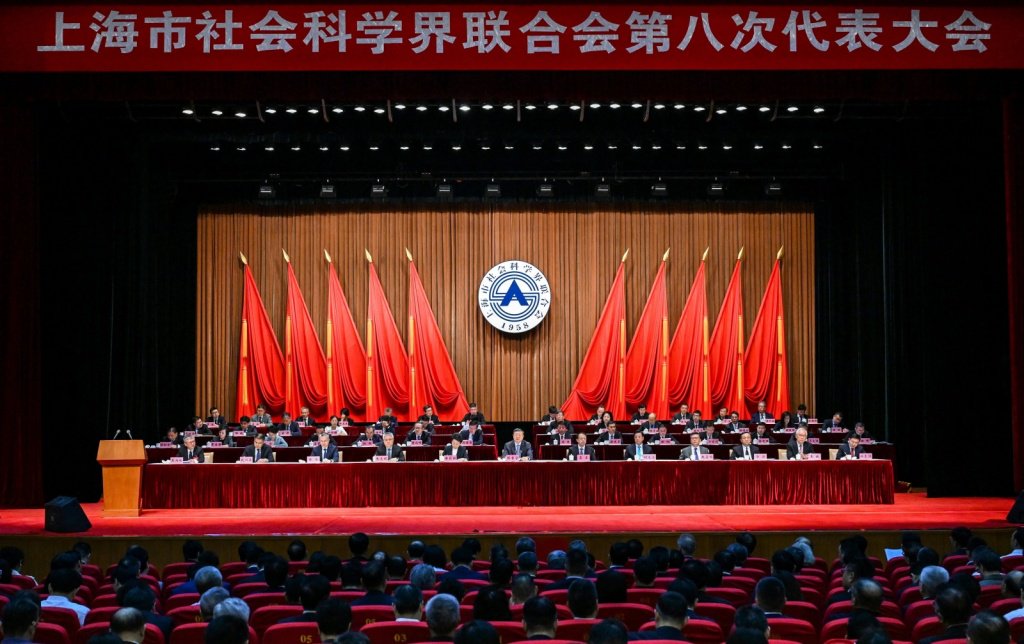
上海市社联代表大会举行,哲学社会科学工作者备受鼓舞
Xin Lang Cai Jing· 2025-06-03 15:24
Group 1 - The Shanghai Social Science Federation held its eighth representative assembly, where the seventh committee's achievements were reviewed under the leadership of the municipal party committee and the publicity department [1][3] - A total of 237 members were elected to the eighth committee, with Xu Jiong elected as the chairman [3] - The assembly emphasized the importance of aligning academic pursuits with national and ethnic development, focusing on theoretical and policy research [3][4] Group 2 - The assembly was marked by a strong sense of democracy and anticipation for future developments in the social sciences [4] - The Shanghai Social Science Federation has played a significant role in guiding research and promoting the innovative theories of the Communist Party, particularly focusing on Xi Jinping's thoughts [6] - Various activities, including annual meetings and forums, have been organized to consolidate the strength of the social science community and enhance research impact [6] Group 3 - The Shanghai social science community is committed to contributing to national strategies and urban development, with a focus on practical applications and international studies [10] - The federation has established a platform for academic exchange and recognition of outstanding contributions in the field, fostering a culture of rigorous research and innovation [10][11] - Future goals include optimizing award mechanisms and supporting young scholars to enhance their contributions to the field [11][14]