网贷

Search documents
暴力催收、利息过高、向未成年人放贷 最严重者可能被暂停业务
Nan Fang Du Shi Bao· 2025-09-14 23:18
Core Viewpoint - The newly issued "Consumer Rights Protection Regulatory Evaluation Measures" by the National Financial Supervision Administration introduces a five-level classification system for evaluating consumer rights protection in financial institutions, with potential penalties including business suspension for the most serious violations [2][6]. Group 1: Regulatory Framework - The evaluation will be based on seven key standards: "system mechanism," "suitability management," "marketing behavior management," "dispute resolution," "financial education," "consumer services," and "personal information protection," which are more refined and detailed compared to the previous six standards [6][4]. - Financial institutions that do not engage in personal business or have a small proportion of personal business may not be subject to this evaluation [3][4]. Group 2: Evaluation Process - The evaluation process will occur annually, with the evaluation period from January 1 to December 31, and results expected by mid-March of the following year [9][8]. - The evaluation includes several steps: information collection, initial evaluation, re-evaluation, and review, with the possibility of adjusting evaluation results based on significant violations or data inaccuracies [9][10]. Group 3: Consequences of Evaluation Results - Institutions rated 1 or 2A may receive reduced on-site inspection frequency and be prioritized for participation in consumer protection policy trials, while those rated lower may face various regulatory measures, including guidance and potential business restrictions [7][6]. - Institutions rated 4 may be restricted from opening new businesses or branches if they fail to rectify issues, while those rated 5 could face business suspension and accountability for responsible personnel [7][6].


高息网贷“换壳术”:从“芸豆花”看快牛系1460%年化利率下监管漏洞
Sou Hu Cai Jing· 2025-08-27 03:48
Core Viewpoint - The article highlights the alarming practices of high-interest lending apps like "Yun Dou Hua," which have rebranded from "Yun Dou Fen" to evade regulatory scrutiny while continuing to exploit consumers with exorbitant interest rates and aggressive collection tactics [1][3][5]. Group 1: User Experiences - Users like Li Fei and Zhang Bin have reported being trapped in a cycle of debt due to high annualized interest rates, with Li Fei facing a staggering 1460% rate and Zhang Bin experiencing an 876% rate [1][4]. - Complaints on platforms like Black Cat Complaints indicate a pattern of short-term loans with high interest, where users face harassment from collection agents after missed payments [4][6]. Group 2: Company Operations - "Yun Dou Hua" is linked to Shanghai Zui Meng Zhe Internet Technology Co., which has no financial business licenses and has been involved in multiple rebrandings to avoid regulatory action [5][10]. - The app operates under a "borrowed shell" model, where it is part of a larger network associated with "Kua Niu" capital, which has a history of high-interest lending practices [6][8]. Group 3: Regulatory Issues - The article points out significant regulatory gaps, particularly in how banks manage their lending partnerships, allowing funds to flow into unregulated platforms like "Yun Dou Hua" [9][10]. - Users are required to sign blank contracts, which enables the platform to impose hidden fees and complicates the process of seeking recourse in disputes [10].

高薪扩张!精心设计的“债务规划”黑洞
Bei Jing Shang Bao· 2025-08-14 08:40
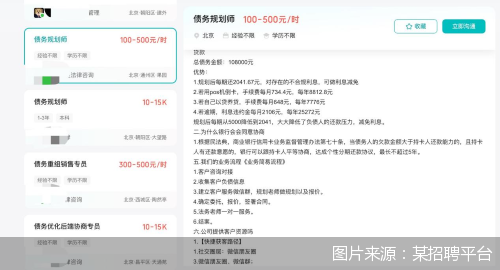
Core Viewpoint - The article highlights the emergence of a predatory debt planning industry that exploits individuals in financial distress, despite regulatory crackdowns and previous rejections by loan platforms [1][8]. Group 1: Industry Practices - Numerous companies are hiring debt planners and credit management specialists, offering salaries as high as 500 RMB per hour, to attract a large pool of indebted individuals [2][5]. - The recruitment process emphasizes finding clients through social media, short videos, and other online platforms, while also utilizing illegal data acquisition methods to target potential victims [2][4]. - The industry has developed a modular approach, with organized operations that include creating fake legal documents and using deceptive marketing tactics to lure clients [3][5]. Group 2: Risks to Consumers - Consumers are often misled into paying high service fees for ineffective debt solutions, which can lead to further financial distress and potential identity theft [6][10]. - The article notes that some organizations may disappear after collecting fees, leaving clients with unresolved debts and damaged credit records [6][10]. - There is a growing trend of using fraudulent practices, such as identity theft to secure new loans, exacerbating the debt crisis for individuals [6][10]. Group 3: Regulatory Response - Regulatory bodies and law enforcement agencies are increasing efforts to combat the rise of fraudulent debt optimization schemes, emphasizing the need for collaboration among financial institutions, platforms, and regulators [7][9]. - New measures include stricter advertising regulations on social media platforms and enhanced scrutiny of debt-related services to protect consumers from scams [9][10]. - Experts suggest that clearer regulations and better consumer education are essential to mitigate the risks associated with these predatory practices [10][11].
起底网贷黑产(下)|高薪扩张!精心设计的“债务规划”黑洞
Bei Jing Shang Bao· 2025-08-14 08:24
Core Viewpoint - The article highlights the emergence of a predatory debt planning industry that exploits individuals in financial distress, despite regulatory crackdowns and previous rejections by loan platforms [1][4][8] Group 1: Industry Practices - Numerous companies are aggressively recruiting debt planners and credit management specialists, offering hourly wages as high as 500 yuan, to target a large pool of indebted individuals [3][4] - The recruitment process emphasizes minimal experience requirements, with training provided to new hires on negotiation tactics and debt optimization strategies [3][4] - The operational model of these companies is highly structured, involving multiple stages from client consultation to contract signing, utilizing social media and online platforms for customer acquisition [3][4] Group 2: Exploitation Tactics - The debt planning black market has developed a systematic approach, utilizing illegal data acquisition and deceptive advertising to lure clients [4][5] - Fraudulent entities often promise unrealistic debt solutions, such as complete debt forgiveness or extended repayment terms, while charging high service fees of 5% to 10% of the debt amount [5][6] - There are reports of these organizations disappearing after collecting fees, leaving clients with unresolved debts and potential identity theft risks due to the sensitive information shared [6][8] Group 3: Regulatory Response - Regulatory bodies and platforms are intensifying efforts to combat the rise of fraudulent debt optimization schemes, emphasizing the need for collaboration among financial institutions, platforms, and regulators [8][9] - Recent actions include stricter advertising regulations on social media and short video platforms, limiting promotions to licensed legal entities and banning misleading content [9][10] - Experts suggest that clearer regulations and enhanced consumer education are essential to mitigate the risks associated with these predatory practices [10]

直击现场!揭秘律所的“债务托管”生意
Bei Jing Shang Bao· 2025-08-14 08:01
Core Viewpoint - The article highlights the risks associated with debt management services marketed by certain law firms and debt optimization companies, which often mislead consumers with false promises and may engage in fraudulent practices [1][12][13]. Group 1: Debt Management Services - Many consumers encounter advertisements for "debt optimization" and "overdue negotiation" services, often presented by individuals claiming to be legal assistants or financial advisors [1][3]. - These services promise to alleviate debt burdens by offering solutions such as "no payments for 1 to 3 years" and "only repaying the principal," which are often unrealistic and misleading [3][5][11]. - The operations of these companies typically involve high-pressure sales tactics and vague contractual agreements that can lead to consumer exploitation [12][13]. Group 2: Consumer Experiences - Consumers report being drawn to local law firms that claim to have extensive experience in handling debt issues, often leading to significant service fees without any real solutions [11][12]. - Complaints on platforms like Black Cat Complaints reveal numerous instances of consumers feeling deceived, with reports of service fees collected without any effective resolution of their debt issues [12][13]. - The article notes that many of these firms have expanded their reach to local markets, using targeted advertising to attract consumers in distress [9][11]. Group 3: Legal and Regulatory Concerns - Legal experts express skepticism about the legitimacy of the services offered, particularly the claims that debt management can be conducted without impacting credit scores [7][8]. - The practices of these debt management companies may violate regulations regarding consumer protection and financial practices, leading to potential legal repercussions for both the companies and the consumers involved [12][13]. - The article emphasizes the need for consumers to be cautious and to seek services from licensed financial institutions rather than unregulated debt management firms [12][13].
起底网贷黑产(上)|直击现场!揭秘律所的“债务托管”生意
Bei Jing Shang Bao· 2025-08-14 07:59
Core Viewpoint - The article highlights the risks associated with debt management services marketed by certain law firms and debt optimization companies, which often mislead consumers into believing they can avoid repayment or mitigate their debts without consequences [1][6][14]. Group 1: Debt Management Services - Many consumers encounter advertisements for "debt optimization" and "overdue negotiation" services, often presented by individuals claiming to be legal assistants or financial advisors [1][3]. - These services promise to help individuals manage their debts by offering solutions such as "1 to 3 years without repayment" and "only repaying the principal" [5][8]. - The operations of these companies often involve high-pressure sales tactics and misleading claims, leading consumers to believe they can avoid the repercussions of their debts [14][15]. Group 2: Consumer Experiences - Consumers report being drawn in by local law firms that claim to have extensive experience in handling debt issues, with some advertising that they have assisted over 10,000 individuals [3][12]. - Many consumers have shared negative experiences, including being charged service fees without receiving any effective assistance in resolving their debts [8][14]. - Complaints on platforms like "Black Cat Complaints" reveal a pattern of consumers feeling deceived by these services, which often fail to deliver on their promises [8][14]. Group 3: Legal and Regulatory Concerns - Legal experts have raised concerns about the legitimacy of the claims made by these debt management services, particularly regarding their ability to prevent negative impacts on credit reports [7][8]. - The methods employed by these companies, such as intercepting collection calls, are viewed as potentially illegal and could exacerbate the consumer's financial situation [7][8]. - The article emphasizes the need for consumers to be cautious and to seek services from legitimate financial institutions rather than these dubious debt management firms [14][15].
揭开助贷兜底面纱 窥见息费高筑背后担保链条
Xin Hua Wang· 2025-08-12 06:10
Group 1 - The article highlights the expansion of high-interest online lending products, with rates approaching 36%, amidst a backdrop of declining consumer loan rates from banks [1][3] - Financing guarantee companies play a crucial role in the online lending ecosystem, providing credit enhancement services such as risk sharing and compensation guarantees [1][6] - The "dual guarantee" model is emerging in the industry, allowing lenders to circumvent the 24% interest rate cap by splitting the pricing into two parts, which increases borrower debt vulnerability [1][7] Group 2 - The proliferation of online lending access points through various apps reflects a strong market demand for financial services, particularly in areas underserved by traditional financial institutions [2][3] - Many online lending platforms are now offering loans with interest rates that can exceed the legal cap of 24%, particularly in the case of licensed financial institutions [3][4] - The high fees associated with financing guarantees are often not disclosed upfront to borrowers, leading to consumer complaints about unexpected costs [8][9] Group 3 - The "dual guarantee" model, while expanding financial service coverage, raises concerns about compliance and consumer protection due to its complexity and potential for high costs [7][9] - Regulatory oversight is needed to address issues such as excessive borrowing, misleading marketing practices, and inadequate risk disclosures by online lending platforms [9][10] - Financial institutions and lending platforms must prioritize data security and transparency in their operations to protect consumer information and rights [10]
网贷套路陷阱值得全民高度警惕
Guo Ji Jin Rong Bao· 2025-07-14 09:25
Core Viewpoint - The National Financial Regulatory Administration has issued a risk warning regarding fraudulent online loan practices, highlighting three main deceptive tactics used by illegal institutions to mislead consumers into taking out loans [1][2][3]. Group 1: Deceptive Tactics - The first tactic involves confusing concepts to mislead borrowers, where illegal platforms use ambiguous terms like "installment payment" instead of "installment loan," leading consumers to sign contracts without fully understanding the terms [1][2]. - The second tactic is making false promises to entice borrowers, such as exaggerated claims about loan approval or government assistance, often accompanied by unfavorable contract terms that benefit the lender [2][3]. - The third tactic is concealing the actual cost of loans, where platforms advertise low interest rates while hiding higher effective rates and additional fees, resulting in borrowers facing unexpected financial burdens [2][3]. Group 2: Current Market Situation - As of the end of 2024, there are approximately 350 million online loan users in China, with 120 million having overdue payments, indicating a significant market penetration and associated risks [3]. - In the first half of 2025, law enforcement uncovered 58,000 cases of fraudulent loans, arresting over 41,000 suspects and seizing 57.7 billion yuan in illicit funds, reflecting the scale of the issue [3]. - A significant portion of victims, 68.3%, are university students, highlighting the vulnerability of certain demographics to these fraudulent practices [3]. Group 3: Recommendations for Consumers - Consumers are advised to critically evaluate promotional content from online loan platforms, ensuring they do not fall for enticing offers that may lead to financial traps [4]. - It is essential for consumers to verify the legitimacy of loan institutions by consulting regulatory bodies or official websites to avoid scams [4]. - Careful examination of contract terms is crucial, with consumers encouraged to seek clarification on any ambiguous clauses before signing [4]. - Protecting personal information is vital, and consumers should take measures to safeguard sensitive data during the loan application process [4].
网贷,仍在围猎大学生
虎嗅APP· 2025-06-08 23:57
Core Viewpoint - The article highlights the pervasive issue of online lending targeting university students, emphasizing the psychological and financial consequences faced by this demographic due to high-interest loans and predatory lending practices [3][10][29]. Group 1: Online Lending Landscape - Online lending has evolved from campus loans to a broader online loan market, which continues to thrive despite regulatory efforts to curb it [10][30]. - Regulatory bodies have issued multiple directives to prohibit online lending to students, yet these measures have been largely ineffective due to loopholes and lack of enforcement [9][30]. - The online lending industry has become a lucrative business, with companies like Qifu Technology and Xinyi Technology reporting significant profits and high sales margins [22]. Group 2: Target Demographic - University students, despite being legally adults, are often ill-equipped to handle financial responsibilities, making them prime targets for online lenders [23][29]. - The lack of financial literacy among students leads to a high acceptance of loans with exorbitant interest rates, often exceeding 36% when hidden fees are included [17][21]. - The ease of access to loans through popular apps and platforms creates a false sense of security, encouraging students to borrow without fully understanding the implications [24][14]. Group 3: Psychological Impact - Many students experience severe psychological distress due to overwhelming debt, with some developing conditions like severe depression [5][29]. - The societal shift towards a culture of borrowing rather than saving is concerning, as it may lead to long-term financial instability for young adults [36][38]. - The article warns that the normalization of debt among the younger generation could mirror the financial crises seen in other countries, particularly the U.S. [38][39]. Group 4: Regulatory Challenges - The fragmented regulatory framework surrounding online lending creates a vacuum where predatory practices can flourish [30]. - Key concepts related to responsible lending, such as "excessive borrowing" and "proper identification of borrowers," remain poorly defined, allowing lenders to exploit these ambiguities [31]. - The article calls for more stringent regulations and clearer definitions to protect vulnerable populations, particularly students, from falling into debt traps [35][31].

网贷,仍在围猎大学生
Hu Xiu· 2025-06-08 22:32
Core Viewpoint - The article highlights the alarming rise of online lending among university students, leading to severe financial and psychological consequences, despite regulatory efforts to curb such practices [1][5][6]. Group 1: Online Lending Issues - A significant number of university students are falling into debt traps due to online lending, with reports indicating over 5000 cases of students seeking redress for loan issues [1][5]. - The average annual interest rates for online loans can range from 15% to 36%, often obscured by various fees, leading to a much higher effective cost for borrowers [11][12]. - Many students are unaware of the true costs associated with these loans, as platforms often use misleading marketing tactics to attract borrowers [9][11]. Group 2: Regulatory Challenges - Despite multiple regulatory attempts since 2016 to ban online loans to students, the industry has adapted, continuing to operate under different guises [5][23]. - The lack of a centralized regulatory body and clear definitions around key concepts like "excessive borrowing" allows online lending platforms to exploit loopholes [23][24]. - Platforms often bypass regulations by not actively verifying student status, allowing them to lend indiscriminately to young borrowers [24]. Group 3: Psychological and Social Impact - The psychological toll on students is significant, with many experiencing severe anxiety and depression due to unmanageable debt [1][5]. - The financial burden often extends to families, as students may rely on parental support to repay loans, creating a cycle of financial strain [20][21]. - The article emphasizes that university students, despite being legally adults, lack the financial literacy and experience to navigate these lending traps effectively [16][20].