钢铁和铝

Search documents
欧盟官员:欧盟认为与美国的贸易谈判正在加速
news flash· 2025-05-15 07:56
Core Viewpoint - The EU believes that trade negotiations with the US are accelerating, with a preference for a quality agreement over a quick deal [1] Group 1: Trade Negotiations - The Polish Deputy Minister of Economic Affairs, Baranowski, stated that negotiations between the EU and the US are speeding up [1] - The EU is optimistic due to signs of the US easing tensions, as indicated by Baranowski [1] - EU Commission Vice President Šefčovič mentioned a constructive call with US Secretary of Commerce Ross, aiming to address current challenges and lay the groundwork for deeper cooperation [1] Group 2: Tariffs and Trade Impact - The US previously imposed tariffs affecting European automotive, steel, and aluminum manufacturers, but later reduced these tariffs to 10% for a 90-day negotiation period [1] - The focus remains on achieving a beneficial agreement rather than rushing into a trade deal [1]
美英达成贸易协议
news flash· 2025-05-08 23:11
Core Viewpoint - The new trade agreement between the United States and the United Kingdom aims to enhance market access for industrial and agricultural products while simplifying customs procedures for U.S. exports [1] Group 1: Trade Agreement Details - The agreement includes a replacement arrangement for the U.S. tariffs on UK automobiles under Section 232, allowing the first 100,000 cars exported annually to the U.S. from the UK to be subject to a 10% reciprocal tariff, while other exports will face a 25% tariff [1] - A new steel and aluminum trade alliance will be established, with the U.S. negotiating alternative arrangements for the Section 232 tariffs on steel and aluminum [1]
石破茂:对美国加征关税非常遗憾
news flash· 2025-05-03 14:49
Core Viewpoint - Japan's Prime Minister Shigeru Ishiba expressed regret over the United States imposing a 25% tariff on key automotive parts and will continue to urge the U.S. to reconsider these tariff measures [1] Group 1: Tariff Negotiations - Japan is currently negotiating with the U.S. regarding tariffs on products including automobiles, steel, and aluminum [1] - There are significant differences in positions between Japan and the U.S., and a consensus has not yet been reached [1] - Japan's government officials reported that during the second round of negotiations, Japan strongly requested a reassessment of various tariff measures, but the U.S. maintained its stance of not granting Japan "special treatment" on automotive and steel products [1]
加拿大大选前美加关税“拉锯战”加剧,卡尼:坚决抵制特朗普关税政策
Di Yi Cai Jing· 2025-04-24 10:26
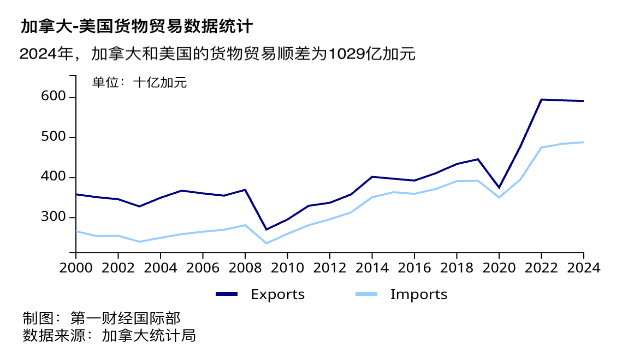
Group 1 - President Trump stated that the U.S. does not need Canadian automobiles, energy, and lumber, claiming that the U.S. spends $200 billion annually to support Canada [1] - Canadian Prime Minister Carney criticized Trump for disrupting global markets and fundamentally reshaping international trade, suggesting that Trump aims to undermine Canada for U.S. control [1] - Economists and trade experts have criticized Trump's $200 billion subsidy claim as unfounded, with Canadian statistics showing a trade surplus of 102.9 billion CAD (approximately $74 billion) with the U.S. in goods for 2024 [1] Group 2 - Trump indicated that he does not plan to raise tariffs on Canadian imported automobiles for now, but future increases are possible, expressing a desire for the U.S. to produce its own cars [6] - U.S. auto manufacturers have voiced concerns over Trump's trade policies, with Stellantis' chairman warning that these policies pose risks to the U.S. and European auto industries [6] - In 2024, Canada exported vehicles and parts worth 78.77 billion CAD to the U.S., while importing 81.98 billion CAD, highlighting the integrated North American auto supply chain [6] Group 3 - Analyst Dan Ives noted that current delays in new car production and supply chains are critical, warning that tariffs could increase the average price of low-end cars by $5,000 and high-end cars by $10,000 to $15,000, potentially reducing new car demand by 15%-20% this year [7] - The U.S. and Canada are engaged in a tariff "tug-of-war," with the U.S. imposing a 25% tariff on Canadian goods and Canada retaliating with similar tariffs on U.S. imports [9] - Effective April 3, the U.S. imposed a 25% tariff on Canadian automobiles, with Canada responding with equivalent measures against U.S. imports not compliant with the USMCA [10]