
渔业

Search documents
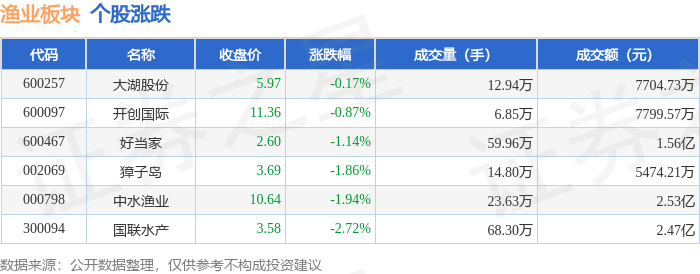
渔业板块12月30日跌1.53%,国联水产领跌,主力资金净流出2869.77万元
Zheng Xing Xing Ye Ri Bao· 2025-12-30 08:56
Core Viewpoint - The fishery sector experienced a decline of 1.53% on December 30, with Guolian Aquatic Products leading the drop. The Shanghai Composite Index closed at 3965.12, down 0.0%, while the Shenzhen Component Index rose by 0.49% to 13604.07 [1]. Group 1: Market Performance - The fishery sector's stocks showed varied performance, with notable declines in several companies, including Guolian Aquatic Products, which fell by 2.72% to a closing price of 3.58 [1]. - The trading volume for Guolian Aquatic Products was 683,000 shares, with a transaction value of 247 million yuan [1]. - Other companies in the sector, such as Dahu Co. and Kaichuang International, also reported declines of 0.17% and 0.87%, respectively [1]. Group 2: Capital Flow - The fishery sector saw a net outflow of 28.7 million yuan from main funds, while retail investors contributed a net inflow of 52.6 million yuan [1]. - The capital flow data indicates that Dahu Co. had a main fund net inflow of over 9.47 million yuan, while Guolian Aquatic Products experienced a significant outflow of 18.69 million yuan [2]. - Retail investors showed a strong interest in Zhongshui Fishery, with a net inflow of 43.07 million yuan, despite the overall negative trend in the sector [2].


放生去哪儿?首批16个科学放鱼体验点公布
Ren Min Wang· 2025-12-30 08:06
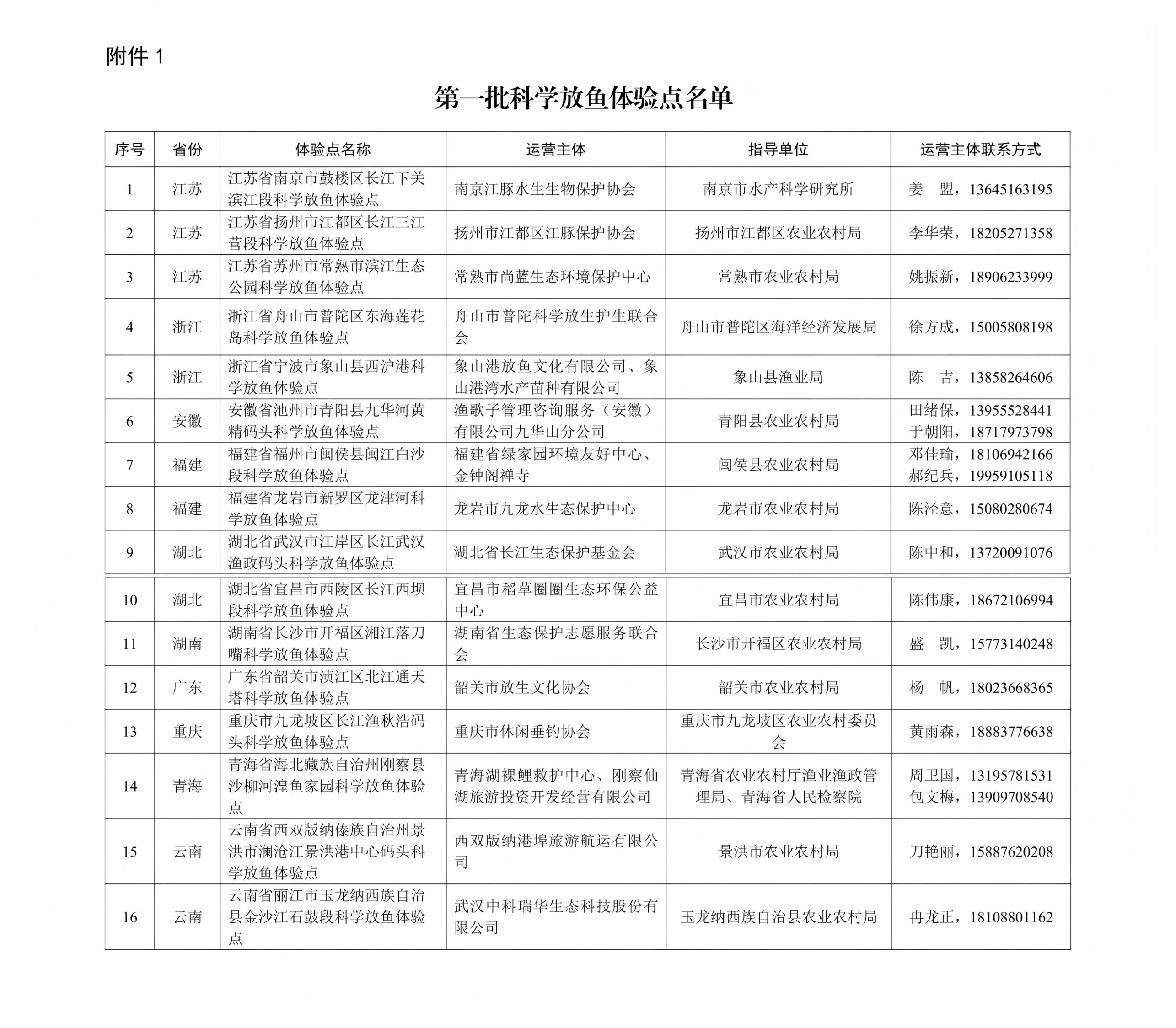
Core Viewpoint - The National Aquatic Technology Promotion Station and the Chinese Society of Fisheries have selected the first batch of 16 scientific fish release experience points and 10 under-construction experience points to guide the public in conducting aquatic life release activities in a standardized manner [1][2]. Group 1: Experience Points Selection - A total of 16 scientific fish release experience points have been selected, with an additional 10 points currently under construction [1]. - The validity period for the recognition of these experience points is three years [1]. Group 2: Guidelines for Experience Points - Technical guidance is emphasized, with provincial promotion agencies required to assist in establishing a record-keeping mechanism for release activities and to provide information on qualified seedling production units [1]. - Experience points are expected to serve as demonstration sites, promoting public participation through various engaging activities that align with local cultural characteristics [1][2]. Group 3: Infrastructure Development - Under-construction experience points must adhere to construction standards and enhance both soft and hardware conditions, including the establishment of temporary facilities for aquatic seedlings [2]. - During the construction phase, these points are prohibited from conducting media promotions or public signage [2]. Group 4: List of Experience Points - A detailed list of the first batch of scientific fish release experience points and those under construction has been provided, including locations across various provinces such as Jiangsu, Zhejiang, and Guangdong [4][5][7].
经销商在抢“它”!今年太紧俏了→
新华网财经· 2025-12-30 07:05
Core Viewpoint - The production of hairtail fish in Zhoushan, Zhejiang has significantly decreased this year, leading to a high demand for fresh, high-quality hairtail fish [1][3]. Group 1: Production and Supply - This year, the hairtail fish production is only about half of last year's output, prompting fishermen to plan additional trips before the Spring Festival [3]. - The "top hairtail," which represents about 10% of the total, is the largest and highest grade, weighing over one pound and measuring more than four fingers in width, and is in short supply in the market [5][7]. Group 2: Pricing Trends - The wholesale price of hairtail fish at the dock varies between 15 yuan and 80 yuan per pound, reflecting an approximate 20% increase compared to last year [9]. - The highest quality "top hairtail" commands the highest wholesale price, approximately 70 yuan per pound [7].

广东“三农”记者的2025|南岭东风
Nan Fang Nong Cun Bao· 2025-12-30 02:00
Core Viewpoint - The article discusses the significant advancements and achievements in Guangdong's agricultural sector as it approaches 2025, highlighting the importance of agricultural development and rural revitalization in the region [9][10][56]. Group 1: Agricultural Achievements - Guangdong's primary industry value has risen to the second highest in the country, with agricultural product import and export values maintaining the top position nationally [10]. - Agricultural technology contribution rate has reached 74.02%, and grain yield per unit has achieved a record high [10]. - The province has built 4.905 million acres of high-standard farmland during the "14th Five-Year Plan" period [52]. Group 2: Local Agricultural Products - The article emphasizes the success of local products such as the "Yunfu sweet potato," which has a weight of 26.23 pounds, and the "Meizhou golden pomelo," valued at 11.327 billion yuan [29][54]. - The "Ningming star oil vine" industry in Guangxi is highlighted for its annual production value exceeding 20,000 yuan per acre, providing over 60,000 job opportunities [45][56]. Group 3: Market Strategies and Initiatives - The Guangdong government has organized various initiatives to promote local agricultural products, including the "2025 Guangdong Lychee Procurement Map" and the "Southern Rural Report" focusing on agricultural media [79][80]. - The article mentions the successful "Guangdong Rural Singer Competition," which attracted over 50,000 participants and garnered over 1.5 billion views online, showcasing the cultural aspect of agricultural development [125][126]. Group 4: Collaborative Efforts - The collaboration between Guangdong and neighboring provinces like Guangxi and Guizhou is emphasized, with initiatives to introduce advanced agricultural techniques and improve local farming practices [95][98]. - The article notes the efforts to enhance the visibility of local products in major markets, such as the promotion of "Tianyang mango" in Shenzhen and Guangzhou [95][96]. Group 5: Future Outlook - The article concludes with a forward-looking perspective, indicating that the agricultural sector in Guangdong is poised for further growth and innovation as it moves towards 2026, with ongoing efforts in rural revitalization and agricultural modernization [148].

深陷亏损、诉讼缠身,獐子岛再遭第三大股东“甩卖”
Shen Zhen Shang Bao· 2025-12-30 00:59
Core Viewpoint - The shareholder Beijing Jirong Yuantong Asset Management Co., Ltd. plans to reduce its stake in Zhuangzi Island by selling up to 7.111 million shares, representing no more than 1% of the company's total share capital, between January 23, 2026, and April 22, 2026 [1][3]. Group 1: Shareholder Actions - As of the announcement date, the fund holds 50,082,685 shares, accounting for 7.04% of the company's total share capital, making it the third-largest shareholder [3]. - This marks the second time in 2023 that the fund has disclosed a reduction plan, having previously completed a round of selling approximately 7.08 million shares at an average price of 4.21 yuan per share, resulting in proceeds of about 29.8 million yuan [3][4]. Group 2: Financial Performance - Zhuangzi Island has faced significant financial challenges, with a net profit of only 8.5882 million yuan in 2023, followed by a projected loss of 21.9126 million yuan in 2024, representing a year-on-year decline of 355.15% [6]. - The company continued to experience losses in 2025, with a net loss of 32.3734 million yuan in the first three quarters, a decrease of 30.79% year-on-year [6][8]. Group 3: Legal Issues - The company has been involved in litigation and arbitration matters totaling 10.0696 million yuan over the past 12 months, which exceeds 10% of its most recent audited net assets, thus meeting disclosure requirements [9]. - The potential impact of these legal matters on the company's current or future profits remains uncertain, as some cases are still pending [9]. Group 4: Market Performance - As of December 29, the company's stock price fell by 1.31%, closing at 3.76 yuan per share, with a total market capitalization of 2.674 billion yuan [9].

南农晨读 | 老腊肉 粤风味
Nan Fang Nong Cun Bao· 2025-12-30 00:35
Group 1 - The article discusses the coordinated development of urban and rural areas in Guangdong, focusing on the "Hundred Counties, Thousand Towns, and Ten Thousand Villages High-Quality Development Project" [4][22] - Various cities in Guangdong are implementing tailored strategies to promote urban-rural integration, including enhancing local tourism and cultural industries [5][11][15] - The article highlights the achievements of Yangxi County, which has been recognized as a national model for rural revitalization and has seen an average annual industrial growth of 9.8% over the past three years [23][25] Group 2 - The "Civilization Market" initiative aims to boost consumer activity by integrating cultural heritage with local products, attracting significant public interest [50][52] - The Guangdong Province's "Consumer Assistance Spring Festival Action" was launched to promote local goods, featuring a two-day exhibition with over 300 participating enterprises [30][34] - The article emphasizes the importance of cultural and tourism integration in enhancing local economies and consumer engagement [19][49] Group 3 - Nanhai District is advancing its aquaculture industry through partnerships with academic institutions to develop superior breeding technologies and establish national-level breeding projects [56][58] - The article outlines the significance of technological innovation and institutional reforms in overcoming agricultural income challenges and enhancing competitiveness [62][63] - The upcoming Guangdong International (Nanhai) Health Food Industry Park opening is expected to further elevate the local aquaculture sector [61]
岁稔年丰 乡村和美——2025,共绘乡村振兴新“丰”景
Xin Hua She· 2025-12-29 23:10
Core Insights - China's grain production has reached a historical high of 14.2975 trillion jin, an increase of 1.675 billion jin compared to the previous year, despite facing various natural disasters [3] - The comprehensive mechanization rate of crop farming has reached 76.7%, indicating significant advancements in agricultural technology [6] - The rural economy is thriving, with per capita disposable income for rural residents reaching 17,686 yuan, a real increase of 6.0% year-on-year [8] Group 1: Grain Production - Grain production in China has stabilized at over 1.4 trillion jin, overcoming challenges such as drought and heavy rainfall [1][3] - The increase in grain production is supported by enhanced agricultural policies, expanded planting areas, and improved crop yields [3] - The soybean planting area has remained above 15 million acres for four consecutive years, with production continuing to exceed 20 million tons [4] Group 2: Agricultural Technology - The implementation of smart agriculture has accelerated, with significant improvements in efficiency and productivity through technology [5][6] - Agricultural technology contributions have surpassed 64%, with over 95% of crop varieties being self-bred [6] - The integration of smart management systems in aquaculture has led to innovative farming models, enhancing productivity [5] Group 3: Rural Development - The rural revitalization strategy has led to the establishment of 2 to 3 dominant industries in 832 poverty alleviation counties, connecting nearly three-quarters of the impoverished population with new agricultural entities [7][10] - The transformation of rural areas has been marked by improved living conditions and increased economic activity, as seen in villages like Wangxiang [9][10] - The construction of rural infrastructure has been prioritized, ensuring access to essential services and enhancing the quality of life for residents [10]
12月30日A股投资避雷针︱赣锋锂业:因涉嫌内幕交易罪单位犯罪,相关案件已被移送检察机关审查起诉
Ge Long Hui· 2025-12-29 22:11
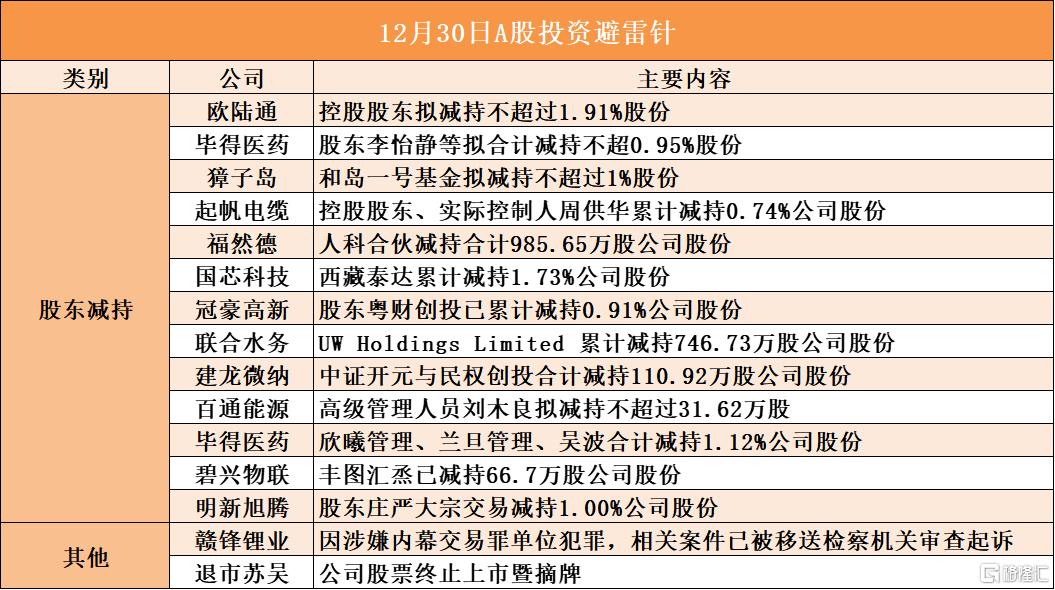
Summary of Key Points Core Viewpoint - Several companies are experiencing significant shareholder reductions, indicating potential shifts in ownership and investor sentiment within the market [1]. Shareholder Reductions - Euro Continental Holdings' controlling shareholder plans to reduce holdings by no more than 1.91% [1] - Bid Medicine's shareholders, including Li Yijing, plan to collectively reduce holdings by no more than 0.95% [1] - Zhanzi Island's shareholders and Island No. 1 Fund intend to reduce holdings by no more than 1% [1] - Qifan Cable's controlling shareholder and actual controller, Zhou Gonghua, has cumulatively reduced 0.74% of company shares [1] - Furan De's shareholder Renke Partnership has reduced a total of 9.8565 million shares [1] - Guoxin Technology's shareholder, Tibet Taida, has cumulatively reduced 1.73% of company shares [1] - Bid Medicine's shareholders, including Xinxin Management, Landan Management, and Wu Bo, have collectively reduced 1.12% of company shares [1] - Other notable reductions include: - Guangdong Financial Investment has cumulatively reduced 0.91% of Guanmeng High-tech shares [1] - UW Holdings Limited has cumulatively reduced 7.4673 million shares of United Water [1] - Zhongzheng Kaiyuan and Minquan Investment have collectively reduced 1.1092 million shares of Jiancheng Zuo Na [1] - Senior management of Baitong Energy, Liu Muliang, plans to reduce no more than 316,200 shares [1] - Junxing Wulian's shareholder Fengtuohui has reduced 667,000 shares [1] - Mingxin Xuteng's shareholder Zhuang Yan has reduced 1.00% of company shares [1] Other Notable Events - Ganfeng Lithium is under investigation for suspected insider trading, with the case transferred to the procuratorate for review and prosecution [1] - Delisting of Suwu Company has been announced, with the company's stock terminated and delisted [1]


山东好当家海洋发展股份有限公司关于控股股东进行股票质押的公告
Shang Hai Zheng Quan Bao· 2025-12-29 18:48
Core Viewpoint - The announcement details the share pledge by the controlling shareholder, Haodangjia Group, which holds a significant portion of the company's shares, and outlines the implications of this pledge on the company’s operations and financial health [1][5]. Group 1: Share Pledge Details - Haodangjia Group holds a total of 555,550,990 shares in the company, representing 38.03% of the total share capital of 1,460,994,304 shares [1]. - Following the recent pledge, Haodangjia Group has pledged a cumulative total of 355,741,400 shares, which accounts for 64.03% of its holdings and 24.35% of the company's total share capital [1]. - On December 22, 2025, Haodangjia Group pledged 10,000,000 shares to Bank of Communications for collateral, which is 0.68% of the company's total share capital [1]. Group 2: Future Pledge and Financial Health - In the next six months, Haodangjia Group has 115,300,000 shares maturing, which is 20.75% of its holdings and 7.89% of the total share capital, with a corresponding financing balance of 13.1 million [3]. - Within the next year, 230,300,000 shares will mature, representing 41.45% of its holdings and 15.76% of the total share capital, with a financing balance of 27.6 million [3]. - Haodangjia Group is reported to have a good credit status and the ability to repay the financing, indicating that the pledge risk is manageable and will not lead to a change in the company's control [3]. Group 3: Impact on the Company - The share pledge is not expected to significantly impact the company's main business, financing credit, financing costs, or ongoing operational capabilities [5]. - There will be no major effects on the appointment of directors by shareholders, the company's independence, or the stability of control and ownership structure [5]. - The pledge will not affect Haodangjia Group's ability to fulfill performance compensation obligations [5].
吃透“一条鱼” 用好“一片海”
Xin Lang Cai Jing· 2025-12-29 17:12
Core Viewpoint - The article highlights the transformation of Dongshan County into a modern fishing industry hub, emphasizing the integration of traditional fishing practices with modern technology and e-commerce to promote rural revitalization and economic growth [1][2][3][4]. Group 1: Economic Development Initiatives - Dongshan County has implemented the "1663" strong county and rich people project, creating a national-level entrepreneurial park for fishermen, which has led to a modern fishing industry chain worth 30 billion yuan [1]. - The county has over 120,000 acres of aquaculture bases, with an annual output of 365,000 tons of aquatic products, showcasing significant production capacity [2]. - The introduction of high-standard aquaculture facilities has allowed companies to achieve profits exceeding 4 million yuan, demonstrating effective cost management and increased productivity [2]. Group 2: E-commerce and Community Engagement - The rise of e-commerce in Dongshan, particularly through live streaming sales, has resulted in annual sales exceeding 350 million yuan, with a significant number of young people returning to their hometowns to engage in this business [3]. - The establishment of "Xingcun Fumin Workshops" has created over 3,100 job opportunities, promoting a collaborative model that integrates party leadership, village investment, and enterprise operation [3]. - The county's strategy includes leveraging the Taiwan Farmers' Entrepreneurial Park to facilitate industry integration, technological cooperation, and talent exchange, enhancing the overall economic landscape [4].