数码

Search documents
明年“国补”范围有增有减,补贴力度有变
第一财经· 2025-12-30 11:23
2025.12. 30 12月30日,国家发展改革委、财政部发布《关于2026年实施大规模设备更新和消费品以旧换新政策 的通知》(下称《通知》),其中明确2026年实施消费品以旧换新,即老百姓口中的"国补",但对 补贴范围和力度有所调整。 与2025年执行的"国补"政策对比,2026年"国补"范围总体稳定,有增有减。 根据上述《通知》,2026年"国补"主要有四类,即汽车报废、汽车置换、家电和数码、智能产品。 与2025年"国补"相比,少了家装、电动自行车两大类。 当然2026年"国补"上述四大类别中涵盖的具体补贴对象,则有增有减。比如,2025年家电产品"国 补"共有12类,分别是冰箱、洗衣机、电视、空调、电脑、热水器、家用灶具、吸油烟机、微波炉、 净水器、洗碗机、电饭煲。而2026年家电"国补"对象降至6类,即冰箱、洗衣机、电视、空调、电 脑、热水器,且必须是1级能效或水效标准的产品。 这意味着2026年家用灶具、吸油烟机、微波炉、净水器、洗碗机、电饭煲不再被纳入"国补"。 根据《通知》,2026年数码"国补"对象是手机、平板、智能手表手环、智能眼镜等4类产品,相比 2025年新增了一项智能眼镜。另外,《 ...

明年“国补”范围有增有减,补贴力度有变
Di Yi Cai Jing· 2025-12-30 11:07
Core Viewpoint - The 2026 "National Subsidy" policy for consumer goods has been clarified, with adjustments in the scope and intensity of subsidies compared to 2025 [2][5]. Group 1: Subsidy Scope Changes - The 2026 "National Subsidy" will focus on four main categories: automotive scrapping, automotive replacement, home appliances, and digital/ smart products, while excluding home decoration and electric bicycles [3][4]. - The home appliance subsidy category has been reduced from 12 types in 2025 to 6 types in 2026, specifically including refrigerators, washing machines, televisions, air conditioners, computers, and water heaters, with the exclusion of kitchen appliances like stoves and microwaves [3][4]. Group 2: Subsidy Intensity Adjustments - The subsidy for automotive scrapping will shift from fixed amounts (20,000 or 15,000 yuan) to a percentage of the new car purchase price (12% or 10%), maintaining the previous upper limit [5]. - For home appliances, the subsidy rate will decrease from 20% to 15%, and the maximum subsidy per appliance will drop from 2,000 yuan to 1,500 yuan [5]. Group 3: Policy Implications - The adjustments in the subsidy policy are expected to promote green and intelligent manufacturing investments, stabilize manufacturing investments, and enhance consumer spending [6]. - The optimization of the consumer goods replacement policy aims to better align with market demands by considering local population and appliance ownership, thereby maximizing the effectiveness of fiscal funds [6].
明年买手机、平板、智能手表手环、智能眼镜,可享15%的“国补”
财联社· 2025-12-30 11:07
国家发展改革委、财政部发布关于2026年实施大规模设备更新和消费品以旧换新政策的通知。 支持智能家居产品(含适老化家居产品)购新补贴,具体补贴品类、补贴标准由地方结合实际自主合理制定。 通知提到,支持家电以旧换新。个人消费者购买冰箱、洗衣机、电视、空调、电脑、热水器等6类家电中1级能效或水效标准的产品,按产品销售价 格的15%给予补贴,每位消费者每类产品可补贴1件,每件补贴不超过1500元。 支持数码和智能产品购新。 个人消费者购买手机、平板、智能手表手环、智能眼镜等4类产品(单件销售价格不超过6000元),按产品销售价格的 15%给予补贴,每位消费者每类产品可补贴1件,每件补贴不超过500元。 ...

优化支持范围!2026年“国补”继续
Xin Lang Cai Jing· 2025-12-30 11:04
Core Viewpoint - The 2026 "Two New" policy aims to optimize support scope, subsidy standards, and implementation mechanisms for large-scale equipment updates and consumer goods replacement programs, enhancing the effectiveness of these initiatives [1][4]. Group 1: Support Scope Optimization - The policy continues the support scope from 2025, adding new areas such as the installation of elevators in old residential communities and equipment updates in elderly care institutions [1][4]. - In the safety sector, updates for firefighting and inspection equipment are included, while consumer infrastructure now covers commercial complexes, shopping centers, department stores, and large supermarkets [1][4]. - The focus on consumer goods replacement will enhance the subsidy rate for key consumer products, maintaining support for vehicle scrappage and replacement, as well as for six categories of home appliances [1][4]. - The scope of digital product subsidies has been expanded to include smart products such as smartphones, tablets, smartwatches, smart glasses, and smart home devices [1][4]. Group 2: Subsidy Standard Optimization - The subsidy for updating old residential elevators will shift from a fixed amount to a tiered system based on the number of elevator floors [2][5]. - For scrapping old commercial trucks, there will be a priority for replacing them with electric trucks [2][5]. - The subsidy for cars will remain capped, but will transition from a fixed amount to a percentage of the vehicle price [2][5]. - Home appliance subsidies will now focus on energy-efficient or water-efficient products, providing 15% of the product price with a maximum subsidy of 1500 yuan per item [2][5]. - The subsidy standards for digital and smart products will remain unchanged from previous levels [2][5]. Group 3: Implementation Mechanism Optimization - The project application and review processes will be streamlined to lower the investment threshold for applications, with increased support for small and medium-sized enterprises [3][6]. - The funding distribution method will be improved, and strict measures will be taken against fraudulent claims and illegal practices [3][6]. - A unified subsidy standard will be enforced nationwide for vehicle scrappage, vehicle replacement, six categories of home appliances, and four categories of digital and smart products [3][6]. - The National Development and Reform Commission will lead the inter-ministerial coordination for the "Two New" policy, with various departments responsible for developing specific implementation guidelines [3][6].
两部门:2026年继续实施消费品以旧换新 支持汽车置换更新
智通财经网· 2025-12-30 10:56
智通财经APP获悉,12月30日,国家发展改革委、财政部发布关于2026年实施大规模设备更新和消费品 以旧换新政策的通知。通知指出,实施消费品以旧换新。支持汽车置换更新。个人消费者转让登记在本 人名下的乘用车,并购买纳入《减免车辆购置税的新能源汽车车型目录》的新能源乘用车或2.0升及以 下排量燃油乘用车的,给予汽车置换更新补贴支持,购买新能源乘用车补贴车价的8%(最高不超过1.5万 元)、购买2.0升及以下排量燃油乘用车补贴车价的6%(最高不超过1.3万元)。 (二)支持老旧营运货车报废更新。继续支持报废国四及以下排放标准营运货车更新为低排放货车,优先 支持更新为电动货车,补贴标准按照《关于实施老旧营运货车报废更新的通知》(交规划发〔2025〕17 号)执行。 支持家电以旧换新。个人消费者购买冰箱、洗衣机、电视、空调、电脑、热水器等6类家电中1级能效或 水效标准的产品,按产品销售价格的15%给予补贴,每位消费者每类产品可补贴1件,每件补贴不超过 1500元。 支持数码和智能产品购新。个人消费者购买手机、平板、智能手表手环、智能眼镜等4类产品(单件销售 价格不超过6000元),按产品销售价格的15%给予补贴,每 ...
利好!2026年“国补”政策来了
Xin Lang Cai Jing· 2025-12-30 10:53
Core Viewpoint - The National Development and Reform Commission (NDRC) and the Ministry of Finance have issued a notice regarding the implementation of a large-scale equipment update and consumer goods replacement policy in 2026, with an initial allocation of 62.5 billion yuan in special long-term bonds to support this initiative [1][17]. Group 1: Large-Scale Equipment Update - The policy supports equipment updates in various sectors, including industrial, electronic information, energy, transportation, and healthcare, while also including the installation of elevators in old residential areas and facilities for elderly care and fire rescue [3][20]. - The initiative aims to enhance the management of project funding, ensuring a comprehensive approach from project reserve to funding disbursement, thereby improving project quality and avoiding resource waste [4][21]. - The policy encourages the replacement of old operational trucks with low-emission vehicles, prioritizing electric trucks, and supports the update of new energy city buses [3][20]. Group 2: Consumer Goods Replacement - The policy provides subsidies for consumers who scrap old vehicles and purchase new energy vehicles or fuel-efficient cars, with subsidies of up to 20,000 yuan for new energy vehicles and 15,000 yuan for fuel-efficient cars [5][22]. - Consumers purchasing energy-efficient home appliances, such as refrigerators and washing machines, will receive a 15% subsidy on the purchase price, capped at 1,500 yuan per item [6][23]. - The initiative also includes support for digital and smart products, offering a 15% subsidy for items like smartphones and tablets, with a maximum subsidy of 500 yuan per item [6][23]. Group 3: Recycling and Circular Economy - The policy emphasizes the establishment of a comprehensive recycling network for waste equipment and consumer goods, promoting the development of a national resource recycling platform [8][25]. - It encourages the growth of the second-hand goods market and the remanufacturing industry, ensuring that remanufactured products meet quality and environmental standards [9][25]. - The initiative aims to strengthen the resource recycling industry through funding support and technological advancements, while also enhancing regulatory oversight of recycling practices [9][25]. Group 4: Implementation and Supervision - The NDRC will lead the coordination of the policy's implementation, ensuring that local governments effectively manage and utilize the allocated funds [11][27]. - A unified subsidy standard will be established across the country for vehicle scrapping and consumer goods replacement, with local governments required to adhere to these standards [7][24]. - The policy includes measures for ongoing evaluation and transparency, with local governments responsible for reporting on the execution and effectiveness of the initiatives [16][31].
2026“国补”继续!第一批625亿元已提前下达,智能产品纳入补贴范围
Mei Ri Jing Ji Xin Wen· 2025-12-30 10:52
Core Viewpoint - The National Development and Reform Commission and the Ministry of Finance have released a notification regarding the implementation of large-scale equipment updates and the old-for-new policy for consumer goods in 2026, outlining the support scope, subsidy standards, and work requirements for the "Two New" policy [1][7]. Group 1: Policy Optimization - The 2026 "Two New" policy has optimized three main areas: 1. Support scope has been expanded to include the installation of elevators in old residential areas, equipment updates in elderly care institutions, and updates for fire rescue and inspection equipment [4][10]. 2. The subsidy standards have been adjusted, including a shift from fixed subsidies for old residential elevators to tiered subsidies based on the number of elevator stops [5][11]. 3. The implementation mechanism has been improved to lower the investment threshold for project applications and enhance support for small and medium-sized enterprises [5][11]. Group 2: Subsidy Details - The policy continues to support the scrapping and replacement of cars and the old-for-new subsidy for home appliances, focusing on six categories: refrigerators, washing machines, televisions, air conditioners, computers, and water heaters [4][10]. - The subsidy for household appliances has been adjusted to 15% of the product price for energy-efficient or water-efficient products, with a maximum subsidy of 1,500 yuan per item [5][11]. Group 3: Implementation and Coordination - The National Development and Reform Commission will lead the inter-ministerial joint meeting system to coordinate the implementation of the "Two New" policy, with a focus on ensuring smooth transitions and meeting seasonal consumption demands [6][12]. - A total of 62.5 billion yuan in special long-term bonds has been allocated to support the old-for-new policy for consumer goods in 2026 [6][12].
两部门:个人购买智能眼镜等产品给予15%补贴,支持智能家居产品购新补贴
Sou Hu Cai Jing· 2025-12-30 10:51
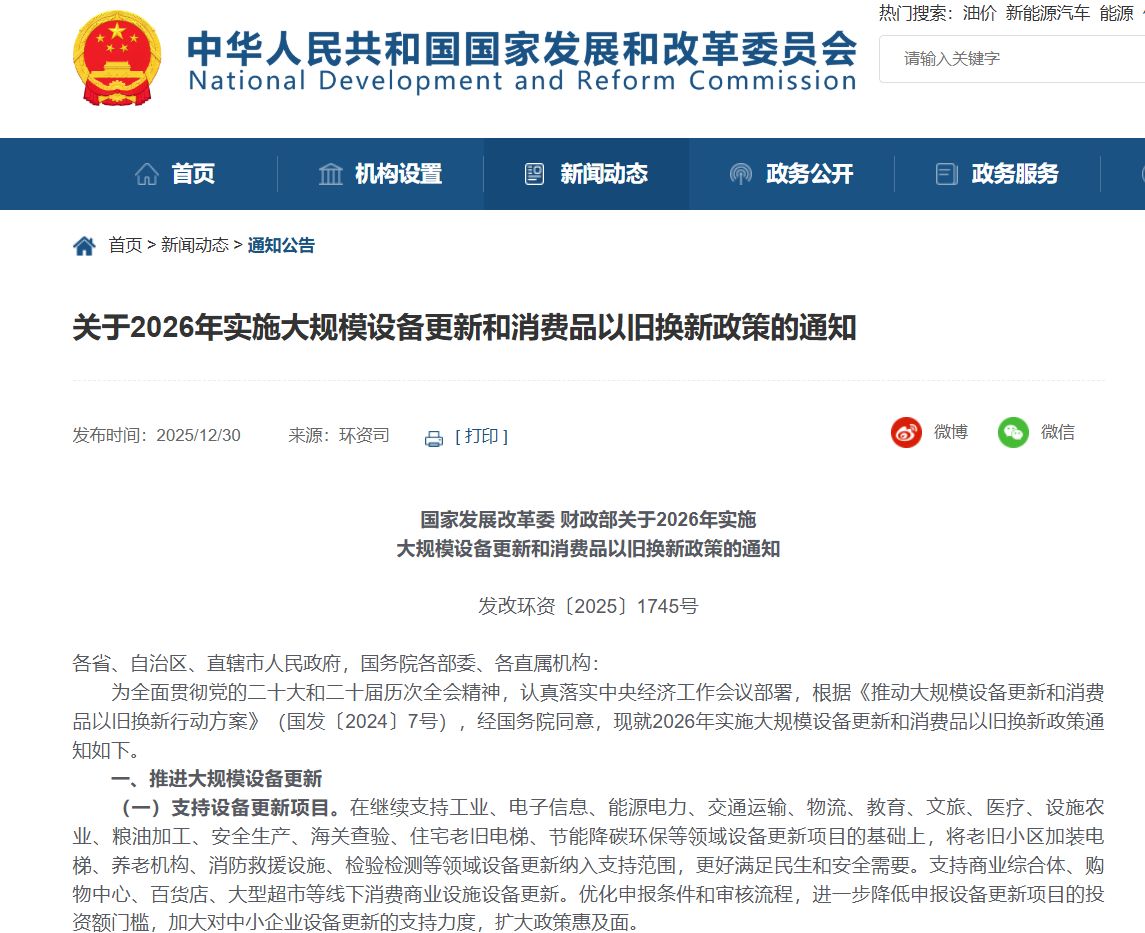
钛媒体App 12月30日消息,国家发展改革委、财政部发布关于2026年实施大规模设备更新和消费品以旧 换新政策的通知。其中提到,支持家电以旧换新。个人消费者购买冰箱、洗衣机、电视、空调、电脑、 热水器等6类家电中1级能效或水效标准的产品,按产品销售价格的15%给予补贴,每位消费者每类产品 可补贴1件,每件补贴不超过1500元。支持数码和智能产品购新。个人消费者购买手机、平板、智能手 表手环、智能眼镜等4类产品(单件销售价格不超过6000元),按产品销售价格的15%给予补贴,每位 消费者每类产品可补贴1件,每件补贴不超过500元。支持智能家居产品(含适老化家居产品)购新补 贴,具体补贴品类、补贴标准由地方结合实际自主合理制定。(国家发改委网站) ...
新增智能产品补贴!2026年“两新”政策发布
Xin Lang Cai Jing· 2025-12-30 10:49
Group 1 - The core viewpoint of the article is the announcement of the "Two New" policy for 2026, which focuses on large-scale equipment updates and the replacement of consumer goods, detailing support scope, subsidy standards, and implementation requirements [1] Group 2 - The support scope for equipment updates will continue from 2025, with additions in the areas of old residential elevator installations, equipment updates for elderly care institutions, and updates for fire rescue and inspection equipment [2] - The consumer goods replacement policy will concentrate resources on key consumer products with strong driving effects, continuing subsidies for vehicle scrappage and replacement, and expanding the scope of subsidies for digital and smart products [3] Group 3 - The subsidy standards for equipment updates will be adjusted, with differentiated subsidies based on the number of floors for old residential elevator updates and prioritizing electric trucks in the scrappage subsidy for old operational trucks [4] - For consumer goods replacement, the subsidy for vehicles will be adjusted to a percentage of the vehicle price while maintaining the upper limit, and the subsidy for home appliances will focus on energy-efficient products with a maximum subsidy of 1,500 yuan per item [5] Group 4 - The implementation mechanism will be optimized by lowering the investment threshold for project applications, increasing support for small and medium-sized enterprises, and expanding the policy's reach [6] - The funding distribution will be improved, with strict measures against fraudulent claims and a unified subsidy standard across the nation for various categories of products, ensuring effective policy implementation [7][8]
两部门明确最新国补政策,625亿元提前下达
21世纪经济报道· 2025-12-30 10:46
支持汽车报废、置换更新, 支持老旧营运货车报废更新 今天(12月30日),国家发展改革委、财政部明确了明年"两新"政策的支持范围和补贴标准。 那么明年以旧换新政策都有哪些变化?老百姓都能享受哪些优惠?一起来看专家的解读。 明年"两新"政策在支持范围上进行了优化。 消费品以旧换新政策重在提升覆盖人群广、带动 效应强的重点消费品"得补率",继续支持汽车、家电、数码产品的补贴,并且增加了智能眼镜 和智能家居产品(含适老化家居产品)的购新补贴。 国家信息中心经济预测部宏观经济研究室副主任邹蕴涵介绍,2026年的消费品以旧换新政策重 在产品向新, 新增了智能产品的补贴 , 消费者在购买比如AR眼镜之类的智能化产品时,也 可以享受消费品以旧换新的补贴,这种是将人工智能等新的产品进一步加快推向普通群众生 活,让高品质智能化的产品更好地走进日常生活。 在补贴标准方面, 邹蕴涵进一步介绍,政策从总体考虑到具体的细则都进行了优化升级,也就是要更好地结合市 场的内生动力的需求,以及政策效力,为民生需求解渴,也为刚需提供更多的助力,能够更好 地推动明年的消费平稳向好。 此外, 国家已于近日向地方提前下达2026年第一批 625亿元 ...