土地开发

Search documents
上海:加快盘活用好城市存量资源 低效产业用地盘活处置要加力推进
Xin Lang Cai Jing· 2025-11-18 11:30
Core Points - The meeting emphasized the importance of revitalizing and effectively utilizing urban stock resources, with a focus on deepening reforms and accelerating transformations in development zones [1] - It highlighted the need for innovation in policies and systems to foster the growth of new industries and business formats [1] - The meeting called for industrial parks and technology parks to adhere to a scale-oriented and intensive development approach, creating a better innovation and industrial ecosystem [1] - There is a push for the active disposal of inefficient industrial land, with an emphasis on dynamic classification assessments and the effective use of an integrated "regulatory storage supply and use" mechanism to enhance urban land management [1] - The update and renovation of commercial office buildings should align with the needs of transformation and upgrading, achieving functional compatibility and conversion [1]
河南首宗“国有+集体”建设用地跨权属组合供应项目落地
Zhong Guo Xin Wen Wang· 2025-11-18 08:29
Core Insights - The first "state-owned + collective" land supply project in Henan has been successfully implemented, addressing the issue of land access for rural industries [1][2] - The project involves a total investment of 50 million yuan, aiming to create a comprehensive commercial facility that includes hotels, dining, and entertainment [1] Group 1: Project Details - The land parcel, located in the core area of Sheng Village, covers an area of 4.71 acres, with 3.98 acres designated as state-owned and 0.73 acres as collective land [1] - The land is planned for commercial use with a 40-year lease, a maximum floor area ratio of 1.5, a building density of less than 40%, and a green space ratio of over 20% [1] Group 2: Economic Impact - The project is expected to generate an annual income of over 500,000 yuan for the local village collective and provide more than 5,000 square meters of commercial service area [1] - It is projected to create over 200 jobs, enhancing the commercial service capacity of the town and promoting rural revitalization [1] Group 3: Policy Innovation - This project represents a significant innovation compared to traditional land transfer models, allowing for simultaneous market entry and equal pricing of state-owned and collective land [2] - The approval process is streamlined, reducing the land acquisition timeline by over 60% and lowering transaction costs for enterprises [2] - The Henan Provincial Natural Resources Department plans to use this case as a model to develop further resource combination supply models across the province [2]
征地123万平方米!惠州这6个区域拟成片开发
Nan Fang Du Shi Bao· 2025-11-17 10:48
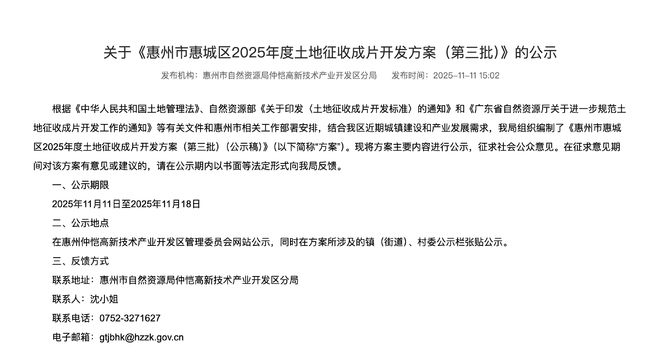
Core Viewpoint - The Huizhou Zhongkai High-tech Zone plans to implement a land acquisition and development scheme for 2025, involving six development areas and a total area of 1.227 million square meters [1][3]. Group 1: Land Acquisition and Development Plan - The land acquisition plan includes six development areas, covering 15 administrative villages, with a total area of 1.227 million square meters [1][3]. - The proposed land acquisition aims to consolidate scattered and inefficient land use, addressing public facility shortcomings and promoting industrial cluster development [3][4]. - The timeline for land development is set for 2026-2027, with 215.622 hectares planned for acquisition in 2026 and 724.238 hectares in 2027 [3]. Group 2: Area and Land Use Distribution - The total area designated for land acquisition is 939.860 hectares, accounting for 76.58% of the overall development plan area [4]. - The development areas include Shuikou, Chenjiang, Huihuan, Lilin, Tonghu, and Tongqiao, with the largest areas in Shuikou and Chenjiang, each approximately 490,000 square meters [7]. - The land use is divided into public and non-public purposes, with public land accounting for 30.75% (377.381 hectares) and non-public land for 69.25% (849.847 hectares) [8]. Group 3: Project Focus and Industry Development - The main focus of the land acquisition is on industrial, residential, and commercial projects, particularly in the fields of smart terminals, ultra-high-definition video display, and energy electronics [8]. - The plan aims to support the development of industries related to new energy precision components, smart equipment, and customized production of materials [8]. - Compensation for agricultural land will follow new standards, with rates set at 83,300 yuan per mu for certain areas and 84,800 yuan per mu for others [9].

Pure Cycle(PCYO) - 2025 Q4 - Earnings Call Transcript
2025-11-13 14:30
Financial Data and Key Metrics Changes - The company reported 25 consecutive quarters of profitability, with Q4 being the strongest quarter despite slight revenue decline due to housing headwinds [4][6] - Year-end net income was slightly below expectations at approximately $12.5 million, primarily due to deferred revenue from land development [10][8] - Earnings per share exceeded forecasts, driven by stronger-than-expected oil and gas royalty income [8][9] Business Line Data and Key Metrics Changes - The water utility segment showed growth with over 1,600 commercial connection points, contributing to recurring revenue [11][12] - Land development faced challenges with sales being off expectations due to housing market headwinds, but phase 2C delivered as planned [18][19] - Single-family rental segment is expected to see substantial growth in 2026, with 40 homes under contract and a strong rental market [29][30] Market Data and Key Metrics Changes - The housing market in Denver is experiencing affordability challenges, impacting sales but the company remains resilient due to its focus on entry-level price points [54][55] - The company is positioned well in the market, with a competitive advantage in delivering affordable homes compared to other developers [65] Company Strategy and Development Direction - The company emphasizes flexibility in its business model to adapt to changing market dynamics, allowing for adjustments in delivery based on customer needs [5] - Future growth is anticipated from both the water utility and single-family rental segments, with plans to increase the number of rental units significantly [37][45] - The company is focused on land acquisitions that enhance its water portfolio, maintaining a strong balance sheet while exploring commercial opportunities [57][59] Management's Comments on Operating Environment and Future Outlook - Management acknowledged headwinds in the housing market but expressed optimism about the company's ability to navigate these challenges due to its strategic positioning [54][55] - The outlook for 2026 includes expectations of continued growth in recurring revenue from both water customers and single-family rentals [37][38] - The company is preparing for significant land development revenue growth in 2028 with the completion of an interchange project [41][42] Other Important Information - The company maintains a strong liquidity position and continues to reinvest in its assets while being conservative in capital allocation due to market conditions [33][35] - The water utility segment is projected to grow significantly, with plans to serve up to 5,000 total connections in the long term [44] Q&A Session Summary Question: Has housing sales in your area slowed down due to affordability? - Management indicated that while Denver faces affordability challenges, the company benefits from focusing on entry-level price points, which helps maintain resilience in the market [54][55] Question: What is the status of land acquisitions and commercial developments? - Management confirmed ongoing discussions for land acquisitions and expressed optimism about potential commercial partnerships, emphasizing the importance of timing and value in these transactions [57][59]

杭州推出工商业用地改革16条新政
Mei Ri Shang Bao· 2025-11-12 22:23
Core Viewpoint - The new policy aims to enhance the effective allocation of industrial and commercial land in Hangzhou, promoting high-quality development in the manufacturing sector through innovative mechanisms and measures [1]. Group 1: Industrial Land Reform - The reform introduces six mechanisms and sixteen measures focused on precise allocation of industrial land, including differentiated supply of commercial land and revitalization of existing space [1]. - In the past three years, Hangzhou has released a total of 37,900 acres of new industrial land, with annual releases consistently above 12,000 acres, increasing the proportion of industrial land from 43% to 64% [2]. - New industrial land will prioritize strategic emerging industries, future industries, and private investment projects, aiming for over 70% concentration of leading industries and 80% private investment [2]. Group 2: Commercial Land Support - The policy introduces a subdivision of commercial land specifically for industrial purposes, aimed at supporting headquarters economy, technology services, and elder care industries [3]. - The allocation of industrial commercial land will be determined based on actual industry development needs, reducing costs for modern service enterprises [3]. Group 3: Mixed-Use Development - The reform allows for temporary changes in building usage and supports phased implementation of redevelopment projects, enhancing the utilization of existing space [4]. - The policy introduces flexible industrial land that can accommodate mixed uses such as logistics, research, and design, adapting to the uncertainties of industry development [4]. - The pricing policy for underground space has been improved, with the first underground level charged at 20% of the above-ground benchmark price, and further reductions for deeper levels [4]. Group 4: Comprehensive Management and Support - A full lifecycle management platform will be established to enhance tracking services across project attraction, land supply, and construction phases, ensuring comprehensive evaluation of industrial land performance [5]. - The government plans to introduce six supporting policies to facilitate the implementation of the industrial and commercial land reform [4][5].
标地营造:上海土地储备开发新模式 打破土地前期开发只管“通、平” 复兴岛和大吴淞列为首批试点片区
Jie Fang Ri Bao· 2025-10-28 01:41
Core Insights - The "Mark Land Construction" mechanism is an innovative land reserve reform initiative being piloted in Shanghai's Fuxing Island and Dawusong areas, aiming to create a dynamic, cross-cycle balanced, and continuously value-adding urban construction and operation model [1][4] Group 1: Mark Land Construction Mechanism - The mechanism involves establishing a graded development system for land use, focusing on "standard land" and "benchmark land" [1] - Standard land emphasizes compliance and efficiency, serving as a basic spatial carrier that meets fundamental construction needs, thereby reducing land costs and prices [1][2] - Benchmark land aims for high quality and functionality, providing superior spatial carriers for urban functional enhancement and brand building [1][2] Group 2: Urban Development Strategy - Shanghai is enhancing the standards and capabilities of basic development spaces, moving beyond previous "communication and flatness" requirements [2] - The strategy integrates planning guidance, spatial support, and resource coordination to support industrial development while controlling land prices [2] - The approach includes a comprehensive design that incorporates topographical shaping, green environments, sponge city concepts, and smart facilities to optimize urban quality [2] Group 3: Fuxing Island Case Study - Fuxing Island serves as a typical example of the Mark Land Construction initiative, with plans to transform its landscape and enhance ecological habitats [3][5] - The existing flood control wall will be modified to restore natural landforms, creating spaces for cultural and recreational activities [3] - A high-star hotel is planned for the island, aiming to fill gaps in cultural tourism and enhance the area's skyline [3][5] Group 4: Challenges and Future Directions - Shanghai faces challenges in spatial resource utilization and land development, necessitating a shift from large-scale expansion to quality enhancement [4] - The city aims to address ecological, social, and economic values of land, which have been underutilized in previous development phases [4] - The Mark Land Construction initiative is still in its exploratory phase, with key pilot areas identified to refine implementation mechanisms [4][6] Group 5: Future Vision for Dawusong - Dawusong is identified as a typical old industrial base, with plans to transform it into a demonstration area for ecological quality and innovative functions [6] - The area aims to showcase Shanghai's transition in development methods and urban renewal actions, aligning with modern Chinese standards [6] - The initiative is expected to enhance resource allocation capabilities and promote high-quality urban development to meet public demands for improved living standards [6]
【土地】兜底!福州国企底价竞得南通145.33亩土地
Sou Hu Cai Jing· 2025-10-24 03:25
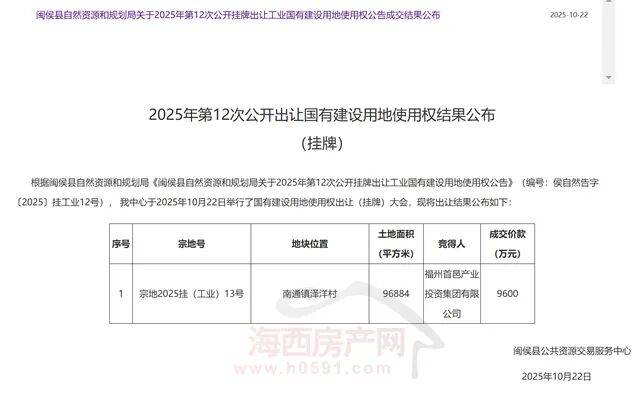
Core Points - The public resource trading service center of Minhou County announced the results of the 12th public auction for state-owned construction land use rights on October 22, 2025 [1] - Fuzhou Shouyi Industrial Investment Group Co., Ltd. won the bid for the industrial land parcel 2025挂(工业) 13号 located in Nantong Town, with a total area of 96,884 square meters and a transaction price of 96 million yuan [3][6] Company Overview - Fuzhou Shouyi Industrial Investment Group Co., Ltd. was established on July 14, 2020, and is located in the National Assets Building, 15th floor, 71 Binhai Avenue, Gancao Street, Minhou County, Fuzhou City, Fujian Province [4] - The company is involved in various activities including investment with its own funds, enterprise headquarters management, supply chain management services, and cultural venue management [4] Land Use and Development Requirements - The land parcel is designated for industrial use, specifically for the manufacturing of automotive parts, intelligent manufacturing, and electronic information [6] - The total area of the land is 96,884 square meters (approximately 145.33 acres), with a required investment intensity of no less than 3 million yuan per acre [7] - The construction must commence within six months of land delivery and be completed within 24 months, with penalties for delays [8][9]
【财经分析】“存量突围”“地尽其用” 要素市场化配置改革激活土地新潜能
Xin Hua Cai Jing· 2025-10-22 02:28
Core Viewpoint - The State Council has approved a pilot implementation plan for the market-oriented allocation of factors in ten regions, aiming to enhance the efficiency of land resource allocation and promote high-quality economic development by 2027 [1][2]. Group 1: Policy and Implementation - The pilot program is part of a broader effort to deepen the market-oriented allocation of factors, transitioning from administrative allocation to market-driven mechanisms to improve land resource utilization efficiency [2][3]. - The pilot areas include Beijing's urban sub-center, Hangzhou-Ningbo-Wenzhou, Hefei metropolitan area, and nine cities in the Guangdong-Hong Kong-Macao Greater Bay Area [1][2]. Group 2: Regional Developments - In Hangzhou, local authorities are implementing low-efficiency land redevelopment strategies, including optimizing land supply models and promoting "industrial upgrading" to enhance land use efficiency [3][4]. - Guangzhou has introduced a comprehensive reform plan to improve land utilization efficiency, including innovative approaches to marine land use and a "two rights unified" transfer model [4]. - Hefei is focusing on new industrialization strategies, particularly in the electric vehicle sector, with significant projects aimed at revitalizing low-efficiency industrial land [5][6]. Group 3: Rural Land Reforms - The reform of collective construction land is seen as a key breakthrough in breaking the urban-rural land divide, facilitating the entry of collective land into the market and enhancing rural asset value [6][7]. - Hefei has established a system for the market entry of collective construction land, with successful pilot projects already completed [6]. Group 4: Future Directions - The National Development and Reform Commission plans to adopt a problem-oriented approach, encouraging differentiated reforms and timely evaluations of pilot outcomes to create replicable models nationwide [7][8]. - Companies are encouraged to engage with local governments to revitalize existing commercial projects and land, optimizing their asset structures in response to the new policies [8].
北京上新9宗地,涉海淀上地、丰台花乡、通州宋庄等优质地块
Xin Jing Bao· 2025-10-16 14:13
Core Points - Beijing's Planning and Natural Resources Committee has released a list of 9 residential land plots for the eighth round of supply in 2025, covering approximately 44 hectares and a construction scale of about 1.03 million square meters [1] - The land plots are located in areas with strong market demand and well-developed infrastructure and public services [1] - The distribution includes 3 plots in the central urban area and 6 plots in sub-centers and plain multi-point areas [1] Group 1 - The central urban area includes 1 plot in Haidian District and 2 plots in Fengtai District [1] - The Haidian District plots are located between the Fifth and Sixth Ring Roads, near the subway lines 13 and Changping, with mature living facilities nearby [1][3] - The Fengtai District plots are situated between the Third and Fourth Ring Roads, close to the subway and with comprehensive living amenities [2][5] Group 2 - The sub-center and plain multi-point areas include plots in Tongzhou, Changping, Shunyi, Daxing, and the Economic Development Zone [1] - The Tongzhou plot is located outside the Sixth Ring Road, surrounded by shopping centers and parks [7] - The Shunyi plot is also between the Fifth and Sixth Ring Roads, with convenient transportation and nearby living facilities [9] Group 3 - The Changping District plots are located between the Fifth and Sixth Ring Roads, with access to the future science city and various parks [11][12] - The Daxing District plots are situated between the Fourth and Fifth Ring Roads, with planned subway access and nearby shopping centers [13][17] - The Economic Development Zone plot is located between the Fifth and Sixth Ring Roads, with nearby parks and shopping facilities [19]
总起拍价7.2亿元!白云挂牌2宗宅地 均为安置房用地
Sou Hu Cai Jing· 2025-10-15 16:57
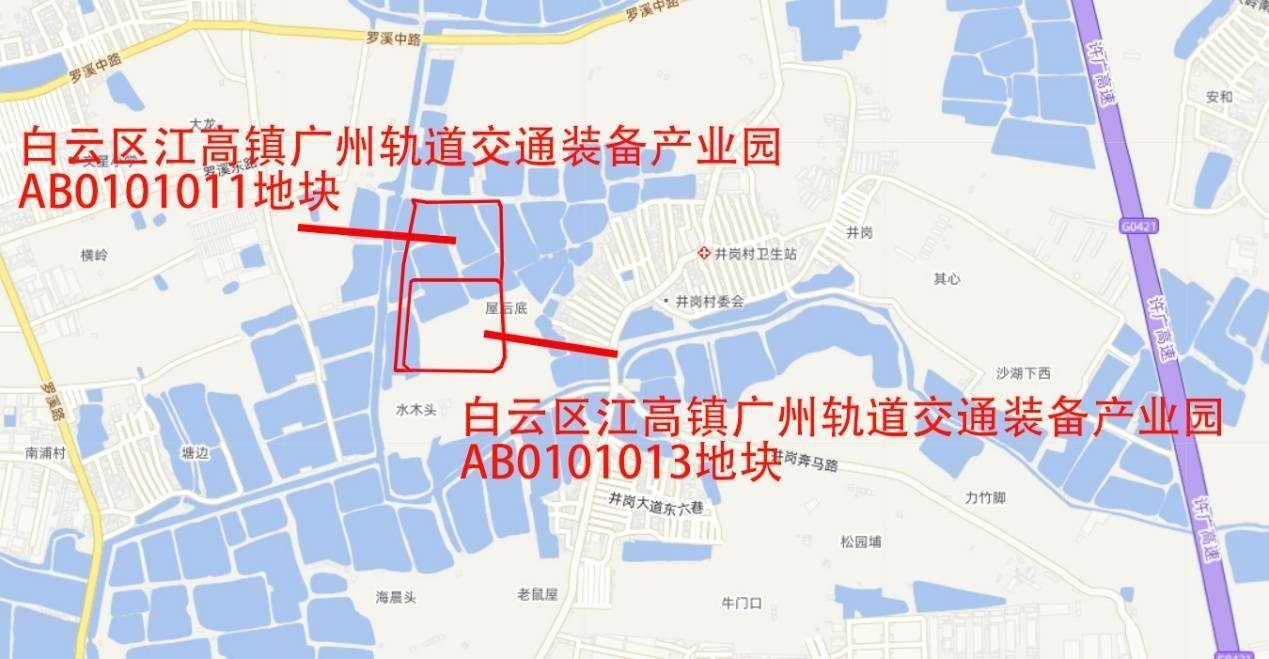
Core Viewpoint - Guangzhou's Planning and Natural Resources Bureau has listed two residential land parcels in Baiyun District for the purpose of relocation housing, specifically for the Guangzhou Rail Transit Equipment Industrial Park [1] Group 1: Land Parcel AB0101011 - The land parcel AB0101011 is designated for residential use (R2) with a total area of 28,201 square meters, of which 17,785 square meters is available for construction, and a floor area ratio of 3.5, resulting in a total buildable area of 62,248 square meters [3] - The starting price for this parcel is set at 290.75 million yuan, translating to a starting floor price of 4,671 yuan per square meter [3] - The land is intended for relocation housing, and the successful bidder must sign a project repurchase contract with Guangzhou Minke Urban Renewal Investment Co., Ltd. within one month of signing the land use rights transfer contract, with a total repurchase price of 889.31 million yuan [5] Group 2: Land Parcel AB0101013 - The land parcel AB0101013 is also designated for residential use (R2) with a total area of 30,081 square meters, of which 26,837 square meters is available for construction, and a floor area ratio of 3.5, resulting in a total buildable area of 93,929 square meters [6] - The starting price for this parcel is set at 433.06 million yuan, translating to a starting floor price of 4,610 yuan per square meter [6] - Similar to AB0101011, the successful bidder must sign a project repurchase contract with Guangzhou Minke Urban Renewal Investment Co., Ltd. within one month, with a total repurchase price of 1.29 billion yuan [8] Group 3: Location and Amenities - Both land parcels are adjacent to each other, located approximately 400 and 500 meters from the Xinshi West Ring Shenshan Station, with the western side already developed along Huangjinwei Avenue [7] - Educational facilities in the vicinity include one primary school (Wenxing Primary School) and two secondary schools (Shenshan Middle School and Guangzhou No. 66 Middle School), with plans for an additional 24-class primary school [7] - Commercial facilities include Shenshan Shopping Plaza, while medical facilities consist of Jianggao Town Health Center, and recreational areas include Luoxi Lotus Pool Park and Nanpu Village Cultural Square [10]