
电动汽车充电

Search documents
我国充电基础设施突破2000万大关 已建成全球最大的电动汽车充电网络
Yang Guang Wang· 2026-01-22 01:02
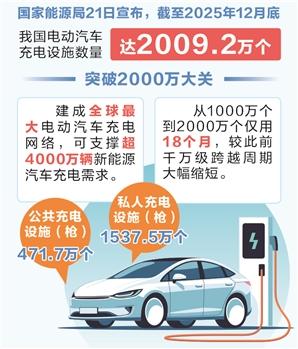
邹朋:从2006年建成首座充电站到2019年6月充电设施数量突破100万个,行业用了13年;从100万 个到2024年6月突破1000万个,行业用了5年;但从1000万到2000万仅用了18个月。 央广网北京1月22日消息(记者韩萌)据中央广播电视总台中国之声《新闻和报纸摘要》报道,国 家能源局昨天(21日)发布,截至2025年12月底,我国电动汽车充电设施数量突破2000万大关,已建成 全球最大的电动汽车充电网络,支撑了超4300万辆新能源汽车的充电需求。 邹朋还强调,2025年,我国充电设施覆盖范围更广,大功率充电设施布局建设速度更快。 最新数据显示,截至2025年12月底,我国电动汽车充电设施数量达到2009.2万个。其中,公共充电 设施471.7万个,私人充电设施1537.5万个。中国电动汽车充电基础设施促进联盟执行秘书长邹朋表示, 2025年,我国充电设施发展持续提质升级,规模增长速度更快。 邹朋:全国公共场站平均充电功率达到46.5千瓦,充电效率同比提升33%,充电服务体验明显提 升。此外,全国高速公路服务区累计建成充电桩7.15万个,覆盖了全国超98%的服务区,19个省份实现 了充电设施"乡乡全 ...
我国电动汽车充电基础设施(枪)总数突破2000万个
Zheng Quan Ri Bao· 2026-01-22 00:57
Core Insights - As of December 2025, China's electric vehicle charging infrastructure has reached a total of 20.092 million charging points, marking a year-on-year growth of 49.7% and surpassing the 20 million milestone [1] - Public charging facilities account for 4.717 million units, with a year-on-year increase of 31.9%, while private charging facilities have reached 15.375 million, growing by 56.2% [1] - The total rated power of public charging stations is 220 million kilowatts, with an average power of approximately 46.53 kilowatts, reflecting a 33% improvement in charging efficiency [1] Summary by Categories Growth and Scale - The growth of charging infrastructure has accelerated significantly, with the time taken to increase from 1 million to 2 million charging points reduced to just 18 months, compared to 13 years for the first million [1] - The overall trend indicates a rapid expansion of the charging network, supporting over 40 million new energy vehicles in China [1] Charging Efficiency - The average charging power for public charging stations has reached 46.5 kilowatts, indicating a substantial improvement in charging efficiency and service experience [1] Coverage and Structure - The number of charging stations in national highway service areas has reached 71,500, covering over 98% of service areas, with 19 provinces achieving "full coverage" of charging facilities [2] - The current structure of charging facilities is characterized by a predominance of private charging points, which cater primarily to home charging needs, while public charging points are better suited for long-distance travel [2]

国家能源局:我国电动汽车充电基础设施(枪)总数突破2000万个
Zheng Quan Ri Bao· 2026-01-21 16:05
Core Insights - The National Energy Administration reported that by the end of December 2025, China's electric vehicle charging infrastructure reached 20.092 million units, a year-on-year increase of 49.7%, surpassing the 20 million mark [1][2] - Public charging facilities accounted for 4.717 million units, growing by 31.9%, with a total rated power of 220 million kilowatts, averaging 46.53 kilowatts per unit [1] - Private charging facilities reached 15.375 million units, a 56.2% increase, with a total installed capacity of 134 million kilovolt-amperes [1] Summary by Categories Growth and Scale - The growth of charging infrastructure has accelerated significantly, with the time taken to increase from 10 million to 20 million units reduced to just 18 months [1] - The first charging station was built in 2006, and it took 13 years to reach 1 million units, while it took only 5 years to grow from 1 million to 10 million [1] Charging Efficiency - The average charging power of public charging stations reached 46.5 kilowatts, with a year-on-year efficiency improvement of 33%, enhancing the charging service experience [1] Coverage and Structure - A total of 71,500 charging stations have been built in highway service areas, covering over 98% of service areas nationwide, with 19 provinces achieving "full coverage" of charging facilities [2] - The current structure of charging facilities is characterized by a predominance of private charging stations, which primarily meet home charging needs, while public stations cater to long-distance travel [2]
突破2000万个!我国建成全球最大电车充电网络!
Xin Lang Cai Jing· 2026-01-21 10:24
Core Insights - The latest data from the National Energy Administration indicates that by the end of December 2025, the number of electric vehicle charging facilities in China will reach 20.092 million, surpassing the 20 million mark, with 4.717 million public charging facilities and 15.375 million private charging facilities [1][4]. Group 1: Growth Characteristics - The growth of charging facilities is accelerating, with the time taken to increase from 10 million to 20 million facilities being only 18 months, compared to 5 years for the previous increase from 1 million to 10 million [3][7]. - Charging efficiency is improving, with the average charging power of public charging stations reaching 46.5 kW, representing a 33% year-on-year increase in charging efficiency [3][7]. - The coverage of charging facilities is expanding, with 71,500 charging piles built in national highway service areas, covering over 98% of service areas, and 19 provinces achieving "full coverage" of charging facilities in every township [3][7]. Group 2: Future Plans - In September 2025, a joint action plan titled "Three-Year Doubling Action Plan for Electric Vehicle Charging Facility Service Capacity (2025-2027)" was issued by six departments, outlining the goals and action paths for the development of charging facilities in the coming period [3][7]. - The National Energy Administration will strengthen work coordination, improve the policy system, and guide localities to accelerate the planning and construction of charging facilities to effectively promote the consumption of new energy vehicles [3][7].
国家能源局:我国充电基础设施数量突破2000万大关
Zhong Guo Xin Wen Wang· 2026-01-21 05:38
国家能源局:我国充电基础设施数量突破2000万大关 中新网1月21日电 据国家能源局微信公众号消息,截至2025年12月底,我国电动汽车充电设施数量达到 2009.2万个,突破2000万大关。其中,公共充电设施(枪)471.7万个,私人充电设施(枪)1537.5万个。目 前,我国已建成全球最大的电动汽车充电网络,支撑了超4000万辆新能源汽车的充电需求。 2025年我国充电设施发展持续提质升级,总体呈现三方面的特点:一是规模增长更快,从2006年我国建 成首座充电站到2019年6月充电设施数量突破100万个,用了13年;从100万个到2024年6月突破1000万 个,用了5年;但从1000万到2000万仅用了18个月。二是充电效率更高,大功率充电设施加快布局建 设,全国公共场站单枪平均充电功率达到46.5千瓦,充电效率同比提升33%,充电服务体验明显提升。 三是设施覆盖更广,全国高速公路服务区累计建成充电桩7.15万个,覆盖了全国超98%的服务区,19个 省份实现了充电设施"乡乡全覆盖"。 2025年9月,国家发展改革委、国家能源局等六部门联合印发《电动汽车充电设施服务能力"三年倍 增"行动方案(2025—2 ...
我国电动汽车充电设施数量突破2000万
Xin Hua She· 2026-01-21 04:20
国家能源局介绍,我国充电设施发展提质升级,呈现三大显著特点。规模增长持续提速,从1000万个到 2000万个仅用18个月,较此前千万级跨越周期大幅缩短;充电效率显著提升,全国公共场站单枪平均充 电功率达46.5千瓦,同比提升33%;设施覆盖更加广泛,全国超98%高速公路服务区建成充电桩7.15万 个,19个省份实现充电设施"乡乡全覆盖"。(完) 其中,公共充电设施(枪)471.7万个,私人充电设施(枪)1537.5万个。 新华社北京1月21日电(记者戴小河、王悦阳)国家能源局21日宣布,截至2025年12月底,我国电动汽 车充电设施数量达2009.2万个,突破2000万大关,建成全球最大电动汽车充电网络,可支撑超4000万辆 新能源汽车充电需求。 ...
我国充电基础设施数量突破2000万大关 呈三方面特点
Yang Shi Wang· 2026-01-21 03:38
2025年9月,国家发展改革委、国家能源局等六部门联合印发《电动汽车充电设施服务能力"三年倍 增"行动方案(2025—2027年)》,明确了今后一段时期充电设施发展的目标和行动路径。下一步,国 家能源局将加强工作统筹,完善政策体系,督促指导各地加快充电设施规划建设,有效促进新能源汽车 消费,确保《行动方案》落地见效。 2025年我国充电设施发展持续提质升级,总体呈现三方面的特点:一是规模增长更快,从2006年我国建 成首座充电站到2019年6月充电设施数量突破100万个,用了13年;从100万个到2024年6月突破1000万 个,用了5年;但从1000万到2000万仅用了18个月。二是充电效率更高,大功率充电设施加快布局建 设,全国公共场站单枪平均充电功率达到46.5千瓦,充电效率同比提升33%,充电服务体验明显提升。 三是设施覆盖更广,全国高速公路服务区累计建成充电桩7.15万个,覆盖了全国超98%的服务区,19个 省份实现了充电设施"乡乡全覆盖"。 央视网消息:据国家能源局微信公众号消息,截至2025年12月底,我国电动汽车充电设施数量达到 2009.2万个,突破2000万大关。其中,公共充电设施(枪)4 ...
我国电动汽车充电基础设施(枪)总数突破2000万大关
Yang Shi Wang· 2026-01-21 03:31
Core Insights - The National Energy Administration of China reported that by the end of December 2025, the total number of electric vehicle charging infrastructure (units) in China reached 20.092 million, marking a year-on-year growth of 49.7% and surpassing the 20 million milestone [1] Group 1: Charging Infrastructure Overview - The total number of public charging facilities (units) reached 4.717 million, with a year-on-year increase of 31.9% [1] - The total rated power of public charging stations reached 220 million kilowatts, with an average power of approximately 46.53 kilowatts [1] - The number of private charging facilities (units) reached 15.375 million, showing a year-on-year growth of 56.2% [1] Group 2: Capacity and Power Metrics - The installed electricity capacity for private charging facilities reached 134 million kilovolt-amperes [1]
截至2025年底,我国电动汽车充电基础设施总数达到2009.2万个,同比增长49.7%
Jin Rong Jie· 2026-01-21 03:27
Core Insights - The National Energy Administration released data on electric vehicle charging infrastructure in China as of December 2025, indicating significant growth in the sector [1] Group 1: Overall Infrastructure Growth - The total number of electric vehicle charging facilities in China reached 20.092 million by the end of December 2025, representing a year-on-year increase of 49.7% [1] - The number of public charging facilities reached 4.717 million, with a year-on-year growth of 31.9% [1] - The total rated power of public charging piles reached 220 million kilowatts, with an average power of approximately 46.53 kilowatts [1] Group 2: Private Charging Facilities - The number of private charging facilities reached 15.375 million, showing a year-on-year increase of 56.2% [1] - The installed power capacity for private charging facilities reached 134 million kilovolt-amperes [1]