统建统服

Search documents
全球最大电动汽车充电网络持续升级 到2027年底将建成2800万个充电设施
Ren Min Ri Bao· 2026-01-29 07:42
Core Insights - The rapid expansion of electric vehicle (EV) charging infrastructure in China aims to support the increasing number of electric vehicles, with a target of 20.09 million charging facilities by the end of 2025 and 28 million by the end of 2027 [1] - The "Three-Year Doubling Action Plan" emphasizes enhancing charging network efficiency, service quality, and innovation in the industry ecosystem to accommodate the growing EV ownership [1] Group 1: Charging Infrastructure Development - By the end of 2025, China aims to have 20.09 million electric vehicle charging facilities, supporting over 43 million electric vehicles [1] - The plan includes building 28 million charging facilities by 2027, providing over 300 million kilowatts of public charging capacity to meet the needs of over 80 million electric vehicles [1] - The development of high-speed service areas with ultra-fast charging stations and rural areas with accessible charging points is underway to improve charging conditions [1] Group 2: Fast Charging Stations - The Taohu Service Area in Suzhou has implemented a "dual-gun" charging system that can charge a vehicle in 15 minutes, significantly improving efficiency [2] - The service area features four dedicated charging spots for heavy-duty electric trucks, with a maximum output power of 480 kilowatts, nearly four times that of traditional fast charging [2] - The average daily service at the Taohu Service Area is 173 vehicles, with an average charging time of 20 minutes [3] Group 3: Rural Charging Solutions - In Dongguo Village, Shanxi Province, local residents now have access to charging stations, alleviating previous concerns about charging accessibility [4] - Longzi County has been selected as a pilot for enhancing charging infrastructure, with plans to build charging stations in 96 villages, aiming for a coverage rate of over 65% [5] - The local government is encouraging private investment in charging infrastructure through subsidy policies [5] Group 4: Community Charging Initiatives - In Chengdu, the "Unified Construction and Service" model is being implemented to address charging difficulties in residential areas, allowing for centralized planning and management of charging facilities [6] - The community has identified over 300 electric vehicles in the area and plans to install around 40 charging stations across two zones [7] - This model is being replicated in other old and resettlement communities to enhance charging convenience for residents [7]
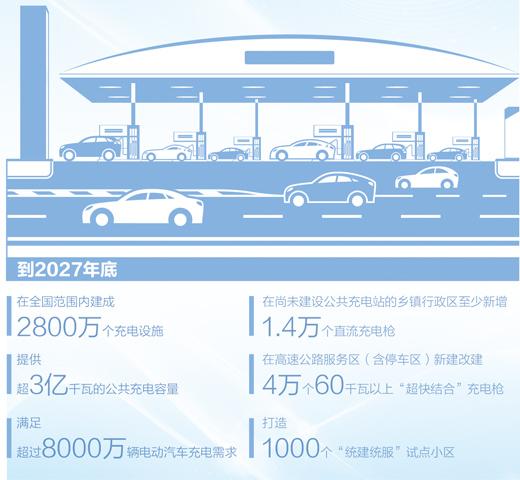
到2027年底将建成2800万个充电设施,服务能力加速增长 全球最大电动汽车充电网络持续升级(大数据观察)
Ren Min Ri Bao· 2026-01-28 22:08
Group 1: Electric Vehicle Charging Infrastructure Development - By the end of December 2025, the number of electric vehicle charging facilities in China is expected to reach 20.092 million, supporting over 43 million electric vehicles [1] - The "Three-Year Doubling Action Plan for Electric Vehicle Charging Facility Service Capacity (2025-2027)" aims to establish 28 million charging facilities by the end of 2027, providing over 300 million kilowatts of public charging capacity to meet the charging needs of over 80 million electric vehicles [1] - The plan emphasizes the continuous improvement of the charging network, enhancement of charging efficiency, optimization of service quality, and innovation in the industry ecosystem to accommodate the increasing number of electric vehicles [1] Group 2: Fast Charging Stations and Technology - The Taihu Service Area in Suzhou has implemented a "dual-gun" charging system that allows two vehicles to charge simultaneously, achieving a charging speed of 63 kilowatt-hours in just 15 minutes [2] - The service area features four dedicated charging spots for electric heavy trucks, with a maximum output power of 480 kilowatts, which is nearly four times more efficient than traditional fast charging [2] - The Taihu Service Area's supercharging station, operational since September last year, integrates a flexible shared supercharging system with an intelligent operation and maintenance system for enhanced safety and efficiency [2][3] Group 3: Rural Charging Solutions - In Dongguo Village, Shanxi Province, a local resident can charge their electric vehicle at a nearby charging station for 0.68 yuan per kilowatt-hour, significantly alleviating "range anxiety" for residents [4][5] - Longzi County has been selected as a pilot for charging infrastructure development, with plans to build charging stations in 96 villages, aiming for a coverage rate of over 65% [5] - The local government is encouraging private investment in charging infrastructure through subsidy policies, while addressing the challenges of existing rural power grid capacity [5] Group 4: Community Charging Initiatives - In Chengdu, the "Unified Construction and Service" model has been adopted to facilitate the installation of public charging facilities in residential areas, addressing the challenges faced by residents in accessing charging points [6][7] - The community has identified over 300 electric vehicles in the area and plans to install approximately 40 charging stations across two zones, with a management system in place for usage and revenue distribution [7] - The "Unified Construction and Service" model is being promoted in various old and resettlement communities to enhance charging convenience for residents [7]
破解老旧小区新能源汽车充电难题 杭州走出多方协同新路径
Hang Zhou Ri Bao· 2025-12-02 02:47
Core Viewpoint - The article discusses the accelerated construction of charging stations for electric vehicles in old residential communities in Hangzhou, highlighting the collaborative efforts of various stakeholders to address the challenges of charging accessibility and affordability for residents [3][4][7]. Group 1: Charging Infrastructure Development - As of the end of last year, Hangzhou has set up 1,321 public charging stations and 18,900 charging facilities in 2,192 old residential communities, achieving a coverage radius of 900 meters for charging services [4]. - In 2023, 265 public charging facilities have been added in 18 old community renovation projects, demonstrating a commitment to integrating charging infrastructure with community upgrades [4][5]. - The city has implemented a "unified construction and service" model, leveraging state-owned enterprises to streamline the construction and management of charging facilities [7][8]. Group 2: Collaborative Efforts and Governance - The construction of charging facilities in old communities requires multi-party collaboration, including property management, resident committees, and government support [9][11]. - A three-party collaboration mechanism has been established under the Hangzhou Property Management Regulations, enhancing the role of party organizations in coordinating charging facility projects [11]. - The city is focusing on public awareness and resident engagement to alleviate concerns about parking impacts from charging facility installations, aiming to improve overall satisfaction and convenience for residents [11].


经济聚焦丨充电服务能力如何“倍增”
Ren Min Ri Bao· 2025-11-20 08:48
Core Viewpoint - The National Development and Reform Commission and five other departments have jointly issued the "Three-Year Doubling Action Plan for Electric Vehicle Charging Facility Service Capacity (2025-2027)", aiming to double the charging service capacity by the end of 2027 [2][3]. Summary by Sections Charging Infrastructure Development - By the end of 2027, the plan aims to establish 28 million charging facilities nationwide, providing over 300 million kilowatts of public charging capacity to meet the charging needs of over 80 million electric vehicles, effectively doubling the service capacity [2][3]. - The action plan is expected to drive over 200 billion yuan in investment in charging facility equipment manufacturing and construction [2]. Spatial Layout and Functionality - The plan emphasizes the need to improve the construction of charging facilities in rural areas, where the infrastructure is currently lacking compared to urban areas [3]. - It aims to add at least 14,000 direct current charging guns in townships without public charging stations by the end of 2027, ensuring comprehensive coverage of public charging facilities in rural areas [3][4]. High-Power Charging Facilities - The average power of public charging facilities in China is currently only 45.5 kilowatts, which is insufficient for high-demand scenarios during holidays and in urban hotspots [4]. - The plan includes the construction of 40,000 high-power charging guns (over 60 kilowatts) in key cities and highway service areas by 2027 [4]. Vehicle-Grid Interaction - The plan proposes to expand vehicle-grid interaction pilot programs, which connect electric vehicles with the power grid to optimize charging and discharging processes [6][7]. - This interaction can help manage electricity demand and enhance the utilization of renewable energy sources [7]. Community Charging Solutions - The "Unified Construction and Service" model is being piloted in residential areas to address charging difficulties, allowing residents to charge their vehicles conveniently and at lower costs [8][9]. - By the end of 2027, the plan aims to establish 1,000 pilot communities under this model, significantly improving the access and management of private charging stations [9].
媒体报道丨到2027年底满足超8000万辆电动汽车充电需求 充电服务能力如何“倍增”
国家能源局· 2025-11-18 08:14
Core Viewpoint - The article discusses the "Three-Year Doubling Action Plan" for electric vehicle charging infrastructure in China, aiming to double the charging service capacity by the end of 2027 to meet the growing demand from over 80 million electric vehicles [4][5]. Group 1: Charging Infrastructure Goals - By the end of 2027, the plan aims to establish 28 million charging facilities, providing over 300 million kilowatts of public charging capacity [5]. - The initiative is expected to drive over 200 billion yuan in investments in charging facility equipment manufacturing and construction [5]. Group 2: Spatial Layout and Functionality - The plan emphasizes the need for balanced development of charging facilities, particularly in rural areas where infrastructure is currently lacking [6]. - It aims to add at least 14,000 direct current charging guns in townships without public charging stations by 2027 [6]. - The average power of public charging facilities is currently 45.5 kilowatts, which is insufficient for high-demand scenarios during holidays [7]. Group 3: Innovation and Interaction - The article highlights the importance of vehicle-grid interaction, where charging stations can facilitate two-way energy flow, allowing electric vehicles to discharge energy back to the grid [8][9]. - The plan proposes to expand vehicle-grid interaction pilot projects, focusing on innovative pricing policies and market mechanisms [9]. Group 4: Community Charging Solutions - The "Unified Construction and Service" model is being piloted in residential areas to simplify the installation and management of charging facilities [10][11]. - By 2027, the goal is to establish 1,000 pilot communities under this model, which is expected to generate over 1 billion yuan in investments [11].
电动汽车充电需求大幅攀升 充电服务能力如何“倍增”
Ren Min Ri Bao· 2025-11-18 00:55
Core Points - The article discusses the "Three-Year Doubling Action Plan for Electric Vehicle Charging Facility Service Capacity (2025-2027)" issued by the National Development and Reform Commission and five other departments, aiming to double the charging service capacity by the end of 2027 [2][3][4] Group 1: Charging Infrastructure Development - By the end of 2027, the plan aims to establish 28 million charging facilities nationwide, providing over 300 million kilowatts of public charging capacity to meet the charging needs of over 80 million electric vehicles [2][3] - The plan is expected to drive over 200 billion yuan in investment in charging facility equipment manufacturing and construction [2][3] Group 2: Spatial Layout and Functionality - The plan emphasizes the need to improve the construction of charging facilities in rural areas, where the infrastructure is currently lacking compared to urban areas [3][4] - It aims to add at least 14,000 direct current charging guns in townships without public charging stations by the end of 2027, ensuring comprehensive coverage of public charging facilities in rural areas [3][4] Group 3: Power Capacity and Speed - The average power of public charging facilities in China is currently only 45.5 kilowatts, which is insufficient for high-demand scenarios during holidays and in urban hotspots [4] - The plan includes the construction of 40,000 "super-fast combined" charging guns with over 60 kilowatts in highway service areas by the end of 2027 [4] Group 4: Innovation and Vehicle-Grid Interaction - The article highlights the development of vehicle-grid interaction, where charging stations can reverse charge to the grid, enhancing the flexibility of electric vehicles as energy storage resources [6][7] - The plan proposes to expand the pilot scope of vehicle-grid interaction, exploring innovations in pricing policies and market mechanisms [6][7] Group 5: Community Charging Solutions - The "Unified Construction and Service" model is being piloted in residential areas, allowing residents to charge their vehicles conveniently without incurring installation costs [8][9] - By the end of 2027, the plan aims to establish 1,000 pilot communities under this model, significantly improving the access and safety of private charging stations [9]
到2027年底满足超8000万辆电动汽车充电需求 充电服务能力如何“倍增”
Ren Min Ri Bao· 2025-11-18 00:14
Core Viewpoint - The National Development and Reform Commission and five other departments have jointly issued the "Three-Year Doubling Action Plan for Electric Vehicle Charging Facility Service Capacity (2025-2027)", aiming to double the charging service capacity by the end of 2027 [2][3] Summary by Sections Charging Infrastructure Development - By the end of 2027, the plan aims to establish 28 million charging facilities nationwide, providing over 300 million kilowatts of public charging capacity to meet the charging needs of over 80 million electric vehicles [2] - The action plan is expected to stimulate over 200 billion yuan in investment in charging facility equipment manufacturing and construction [2] Spatial Layout and Functionality - The plan emphasizes the need to improve the construction of charging facilities in rural areas, where the infrastructure is currently lacking compared to urban areas [3] - It aims to add at least 14,000 direct current charging guns in townships without public charging stations by the end of 2027, ensuring comprehensive coverage of public charging facilities in rural areas [3] - The average power of public charging facilities in China is currently only 45.5 kilowatts, which is insufficient for high-demand scenarios during holidays and in urban hotspots [4] - The plan includes the construction of 40,000 "super fast combination" charging guns with over 60 kilowatts in highway service areas by 2027 [4] Innovation and Interaction - The plan proposes to expand the trial scope of vehicle-grid interaction, which connects electric vehicles with the power grid for organized charging and discharging [5][7] - A NIO battery swap station in Nanjing allows for a quick battery swap process, with the remaining battery power being fed back into the grid [6] Community Charging Solutions - The "Unified Construction and Service" model is being piloted in residential areas, allowing residents to charge their vehicles conveniently without incurring installation costs [8][9] - By the end of 2027, the plan aims to establish 1,000 "Unified Construction and Service" pilot communities, significantly enhancing the access and safety management of private charging piles [9]
我国充电服务能力如何"倍增"
Ren Min Ri Bao· 2025-11-17 23:41
Core Viewpoint - The National Development and Reform Commission and five other departments have jointly issued the "Three-Year Doubling Action Plan for Electric Vehicle Charging Facility Service Capacity (2025-2027)", aiming to double the charging service capacity by the end of 2027, with a target of building 28 million charging facilities and providing over 300 million kilowatts of public charging capacity to meet the charging needs of over 80 million electric vehicles [1][2]. Group 1: Charging Infrastructure Development - The action plan emphasizes both scale and power as evaluation indicators for the development of a high-quality charging facility system, which is expected to drive over 200 billion yuan in investment in charging facility equipment manufacturing and construction [2]. - The plan aims to address the imbalance in charging facility construction between urban and rural areas, with a focus on enhancing charging infrastructure in rural regions where challenges such as weak power grids and low electric vehicle ownership exist [2][3]. - By the end of 2027, at least 14,000 direct current charging guns will be added in townships without public charging stations, ensuring comprehensive coverage of public charging facilities in rural areas [2]. Group 2: Technological Innovations - The average power of public charging facilities in China is currently only 45.5 kilowatts, which is insufficient for rapid charging needs during peak travel times. The action plan aims to accelerate the planning and construction of high-power charging facilities in key cities and highway service areas [3][4]. - The plan includes the construction of 40,000 "super fast combination" charging guns with over 60 kilowatts in highway service areas by the end of 2027 to meet the demand for fast charging [3]. Group 3: Vehicle-Grid Interaction - The action plan proposes to continuously expand the pilot scope of vehicle-grid interaction, which connects electric vehicles with the power grid to facilitate smart charging and bidirectional power flow, effectively utilizing electric vehicles as flexible energy storage resources [5][6]. - The implementation of vehicle-grid interaction on a large scale is still in the preparatory phase, requiring advancements in technology, mechanisms, and policies to support future applications [6]. Group 4: Community Charging Solutions - The "Unified Construction and Service" model is being piloted in residential areas to address the challenges of charging infrastructure in older communities, allowing residents to charge their vehicles conveniently and at lower costs [7][8]. - By the end of 2027, the plan aims to establish 1,000 "Unified Construction and Service" pilot communities, significantly enhancing the access and safety management of private charging piles, which is expected to stimulate over 1 billion yuan in investment [8].
到2027年底满足超8000万辆电动汽车充电需求——充电服务能力如何“倍增”
Xin Hua Wang· 2025-11-17 23:39
Core Insights - The National Development and Reform Commission and five other departments have jointly issued the "Three-Year Doubling Action Plan for Electric Vehicle Charging Facility Service Capacity (2025-2027)", aiming to double the charging service capacity by the end of 2027 [2][3] Summary by Sections Charging Infrastructure Development - By the end of 2027, the plan aims to establish 28 million charging facilities nationwide, providing over 300 million kilowatts of public charging capacity to meet the charging needs of over 80 million electric vehicles [2] - The action plan is expected to drive over 200 billion yuan in investment in charging facility equipment manufacturing and construction [2] Spatial Layout and Functionality - The plan emphasizes the need to improve the construction of charging facilities in rural areas, where the infrastructure is currently lacking compared to urban areas [3] - It proposes adding at least 14,000 direct current charging guns in townships without public charging stations by the end of 2027, ensuring comprehensive coverage of public charging facilities in rural areas [3] - The average power of public charging facilities in China is currently only 45.5 kilowatts, which is insufficient for high-demand scenarios during holidays [4] - The plan includes the construction of 40,000 "super-fast combined" charging guns with over 60 kilowatts in key cities and highway service areas by 2027 [4] Innovation and Interaction - The plan promotes the expansion of vehicle-grid interaction pilot programs, allowing electric vehicles to connect with the power grid for smart charging and bidirectional energy flow [5][6] - The NIO battery swap station in Nanjing exemplifies this innovation, enabling battery swapping and reverse energy delivery to the grid [5][6] Community Charging Solutions - The "Unified Construction and Service" model is being piloted in residential areas, allowing residents to charge their vehicles conveniently without incurring installation costs [7][8] - By the end of 2027, the plan aims to establish 1,000 "Unified Construction and Service" pilot communities, significantly enhancing the access and safety of private charging stations [8]
充电服务能力如何“倍增”
Ren Min Ri Bao· 2025-11-17 23:11
Core Viewpoint - The National Development and Reform Commission and five other departments have jointly issued the "Three-Year Doubling Action Plan for Electric Vehicle Charging Facility Service Capacity (2025-2027)", aiming to double the charging service capacity by the end of 2027 [2][3]. Summary by Sections Charging Infrastructure Development - By the end of 2027, the plan aims to establish 28 million charging facilities nationwide, providing over 300 million kilowatts of public charging capacity to meet the charging needs of over 80 million electric vehicles, effectively doubling the service capacity [3]. - The action plan is expected to stimulate over 200 billion yuan in investment in charging facility equipment manufacturing and construction [3]. Spatial Layout and Functionality - The current charging service capacity is relatively sufficient in urban areas, but rural areas face challenges due to weaker power grids and lower electric vehicle ownership [4]. - The plan emphasizes the need to enhance charging infrastructure in rural areas, with a target of adding at least 14,000 direct current charging guns in townships without existing public charging stations by 2027 [5]. - The average power of public charging facilities is currently 45.5 kilowatts, which is inadequate for high-demand scenarios during holidays; thus, the plan includes the construction of 40,000 high-power charging guns (over 60 kilowatts) in key cities and highway service areas [6]. Innovation and Interaction - The plan promotes the expansion of vehicle-grid interaction pilot projects, which allow electric vehicles to connect with the power grid for smart charging and discharging [7][8]. - The dual-direction charging stations can charge during low-demand periods and discharge during peak times, generating additional revenue for operators [7]. Inclusivity and Community Engagement - The "Unified Construction and Service" model is being piloted in residential areas to address charging difficulties, allowing residents to charge their vehicles conveniently at home without incurring installation costs [9][10]. - By the end of 2027, the plan aims to establish 1,000 pilot communities under this model, significantly improving the access and safety of private charging stations [10].