
Semiconductor Foundry

Search documents
5 Dividend Growth Stocks for a Safe & Income-Driven Portfolio
ZACKS· 2025-07-16 16:11
Core Insights - Dividend investing is gaining popularity in 2025 due to market volatility and uncertainties, with U.S. stocks near record highs driven by trade optimism, strong corporate earnings, and AI advancements [1][2] Group 1: Dividend Growth Strategy - Dividends provide a reliable income stream, making them appealing during uncertain times, and dividend-paying stocks tend to stabilize portfolios [2][9] - Companies with a history of increasing dividends are typically financially strong and offer better long-term capital appreciation, leading to a more resilient portfolio [3][4] - Focusing on dividend growth rather than just yield can enhance returns, as these stocks often have superior fundamentals, including sustainable business models and strong cash flows [5][6] Group 2: Stock Selection Criteria - Selected stocks for dividend growth include Agnico Eagle Mines Limited (AEM), UGI Corporation (UGI), Qifu Technology Inc. (QFIN), Taiwan Semiconductor Manufacturing Company Ltd. (TSM), and Group 1 Automotive (GPI), all showing strong earnings and sales growth [3][9] - Criteria for selection include positive historical dividend growth, sales growth, and earnings per share (EPS) growth, along with expected future EPS growth [7][8] - Stocks are also evaluated based on their price-to-cash flow ratio being less than the industry average and having outperformed the S&P 500 over the past year [8][9] Group 3: Individual Stock Highlights - AEM is a gold producer with a positive earnings estimate revision of $0.42 and an estimated earnings growth rate of 52.5%, holding a Zacks Rank 1 and a Growth Score of B [10][11] - UGI Corp. has an estimated earnings growth rate of 2.29% and an average earnings surprise of 75.67%, also holding a Zacks Rank 1 and a Growth Score of B [12][13] - Qifu Technology has an estimated earnings growth rate of 25.62% and a Zacks Rank 1 with a Growth Score of B [14][15] - TSM has an estimated earnings growth rate of 34.66% and holds a Zacks Rank 2 with a Growth Score of A [15] - Group 1 Automotive has an estimated earnings growth rate of 4.3% and holds a Zacks Rank 1 with a Growth Score of A [16]





弘则研究 科技前言:晶圆代工行业调研
2025-07-16 15:25
Summary of Conference Call on the Wafer Foundry Industry Industry Overview - The conference call focused on the wafer foundry industry, specifically Tower Semiconductor and its operations in various global markets including Israel, Japan, the United States, and Italy [1][3][4]. Key Points and Arguments Production Capacity and Utilization - Tower Semiconductor has multiple production bases globally but lacks a physical factory in China, relying instead on a cooperative testing facility [1][3]. - Utilization rates vary significantly across locations: - Israel: 60%-70% - Japan: 85% for the 12-inch joint venture factory, lower for the 8-inch traditional factory - Texas, USA: below 50% [4][6]. - The 8-inch CMOS sector is experiencing price reductions due to weak downstream demand, while the 12-inch product line faces intense competition [1][3][4]. Market Competition - The Chinese wafer foundry market is highly competitive, with local firms like SMIC and Hua Hong actively enhancing their capacity and technology, primarily starting from 55/65 nm CMOS processes [1][7]. - Price wars are ongoing, particularly in the analog product sector, with expectations of more mergers and acquisitions in the near future [1][8]. Geopolitical Influences - Geopolitical factors are driving domestic substitution, with major end customers requiring a certain percentage of their supply chain to be located domestically [1][9][10]. - This has led to larger domestic companies becoming secondary or tertiary suppliers [10][28]. Demand Trends - Demand for mobile RF components is currently stagnant, with no significant changes in purchasing intentions despite government incentives [11]. - Emerging markets such as automotive electronics and AI-driven optical modules have not yet fully replaced traditional mobile RF demand [11][18]. Technology and Product Development - Tower Semiconductor excels in RF and analog products, including BCD processes and specialized MEMS applications [2][5]. - The silicon photonics market is rapidly growing, with expected output increasing fivefold in 2024, contributing 15%-20% to overall revenue [3][20]. Future Outlook - The silicon photonics technology is anticipated to continue its high growth trajectory, with a significant expansion in the customer base [20]. - Domestic wafer foundries face challenges such as overcapacity and intense technological competition, particularly in the 12-inch market [26][28]. Additional Important Insights - The competition between design companies and wafer foundries is distinct, with wafer foundries adjusting capacity based on downstream demand rather than internal design competition [12][15]. - The domestic wafer foundry industry is currently in a phase of rapid development, but many companies are still in the early stages of technology accumulation, particularly in silicon photonics [24][25]. - Geopolitical factors are pushing domestic companies to seek partnerships with Asian firms to mitigate risks associated with reliance on U.S. technology and resources [28].
Prediction: This Magnificent Artificial Intelligence (AI) Stock Will Skyrocket to New Highs in July
The Motley Fool· 2025-07-04 11:36
Core Viewpoint - TSMC's stock has surged 37% in the past three months, with expectations of reaching new highs following its upcoming Q2 earnings report on July 17 [1][12]. Group 1: Market Position and Revenue Growth - TSMC's foundry market share has increased to nearly 68% in Q1 2025, a six percentage point improvement year-over-year [4]. - The company experienced significant revenue growth, with April revenue up 48% year-over-year and May revenue up almost 40% [5]. - Analysts project a 37% increase in TSMC's Q1 revenue compared to the previous year, indicating strong performance [5]. Group 2: Demand for AI Chips - TSMC is witnessing a surge in demand for AI chips, with major clients like Nvidia and Apple increasing orders [6][7]. - The company is expanding its production capacity, planning to build nine new fabrication plants by 2025 to meet this demand [7]. Group 3: Financial Performance Expectations - TSMC is expected to exceed Wall Street's Q2 expectations due to increased capacity and strong demand for its chips [8]. - The company is raising prices for its current and next-generation process nodes, which may enhance its margin profile and earnings growth [9]. - Analysts forecast a 54% increase in TSMC's earnings for the current quarter, estimating earnings of $2.28 per share [11]. Group 4: Valuation and Investment Considerations - TSMC is trading at 27 times sales, which is lower than the Nasdaq-100 index's price-to-earnings ratio of 32, making it an attractive investment [13]. - The forward earnings multiple of 24 is appealing, especially with expected acceleration in bottom-line growth [14]. - The strong outlook for TSMC, driven by robust demand for AI chips, suggests potential for stock price appreciation [12][16].

最新10大晶圆代工厂排名!
国芯网· 2025-06-10 10:42
Core Viewpoint - The global wafer foundry industry is experiencing a seasonal revenue decline of approximately 5.4%, reaching $36.4 billion in Q1 2025, influenced by the U.S. tariff policy and China's old-for-new subsidy program [1][4]. Group 1: Industry Overview - According to TrendForce, the global wafer foundry industry is expected to see a revenue decrease of about 5.4% in Q1 2025, totaling $36.4 billion, due to the impact of U.S. tariff policies and the advance stocking effect before the expiration of tariff exemptions [1]. - The overall industry revenue is being supported by China's continuation of the old-for-new subsidy policy, which mitigates some seasonal impacts [1]. Group 2: Company Performance - TSMC maintains the top position with a market share of 67.6%, reporting a revenue of $25.5 billion, a 5% decrease due to the smartphone inventory seasonality, partially offset by stable AI HPC demand and urgent orders from television manufacturers [4]. - Samsung, ranked second, faced an 11.3% revenue decline to $2.89 billion, with a market share slightly decreasing to 7.7%, affected by U.S. advanced process restrictions on Chinese customers [4]. - SMIC, in third place, benefited from customers' advance stocking due to U.S. tariffs and China's subsidy policy, resulting in a 1.8% revenue increase to $2.25 billion [4]. Group 3: Future Outlook - TrendForce anticipates that as the advance stocking driven by tariffs concludes, overall momentum will gradually slow down. However, the continuation of China's old-for-new subsidy policy, along with the upcoming smartphone launches and stable AI HPC demand, is expected to drive capacity utilization and shipments in Q2 [5]. - The top ten wafer foundry companies are projected to see a revenue increase in Q2 [5].

备货需求叠加“国补”对冲淡季效应 一季度全球晶圆代工厂营业收入364亿美元
Zheng Quan Shi Bao Wang· 2025-06-09 12:48
Group 1 - The global wafer foundry industry experienced a recovery in Q1 2025, despite being a traditional off-season, driven by strong downstream stocking demand and China's subsidy policy for trade-in programs [1][2] - TrendForce reported that the revenue of global wafer foundries in Q1 2025 was approximately $36.4 billion, reflecting a decrease of about 5.4% compared to the previous quarter [1] - The top ten wafer foundries are expected to see revenue growth in Q2 2025, supported by ongoing demand from AI HPC and the launch of new smartphone models [2] Group 2 - TSMC maintained a leading market share of 67.6% in Q1 2025, with revenue of $25.5 billion, a quarter-over-quarter decrease of 5% [4] - SMIC benefited from early stocking by customers and China's consumption subsidies, achieving a revenue increase of 1.8% to $2.25 billion, ranking third [4] - Other foundries like Huahong and Hefei Jinghe also reported revenue growth due to urgent orders, with Huahong's revenue remaining stable at approximately $1.01 billion [5]

新进设备较多、产线遭遇突发,中芯国际一季度收入不及预期
Guan Cha Zhe Wang· 2025-05-09 07:04
Core Viewpoint - SMIC reported a strong year-on-year increase in revenue and net profit for Q1 2025, but did not meet revenue guidance, with expectations of a sequential decline in Q2 revenue due to production fluctuations and pricing pressures in the market [1][2]. Financial Performance - The company achieved total revenue of 16.301 billion yuan, a year-on-year increase of 29.4%, and a net profit of 1.356 billion yuan, up 166.5% year-on-year [1]. - Despite a decline in average selling prices, the gross margin increased to 22.5%, exceeding the guidance of 19% to 21%, driven by a 27.7% year-on-year increase in wafer shipments [1]. Revenue Breakdown - Wafer revenue accounted for 95.2% of total revenue, with a year-on-year increase of 2.2% and a sequential increase of 2.7% [2]. - Revenue by application: - Smartphones: 24.2% (down 7% YoY) - Computers and tablets: 17.3% (down 0.2% YoY) - Consumer electronics: 40.6% (up 9.7% YoY) - IoT and wearables: 8.3% (down 4.9% YoY) - Industrial and automotive: 9.6% (up 2.4% YoY) [2]. Market Outlook - The company anticipates downward adjustments in customer inventory targets for smartphones and stable but lackluster growth in PC sales, with overall supply exceeding demand in the panel market [2]. - SMIC will support customers in facing market price competition but will not engage in proactive price cuts to gain market share [2]. Regional Performance - Revenue by region: - China: 84.3% (up 2.7 percentage points YoY, down 4.8 percentage points QoQ) - USA: 12.6% (down 2.3 percentage points YoY, up 3.7 percentage points QoQ) - Eurasia: 3.1% (down 0.4 percentage points YoY, up 1.1 percentage points QoQ) [3]. Impact of Tariffs - The company noted minimal direct impact from new tariffs, estimating the effect to be less than one percentage point, with continued strong capacity utilization and positive signals of recovery in various sectors [3].

TSMC: Tariffs Or Not, Why I'm Betting On The Foundry Leader
Seeking Alpha· 2025-04-16 13:00
The group is designed for investors seeking to capitalize on growth stocks with robust fundamentals, buying momentum, and turnaround plays at highly attractive valuations. Learn more He focuses on identifying growth investing opportunities that present the most attractive risk/reward upside potential. His approach combines sharp price action analysis with fundamentals investing. He tends to avoid overhyped and overvalued stocks while capitalizing on battered stocks with significant upside recovery possibili ...

If I Could Only Buy 1 Artificial Intelligence (AI) Chip Stock Over the Next Decade, This Would Be It (Hint: It's Not Nvidia)
The Motley Fool· 2025-03-19 22:25
Core Viewpoint - The rise of artificial intelligence (AI) has significantly impacted various industries, leading to increased investments in companies associated with AI, particularly in software and hardware sectors [1][2]. Company Analysis - Nvidia has seen a remarkable increase in its stock price, climbing nearly 680% since the release of ChatGPT on November 30, 2022, which has added trillions to its market value [2]. - Despite Nvidia's strong performance and promising future, its current market cap of nearly $3 trillion raises concerns about the sustainability of further growth [3]. - Taiwan Semiconductor Manufacturing Company (TSMC) is identified as a top pick among AI chip stocks, with significant potential for growth compared to Nvidia [4]. Industry Position - TSMC is the leading player in the foundry business, crucial for manufacturing advanced chips, and holds a commanding 67% share of the global third-party foundry market as of the end of 2024 [6]. - TSMC collaborates closely with major tech companies, including Nvidia, AMD, and Apple, which positions it favorably within the AI narrative [6]. - The company has demonstrated impressive sales growth and has successfully widened its profit margins during a period of rapid expansion [7]. Investment Strategy - TSMC is reinvesting profits into expanding its capacity, with a $65 billion investment in Arizona and an additional $100 billion planned for R&D and fabrication facilities in the U.S. [8][9]. - Despite a challenging start to 2025 for the stock market, TSMC shares have declined about 12% year-to-date, presenting a potential buying opportunity [10][11]. - TSMC's forward price-to-earnings (P/E) ratio of 19.2 is consistent with its three-year average, yet the company has become a key player in the AI chip industry, suggesting undervaluation [12]. - The long-term prospects for TSMC appear bright due to increasing infrastructure spending on data centers and chips, making its shares an attractive investment for those with a long-term horizon [12][13].
2024 年 Q4 全球晶圆代工行业收入同比增长 26%
Counterpoint Research· 2025-03-18 09:14
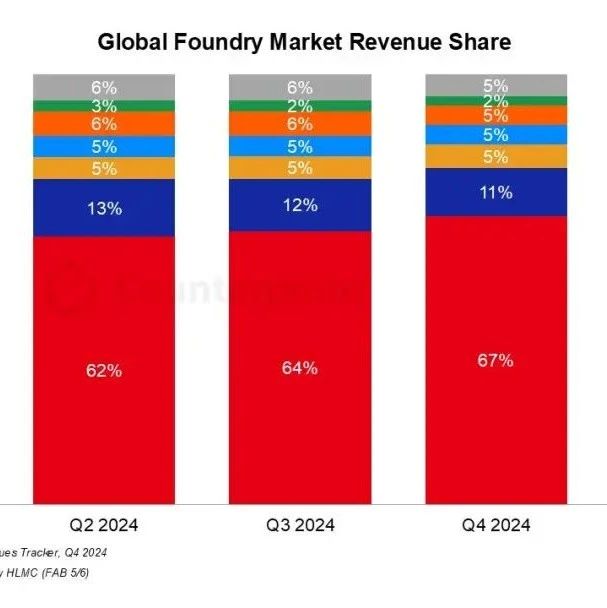
Core Viewpoint - The global wafer foundry industry is expected to see a 26% year-on-year revenue growth and a 9% quarter-on-quarter growth in Q4 2024, driven primarily by strong AI demand and the ongoing recovery of the Chinese market [1][3]. Summary by Sections Industry Performance - The advanced process capacity utilization remains high, driven by AI and flagship smartphone demand, particularly for TSMC's N3 and N5 processes [1][3]. - The overall utilization rate for global (excluding China) mature process foundries hovers between 65%-70%, with 12-inch processes recovering faster than 8-inch processes due to weaker demand in automotive and industrial sectors [1][3]. Demand Recovery - Non-AI demand is gradually recovering, particularly in consumer electronics and PC semiconductor sectors, supported by pre-production demand related to U.S. tariffs and demand driven by Chinese subsidies [1][3]. - Advanced packaging demand remains strong and stable, with TSMC actively expanding its CoWoS-L and CoWoS-R capacities, alleviating previous market concerns regarding capacity and order adjustments [1][3]. Company-Specific Insights - TSMC's revenue share reached a record 67% in Q4 2024, up from 64% in the previous quarter, primarily due to high capacity utilization in advanced processes [4]. - Samsung Foundry experienced a slight quarter-on-quarter revenue decline in Q4 2024, attributed to lower-than-expected demand for Android smartphones, leading to a decrease in its market share from 12% to 11% [5]. - SMIC's performance in Q4 2024 met expectations, with revenue growth driven by the recovery in consumer electronics and domestic localization efforts, although overall capacity utilization decreased from 90.4% to 85.5% [6]. - UMC's performance in Q4 2024 was stable, supported by occasional urgent orders in consumer electronics, but faced pricing pressure and a negative impact from a January earthquake [7]. - GlobalFoundries reported stable performance in Q4 2024, with strong wafer shipments offsetting seasonal weakness in the smartphone sector, driven by automotive demand and growth in communication infrastructure [8]. Analyst Commentary - The strong performance of the wafer foundry industry in Q4 2024 is largely attributed to the surge in AI and flagship smartphone demand, maintaining high capacity utilization in advanced processes [9].
2024 年 Q4 全球晶圆代工行业收入同比增长 26%
Counterpoint Research· 2025-03-18 09:14
根据 Counterpoint Research 的 《晶圆代工季度追踪报告》 数据,全球晶圆代工行业在 2024 年 Q4 收 入同比增长 26% ,环比增长 9% ,主要受强劲的 AI 需求以及中国市场持续复苏的推动。先进制程 的产能利用率依然维持在高位,主要受 AI 及旗舰智能手机需求驱动,尤其是TSMC的 N3 和 N5 制 程。与此同时,全球(不含中国)的成熟制程晶圆代工厂仍面临较低的产能利用率困境,本季度整 体利用率徘徊在 65%-70% 之间。其中,12 英寸制程的复苏势头强于 8 英寸制程,后者受汽车和工 业领域需求低迷的影响更大。不过,非 AI 需求正逐步回暖,尤其是在消费电子和 PC 半导体领域, 这得益于与美国关税相关的预先生产需求以及中国补贴驱动的需求,这为更广泛的市场稳定带来了 一些乐观因素。 随着 AI 和高性能计算(HPC)持续推动先进制程需求增长,先进封装在支撑行业增长方面发挥了关 键作用。TSMC 积极扩展 CoWoS-L 和 CoWoS-R 产能,进一步强化这一趋势,并缓解了市场此前对 产能及订单调整的担忧。 数据来源:《2024 年 Q4 全球晶圆代工行业收入追踪报告》, ...