
广播电视

Search documents
市场监管总局拟对公用事业领域反垄断出台新规
Xin Hua Wang· 2025-08-20 15:44
Core Points - The State Administration for Market Regulation has released a draft guideline on antitrust measures in the public utility sector, seeking public feedback [1][2] - The public utility sector includes essential services such as water, electricity, gas, heating, sewage treatment, waste disposal, broadcasting, and public transportation, which often exhibit natural monopoly characteristics [1][2] - The draft aims to clarify the basic principles of antitrust enforcement in the public utility sector, detailing the analysis and identification of monopolistic behaviors to promote compliance and healthy development [2] Summary by Category - **Antitrust Guidelines** - The draft guideline provides detailed considerations for identifying abusive market dominance behaviors, including unfair pricing, refusal to deal, and tying arrangements [1] - Specific attention is given to limiting trading practices, such as requiring customers to purchase services exclusively from designated providers [1] - **Sector Characteristics** - The public utility sector is characterized by its public nature, regional focus, and policy implications, leading to unique types and manifestations of monopolistic behavior [2] - The guideline aims to establish a long-term regulatory mechanism to ensure the sustainable and healthy development of the public utility sector [2]
公用事业反垄断指南将出炉 界定垄断行为边界
Zheng Quan Shi Bao Wang· 2025-08-20 14:12
Core Viewpoint - The State Administration for Market Regulation has released a draft guideline on antitrust practices in the public utility sector, aiming to clarify enforcement principles and provide guidance for compliance, thereby promoting healthy development in this sector [1][2]. Group 1: Antitrust Guidelines - The guideline specifies regulations against the abuse of market dominance in the public utility sector, which includes essential services like water, electricity, gas, heating, sewage treatment, waste disposal, broadcasting, and public transportation [2][3]. - It highlights the prevalence of monopolistic behaviors in the public utility sector, particularly in water, gas, electricity, and heating industries, where operators often extend their monopolistic advantages to competitive upstream and downstream markets [2][3]. Group 2: Market Dominance Assessment - The guideline details factors for determining market dominance, considering the natural monopoly characteristics, franchise models, and public, regional, and policy-related aspects of public utilities [3]. - Key considerations include market share, competition status, control over essential infrastructure, user dependency on services, and barriers to market entry [3]. Group 3: Abuse of Market Dominance - Specific abusive practices are outlined, such as unfair pricing, refusal to deal, tying arrangements, imposing unreasonable conditions, and differential treatment [3][4]. - The guideline provides examples of limiting trading behaviors, including requiring customers to procure services exclusively from the utility provider or its designated operators [3]. Group 4: Justifiable Reasons for Actions - The guideline lists common justifiable reasons for actions that may otherwise be deemed abusive, such as compliance with laws and regulations or adherence to industry norms [4]. - It also specifies situations that generally cannot be considered justifiable, particularly in cases of refusal to deal or differential treatment [4]. Group 5: Compliance and Fair Competition - Public utility operators and industry associations are encouraged to conduct business in accordance with the Antitrust Law, promoting fair competition and voluntary cooperation to enhance market competitiveness [5]. - The guideline emphasizes that even operators below the reporting threshold may need to declare their concentration if it could restrict competition [5]. Group 6: Administrative Power and Legal Responsibility - The guideline provides clear behavioral directives for administrative agencies regarding the prohibition of actions that restrict competition, including limiting market entry and hindering free trade [6]. - It outlines the legal responsibilities of public utility operators and associations in cases of antitrust law violations, including potential leniency if actions were taken under administrative coercion [6].
《关于公用事业领域的反垄断指南》公开征求意见
Xin Jing Bao· 2025-08-20 09:12
Core Viewpoint - The State Administration for Market Regulation (SAMR) has released a draft guideline on antitrust regulations in the public utility sector, aiming to enhance market competition, protect consumer interests, and ensure compliance with the Antitrust Law of the People's Republic of China [1][2]. Group 1: Purpose and Basis - The guideline aims to prevent and curb monopolistic behaviors in the public utility sector, guiding operators to strengthen antitrust compliance and enhance regulation in natural monopoly areas [2]. - It is based on the Antitrust Law and other legal provisions [2]. Group 2: Definition of Public Utilities - Public utilities refer to a series of industries that provide essential goods or services to the public, including water supply, electricity, gas, heating, sewage treatment, waste disposal, broadcasting, and public transportation [3]. Group 3: Basic Principles - The enforcement of antitrust regulations in the public utility sector will adhere to principles such as maintaining fair competition, scientific regulation, enhancing public welfare, and supporting high-quality development [5][6]. Group 4: Antitrust Compliance - Public utility operators are encouraged to strengthen antitrust compliance management systems to effectively identify potential legal risks and take preventive measures [7]. Group 5: Market Definition - The guideline outlines the criteria for defining relevant product and geographic markets in the public utility sector, considering factors like demand substitution and the characteristics of natural monopolies [8][9]. Group 6: Monopolistic Agreements - The guideline provides a framework for identifying monopolistic agreements in the public utility sector, referencing specific articles of the Antitrust Law [11]. - It details horizontal and vertical monopolistic agreements that may arise among public utility operators [12][14]. Group 7: Abuse of Market Dominance - The guideline outlines the framework for identifying abuse of market dominance, including unfair pricing and refusal to deal, and emphasizes the need for justifications for such behaviors [20][22]. Group 8: Operator Concentration - Public utility operators can legally implement concentration through fair competition and voluntary cooperation, but must adhere to reporting standards set by the State Council [33][35]. Group 9: Fair Competition Review - Administrative bodies must conduct fair competition reviews for policies affecting public utility operators to ensure equal access to production factors and fair market participation [40]. Group 10: Legal Responsibilities - Public utility operators and industry associations violating the Antitrust Law will face legal consequences, and the enforcement agency will consider the implementation of compliance management systems during investigations [50][51].
商务早新闻(8月20日)
Sou Hu Cai Jing· 2025-08-20 02:30
Group 1: Logistics and Transportation - The first multi-modal transport "single document" train from Guizhou carrying 4,320 tons of fertilizer has officially launched, marking the implementation of this transport service model in Guizhou [1] - The China-Europe Railway Express (Shenzhen) celebrated its 5th anniversary, having cumulatively transported goods worth over $30 billion and connecting 47 countries and regions [2][5] - The Guizhou International Cargo Center has achieved a total cargo throughput of 10,700 tons since the launch of the all-cargo flight from Guizhou to Kolkata on December 13, 2023, supporting the development of international air cargo in Guizhou [7] Group 2: Economic Indicators - The total revenue of the national broadcasting and television service industry reached 688.41 billion yuan in the first half of the year, with a year-on-year growth of 5.24% [2] - India's government proposed to reduce the consumption tax on small cars from 28% to 18% as part of a broader tax reduction plan [3] - Spain's trade deficit expanded from 2.543 billion euros in May to 3.588 billion euros in June [3]


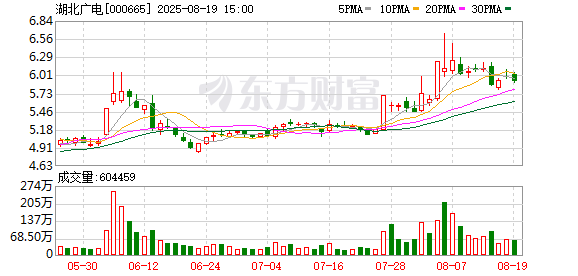
湖北广电:8月18日召开董事会会议
Mei Ri Jing Ji Xin Wen· 2025-08-19 12:40
Group 1 - Hubei Broadcasting announced the convening of its 30th meeting of the 10th Board of Directors on August 18, 2025, via communication method [1] - The meeting reviewed the full text and summary of the 2025 semi-annual report [1] - For the first half of 2025, Hubei Broadcasting's revenue composition was 100.0% from cable television services [1] Group 2 - As of the report, Hubei Broadcasting's market capitalization is 6.7 billion yuan [2]

湖北广电(000665.SZ):上半年净亏损2.46亿元
Ge Long Hui A P P· 2025-08-19 12:34
Core Viewpoint - Hubei Broadcasting (000665.SZ) reported a decline in revenue and a significant net loss for the first half of 2025, indicating financial challenges for the company [1] Financial Performance - The company achieved an operating revenue of 822 million yuan, representing a year-on-year decrease of 11.13% [1] - The net profit attributable to shareholders of the listed company was -246 million yuan [1] - The net profit attributable to shareholders after deducting non-recurring gains and losses was -258 million yuan [1] - The basic earnings per share were -0.228 yuan [1]
湖北广电:2025年半年度净利润亏损约2.46亿元
Mei Ri Jing Ji Xin Wen· 2025-08-19 12:13
Group 1 - The company Hubei Broadcasting (SZ 000665) reported a revenue of approximately 822 million yuan for the first half of 2025, representing a year-on-year decrease of 11.13% [2] - The net profit attributable to shareholders of the listed company was a loss of approximately 246 million yuan [2] - The basic earnings per share showed a loss of 0.22 yuan [2]
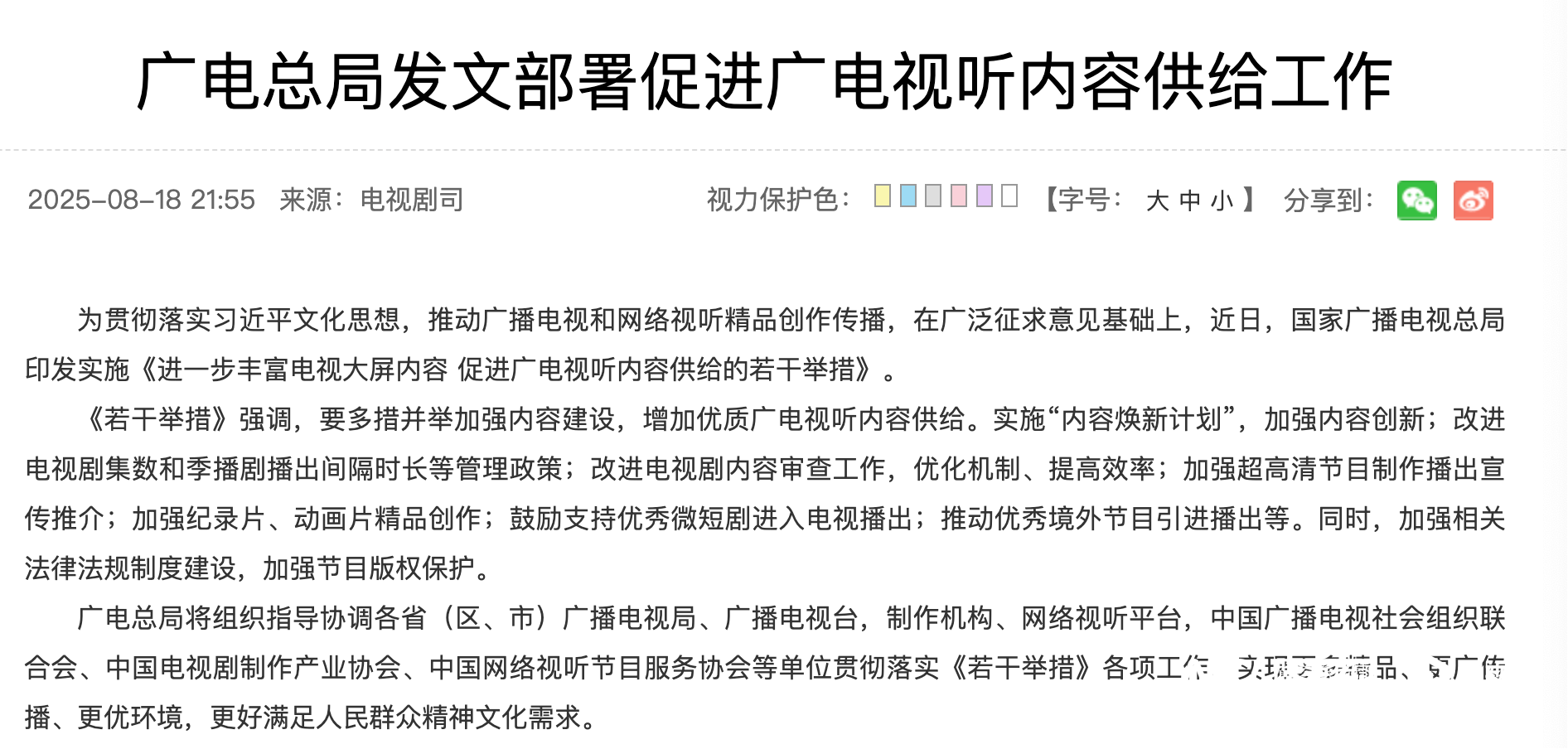
广电总局发文,将改进电视剧集数限制、季播间隔、审查机制!
Nan Fang Du Shi Bao· 2025-08-19 05:12
Core Viewpoint - The article emphasizes the need for multiple measures to enhance content development and increase the supply of high-quality television and audio-visual content [2] Group 1: Content Development Initiatives - Implementation of the "Content Renewal Plan" to strengthen content innovation [2] - Improvement of management policies regarding the number of episodes in TV dramas and the interval duration for seasonal broadcasts [2] - Enhancement of content review processes for TV dramas to optimize mechanisms and improve efficiency [2] Group 2: Promotion of Quality Programming - Strengthening the production, broadcasting, and promotion of ultra-high-definition programs [2] - Encouragement and support for the creation of high-quality documentaries and animated series [2] - Promotion of excellent micro and short dramas for television broadcasting [2] Group 3: Regulatory and Collaborative Efforts - Encouragement of the introduction and broadcasting of outstanding foreign programs [2] - Strengthening of relevant legal and regulatory frameworks, particularly in the area of program copyright protection [2] - Coordination among various broadcasting and television organizations to implement the outlined measures effectively [2]
上半年全国广播电视服务业总收入6884.14亿元 同比增长5.24%
Yang Shi Wang· 2025-08-19 03:44
Core Insights - The core viewpoint of the article highlights the growth and performance of the broadcasting and television service industry in China during the first half of 2025, showcasing significant revenue increases and user statistics [1] Revenue Performance - The total revenue of the broadcasting and television service industry reached 688.41 billion yuan, representing a year-on-year growth of 5.24% [1] - The actual revenue generated was 608.15 billion yuan, with a year-on-year increase of 5.76% [1] - Revenue breakdown shows broadcasting institutions earned 297.61 billion yuan, while online audio-visual service institutions generated 390.81 billion yuan [1] Broadcasting Statistics - The total broadcasting time for radio programs was 7.83 million hours, while television programs aired for 9.36 million hours [1] - As of the end of June, there were 206 million actual cable television users and 35.46 million broadcasting 5G users in the country [1]
贵广网络: 关于控股股东部分股份解除质押的公告
Zheng Quan Zhi Xing· 2025-08-18 16:17
证券代码:600996 证券简称:贵广网络 公告编号:2025-042 贵州省广播电视信息网络股份有限公司 本公司董事会及全体董事保证本公告内容不存在任何虚假记载、误导性陈述 或者重大遗漏,并对其内容的真实性、准确性和完整性承担法律责任。 重要内容提示: ? 贵州省广播电视信息网络股份有限公司(简称"公司")控股股东贵州 广播影视投资有限公司(简称"贵广投资")持有公司无限售条件流通 股 393,224,636 股,占截至 2025 年 6 月 30 日公司总股本 1,246,799,854 股的 31.54%。本次部分股份解除质押后,贵广投资累计质押数量为 致行动人累计所持公司股份总数的 34.03%,占公司总股本的 12.69%。 公司于近日收到控股股东贵广投资通知,贵广投资将其所持公司部分股份办 理了解除质押,具体事项如下。 股东名称 贵州广播影视投资有限公司 本次解质股份 38,220,000 股 占其所持股份比例 9.72% 占公司总股本比例 3.07% 解除质押时间 2025 年 8 月 14 日 持股数量 393,224,636 股 持股比例 31.54% 剩余被质押股份数量 158,205,0 ...
