Smartphones

Search documents
比亚迪_智能驾驶_新智能手机产品推动未来增长;研发投入增加,数据中心业务存在潜在上行空间
2025-09-22 01:00
Summary of BYDE (0285.HK) Conference Call Company Overview - **Company**: BYDE (0285.HK) - **Industry**: Technology and Automotive Key Points and Arguments Revenue Growth Expectations - BYDE's revenue for 2H25 is expected to grow by **35% HoH** due to improved seasonality and the smart driving trend, alongside a new smartphone product cycle [1][2] - The company is expanding into AI data centers, which may diversify its end markets in the long run [1] Market Conditions - The global smartphone shipment increased by **1% YoY** in 1H25, while the China market declined by **6.5% YoY** [1] - BYD's vehicle shipment increased by **33% YoY** in 1H25, with July and August showing slight growth of **0.56% YoY** and **0.15% YoY**, respectively [1] Financial Performance and Projections - Net income estimates for BYDE have been reduced by **11%/24%/26%** for 2025E/26E/27E due to lower revenue and gross margin (GM) expectations [2] - The gross margin is projected to expand to **9.7% by 2027E** from **6.9% in 1H25** [2][6] - Automotive electronics are expected to contribute **25% of total revenue by 2027E**, down from a previous estimate of **29%** [2] R&D and Operational Expenses - R&D expenses are anticipated to grow at a **30% CAGR** to **Rmb8.9bn (US$1.3bn)**, maintaining a ratio of **3.8%** similar to 2022-23 levels [2] - The operating expense (opex) ratio is expected to increase slightly in 2026E/27E due to higher R&D expenses [2] Earnings Revision - The earnings revision reflects a slower end market growth and the time required for the AI data center expansion to offset impacts [2] - Despite the earnings cut, BYDE is expected to achieve a **net income CAGR of +26%** from 2025E to 2027E [6] Valuation and Price Target - The target price has been lowered by **3.5% to HK$53.08**, implying a **2026E P/E of 17.1x** [11] - The new target price reflects a positive view on BYDE's product mix upgrade and is in line with peers [11][15] Risks - Key risks include customer concentration in the automotive business, slower-than-expected ramp-up of automotive products, and increased competition [16] Additional Important Information - BYDE's strategy focuses on leading customers like Apple and expanding product lines, which is expected to drive up dollar content per vehicle [2] - The company is maintaining a **Buy** rating despite the earnings revisions, indicating confidence in its long-term growth strategy [11][19]

2025年第二季度销量排名前五的智能手机品牌中 中国品牌占据四席 中国品牌手机日益走俏拉美市场(国际视点)
Ren Min Ri Bao· 2025-09-21 22:21
Market Growth - The overall smartphone sales in the Latin American region are projected to grow by approximately 2% in Q2 2025, reaching 34.3 million units [2] - Xiaomi's smartphone sales increased by 8%, achieving a record of 6.7 million units in the same period [2] - In Brazil, Motorola accounted for about 24% of the smartphone market share, while Xiaomi and Realme held 17% and 6% respectively [3] Brand Performance - Chinese smartphone brands dominate the top five positions in the Latin American market, with Xiaomi, Motorola, Honor, and Transsion leading [2] - In Mexico, Chinese brands hold approximately 43% of the smartphone market share, a significant increase from nearly zero in 2019 [4] - In Peru, Xiaomi and Honor were the top two imported smartphone brands, with imports of 890,000 and 830,000 units respectively, showing quarter-on-quarter growth of 11.2% and 25.7% [4] Consumer Preferences - Over 60% of Brazilian respondents prefer Chinese smartphones, with 67% believing that China has a technological innovation advantage [3] - Consumers in Ecuador prioritize cost-effectiveness, speed, storage, camera quality, and screen design, favoring Chinese brands for their competitive advantages [5] Innovation and Localization Strategy - Chinese smartphone brands are successful in Latin America due to their focus on localization strategies, adapting product features and marketing to local preferences [6] - The introduction of advanced technologies such as artificial intelligence and foldable screens by Chinese brands is attracting consumers [6] - Industry experts emphasize the need for diversified and personalized operational models to maintain long-term competitiveness in the market [7] Local Production and Collaboration - Chinese smartphone manufacturers are increasingly establishing local production lines or collaborating with local companies in Latin America [9] - The establishment of local manufacturing capabilities is seen as a strategic long-term decision to better understand consumer needs and enhance supply chain efficiency [9] - Strengthening the smartphone industry chain cooperation between China and Latin America is expected to improve local manufacturing capabilities and contribute to regional industrialization [9]


Apple iPhone 17 Goes on Sale Around the World
Bloomberg Television· 2025-09-19 14:37
Also happening this morning, it is Apple's launch of the new iPhone 17, its first noticeable overhaul of the smartphone in about 40 years. CEO Tim Cook greeted customers. You can see that they're at the flagship store in Manhattan on Fifth Avenue clapping everybody who's been, I guess, camping out and waiting in line, which is where we also find Bloomberg Tech co-host Caroline Hyde this morning.Caroline, it's my understanding you did not camp out and I think that was the right move. What has early reception ...


数据机构:荣耀份额下滑近一成,苹果销量降 6%,vivo 重回中国手机市场销冠
Yang Zi Wan Bao Wang· 2025-09-19 07:06
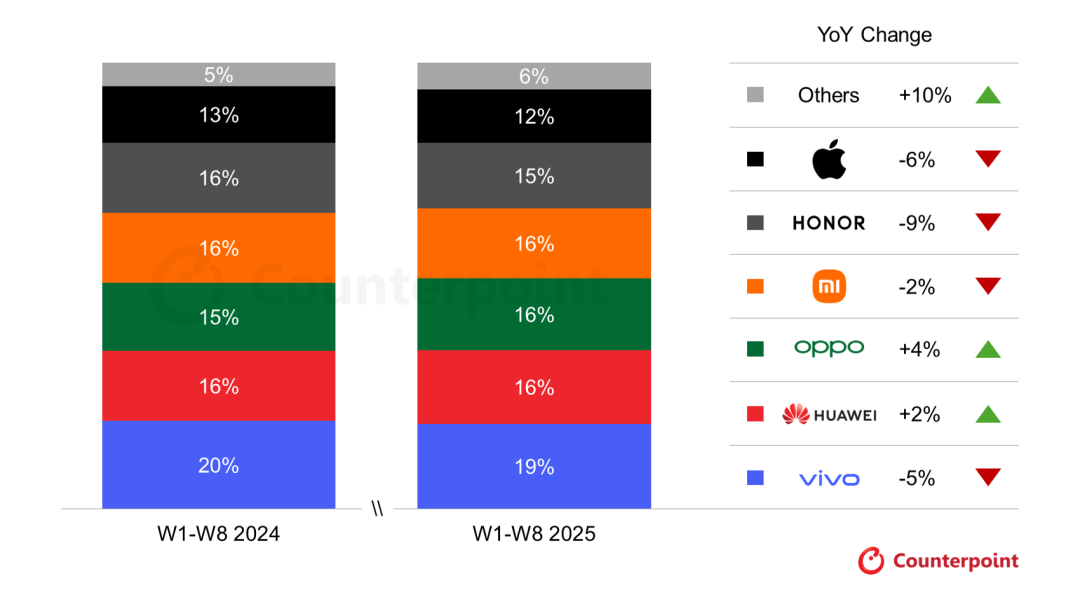
Core Insights - The report from Counterpoint indicates that vivo has captured the top position in the Chinese smartphone market with a 19% market share, leading by 3 percentage points over the second place [1] - The market is characterized by a "one leader and three strong competitors" dynamic, with notable performances from OPPO and Xiaomi, while Huawei shows growth and Honor experiences a decline of nearly 10% in market share [1][2] - The overall smartphone market in China saw a 2% year-on-year decline in total sales during the first eight weeks of Q3 [3] Company Performance - Vivo's success is attributed to the strong performance of its S30 and X200s series, which together contributed over 60% of its sales during the reporting period, aligning with consumer preferences for mid-to-high-end products [1] - OPPO recorded the highest growth among manufacturers, with a 4% year-on-year increase in sales, driven by a well-rounded product lineup, particularly the Reno 14 series, which has become one of the best-selling flagship phones in China [2] - Huawei achieved a 2% year-on-year growth, supported by supply chain optimization and strong sales of the Nova 14 series, alongside continued demand for older flagship models like the Mate 70 series [2] Competitive Landscape - Apple's sales declined by 6% year-on-year, with a 1 percentage point drop in market share, attributed to increased competition from domestic brands like vivo, Huawei, Xiaomi, and Honor, which launched competitive models during the summer [2] - Honor's market share decline is a significant factor in the overall market downturn, prompting the company to initiate a retail channel reform in 10 provinces to improve efficiency and address its market challenges [3] - Counterpoint forecasts a 3%-5% quarter-on-quarter decline in the smartphone market due to weak consumer demand and a lull in new product releases, although the overall annual performance is expected to remain flat compared to last year [3]
机构:第三季度前八周中国智能手机销量vivo位居第一
Zheng Quan Shi Bao Wang· 2025-09-18 03:14
Core Insights - Vivo leads the Chinese smartphone market with a 19% market share in the first eight weeks of Q3, driven by strong performance of S30 and X200s series products [1] - Huawei, OPPO, and Xiaomi are tied for second, third, and fourth places with a market share of 16% each [1] - The overall Chinese smartphone market is expected to see a slight decline in Q3, while the annual performance is projected to remain stable [1]
Counterpoint:Q3前八周中国智能手机销量同比下降2% 预计三季度整体将小幅下跌
Zhi Tong Cai Jing· 2025-09-18 01:17
Group 1 - The Chinese smartphone market experienced a 2% year-on-year decline in sales during the first eight weeks of Q3 2025, primarily due to significant drops in sales from vivo and Honor [1] - Counterpoint forecasts a slight decline in the Chinese smartphone market for Q3 2025, with overall performance expected to remain stable for the year [1] - OPPO and Huawei benefited from increased consumer preference for mid-to-high-end products, as promotional activities and national subsidy policies intensified competition in the mid-range market [1] Group 2 - OPPO emerged as the fastest-growing manufacturer, with its Reno14 series gaining popularity due to its flagship features at a mid-range price, making it one of the best-selling flagship phones in China [3] - Huawei maintained growth through an expanding product portfolio, with the Nova14 series continuing the strong performance of the Nova13 series since its launch in May, alongside the sustained success of older flagship models like the Mate70 series [3] - Honor faced significant challenges, experiencing the largest market share decline among major OEMs due to ongoing adjustments in its channel strategy [3]
Apple's China phone sales fall 6% ahead of iPhone 17 launch
Invezz· 2025-09-17 09:25
Core Insights - Apple's smartphone sales in China decreased by 6% in the eight weeks prior to the iPhone 17 launch, indicating significant competition in the largest smartphone market globally [1] Industry Summary - The decline in sales underscores the intense competition faced by companies in the Chinese smartphone market, which is characterized by a rapidly evolving landscape and aggressive pricing strategies from competitors [1]

The 720- 中国互联网(人工智能、云计算、阿里巴巴)、中国消费(动态观察、白酒第三季度前瞻、百威亚太)、环球晶圆、日本房地产-_ China Internet (AI, Cloud, Alibaba), China Consumer (Pulse Check, Spirits 3Q preview, Bud APAC), GlobalWafers, JP Property
2025-09-17 01:51
Summary of Key Points from Conference Call Records Industry Overview China Internet - Focus on multi-modal AI infrastructure with renewed narratives following Alibaba's cloud and capital expenditure performance [1] - Significant developments in AI infrastructure, including new AI model launches such as Alibaba's Qwen3-Next and AI assistants from transaction platforms [1] - Positive growth outlook for companies with AI models and inference chip capabilities, supported by insights from US peers at recent conferences [1] China Consumer - Softer demand and pricing trends observed in 2Q25, with a cautious outlook for the second half of the year due to demand uncertainty [2] - Categories like sportswear and spirits are facing downside risks in pricing, while the restaurant sector is experiencing intensified pricing activity [2] - Structural growth opportunities remain, including demand for experience-based consumption and expansion in lower-tier cities [2] China Spirits - Spirits companies are under pressure due to the anti-extravagance policy, leading to a focus on channel health through destocking and tighter shipment discipline [5] - Expected sales decline of 5-27% in 3Q across coverage, with Moutai expected to remain flat and Wuliangye down 9% [5] - Forecasts for super-premium and upper-mid-end spirits sales and net profit have been cut by up to 6%/8% and 17%/28%, respectively [5] GlobalWafers - Upgraded to Buy based on signs of bottoming in the memory sector and expansion into advanced nodes in the US [6] - Shift towards high-value specialty wafers (SiC, GaN) expected to drive long-term growth and margin expansion [6] - Target price raised to NT$600 from NT$380, with EPS estimates revised up by 7-11% for 2026-2027 [6] Japan Real Estate - Office vacancy rates in Tokyo have decreased from 6% to 2%, driven by increased demand for well-located offices [8] - New office asking rents are growing at a CAGR above 4%, leading to an average target price increase of 8% across Japan real estate coverage [8] Transsion - Downgraded to Neutral due to slowing smartphone shipment growth, despite positive outlook for market share gains and product mix upgrades [8] - Recent shipment growth slowed to -15% YoY in 1H25, but expected to recover to +20% YoY in 2H25 [8] - New target price set at Rmb99, reflecting current trading levels [8] Key Financial Metrics - Alibaba Cloud valuation increased to US$43 per ADS, with cloud growth assumptions lifted to 30-32% YoY for 2Q-4Q FY26E [1] - Alibaba's 12-month target price raised to US$179/HK$174 from US$163/HK$158 [1] - Budweiser APAC's 12-month target price set at HK$9, reflecting strong product portfolio and innovation capabilities [5] Additional Insights - The cautious outlook in the China consumer sector is attributed to macroeconomic factors and policy impacts, which may affect investment decisions [2] - The spirits sector's focus on inventory normalization may lead to short-term softness but could facilitate a quicker recovery [5] - GlobalWafers' strategic pivot towards specialty wafers is seen as a key driver for future growth amidst a recovering memory sector [6]

Pain or Gain Ahead of Apple? ETFs in Focus
ZACKS· 2025-09-16 12:36
Core Insights - Apple shares have shown mixed performance, gaining 1% over the past month, 9.4% over six months, but losing 4% year-to-date, with the iPhone 17 launch failing to excite investors [1][2] - Competition from Xiaomi is intensifying as it prepares to launch its flagship Xiaomi 17 series, directly targeting Apple's premium market share [3][4] - Apple's strong presence in China is supported by government subsidies, but challenges remain due to competition and economic factors [6][8] Financial Performance - Apple's iPhone currently holds 62% of the $600 and above smartphone market [4] - Greater China sales accounted for 16.3% of Apple's total sales in Q3 of fiscal 2025 [9] - Apple shares trade at a forward P/E of 31.8X, higher than Xiaomi's 23.75X and the industry average of 28.2X [13] Market Competition - Xiaomi's premium smartphone sales surged 55% in the first half of the year, indicating its ambition to capture more market share [5] - IDC data shows Apple with a 15.7% global smartphone market share, behind Samsung's 19.7% and ahead of Xiaomi's 14.4% [5] AI Developments - Concerns exist regarding Apple's progress in artificial intelligence, with delays in AI features and departures of key AI researchers [10][11] - Apple has made several acquisitions to enhance its AI capabilities and plans to launch an AI-powered web search tool next year [12] Price Target and Investment Strategy - Analysts have set an average price target of $241.14 for Apple, representing a potential increase of 4.83% from its recent closing price [14] - A basket approach through ETFs is recommended to mitigate company-specific risks while capitalizing on potential rallies in Apple shares [15][16]
Apple Inc: From Innovation Pioneer to Technological Stagnation
Medium· 2025-09-15 12:56
Core Viewpoint - Apple is facing criticism for perceived stagnation in innovation, with notable figures like Meta CEO Mark Zuckerberg highlighting the company's reliance on past successes rather than introducing significant new technologies [1][2][5]. Group 1: Criticism of Innovation - Zuckerberg criticized Apple for not making breakthroughs since the introduction of the iPhone, claiming the company is "resting on its laurels" and imposing high App Store commissions [2][5]. - The launch of the iPhone 17 on September 9, 2025, led to a 3.2% drop in Apple's stock, erasing approximately US$100 billion in market capitalization due to minor updates and lack of AI advancements [5][6]. - iPhone market share in the U.S. decreased from 56% to 49%, while Samsung's share increased from 23% to 31%, indicating a shift in consumer preference towards competitors [6]. Group 2: Apple's Achievements and Market Position - Despite criticism, the iPhone 17 introduced features like a scratch-resistant ceramic screen and a larger battery, with third-quarter 2025 sales up 13% year-on-year [8][10]. - Apple has sold over 3 billion iPhones since 2007, and its ecosystem remains superior in integration, providing a seamless user experience [8][10]. - The company is investing in new markets, such as establishing the Apple Developer Academy in Indonesia with a US$160 million investment, indicating a commitment to local technology ecosystems [9]. Group 3: Financial Strength and Market Strategy - Apple's market valuation remains around US$3.48 trillion, making it one of the largest companies globally, despite the stock drop post-iPhone 17 launch [10]. - The company has maintained good relations with the government through a US$100 billion investment in the U.S., demonstrating resilience against external pressures like tariffs [10]. - Apple's focus on privacy and a closed ecosystem, while limiting AI innovation speed, is also seen as a strength in an era of data privacy concerns [11]. Group 4: Future Outlook - Allegations of stagnation have impacted investor confidence, but Apple has opportunities for recovery with plans for a foldable iPhone and a 20th-anniversary edition in 2027 [14]. - The company must balance its "quality over speed" philosophy with the need for radical innovation to meet high market expectations [15].