博物馆

Search documents
博物馆服务延时好事要办好
Jing Ji Ri Bao· 2025-07-24 22:04
Core Insights - The "museum fever" is rising during the summer, with museums in cities like Beijing, Shanghai, and Hangzhou extending their opening hours and adjusting closing days to enhance public cultural experiences [1] - Museums are implementing staggered and extended hours to accommodate diverse cultural needs, addressing issues like ticket shortages and long queues during peak times [1] - The shift towards extended hours is seen as a response to the public's evolving cultural demands and reflects an upgrade in public cultural services [1] Group 1 - Museums are extending their hours and introducing activities like "Museum Night" to provide a more flexible cultural experience for the public [1] - The adjustment of closing days from Monday to Tuesday or eliminating closing days altogether is aimed at increasing visitor capacity and improving overall experience [1] - The extended hours are not only enhancing public cultural coverage but also stimulating new vitality in cultural tourism consumption [1] Group 2 - To sustain the extended hours, museums need to focus on management and operations, including resource reallocation for security, power, and artifact protection [2] - Some museums are exploring flexible operational models, such as third-party management and dynamic scheduling, to balance artifact safety with visitor experience [2] - The implementation of structured systems and regulations, such as a "whitelist" for guides and real-time monitoring of ticket sales, is essential for orderly extended services [2]
高校博物馆激活公共文化服务价值
Xiao Fei Ri Bao Wang· 2025-07-23 02:21
Group 1 - The core viewpoint is that university museums are becoming important platforms for public cultural services, with initiatives to open their doors to the public and engage in educational activities [1][3][5] - A survey indicated that 64.32% of respondents believe university museums should be open to the public, and 56.61% see them as playing an indispensable role in social education [3][4] - University museums are encouraged to leverage their academic strengths to better serve community cultural needs and enhance their role in cultural tourism [3][4] Group 2 - Challenges faced by university museums include low public awareness, limited exhibition appeal, and restricted opening hours, as highlighted by a survey showing 65.29% cited insufficient promotion [4][5] - The average exhibition area of university museums is often less than 3,000 square meters, which limits their display capacity and visitor reception [4][5] - There is growing attention from government and society towards the development of university museums, with some receiving support from various levels of government [4][5]
“品游山西” 感受太原文旅之“最”
Yang Shi Wang· 2025-07-23 02:14
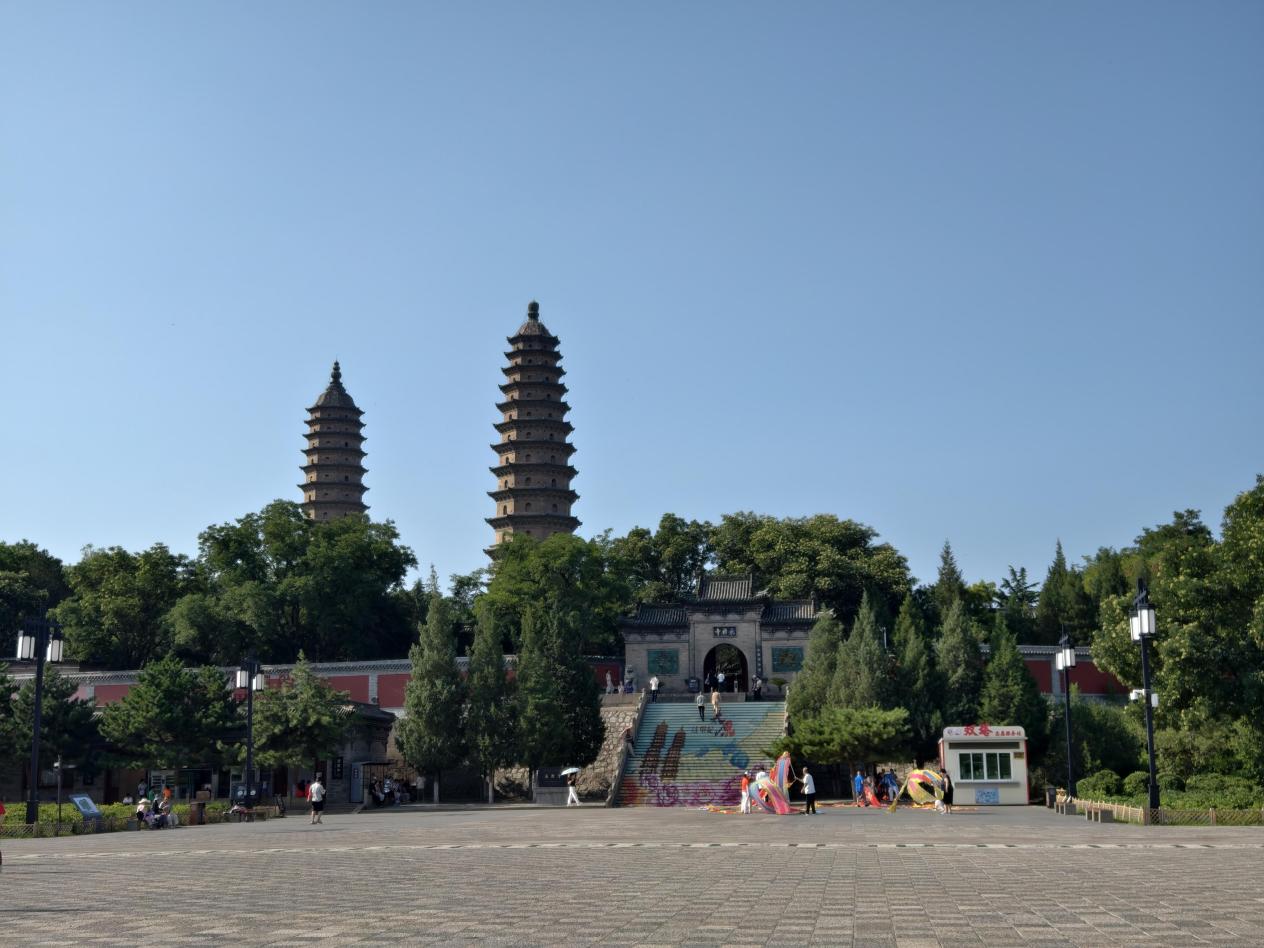
Core Points - The article highlights the cultural and historical significance of Taiyuan, a city with a 2500-year history, and its attractions during the "Explore Shanxi, Seek Roots" media event [1] Group 1: Cultural Heritage - Yongzuo Temple Twin Towers, known as Lingxiao Twin Towers, are the largest and most complete existing brick tower pair in China, with heights of 54.76 meters and 54.78 meters respectively [2] - Shanxi Provincial Museum has become a popular destination for families during the summer, averaging about 17,000 visitors per day, showcasing various historical and cultural exhibitions [3] Group 2: Local Cuisine - The Donghu Vinegar Culture Park emphasizes the unique production of Shanxi aged vinegar, which requires a minimum aging period of over 400 days, showcasing its rich flavor profile and traditional brewing techniques [4]

历史、艺术、时尚交融,恭王府打造“精雅生活”新空间
Bei Jing Ri Bao Ke Hu Duan· 2025-07-22 06:31
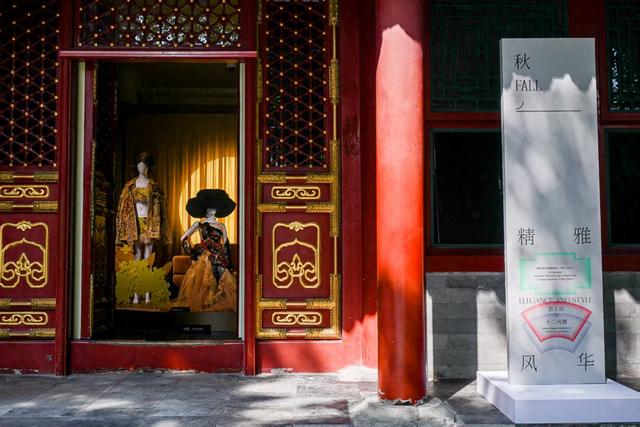
Core Insights - The exhibition "Elegant Style: Prince Gong's Mansion and Chinese Fashion (1780-2025)" showcases the integration of traditional aesthetics with contemporary fashion, featuring nearly 50 pieces of clothing and artworks from 26 prominent designers and artists [1][2] Group 1 - The exhibition is organized by the Ministry of Culture and Tourism and takes place at Prince Gong's Mansion, highlighting the seasonal aesthetics and cultural significance of the site [1] - The narrative of the exhibition is centered around the theme of "Twelve Elegances," presenting the mansion's iconic scenes throughout the year [1][2] - The exhibition aims to elevate Prince Gong's Mansion from a historical site to a living space of Chinese aesthetics, promoting "elegant living" as a new cultural symbol [2] Group 2 - Featured artworks include bamboo weaving by artist Qian Lihua, which reflects the inheritance and innovation of traditional craftsmanship [2] - Designer Ma Kai's work emphasizes the beauty of traditional cultural elements through color, showcasing insights into Eastern living [2] - The exhibition represents the exploration and redefinition of traditional aesthetics by Chinese original design forces, contributing to the lifestyle and branding of traditional cultural IP [2]
将传统文化带入大众生活
Ren Min Ri Bao Hai Wai Ban· 2025-07-22 01:20
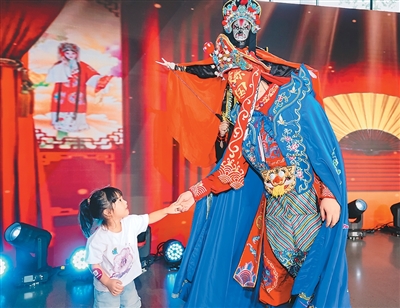
Core Insights - The "Dachuan Seeking Elegance - Classical National Style Night Market" event at Sichuan University Museum has gained significant popularity, expanding from a one-day event last year to a three-day event this year due to high demand [1][4] - The event features a variety of immersive experiences that allow visitors to engage closely with traditional culture, including performances, hands-on activities, and interactive games [1][2] Group 1: Event Overview - The event showcases traditional cultural elements such as Sichuan Qingyin and puppet shows, attracting a diverse audience [2][4] - Activities include handcraft workshops, traditional games, and tea ceremonies, appealing to different age groups [2][4] - The event is recognized as one of the "2024 National Cultural Heritage Education Innovation Cases" [1] Group 2: Cultural Engagement - The event utilizes a stamp collection method to encourage visitors to explore the museum and learn about cultural heritage [1] - Performances by the Sichuan University student choir and traditional music groups highlight the diversity of traditional arts, including poetry recitation and dance [4] - The involvement of local intangible cultural heritage practitioners emphasizes the museum's role as a dynamic space for cultural exchange [4][5] Group 3: Community Involvement - Young volunteers from Sichuan University play a crucial role in facilitating the event, serving as guides and assisting with activities [5] - The initiative aims to integrate the museum into daily life, fostering a deeper appreciation for cultural heritage among the public [5] - The collaboration between the museum and local artisans aims to transform traditional crafts into modern cultural experiences [4][5]
6家博物馆暑期惠民 举措共绽文化魅力
Zheng Zhou Ri Bao· 2025-07-21 00:43
Core Points - Zhengzhou's cultural institutions are enhancing public cultural services during the summer to meet the demand for visits, with measures including extended opening hours, optimized entry methods, and diverse activities [1][2][3] Group 1: Opening Hours and Entry Methods - Six museums in Zhengzhou will be open without closure from July 21 to August 31, operating daily from 9:00 AM to 6:00 PM, allowing more time for visitors to explore cultural history [1] - Except for the newly opened Zhengzhou Dahuacun Ruins Museum, other museums will implement a no-reservation policy for entry, requiring only valid identification for visitors [1] Group 2: Special Activities - Zhengzhou Museum is hosting the "Mountains and Rivers Forever - Revolutionary Relics Exhibition" and a parent-child theater activity "Seeing Elephants in Henan," aimed at educating children about local history and health [2] - Zhengzhou Shang Dynasty Capital Ruins Museum is offering immersive theater experiences and summer study activities that combine technology with historical exploration [2] - Zhengzhou Erqi Memorial Hall is recruiting young guides and producing animated films to promote red culture among children [2] - The Henan South-to-North Water Diversion Museum is showcasing a Tang Dynasty blue-and-white porcelain exhibition, highlighting cultural exchanges along the Silk Road [3] - Zhengzhou Museum's ancient iron smelting site is conducting summer classes to educate students about Han Dynasty iron culture through interactive learning [3]
大河村遗址博物馆:全景式呈现仰韶文化
Ke Ji Ri Bao· 2025-07-18 02:10
Core Insights - The newly opened Dahu Village Ruins Museum in Zhengzhou, Henan Province, showcases the origins and development of Chinese civilization, particularly the Yangshao culture, through over a thousand artifacts from more than 30 significant archaeological sites [1][2] Group 1: Historical Significance - Dahu Village Ruins, discovered 61 years ago, spans approximately 530,000 square meters with a cultural layer thickness of 12.5 meters, encompassing multiple ancient cultures including Yangshao, Longshan, Erlitou, and Shang [2] - The site reflects a continuous cultural development from 6,800 to 3,500 years ago, making it unique compared to other ancient sites [2] Group 2: Architectural Insights - The museum features well-preserved remains of a 5,000-year-old residence, showcasing advanced construction techniques with wooden frameworks and mud walls, marking a milestone in ancient Chinese architecture [3] - The transition from semi-subterranean dwellings to ground-level buildings indicates a shift towards more complex societal structures and living arrangements [3] Group 3: Cultural Artifacts - The most notable artifacts from the site are the colorful pottery pieces, which signify a peak in prehistoric pottery culture, with the museum's centerpiece being a white pottery basin with intricate symmetrical designs [4] - The artifacts also reveal early astronomical observations by the inhabitants, indicating the development of timekeeping concepts [4] Group 4: Cultural Impact - The opening of the new museum is expected to enhance Zhengzhou's status as a cultural landmark along the Yellow River, providing a unique opportunity for the public to engage with the origins of the Yangshao culture and Chinese civilization [4]
新华全媒+丨汉魏洛阳故城遗址博物馆开馆
Xin Hua Wang· 2025-07-17 02:17
Core Points - The Han-Wei Luoyang Ancient City Ruins Museum officially opened to the public on July 16, as part of the national "14th Five-Year" cultural protection and utilization project [3][4][8] - The museum focuses on the historical culture of the Han and Wei periods, showcasing over 1,300 valuable cultural relics that comprehensively display the civilization of the Han-Wei Luoyang ancient city [3][4][8] Summary by Categories - **Museum Opening** - The museum is a significant component of the "Five Major Capital Ruins Museum Group" in Luoyang [3][4][8] - It aims to enhance cultural heritage protection and transmission during the "14th Five-Year" period [3][4][8] - **Exhibits and Collections** - The museum features more than 1,300 pieces (sets) of precious artifacts [3][4][8] - It provides a comprehensive exhibition of the cultural prosperity of the Han-Wei Luoyang ancient city [3][4][8]
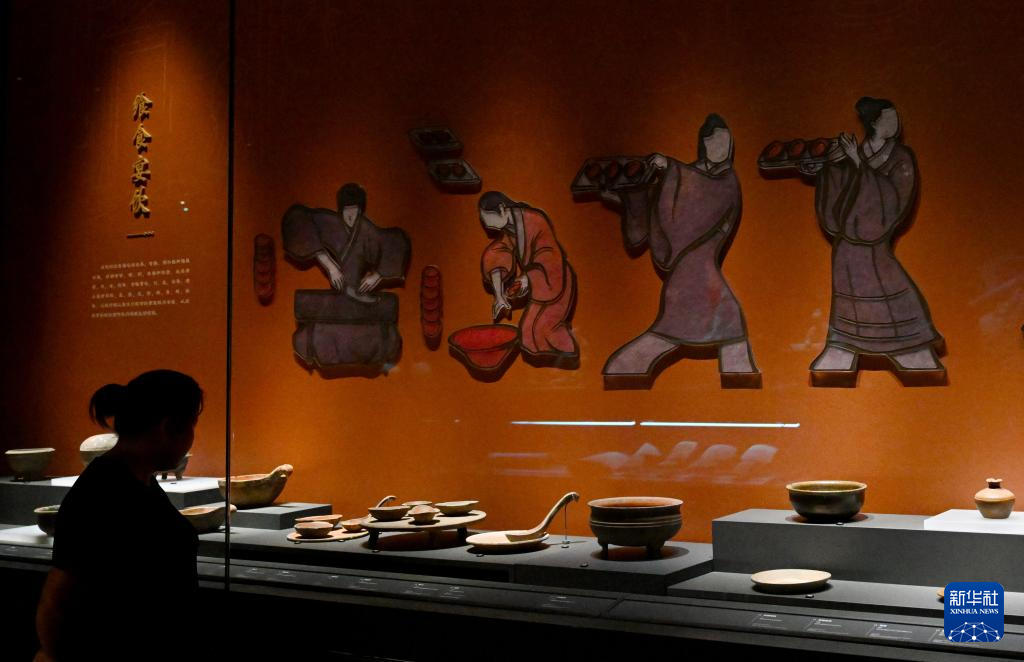
文化中国行 主根主脉看河南 行走大遗址丨打开一千六百年历史画卷 遗址中“长”出博物馆
He Nan Ri Bao· 2025-07-16 23:36
Core Viewpoint - The newly opened Han-Wei Luoyang City Ruins Museum aims to revitalize the historical significance of Luoyang, a key birthplace of Chinese civilization, through the construction of a cultural hub that showcases ancient artifacts and promotes cultural heritage [8][10][14]. Group 1: Museum Overview - The Han-Wei Luoyang City Ruins Museum, covering an area of 219 acres and with a total construction area of 29,000 square meters, is designed to reflect the grandeur of the Han and Wei dynasties [10]. - The museum features a series of architectural elements that recreate the spatial order of the ancient capital, allowing visitors to experience the historical layout of the city [10][13]. - The museum is part of a broader initiative to establish Luoyang as a "Museum City of the East," enhancing the visibility and accessibility of its rich cultural heritage [8][13]. Group 2: Exhibition and Artifacts - The museum's main exhibition, titled "The History of China - Han-Wei Luoyang City Ruins Museum," is organized around three thematic halls: "Central," "Harmony," and "Unity," providing a multi-dimensional understanding of the ancient city [11]. - The "Central" hall emphasizes the strict governance and order of the capital, showcasing artifacts such as roof tiles inscribed with "Heavenly Spirits" and models of the palace layout [11]. - The "Harmony" hall features over a thousand precious artifacts that illustrate the cultural exchanges and integration of various ethnic groups during the Wei, Jin, and Northern Dynasties [11][12]. Group 3: Cultural Significance - The Han-Wei Luoyang City was historically one of the largest cities in the world, with a population exceeding one million at its peak, underscoring its significance as a "world capital" [12]. - The museum serves as a cultural hub, integrating archaeological research, artifact restoration, and academic activities, positioning itself as a center for the study of early Chinese capital culture [13][14]. - The establishment of the museum aligns with national efforts to protect and promote cultural heritage, making it a key player in the innovative practice of immersive heritage display [13].
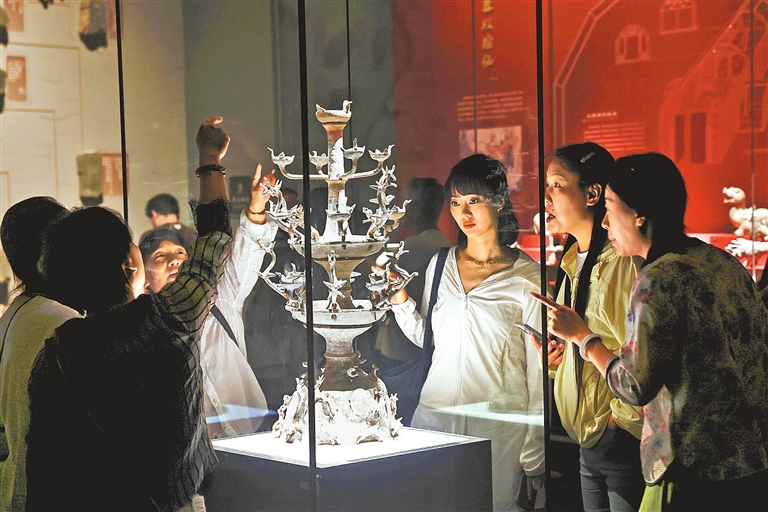
“登”明代商船游万国 全景漫游莫高窟……走,去博物馆体验“穿越”之旅
Yang Shi Xin Wen· 2025-07-13 07:27
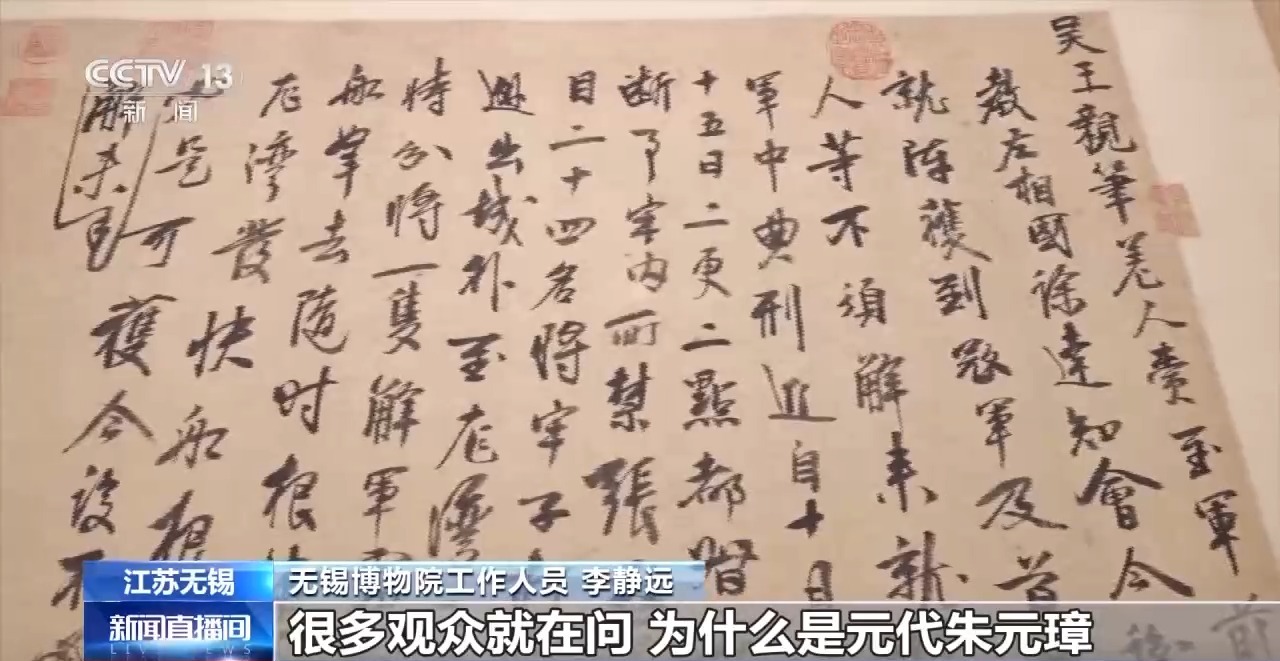
Group 1 - The article highlights the increasing popularity of museums during the summer, particularly focusing on the Wuxi Museum's exhibition that combines traditional art with modern technology [1] - The Wuxi Museum exhibition features over 60 pieces of fine cultural relics, including 13 first-class collections, primarily showcasing calligraphy and paintings [2][4] - A notable piece in the exhibition is a calligraphy scroll by Zhu Yuanzhang from the Yuan Dynasty, which is significant as it predates the establishment of the Ming Dynasty [3][4] Group 2 - The exhibition also includes other rare items such as a Ming Dynasty gold thread hair cover and Tang Yin's "Autumn Forest Walk" [7] - The museum employs digital technologies like AR, VR, and 3D modeling to create immersive experiences that allow visitors to engage with the cultural context of the artifacts [9] - The Nanjing Museum is also utilizing digital technology in its exhibition of the "Kunyu Wanguo Quantu," a Ming Dynasty world map, enhancing visitor understanding of its historical significance [10][11] Group 3 - The "Kunyu Wanguo Quantu" is noted as the earliest and most complete Chinese version of a world map, created in collaboration between Italian missionary Matteo Ricci and Ming scholar Li Zhizao [13][15] - The map features illustrations of both real and mythical creatures, reflecting the knowledge and imagination of the time [16] - The Nanjing Museum offers a VR immersive exhibition that allows visitors to experience the historical context of the map in a dynamic way [18][20] Group 4 - In Hangzhou, the Zhejiang Museum is showcasing an exhibition that combines physical artifacts with digital immersive experiences, featuring 81 items from various ancient caves [23][24] - The exhibition allows visitors to explore the evolution of cave art through VR technology, enhancing their understanding of the cultural heritage [26] - The curator emphasizes the integration of technology and content to make the artifacts more engaging and relatable to the audience [28]