石油天然气

Search documents
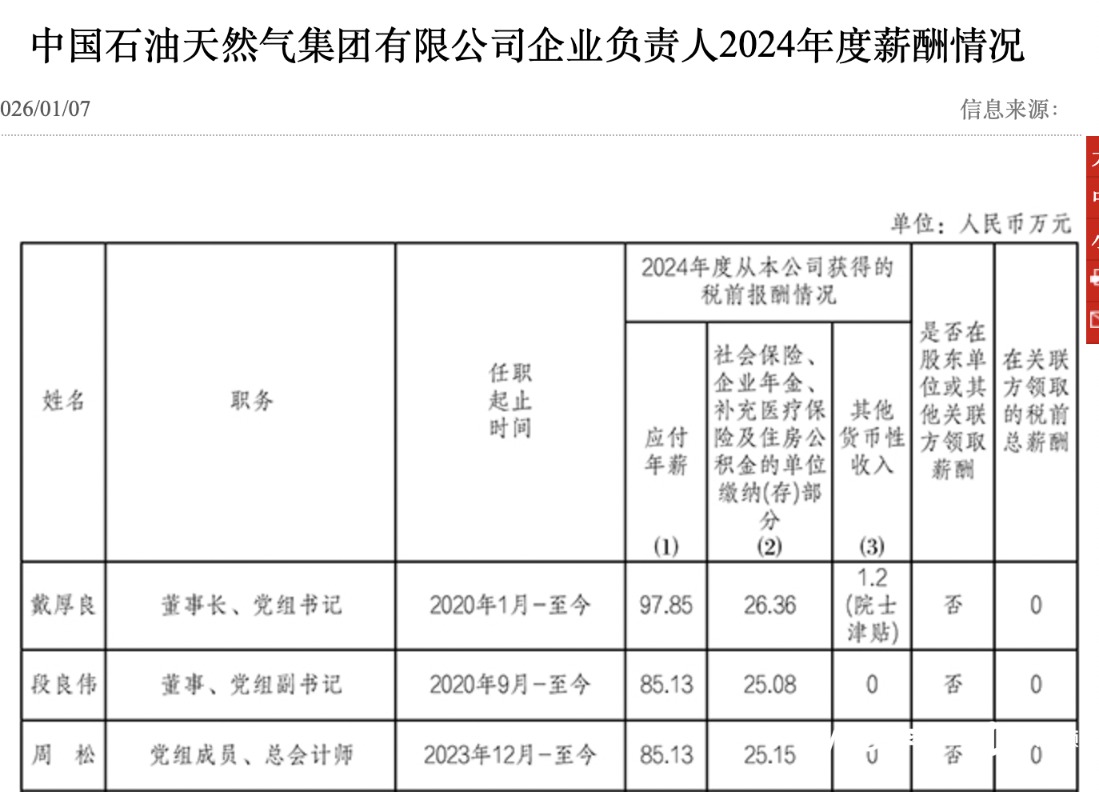
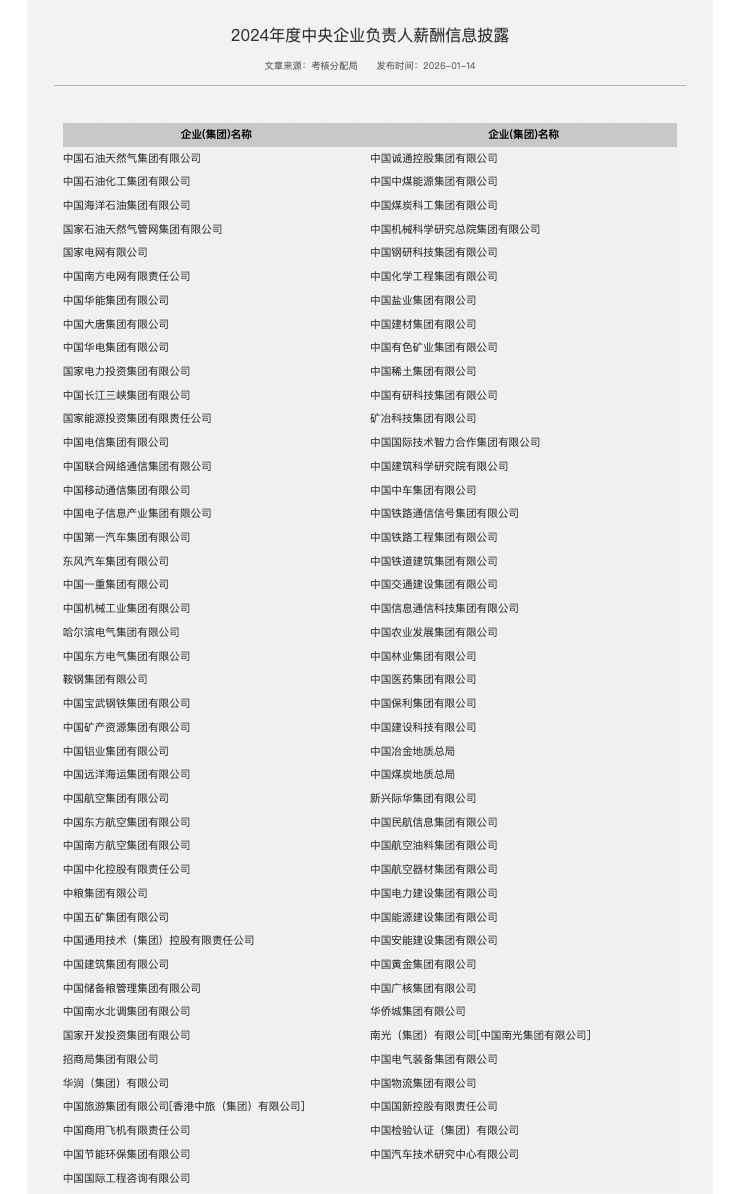
中石油、中石化等央企负责人能领多少钱?国资委披露
Nan Fang Du Shi Bao· 2026-01-14 15:10
Core Insights - The State-owned Assets Supervision and Administration Commission (SASAC) disclosed the 2024 salary information for over 80 central enterprises, indicating a stable salary range for executives, characterized by "top-tier leadership, concentrated median, and compliant lower-tier" without extreme high salaries [1] Group 1: Salary Distribution - The top tier of executive salaries is dominated by telecommunications and energy central enterprises, with China Mobile's former chairman Yang Jie leading at a pre-tax salary of 1.2582 million yuan, followed by China Telecom's chairman Ke Ruiwen and China Unicom's chairman Chen Zhongyue with pre-tax salaries of 1.2160 million yuan and 1.2101 million yuan respectively [1] - In the energy sector, PetroChina's chairman Dai Houliang and general manager Hou Qijun both have an annual salary of 978,500 yuan, ranking first among energy central enterprises, while China National Offshore Oil Corporation's chairman Wang Dongjin follows with an annual salary of 966,900 yuan [2] - Comprehensive central enterprises like China Merchants Group and China Resources Group also maintain high salaries, with China Merchants' chairman Miao Jianmin earning an annual salary of 946,400 yuan and China Resources' chairman Wang Xiangming earning 951,200 yuan [3] Group 2: Salary Tiers - The second tier includes core central enterprises in electricity, construction, and automotive industries, with State Grid's chairman Zhang Zhigang earning an annual salary of 735,000 yuan, and China General Nuclear Power Group's chairman Yang Changli earning 930,000 yuan [4] - The automotive sector features China FAW's chairman Qiu Xiandong with an annual salary of 909,700 yuan, and China National Automotive Industry Corporation's chairman Yang Qing with 868,600 yuan [4] - The third tier consists of public welfare-oriented central enterprises, with China Forestry Group's chairman Shan Zhongli and Overseas Chinese Town Group's chairman Zhang Zhenga both earning 438,500 yuan, which is below the average salary level for central enterprises [4] Group 3: Salary Disparities - Within the same industry, the salary differences among executives of central enterprises are manageable, with the highest annual salary in the energy sector (PetroChina at 978,500 yuan) and the lowest (National Pipeline at 872,900 yuan) showing a gap of approximately 100,000 yuan [5] - The salary disparity among the three major telecommunications operators' chairmen is less than 50,000 yuan, while the five major power generation group chairmen's salaries are concentrated in the range of 880,000 to 960,000 yuan, indicating a relatively balanced ranking [5]

极度恐慌、情绪崩溃,李勇在阁楼烧现金企图脱罪
中国能源报· 2026-01-14 14:33
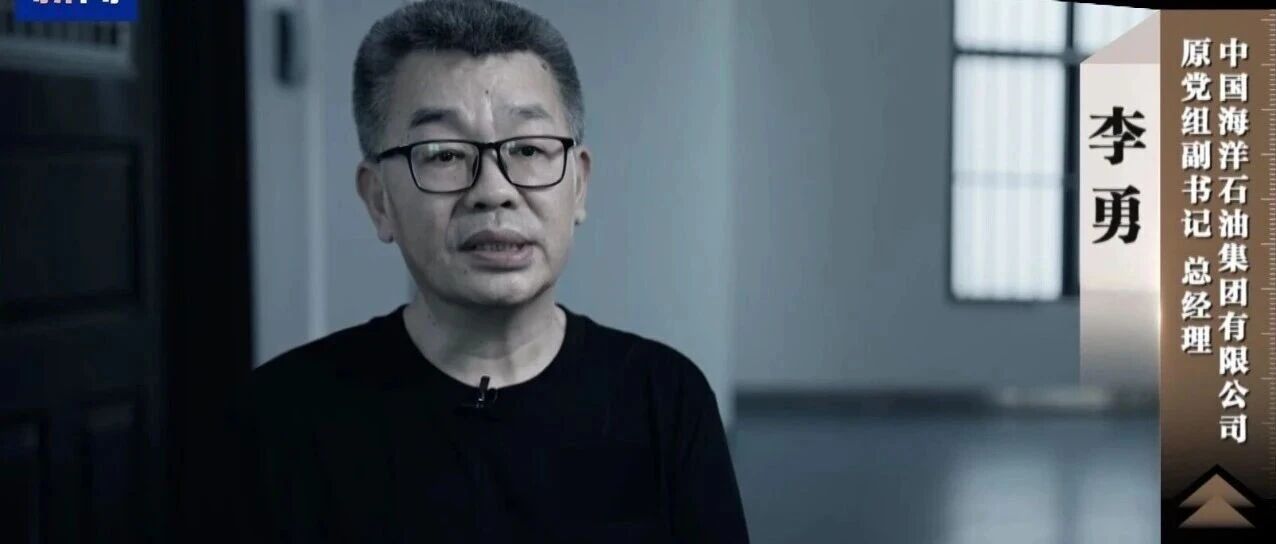
Core Viewpoint - The article discusses the case of Li Yong, former Deputy Secretary of the Party Committee and General Manager of China National Offshore Oil Corporation (CNOOC), highlighting the use of technology in anti-corruption efforts and the challenges of cross-border corruption investigations [1][6][8]. Group 1: Case Background - Li Yong was involved in significant overseas projects for CNOOC, with a prominent issue of cross-border corruption [6]. - Over 83% of the illicit funds in Li Yong's case originated from abroad, with investigations spanning 10 countries and regions [8]. - Li Yong believed that operating overseas would shield him from investigations, thinking that evidence would be hard to trace [12]. Group 2: Investigation Techniques - The disciplinary inspection and supervision authorities utilized big data and information technology to enhance the effectiveness of their investigations [1][17]. - A specialized task force analyzed extensive business records and employed data collision techniques to identify key suspects linked to Li Yong [15][17]. - The investigation revealed suspicious procurement projects linked to a businessman named Ren Fengde, who had close ties with Li Yong [18][22]. Group 3: Corruption Methods - Li Yong engaged in corrupt practices by disguising bribery within seemingly legitimate project collaborations, believing he could evade detection [10][26]. - He facilitated the receipt of bribes through intermediaries, such as Ren Fengde, who acted as a "white glove" to obscure the transactions [26][31]. - Li Yong's methods included creating offshore accounts to hide illicit funds, complicating the money trail across multiple jurisdictions [37][39]. Group 4: Consequences and Legal Actions - Following the investigation, Li Yong was placed under scrutiny and ultimately detained, leading to a conviction for bribery with a sentence of 14 years in prison and a fine of 3 million yuan [59][61]. - The case exemplifies the effectiveness of international cooperation in anti-corruption efforts, with successful evidence collection from foreign jurisdictions [39].

英国石油:Q4财报将计40 - 50亿美元资产减值损失
Sou Hu Cai Jing· 2026-01-14 14:02
Core Viewpoint - BP expects to report a post-tax asset impairment loss of $4 billion to $5 billion in its fourth-quarter financial results, primarily affecting its natural gas and low-carbon energy segments [1] Group 1 - The impairment loss is attributed mainly to the natural gas and low-carbon energy business segments [1] - The impairment will not impact the core earnings metrics based on reset cost profits [1]

英国石油:四季度财报将计40 - 50亿美元减值损失
Sou Hu Cai Jing· 2026-01-14 13:50
Core Viewpoint - BP expects to report a post-tax asset impairment loss of $4 billion to $5 billion in its fourth-quarter financial results, primarily affecting its natural gas and low-carbon energy segments [1] Group 1 - The impairment loss is attributed mainly to the natural gas and low-carbon energy business segments [1] - The impairment will not affect the core earnings metrics based on reset cost profits [1]
英国石油预计Q4将计入至多50亿美元资产减值损失
Ge Long Hui A P P· 2026-01-14 13:29
Core Viewpoint - BP expects to report an after-tax asset impairment loss of $4 billion to $5 billion in its fourth-quarter financial results, primarily driven by its natural gas and low-carbon energy segments, which will not affect core earnings based on reset cost profits [1] Group 1 - The impairment loss is mainly attributed to the natural gas and low-carbon energy business segments [1] - The reported impairment will not impact the core earnings metrics based on reset cost profits [1]
极度恐慌、情绪崩溃,副部级李勇在阁楼烧现金企图脱罪
2 1 Shi Ji Jing Ji Bao Dao· 2026-01-14 13:15
Core Viewpoint - The documentary highlights the case of Li Yong, former Deputy Secretary of the Party Committee and General Manager of China National Offshore Oil Corporation (CNOOC), emphasizing the role of technology in enhancing anti-corruption efforts through digital monitoring and data analysis [1][5][37]. Group 1: Case Overview - Li Yong has been under investigation since March 2024 for serious corruption issues related to his extensive overseas projects [5]. - The case is characterized as a typical example of cross-border corruption in state-owned enterprises, with over 83% of the illicit funds originating from abroad [7]. - Li Yong's long tenure in the oil sector allowed him to disguise corrupt practices within seemingly legitimate business collaborations [9]. Group 2: Investigative Techniques - The disciplinary inspection and supervision authorities utilized big data and information technology to uncover Li Yong's corruption, leading to a comprehensive analysis of his business dealings [11][14]. - The investigation involved international cooperation across ten countries and regions to gather evidence [7][27]. - Data analysis revealed suspicious relationships and transactions, particularly involving a businessman named Ren Fengde, who was found to have significant ties to Li Yong [15][17]. Group 3: Corruption Mechanisms - Li Yong facilitated corrupt transactions by using intermediaries to obscure the flow of illicit funds, including setting up offshore accounts [19][25]. - He engaged in schemes where high commissions were paid to foreign agents, which were then funneled back to him through complex financial arrangements [29][31]. - The investigation uncovered that Li Yong had received millions in bribes disguised as "thank you fees" for facilitating contracts [23][19]. Group 4: Consequences and Sentencing - Following the investigation, Li Yong was detained and ultimately sentenced to 14 years in prison for bribery, along with a fine of 3 million yuan [37]. - The case serves as a cautionary tale about the consequences of corruption, highlighting the irreversible damage to personal reputation and public trust [39].
落马贪官李勇受贿超83%赃款来自海外
Zhong Guo Xin Wen Wang· 2026-01-14 12:46
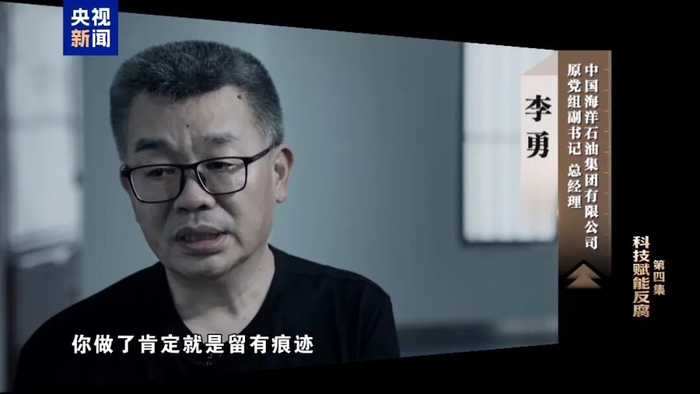
落马贪官李勇受贿超83%赃款来自海外 14日播出的反腐专题片《一步不停歇 半步不退让》第四集披露,中国海油原党组副书记、总经理李勇 在石油系统工作近40年,他利用自己对国际海洋石油领域商业模式的深度了解,将权钱交易包裹在看似 正常的项目合作之中。其跨境腐败问题极其突出,超过83%的赃款来自境外,商人老板在境外代为收 受、流转和存放赃款,对其境外调查取证工作涉及10个国家和地区。李勇称,"我就觉得在海外就没有 调查权,鞭长莫及。有些项目闻你都能闻出那个味儿来,就是不正常,但是你没法查。" 本文为转载内容,授权事宜请联系原著作权人 中新经纬版权所有,未经书面授权,任何单位及个人不得转载、摘编或以其它方式使用。 关注中新经纬微信公众号(微信搜索"中新经纬"或"jwview"),看更多精彩财经资讯。 编辑:陈俊明 广告等商务合作,请点击这里 来源:中国新闻网 ...
英国石油(BP.US)预计Q4计提高达50亿美元减值 能源转型业务遭遇重大挫折
Zhi Tong Cai Jing· 2026-01-14 12:37
Core Viewpoint - BP is expected to report a significant after-tax asset impairment loss of $4 billion to $5 billion in its fourth-quarter earnings, primarily related to its transition to low-carbon energy [1] Group 1: Performance Expectations - Despite the impairment, BP anticipates that its total upstream oil and gas production will remain stable compared to the previous quarter, with crude oil production holding steady while natural gas and low-carbon energy output is expected to decline [2] - The natural gas and low-carbon energy segment is projected to face a negative impact of $100 million to $300 million on quarterly performance due to price fluctuations outside of Henry Hub [2] - Retail business sales are expected to decline due to seasonal factors, while fuel margins are anticipated to remain flat [2] Group 2: Financial Structure Adjustments - BP expects its net debt to decrease to between $22 billion and $23 billion by the end of the fourth quarter, a significant improvement from $26.1 billion at the end of the third quarter [3] - The company has raised its expected effective tax rate for the full year 2025 from approximately 40% to 42% due to changes in the geographic structure of earnings [3] - The large impairment highlights the challenges and financial costs faced by traditional energy giants in reshaping their asset portfolios amid global energy price volatility and uncertainties in transition pathways [3]
中石油、中石化等能源央企负责人年薪多少?国务院披露
Feng Huang Wang Cai Jing· 2026-01-14 12:23
Core Viewpoint - The State-owned Assets Supervision and Administration Commission (SASAC) has disclosed the salary information of over 80 central enterprise leaders for the year 2024, emphasizing the importance of transparency in key areas and responding to public concerns [1] Group 1: Salary Disclosure - The disclosure includes salary information for leaders of major state-owned enterprises, highlighting a commitment to transparency [1] - Notable energy central enterprises have leaders with annual salaries close to one million yuan [2] Group 2: Top Salaries - The highest salary is held by Dai Houliang, Chairman of China National Petroleum Corporation, with an annual salary of 978,500 yuan [3] - Wang Dongjin, Chairman of China National Offshore Oil Corporation, ranks second with a salary of 966,900 yuan [3] - Ma Yongsheng, Chairman of Sinopec, ranks third with a salary of 935,500 yuan [3] - Zhang Wei, Chairman of the National Oil and Gas Pipeline Network Group, ranks fourth with a salary of 872,900 yuan [3]


哈萨克斯坦油轮遭袭引发爆炸
中国能源报· 2026-01-14 08:59
Core Viewpoint - A Kazakhstani oil tanker, the "Matilda," was attacked by a drone in the Caspian Sea, resulting in an explosion but no subsequent fire. Initial assessments indicate that the tanker remains navigable and no severe structural damage was found [1]. Group 1 - The incident occurred on January 13, as reported by the Kazakh National Oil and Gas Company [1]. - The attack did not lead to a fire, which is a critical factor in assessing the overall impact of the incident [1]. - Preliminary evaluations suggest that the oil tanker can still operate, indicating a lower risk of long-term operational disruption [1].