
预制菜

Search documents
全网刷屏!罗永浩和西贝“吵翻了”,新华社发声
Zhong Guo Ji Jin Bao· 2025-09-13 14:38
Core Viewpoint - The discussion around "pre-prepared dishes" reflects consumer concerns about their right to know and the demand for improved food quality [2][6] Group 1: Definition and Characteristics of Pre-prepared Dishes - Pre-prepared dishes are defined as packaged meals made from one or more food products, processed industrially without preservatives, and require heating or cooking before consumption [3] - The use of pre-prepared dishes can enhance operational efficiency in the restaurant industry, particularly in fast-food settings, by allowing quick replication of flavors [3][5] Group 2: Safety and Nutritional Concerns - Fresh ingredients retain more nutrients, but pre-prepared dishes can meet caloric and nutritional needs if produced and handled according to safety standards [4] - The safety of pre-prepared dishes is questioned due to the lack of hygiene in some small-scale food establishments, leading to a negative perception among consumers [6][7] Group 3: Consumer Rights and Industry Standards - There is a significant concern regarding transparency, as some businesses misrepresent pre-prepared dishes as freshly cooked, violating consumer rights [7] - The industry is urged to establish clear standards and regulations to ensure the safe production and labeling of pre-prepared dishes, thereby protecting consumer rights [8][9] Group 4: Industry Development and Future Directions - The industry is focusing on high-quality development through initiatives like building cold chain logistics and creating quality raw material bases [8] - Experts suggest that standardization, transparency, and innovation are essential for the future of the pre-prepared dish industry [8]
概念股总数超30只,被罗永浩骂惨的预制菜到底有多赚钱?
Di Yi Cai Jing· 2025-09-13 14:04
Core Viewpoint - The pre-prepared food sector is gaining attention, with several companies in the market reaching significant market capitalizations, including those exceeding 100 billion yuan and even 1 trillion yuan [2][3]. Company Overview - There are currently 31 A-share companies in the pre-prepared food sector, with major players including Jinlongyu (金龙鱼, 300999.SZ), Shuanghui Development (双汇发展, 000895.SZ), and Sanquan Foods (三全食品, 002216.SZ) [2]. - Jinlongyu is the only company in the sector with a market capitalization exceeding 1 trillion yuan, valued at 179.726 billion yuan as of September 12 [2]. - Other notable companies include Shuanghui Development and New Hope (新希望, 000876.SZ), with market capitalizations of 89.076 billion yuan and 46.647 billion yuan, respectively [2]. Market Performance - As of September 12, the pre-prepared food sector has shown a 10.27% increase since early July, with over 90% of the stocks in the sector experiencing price increases during this period [3][4]. - The stock with the highest price on September 12 was Anjixin Foods (安井食品, 603345.SH) at 74.01 yuan per share, followed by Qianwei Yangchun (千味央厨) and Jinlongyu at 33.59 yuan and 33.15 yuan, respectively [3]. Financial Performance - In the first half of the year, Jinlongyu reported the highest revenue in the sector at 115.682 billion yuan, a year-on-year increase of 5.67%, with a net profit of 1.756 billion yuan, up 60.07% [5][7]. - New Hope achieved revenue of 51.625 billion yuan, with a net profit of 755 million yuan, reflecting a year-on-year growth of 4.13% and 162%, respectively [5][7]. - Shuanghui Development reported revenue of 28.414 billion yuan and a net profit of 2.323 billion yuan, with year-on-year growth rates of 2.97% and 1.17% [5][7].



全网刷屏!罗永浩和西贝“吵翻了”,新华社发声
中国基金报· 2025-09-13 14:03
Core Viewpoint - The article discusses the growing consumer interest in "pre-prepared dishes" (pre-made meals) and emphasizes the importance of consumer awareness and the demand for improved food quality in the restaurant industry [6][10]. Group 1: Definition and Characteristics of Pre-prepared Dishes - Pre-prepared dishes are defined as meals made from one or more food products that undergo industrial pre-processing, such as marinating or cooking, and are packaged for storage and sale [7]. - The use of pre-prepared dishes can significantly enhance operational efficiency in the restaurant industry, particularly in fast-food settings, by allowing restaurants to replicate flavors quickly [7][9]. Group 2: Safety and Nutritional Concerns - Fresh ingredients retain more nutrients, but pre-prepared dishes can still meet nutritional needs if produced and handled according to food safety standards [8]. - The safety of pre-prepared dishes is questioned due to concerns about hygiene in small-scale food establishments, which can lead to a negative perception among consumers [10]. Group 3: Consumer Rights and Industry Standards - There is a lack of clear definitions and standards for pre-prepared dishes, leading to consumer uncertainty and mistrust [11]. - The article highlights the need for transparency in the use of pre-prepared dishes in restaurants, advocating for clear labeling to protect consumer rights [11][13]. Group 4: Industry Development and Future Directions - The article suggests that the future of the pre-prepared dish industry lies in standardization, transparency, and innovation [13]. - Initiatives in various regions aim to promote high-quality development of the pre-prepared dish industry through improved logistics, branding, and resource management [12].

记者来信:讨论预制菜时 我们在关心什么?
Xin Hua Wang· 2025-09-13 13:34
Core Viewpoint - The topic of "pre-prepared dishes" has gained significant attention from consumers, highlighting their concerns about the right to know and the demand for improved food quality [1] Group 1: Definition and Characteristics of Pre-prepared Dishes - Pre-prepared dishes are defined as packaged meals made from one or more food products, processed industrially without preservatives, and require heating or cooking before consumption [2] - The use of pre-prepared dishes can enhance operational efficiency in the restaurant industry, particularly in fast food settings, by allowing restaurants to replicate flavors in a matter of minutes [2] Group 2: Safety and Nutritional Aspects - Fresh ingredients retain more nutrients, but pre-prepared dishes can still meet caloric and nutritional needs if produced, transported, stored, and cooked according to food safety standards [3] Group 3: Industry Practices and Consumer Concerns - Large chain restaurants commonly use pre-prepared dishes due to safety regulations and cost efficiency, which can enhance customer experience by speeding up service [4] - Concerns arise from small-scale restaurants where food safety may be compromised, leading to a negative perception of pre-prepared dishes as low-quality [5] - The lack of clear definitions and standards for pre-prepared dishes contributes to consumer uncertainty, and some businesses misrepresent pre-prepared dishes as freshly cooked, violating consumer rights [5] Group 4: Industry Development and Future Directions - The pre-prepared dish industry is recognized as a vital part of the food industry, and its healthy development is essential to meet diverse consumer demands [6] - Various regions are implementing measures to promote high-quality development in the pre-prepared dish sector, such as establishing cold chain logistics and creating quality raw material bases [6] - Experts suggest that standardization, transparency, and innovation are crucial for the future of the pre-prepared dish industry, including the establishment of national standards and consumer notification systems [7]
不怕你预制,怕你不告诉我
Xin Hua She· 2025-09-13 13:33
Core Viewpoint - The discussion around "pre-prepared dishes" reflects consumer concerns about their right to know and the demand for improved food quality in the restaurant industry [1] Group 1: Definition and Characteristics of Pre-prepared Dishes - Pre-prepared dishes are defined as packaged meals made from one or more food products, processed industrially without preservatives, and require heating or cooking before consumption [2] - The use of pre-prepared dishes can significantly enhance operational efficiency in the restaurant industry, particularly in fast food settings, by allowing for quick flavor replication [2] Group 2: Safety and Nutritional Aspects - Fresh ingredients retain more nutrients, but pre-prepared dishes can meet caloric and nutritional needs if produced, transported, stored, and cooked according to food safety standards [3] Group 3: Industry Adoption and Consumer Concerns - Large chain restaurants commonly use pre-prepared dishes due to safety regulations and cost efficiency, which can enhance customer experience by speeding up service [4] - Concerns arise from small-scale restaurants where food safety may be compromised, leading to a negative perception of pre-prepared dishes as low-quality [5] - The lack of clear definitions and standards for pre-prepared dishes contributes to consumer uncertainty and mistrust [5] Group 4: Regulatory and Development Initiatives - The industry is encouraged to promote transparency regarding the use of pre-prepared dishes to protect consumer rights and choices [5] - Various regions are implementing measures to support the high-quality development of the pre-prepared dish industry, including building cold chain logistics and cultivating quality raw material bases [6][7] - Experts suggest that standardization, transparency, and innovation are essential for the future of the pre-prepared dish industry, including the establishment of national standards and consumer notification systems [7]
新华社:不怕你预制,怕你不告诉我
Xin Hua She· 2025-09-13 13:10
Core Viewpoint - The discussion around "pre-prepared dishes" reflects consumer concerns about their right to know and the demand for improved food quality in the restaurant industry [1][5]. Group 1: Definition and Characteristics of Pre-prepared Dishes - Pre-prepared dishes are defined as packaged meals made from one or more food products, processed industrially without preservatives, and requiring heating or cooking before consumption [2]. - The use of pre-prepared dishes can enhance operational efficiency in the restaurant industry, particularly in fast-food settings, by allowing restaurants to replicate flavors in minutes [2]. Group 2: Safety and Nutritional Aspects - Fresh ingredients retain more nutrients, but pre-prepared dishes can meet caloric and nutritional needs if produced, transported, stored, and cooked according to food safety standards [3]. Group 3: Industry Practices and Consumer Concerns - Large chain restaurants commonly use pre-prepared dishes due to safety regulations and cost efficiency, which can enhance customer experience by speeding up service [4]. - Concerns arise from small-scale restaurants where food safety may be compromised, leading to a negative perception of pre-prepared dishes as low-quality [5]. - The lack of clear definitions and standards for pre-prepared dishes contributes to consumer uncertainty and mistrust [5]. Group 4: Regulatory and Developmental Initiatives - The industry is encouraged to promote transparency regarding the use of pre-prepared dishes to protect consumer rights [5][8]. - Various regions are implementing measures to support the high-quality development of the pre-prepared dish industry, including building cold chain logistics and developing quality raw material bases [7]. Group 5: Future Directions for the Industry - Experts suggest that standardization, transparency, and innovation are essential for the future of the pre-prepared dish industry [8]. - There is a call for the establishment of national standards for the production and handling of pre-prepared dishes, as well as a system to inform consumers about their use in restaurants [8].

专家:国家已划定预制菜范围,预处理的食品原料不等同于预制菜
Di Yi Cai Jing· 2025-09-13 12:56
作者 | 第一财经 马晓华、宋婕 事实上,公众对"预制菜"的概念一直较为模糊。然而,《通知》已作出明确定义:预制菜应当兼具"预 制化"和"菜肴"的双重特征,突出工业化预加工的特点和菜肴属性,具备规模化、标准化、洁净化、规 范化的食品生产加工要求。同时,预制菜必须是加热或熟制后方可食用的预包装菜肴。 "国家已经划定了预制菜的范围。预处理的食品原料并不等同于预制菜,比如清洗后的鱼或切块肉类, 它们都不具备'菜肴'的特征。"一位食品专家告诉第一财经。 预制菜是食品工业化的必然产物。日本、欧美等国家已普及数十年。美国FDA将即食食品、即热食品、 即烹食品、即配食品均归为预制食品。其之所以能在国际上行之多年,价值不容忽视。 预制菜通过工业标准化手段,破解"时间—美味—营养"的不可能三角:将洗、切、腌、调味、火候等耗 时环节前置到工厂,让消费者在几分钟内复现餐厅级口感;借助冷链与锁鲜技术,即使不添加防腐剂, 也能实现常温或低温长保,减少约30%的食材浪费;中央厨房集中生产,使油盐糖用量精准可控,为老 龄化社会、小家庭、单身人群提供低盐、低GI、高蛋白等健康选择;同时降低餐饮B端的人工与租金成 本,实现社会资源的最优配置, ...
记者来信:讨论预制菜时,我们在关心什么?
Xin Hua Wang· 2025-09-13 12:00
Core Viewpoint - The discussion around "pre-prepared dishes" reflects consumer concerns about their right to know and the demand for improved food quality, prompting the food industry to consider how to better integrate pre-prepared dishes into their offerings [1] Group 1: Definition and Characteristics of Pre-prepared Dishes - Pre-prepared dishes are defined as packaged meals made from one or more food products, which undergo industrial pre-processing and are safe for consumption after heating [2] - The use of pre-prepared dishes can enhance operational efficiency in the restaurant industry, particularly in fast-food settings, by allowing for quick meal preparation [2] Group 2: Safety and Nutritional Aspects - Fresh ingredients retain more nutrients, but pre-prepared dishes can still meet nutritional needs if produced and handled according to food safety standards [3] Group 3: Industry Practices and Consumer Concerns - Large chain restaurants commonly use pre-prepared dishes due to safety regulations and cost efficiency, which can enhance customer experience by speeding up service [4] - Concerns arise from small-scale restaurants where food safety may be compromised, leading to a negative perception of pre-prepared dishes as low-quality [5] - The lack of clear definitions and standards for pre-prepared dishes contributes to consumer uncertainty and mistrust [5] Group 4: Regulatory and Development Initiatives - There is a recognized need for the pre-prepared dish industry to develop standards, transparency, and innovation to meet diverse consumer demands [6][8] - Various regions are implementing measures to promote high-quality development in the pre-prepared dish sector, including building cold chain logistics and cultivating industry brands [7] Group 5: Future Directions - Experts suggest that establishing national standards, promoting transparency in the use of pre-prepared dishes, and providing clear consumer complaint channels are essential for the industry's future [8]
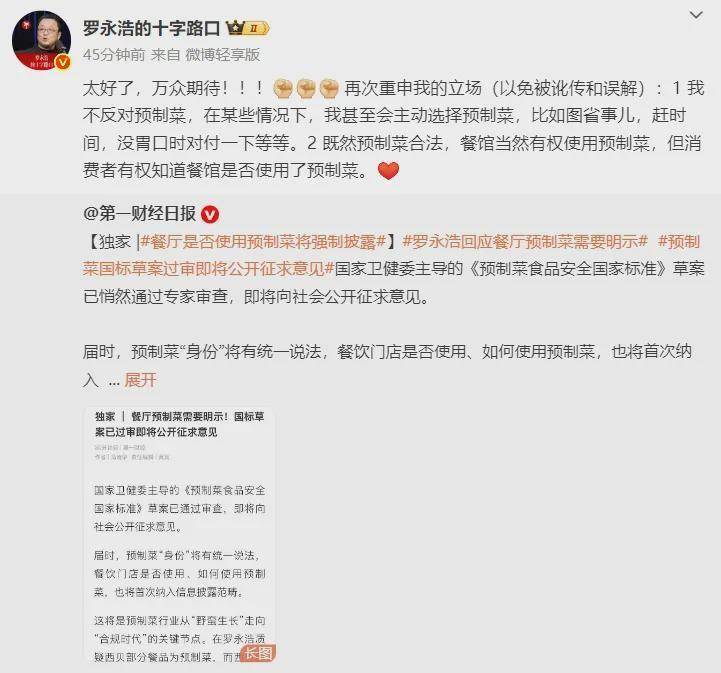
餐厅预制菜需要明示!国标草案已过审即将公开征求意见!罗永浩:太好了,万众期待
Sou Hu Cai Jing· 2025-09-13 10:51
Group 1 - The draft of the national standard for pre-prepared food safety, led by the National Health Commission, has passed review and will soon seek public opinion, marking a key transition for the pre-prepared food industry from "wild growth" to a "compliance era" [1] - The standard will define pre-prepared food categories, raw materials, processing methods, storage, transportation, and inspection methods, with mandatory indicators such as "no added preservatives" [1][4] - The introduction of the national standard is expected to increase costs by 15% to 30% due to requirements for "preservative bans" and cold chain upgrades, potentially leading to the acquisition or exit of small factories unable to bear the transformation costs [4] Group 2 - The recent controversy involving celebrity Luo Yonghao questioning the use of pre-prepared food by a restaurant chain has drawn significant attention, highlighting the need for transparency in the use of pre-prepared food in restaurants [1][3] - The national standard aims to enhance food safety regulation for food service operators and encourage restaurants to voluntarily disclose their use of pre-prepared food, fostering industry self-discipline and a better consumer environment [4] - The arrival of the national standard will compel the restaurant industry to abandon "ambiguous marketing," ensuring that consumer choice is genuinely realized as disclosure becomes a legal obligation [4]
罗永浩与西贝谁有理?与其口水仗,不如让大家吃得明白
Qi Lu Wan Bao· 2025-09-13 10:41
Core Viewpoint - The ongoing debate between Luo Yonghao and Jia Guolong regarding pre-prepared dishes has sparked widespread attention, highlighting issues such as the definition of pre-prepared dishes, their use in dine-in restaurants, and the protection of consumer rights [1][2]. Industry Insights - The pre-prepared dish market in China is projected to exceed 600 billion yuan by 2025, indicating that the industry is entering a phase of standardized development [3]. - Major restaurant chains are encouraged to take the lead in ensuring food safety and quality, demonstrating their commitment to consumers [3]. Consumer Expectations - Consumers are generally open to pre-prepared dishes, especially given the time-consuming nature of food preparation; however, they demand transparency regarding the nature of the dishes served, including which are pre-prepared and which are freshly cooked [2][3]. - There is a clear expectation for restaurants to provide transparent information about their dishes, ensuring that price and quality align, which reflects a respect for consumer rights [2]. Regulatory Context - The official definition of pre-prepared dishes was established by the State Administration for Market Regulation in March of last year, clarifying that dishes made in central kitchens do not fall under this category [1].