
农产品流通

Search documents
新发地河北再落子,永清保供仓开工奠基
Xin Jing Bao· 2025-11-26 09:47
Group 1 - The project of Xinfadi Yongqing sub-market marks an important addition to the capital's agricultural product supply system in the Beijing-Tianjin-Hebei region, enhancing the efficiency of agricultural product circulation [1][2] - The Yongqing County is strategically located in the "Golden Triangle" of Beijing, Tianjin, and Xiong'an, serving as a significant supply base for fresh vegetables and specialty crops, thus playing a crucial role in ensuring the diversity and freshness of agricultural products for the capital [1] - The project covers a total planned area of 406 acres, with the initial construction covering 189 acres and a building area of 125,000 square meters, involving an initial investment of approximately 720 million yuan [1] Group 2 - The Yongqing sub-market will prioritize the stable supply of agricultural products to the capital in emergency supply scenarios, leveraging its geographical advantages [2] - The project includes plans for a 1,000-acre agricultural product research and promotion base, aimed at driving innovation and industrialization in agriculture [2] - The comprehensive market will serve as an "accelerator" for regional agricultural product circulation, injecting new momentum into the coordinated development of the Beijing-Tianjin-Hebei area [2]
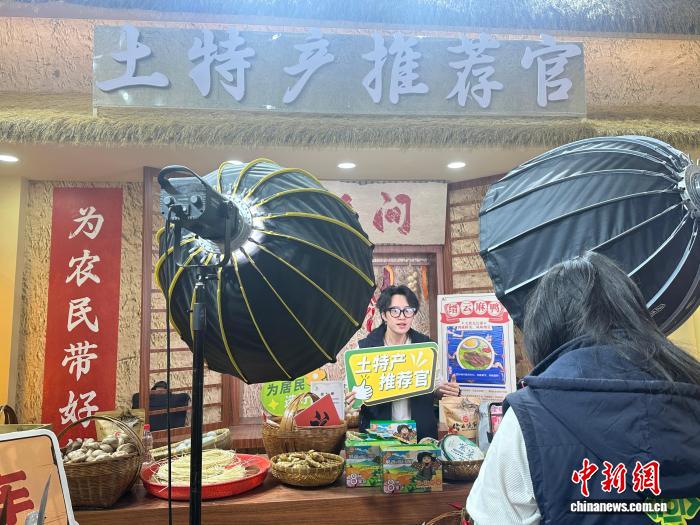
土特产“触网”出山 浙江供销在农博会搭起“云上共富桥”
Zhong Guo Xin Wen Wang· 2025-11-23 01:00
Core Points - The Zhejiang Agricultural Expo, held from November 21 to 25, 2025, focuses on promoting local specialties and enhancing shared prosperity, featuring over 3,500 enterprises and more than 40,000 products [1] - The Zhejiang Supply and Marketing Cooperative showcased over 200 local specialties and utilized 25 "local specialty promoters" to conduct live broadcasts, connecting rural products to a wider audience [1][2] - The "Supply and Marketing Big Caravan" initiative has served over 4,000 remote villages since its launch in 2021, facilitating the sale of agricultural products and providing essential services to farmers [4] Group 1 - The "local specialty promoters" are not only showcasing their hometown products but also taking on the responsibility of assisting farmers, with training sessions on e-commerce and marketing strategies [2] - The initiative has led to over 500,000 yuan in sales from more than 20 assistance activities conducted in the past six months [3] - The "Supply and Marketing Big Caravan" has improved the market competitiveness of agricultural products by establishing a standardized system and providing targeted recommendations to farmers [4] Group 2 - The first day of the expo saw online and offline sales exceeding 350,000 yuan, indicating strong market interest in local products [4] - The event highlighted various local delicacies, attracting many visitors and promoting the consumption of regional specialties [3][4] - The digital technology integration is enhancing the connection between urban and rural markets, paving the way for broader shared prosperity [4]

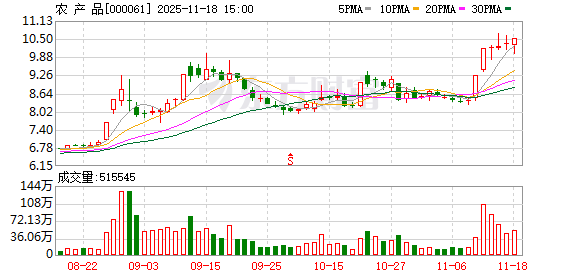
农 产 品(000061) - 000061农产品2025年11月21日投资者关系活动记录表
2025-11-21 12:57
Group 1: Company Overview - The company was established in 1989 and listed on the Shenzhen Stock Exchange in 1997, with 35 logistics park projects in over 20 major cities across China, forming the largest wholesale market network for agricultural products in the country [1] - The average annual trading volume of the company's wholesale markets exceeds 33 million tons, with an average annual transaction value exceeding 250 billion yuan [1] - The company's business scope includes standardized base planting, cold chain processing, wholesale market construction and operation, urban ingredient distribution, brand development, and import-export trade [1] Group 2: Competitive Advantages - After 36 years of development, the company has extensive experience in operating wholesale markets and a strong management talent pool [2] - The company integrates global partner resources and provides a one-stop service for the entire agricultural product supply chain, including wholesale trading venues, food safety testing, and brand cultivation [2] Group 3: Impact of New Retail Formats - The development of online new retail formats complements and collaborates with the wholesale market, creating an efficient supply chain linkage [3] - The company is enhancing its service capabilities through digital and intelligent tools, reinforcing its role as a core hub in the supply chain [4] Group 4: Revenue Enhancement Strategies - The company aims to improve transaction efficiency in the agricultural product circulation sector by accelerating project development and optimizing market layouts [4] - It plans to expand its business around the wholesale market, including supply chain connections, ingredient distribution, and brand development [4] Group 5: Market Management and Pricing - Revenue from the company's wholesale market management primarily comes from rent, commissions, management fees, and parking fees, with pricing based on market conditions and local economic factors [4] Group 6: Network Expansion Initiatives - The company is enhancing its national network by advancing key projects and promoting multi-regional collaboration [5] - New projects are being developed in strategic areas, including Shanghai, Chengdu, and Guangzhou, while older markets may undergo relocation or upgrades [7] Group 7: Base Operations and Supply Chain - The company has established cooperative relationships with approximately 10,000 acres of planting bases across multiple provinces, focusing on high-quality product cultivation [9] - It is actively developing the "Deep Farm" initiative to integrate agricultural production with rural revitalization [9] Group 8: Urban Ingredient Distribution - The company has expanded its ingredient distribution business, establishing 21 branches in major cities and covering various regions [9] - It aims to enhance food safety management capabilities and has been recognized for its quality management [9] Group 9: Digital Transformation - The company is leveraging big data, IoT, and cloud computing to enhance its digital operations and accelerate transformation [9] - Initiatives include the implementation of a unified transaction system and the launch of a price collection and release platform to improve market transparency [9]

农 产 品(000061) - 000061农产品2025年11月20日投资者关系活动记录表
2025-11-21 04:54
Group 1: Investment Strategy - The company has been expanding its market presence through new establishments and acquisitions, with 35 physical agricultural logistics park projects in over 20 major cities across the country [1] - The company plans to continue investing in quality projects to enhance its core competitiveness and profitability [1] Group 2: Brand Development - The company is focused on developing the "Haijixing" brand, transitioning from traditional distribution to a smart ecological model, which aims to improve operational efficiency and service capabilities [2] - Over 90 "Deep Agricultural Selection" products have been developed, enhancing brand image and product value [2] Group 3: Urban Renewal and Collaborations - The urban renewal project at the Buji market is progressing, with the draft legal plan completed and under review [2] - A strategic cooperation agreement has been signed with Feige Group to explore future collaboration opportunities in agricultural production and tourism integration [2] Group 4: Employee Stock Ownership and Dividend Strategy - The 2024 employee stock ownership plan will allow stock transfer to individual accounts or management committee sales based on market conditions [2] - The company emphasizes a stable profit distribution policy, considering various factors such as profitability, cash flow, and investment needs when formulating its dividend strategy [3] Group 5: Market Value Management - The company is committed to enhancing shareholder returns by transitioning to a modern agricultural product distribution model and improving operational efficiency across the entire industry chain [3]
南农晨读 | 食在广东 养在肇庆
Nan Fang Nong Cun Bao· 2025-11-21 02:31
Group 1 - The 2025 China Southern Medicine Food and Health Industry Conference was successfully held in Zhaoqing, focusing on the development of Southern medicine and food integration [4][30] - The conference gathered leaders from the Ministry of Agriculture and Rural Affairs, Guangdong Provincial Department of Agriculture and Rural Affairs, and experts in traditional Chinese medicine to discuss the development of cinnamon and Ba Jitian [6][5] - The event aimed to establish a standardized system and brand development path for the Southern medicine industry in Zhaoqing [7][6] Group 2 - The "China Agricultural Product Wholesale Market Industry Development 40 Years Conference" is scheduled to take place from December 12 to 14, 2025, in Guangzhou, highlighting the evolution of the agricultural product circulation system [14][13] - The conference will leverage the media advantages of the Greater Bay Area to showcase the significant changes in the agricultural product wholesale market over the past four decades [22][19] Group 3 - Guangdong's tea industry performed well in the 2025 "National Tea Figures" selection, with two individuals recognized as "Master Tea Makers" and one as a "Tea Craftsman" [26][24] - The event reflects the growing recognition and development of the tea industry in Guangdong [27]

南农晨读 | 农艺筑梦
Nan Fang Nong Cun Bao· 2025-11-20 02:03
Group 1 - "Zhanjiang Bay No. 1" has officially been delivered, marking a significant development in the aquaculture sector in Zhanjiang [3][5][26] - The large-scale aquaculture platform in Zhanjiang accounts for approximately 38% of the province's total, indicating a shift towards deep-sea aquaculture to meet the demand for high-quality protein [26][28] - The third Guangdong Forestry Expo will be held in Meizhou from December 1-3, inviting nearly 400 participating enterprises and buyers, focusing on the theme "Green Beautiful Guangdong, Green Rich People" [10][12] Group 2 - The Guangdong-Hong Kong-Macao Greater Bay Area Agricultural Products Trading Fair will take place from December 12-14 in Guangzhou, marking a significant transformation in the agricultural product circulation system [15][16][18] - The event will also see the establishment of the Greater Bay Area Buyers International Club, aimed at enhancing agricultural product distribution [17][18] Group 3 - The integration of sports and culture is being promoted in Yangjiang, known as the "Kite Capital," with plans to develop branded events and enhance the synergy between sports and tourism [40][42] - The 15th National Games will conclude with a closing ceremony in Shenzhen on November 21, 2025, with favorable weather conditions expected [46][48]
聚焦大湾区农交会|“媒体+”擎旗,采购商俱乐部开启农品流通新篇章
Nan Fang Nong Cun Bao· 2025-11-18 14:36
Core Viewpoint - The Guangdong-Hong Kong-Macao Greater Bay Area is undergoing significant changes in its agricultural product circulation system, highlighted by the upcoming Greater Bay Area Agricultural Products Trade Fair and the establishment of the International Buyers Club [6][7][10]. Group 1: Event Overview - The Greater Bay Area Agricultural Products Trade Fair will take place from December 12 to 14 in Guangzhou [6][7]. - The International Buyers Club aims to initiate a new chapter in agricultural product circulation [8]. Group 2: Club Structure and Services - The club will implement a tiered membership system, including "core buyers" and "growing buyers" [14]. - Core members must meet strict criteria, such as being among the top 500 agricultural companies or having an annual procurement amount exceeding 10 million yuan [15]. - Members can enjoy various benefits, including direct sourcing from Guangdong and exclusive pricing, potentially reducing procurement costs by 5%-15% [16]. Group 3: Development Plan - The club has a clear three-phase development plan: a rapid startup phase from 2025 to 2026, a deepening operation phase in 2027, and an enhancement phase in 2028 [26][27][28]. - The goal for 2028 is to achieve a member transaction volume exceeding 1 billion yuan [29]. Group 4: Market Impact and Innovation - The club's establishment coincides with a critical point in the innovation of agricultural product circulation systems in the digital economy era [36]. - The tiered membership design caters to both large enterprises and emerging companies, fostering a more robust industry ecosystem [42]. - The club aims to set a "Bay Area Standard" for agricultural product circulation, which could serve as a model for modernization across the country [48][56]. Group 5: Future Prospects - The club's operations are expected to accelerate the standardization of agricultural product circulation, cultivate new supply chain service models, and promote agricultural industrialization [55][61]. - The club may explore establishing a digital service platform covering the entire industry chain, contributing to innovative agricultural product circulation models [60].
农产品:经过36年的发展,公司在全国20余个大中城市投资了35家实体农产品物流园项目
Zheng Quan Ri Bao· 2025-11-18 11:42
Core Viewpoint - The company has developed a comprehensive agricultural product logistics network over 36 years, establishing itself as a leader in the wholesale market for agricultural products in China [2] Group 1: Company Development - The company has invested in 35 physical agricultural product logistics park projects across more than 20 major cities in China [2] - It has built the largest wholesale market network for agricultural products in the country, showcasing extensive operational experience and a strong management talent pool in the agricultural wholesale market [2] Group 2: Industry Positioning - The company focuses on the entire agricultural product circulation industry chain, extending from wholesale markets to various services [2] - It integrates global partner resources to enhance the value of the industry chain, providing a one-stop service that includes wholesale trading venues, base certification, food safety testing, brand cultivation, centralized processing and distribution, promotion of quality specialty agricultural products, supply-demand matching, and import-export services [2] Group 3: New Development Framework - The company has established a new development framework that promotes interaction and sharing between domestic wholesale markets and international business resources [2]
200亿深圳国企换帅!农产品董事长黄伟卸任,总裁张磊接棒
Nan Fang Du Shi Bao· 2025-11-18 08:04
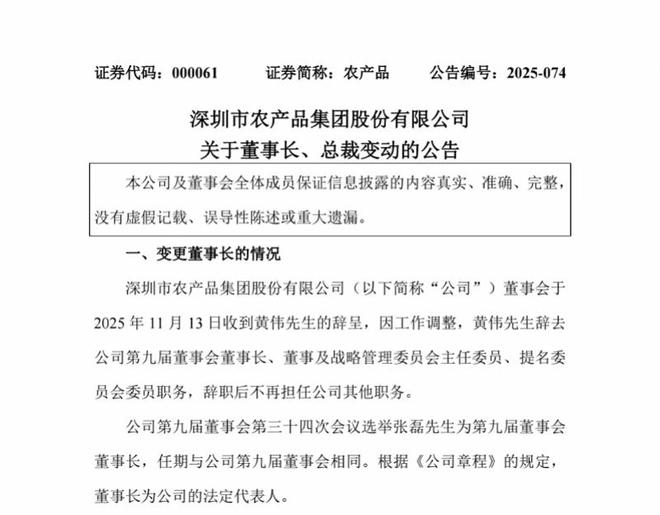
Core Viewpoint - The recent resignation of Chairman Huang Wei from the board of Shenzhen Agricultural Products Co., Ltd. marks a significant leadership change, with current President Zhang Lei stepping in as the new chairman, raising concerns about future management structure adjustments [1][3][10]. Group 1: Leadership Transition - Huang Wei has served as chairman for over four years, leading the company through a transformation towards modern agricultural product circulation, but faced challenges in profitability despite revenue growth [3][5]. - Zhang Lei, the new chairman, has a strong financial background and extensive experience in corporate management, which may help address the company's profitability issues and enhance operational efficiency [10][11]. Group 2: Financial Performance - During Huang Wei's tenure, the company's revenue increased from 4.09 billion in 2021 to 5.63 billion in 2024, a growth of 38%, while net profit only slightly rose from 374 million to 384 million, indicating a significant "revenue without profit" issue [5][6]. - In the first three quarters of 2025, revenue surged by 36% to 5.2 billion, nearing the total revenue of 2024, but net profit fell by 16% to 260 million, highlighting ongoing challenges in cost control and profitability [6]. Group 3: Future Challenges - The new management team will need to continue the transition from traditional wholesale to a modern agricultural product supply chain, focusing on technology integration and digital investment to improve supply chain efficiency [12]. - Addressing the "revenue without profit" issue and optimizing the profit structure will be critical for enhancing the company's sustainable profitability [12].
农 产 品(000061) - 000061农产品2025年11月17日至11月18日投资者关系活动记录表
2025-11-18 05:20
Company Overview - Shenzhen Agricultural Products Group Co., Ltd. was established in 1989 and listed on the Shenzhen Stock Exchange in 1997, operating 35 logistics park projects across over 20 major cities in China, forming the largest wholesale market network in the country [1] - The average annual trading volume of the company's wholesale markets exceeds 33 million tons, with an average annual transaction value exceeding CNY 250 billion [1] Business Operations - The company focuses on the entire agricultural product circulation chain, including standardized planting, cold chain processing, wholesale market construction, urban ingredient distribution, brand development, and import-export services [1][2] - It leverages a "national network" strategy to establish high-quality planting bases and guides production based on market demand, promoting standardized and digitalized planting [2] Financial Performance - In the first three quarters of 2025, the company achieved a revenue of CNY 5.197 billion, a year-on-year increase of 36.11%, driven by business expansion and new product categories [4] - The net profit attributable to shareholders decreased due to competitive market strategies and a significant reduction in non-recurring gains compared to the previous year [5] Market Strategy - The company has developed a comprehensive service model for the agricultural product supply chain, offering one-stop services including wholesale trading venues, food safety testing, brand cultivation, and import-export facilitation [3] - Future plans include expanding the wholesale market layout, with ongoing projects in key areas such as Shanghai, Chengdu, and Guangzhou, while also upgrading older markets [5][6] Digital Transformation - The company is enhancing its digital operations through big data, IoT, and cloud computing, focusing on improving efficiency in wholesale markets and implementing various information management systems [6] - Initiatives include the launch of a price collection and release platform, providing merchants with price dynamics and trend analysis tools [6] Product Development - The company is actively expanding its "Deep Agricultural Selection" product matrix, ensuring quality through multiple rounds of testing and promoting products through events like "Fushi Market" [6] - Successful products include various high-quality items such as Sichuan Yaba Gan, Danzhou Beibei Pumpkin, and Cat Mountain King Durian Mooncake [6]