
卫星产业

Search documents
卫星ETF鹏华(563790)涨近2%,马斯克正积极推进SpaceX上市
Xin Lang Cai Jing· 2026-01-22 03:41
Group 1 - Elon Musk is actively advancing SpaceX's IPO plan, aiming to complete it by July this year [1] - The Chinese commercial rocket launch service market is expected to grow from 10.26 billion yuan in 2025 to 47.39 billion yuan in 2030, with a CAGR of approximately 35.8% driven by high-frequency launch demand from low-orbit satellite deployments [1] - The value structure of the rocket launch service segment shows that engines (54%) and rocket structures (24%) together account for 78% of the value [1] Group 2 - The industry is expected to maintain medium to long-term growth, with over 237,000 low-orbit satellites needing to be deployed by 2039 according to ITU rules [1] - As of January 22, 2026, the Zhongzheng Satellite Industry Index (931594) rose by 2.27%, with significant gains in constituent stocks such as Xinwei Communication (7.08%) and Aerospace Electronic (5.09%) [1] - The Satellite ETF Penghua (563790) increased by 1.90%, with the latest price at 1.23 yuan [1] Group 3 - The Zhongzheng Satellite Industry Index tracks 50 listed companies involved in satellite manufacturing, launching, communication, navigation, and remote sensing, reflecting the overall performance of the satellite industry [2] - As of December 31, 2025, the top ten weighted stocks in the Zhongzheng Satellite Industry Index include China Satellite, Aerospace Electronic, and China Satcom, collectively accounting for 63.64% of the index [2]
卫星ETF鹏华(563790)涨超3%,北京商业航天产业高质量发展推进会即将举办
Xin Lang Cai Jing· 2026-01-22 02:40
Group 1 - The third Beijing Commercial Aerospace Industry High-Quality Development Promotion Conference will be held from January 23 to 24, focusing on technological transformation and industry development [1] - The conference will feature multiple segments including results release, keynote speeches, and thematic discussions, with participation from government departments, aerospace institutions, leading enterprises, and financial institutions [1] - Beijing Economic-Technological Development Area will officially launch several innovative service platforms to optimize the development ecosystem of Rocket Street [1] Group 2 - The core energy technology of satellites, solar wings, is evolving from rigid to flexible, significantly reducing size and weight, which aids in satellite lightweight integration and lowers launch costs [1] - Space photovoltaic technology utilizes high-intensity sunlight to efficiently support energy needs for satellites and space stations, with potential for wireless energy transmission to provide clean power to the ground [1] - As of January 22, 2026, the China Securities Satellite Industry Index (931594) rose by 3.46%, with notable increases in stocks such as Aerospace Electronics (up 8.61%) and Hailanxin (up 8.23%) [1] Group 3 - The Satellite ETF Penghua closely tracks the China Securities Satellite Industry Index, which includes 50 listed companies involved in satellite manufacturing, launching, communication, navigation, and remote sensing [2] - As of December 31, 2025, the top ten weighted stocks in the index include China Satellite, Aerospace Electronics, and China Satcom, collectively accounting for 63.64% of the index [2]
银行卫星纷纷上天!两融标的卫星产业ETF(159218)今年以来累计成交近150亿
Sou Hu Cai Jing· 2026-01-21 01:34
Group 1 - The core viewpoint of the article highlights the unprecedented enthusiasm in the commercial aerospace sector, with significant market activity and investment flowing into satellite industry ETFs, indicating strong investor interest and market liquidity [1][3] - The satellite industry ETF (159218) achieved a remarkable trading volume of over 14.9 billion yuan and a net inflow of nearly 2.2 billion yuan within just 12 trading days at the start of 2026, showcasing the capital market's confidence in the "space economy" driven by both state and market forces [1][3] - Banks are increasingly participating in the commercial aerospace trend, with several banks successfully launching satellites aimed at enhancing their risk control capabilities, utilizing satellite remote sensing technology for real-time monitoring of loan projects and collateral status [3] Group 2 - The satellite industry ETF (159218) has become the first in the market to double its returns, serving as a key financial vehicle for investors to share in the benefits of this new era of certainty [3]

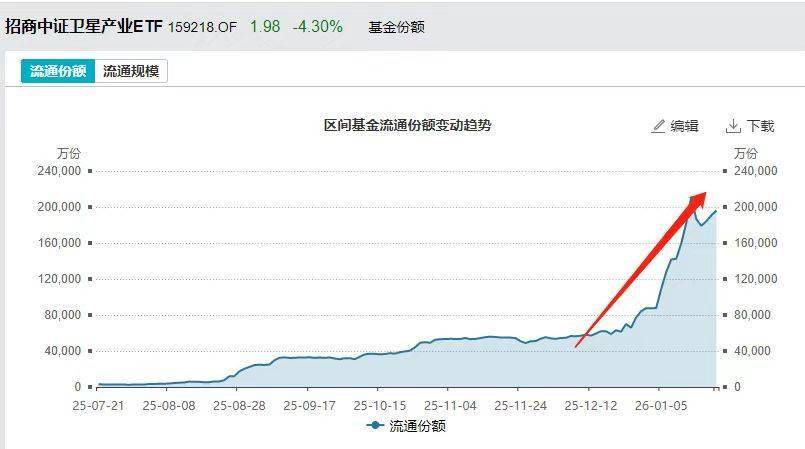
一键精准布局卫星全产业链
量化藏经阁· 2026-01-21 00:08
Group 1 - The commercial aerospace sector has significant market potential, with the global space economy expected to reach $612 billion in 2024, of which commercial aerospace revenue is projected to be $480 billion, accounting for 78% [2][4] - China's commercial aerospace market has rapidly grown from approximately 0.38 trillion yuan in 2015 to 2.3 trillion yuan in 2024, with an annual compound growth rate of about 22%. The market is expected to reach between 7 trillion and 10 trillion yuan by 2030 [4][6] - Countries are accelerating their efforts to secure satellite frequency and orbital resources, which are considered strategic assets. The "first come, first served" rule by the International Telecommunication Union (ITU) reshapes the competition landscape [6][8] Group 2 - The CSI Satellite Industry Index (931594.CSI) includes up to 50 listed companies involved in satellite manufacturing, launching, ground equipment, navigation, and communication, reflecting the overall performance of the satellite industry [16] - The index is heavily weighted towards the defense and military industry, with a weight of 59.26%. Companies within the index generally have high R&D expenditures, with 38% of constituent stocks spending over 20% of their revenue on R&D [18][21] - The index's revenue growth is projected at 18.12% for 2024, with net profit growth expected to be 222.01% in 2025, 48.86% in 2026, and 32.34% in 2027 [25] Group 3 - The China Securities Index Satellite Industry ETF (159218) is designed to track the CSI Satellite Industry Index and was established on May 14, 2025. The fund aims to minimize tracking deviation and error [42][43] - As of January 13, 2026, the ETF's circulation reached 2.115 billion shares, with a scale of 4.744 billion yuan, indicating significant recent growth and investor interest [44] - The fund manager, Ms. Xu Rongman, has extensive experience in managing index funds, overseeing products with a total scale exceeding 40 billion yuan [46]




越跌越买!两融标的卫星产业ETF(159218)盘中再揽金近1亿!臻镭科技、航天环宇、航宇微跌超10%
Sou Hu Cai Jing· 2026-01-20 05:58
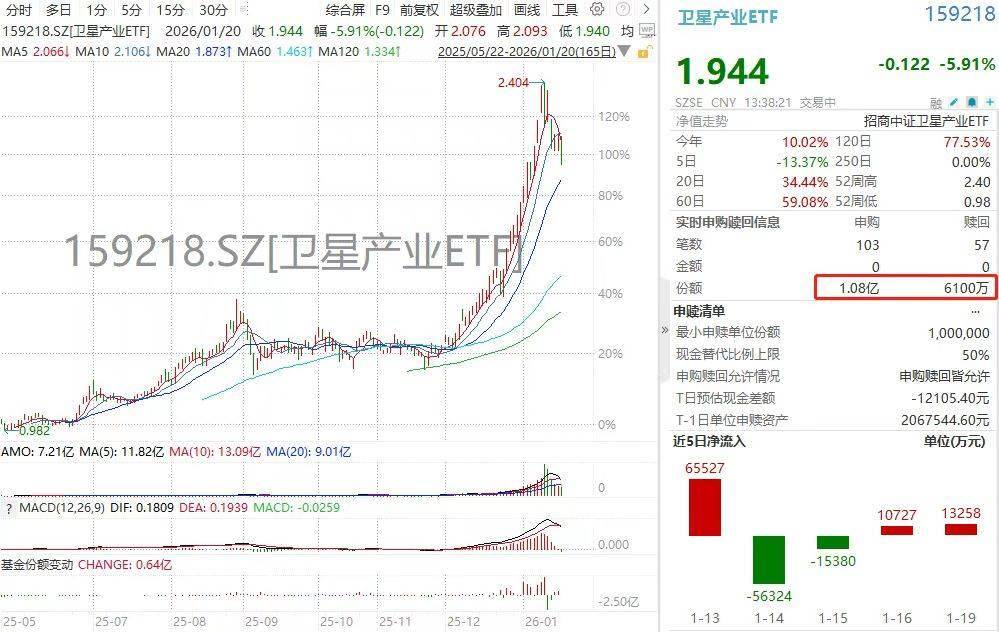
Core Viewpoint - The satellite sector continues to adjust, with evident intentions for capital to accumulate at lower levels, as indicated by recent trading data [1][3]. Group 1: Market Performance - As of 1:34 PM, the satellite industry ETF (159218) experienced a decline of 5.95%, with companies like Zhenlei Technology, Aerospace Huanyu, Aerospace Micro, Changjiang Communication, and China Satellite Communications leading the losses [1]. - Despite the downturn, there was a net inflow of approximately 96 million yuan during the trading session, with the fund seeing a continuous net inflow over three days, totaling around 340 million yuan [1]. Group 2: Industry Developments - On January 19, China successfully launched 19 low-orbit satellites for satellite internet using the Long March 12 rocket from the Hainan commercial space launch site, marking a significant step in the construction of the satellite internet constellation [3]. - This successful launch reinforces the acceleration of the satellite industry in accordance with planned developments, providing solid orders and growth expectations for the sector [3]. - The satellite industry has become widely recognized as a high-growth sector, driven by the ongoing commercialization and rapid development of low-orbit satellite constellations [3]. - The satellite industry ETF (159218) is the first in the market to double its returns while tracking the CSI Satellite Industry Index, covering upstream and downstream companies involved in satellite manufacturing, launching, and navigation communication applications [3].
两融余额飙升,卫星产业ETF(159218)资金面明显回暖!长征十二号再传捷报
Sou Hu Cai Jing· 2026-01-20 01:51
Group 1 - The satellite industry is experiencing increased funding interest, as evidenced by the recent performance of the satellite industry ETF (159218), which rose by 0.73% and saw a net inflow of funds for two consecutive days, with financing balance reaching 256 million yuan over six trading days, setting a new historical record [1][2] - The record high in financing balance is corroborated by successful launch missions, indicating a deepening market consensus on commercial aerospace, characterized by a clear long-term logic and concentrated short-term catalysts [2] - The satellite industry has been recognized as a high-growth sector, with the ETF covering the entire industry chain and reflecting market confidence in China's commercial aerospace entering a golden development period [2] Group 2 - A significant milestone was achieved in the industry with the successful launch of 19 low-orbit satellites using the Long March 12 rocket from Hainan's commercial space launch site, further demonstrating the steady progress of China's satellite internet constellation construction [4] - This successful launch provides clear and solid orders and development expectations for various segments of the industry chain, reinforcing the positive outlook for the sector [4]
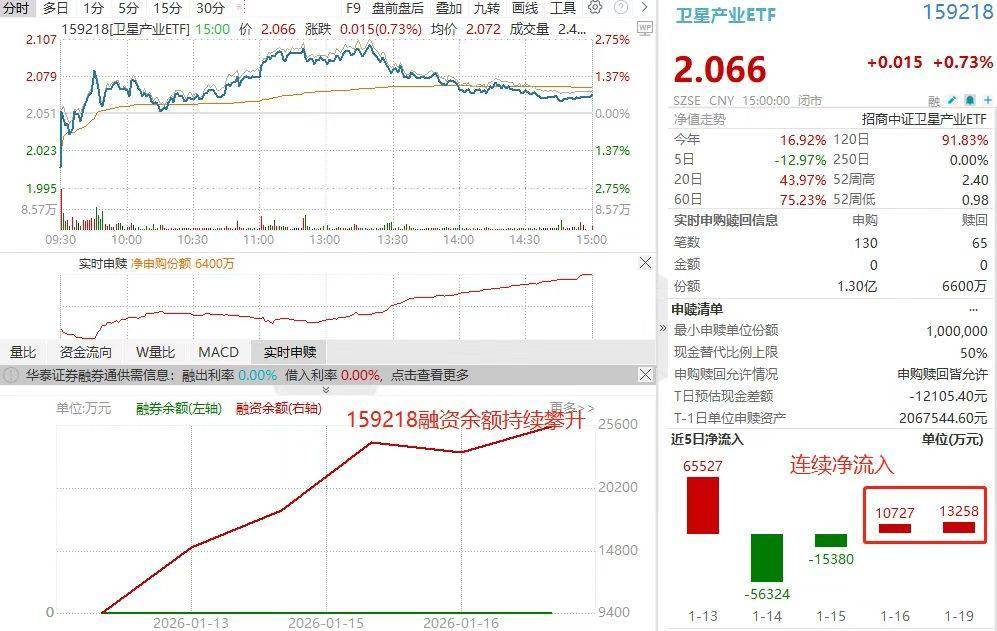
融资客加速涌入!卫星产业ETF(159218)融资余额6日超2.5亿迭创新高,卫星互联网低轨19组卫星发射成功
Sou Hu Cai Jing· 2026-01-20 01:22
Group 1 - The satellite sector is experiencing sustained capital activity, with the satellite industry ETF (159218) rising by 0.73% on January 19, and attracting a net inflow of approximately 240 million over two consecutive days, with financing balance reaching a record high of 256 million over six trading days [1][2] - The satellite industry ETF (159218) is the first in the market to double its returns and tracks the CSI Satellite Industry Index, covering upstream and downstream companies involved in satellite manufacturing, launching, and navigation communication applications. The price and scale increase reflects market sentiment and a consensus on the "golden development period" for China's commercial aerospace industry [2] - On January 19, China successfully launched 19 low-orbit satellites for satellite internet using the Long March 12 carrier rocket, marking a significant step in the construction of the satellite internet constellation. This success reinforces the industry's accelerated implementation according to plans, providing solid orders and development expectations [4] Group 2 - The financing balance reaching a new high indicates a high-risk appetite among investors, reflecting optimism about short-term trends and a deepening consensus on the industry's "long-term logic realization and short-term catalysts" [4] - The satellite industry is recognized as a high-growth sector, with increasing attention expected as more launch missions and policy support are implemented [4]
调整不改热度,卫星产业ETF(159218)盘中成交额超4亿!太空淘金还行吗?
Sou Hu Cai Jing· 2026-01-19 04:16
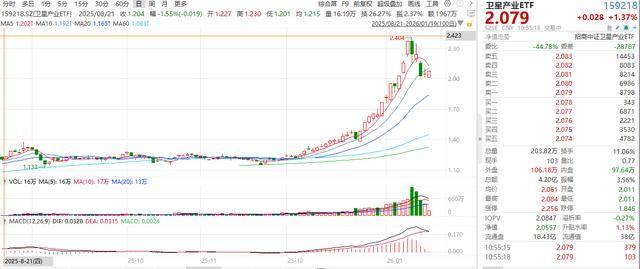
Core Viewpoint - The satellite industry ETF (159218) is experiencing a volatile upward trend, with trading volume exceeding 500 million yuan, indicating strong investor confidence in the long-term potential of the sector despite short-term fluctuations [1]. Group 1: Industry Developments - The commercial aerospace sector received a boost with Beijing Chuanweizhe's successful test of its manned spacecraft, which surpassed key performance indicators, marking a significant technological advancement and contributing to the maturation of the commercial aerospace industry chain [3]. - The National Space Administration has established a Commercial Aerospace Department, and the "2025-2027 High-Quality Safe Development Action Plan" aims to open national research projects and support the development of reusable rockets and smart satellites, indicating ongoing policy support for the industry [3]. - Local governments are also increasing support, with funds such as 4 billion yuan from Hainan and 500 million yuan from Jiuquan being allocated, alongside the accelerated construction of various rocket assembly bases and the implementation of launch subsidies and tax incentives [3]. Group 2: Market Dynamics - The recent adjustments in the commercial aerospace sector are viewed as temporary, with multiple driving factors suggesting that the market is merely taking a "midway break" rather than reaching the end of its growth cycle [3]. - The satellite industry ETF closely tracks the CSI Satellite Industry Index, which is considered the purest index for commercial aerospace, covering the entire industry chain including satellite communication, navigation, remote sensing, and aerospace materials, with the top ten weighted stocks accounting for over 64% of the index [4].
中经评论:我国为何一口气申报20万颗卫星
Jing Ji Ri Bao· 2026-01-19 00:12
Core Viewpoint - China's application for 203,000 satellite frequency resources to the International Telecommunication Union (ITU) is a strategic move to secure its space development rights and transition from experimental to industrial capabilities in aerospace [1][2]. Group 1: Strategic Importance - The application of 203,000 satellites is a necessary action to safeguard China's space development rights amid global competition for low Earth orbit resources, which are physically scarce and non-renewable [2]. - The current technological limit for safely deploying low Earth orbit satellites is approximately 100,000, with optimistic estimates reaching 175,000, while global applications have already surpassed this threshold [2]. - The ITU's "first come, first served" allocation rule emphasizes the need for early applications to secure development opportunities, making China's application a rational and rule-compliant strategy [2]. Group 2: Industry Development - The ambitious goal of deploying 203,000 satellites presents both opportunities and challenges, potentially driving a trillion-yuan industry upgrade encompassing rocket launches, satellite production, ground equipment, and operational services [3]. - Achieving this goal requires substantial industrial capabilities, as the ITU mandates that the first satellite must be launched within seven years of application, and the entire constellation must be deployed within 14 years [3]. - Current launch capacity is a significant bottleneck, with only 500 low Earth commercial satellites deployed in 2025, highlighting a vast gap compared to the annual requirement of over 10,000 satellites to meet the 203,000 target [3]. Group 3: Implementation Strategies - To realize the goal of 203,000 satellites, a three-pronged approach involving technological breakthroughs, supportive policies, and collaborative ecosystems is essential [4]. - Technological focus should be on developing high-capacity reusable rockets and optimizing satellite mass production capabilities to ensure an annual supply of over 10,000 satellites [4]. - Policy frameworks need to be enhanced, including establishing industry-specific funds, optimizing commercial launch site layouts, and fostering collaboration between state-owned and private enterprises to avoid chaotic competition [4]. Group 4: International Cooperation - Emphasizing a shared future for humanity, there is a need to establish an international regulatory mechanism for space resources that includes pre-deployment assessments [4]. - Collaboration with other countries on collision warnings and space debris management is crucial, alongside technology sharing and joint research initiatives within the framework of international regulations [4].
我国为何一口气申报20万颗卫星
Jing Ji Ri Bao· 2026-01-18 22:14
Core Viewpoint - China's application for 203,000 satellite frequency resources to the International Telecommunication Union (ITU) is a strategic move to secure its space development rights and transition from experimental to industrial capabilities in aerospace [1] Group 1: Strategic Importance - The application for over 200,000 satellites is a necessary action to safeguard China's interests in the competitive global space resource landscape [1] - Low Earth orbit (LEO) resources are physically scarce and non-renewable, with a current safe deployment limit of approximately 100,000 satellites, while global applications have already surpassed this threshold [1] - The ITU's "first come, first served" allocation rule emphasizes the need for early applications to secure development opportunities, making China's submission a rational step [1] Group 2: Industry Development - The ambitious goal of 200,000 satellites presents both opportunities and challenges, potentially driving a trillion-yuan industry upgrade encompassing rocket launches, satellite production, ground equipment, and operational services [2] - Achieving this goal requires substantial industrial capabilities, as the ITU mandates that the first satellite must be launched within seven years of application and the entire constellation within 14 years [2] - Current launch capacity is a significant bottleneck, with only 500 low Earth commercial satellites deployed in 2025, highlighting a vast gap compared to the annual requirement of over 10,000 satellites [2] Group 3: Implementation Strategy - To realize the 200,000 satellite goal, a three-pronged approach involving technological breakthroughs, policy support, and ecosystem collaboration is essential [3] - Technological focus should be on developing high-capacity reusable rockets and optimizing satellite mass production capabilities to ensure an annual supply of over 10,000 satellites [3] - Policy frameworks need to be enhanced, including establishing industry-specific funds and optimizing commercial launch site layouts to support sustainable growth in the aerospace sector [3] - International cooperation is crucial, advocating for a regulatory mechanism for space resources and fostering collaborative efforts in collision warning and space debris management [3]