
卫星产业ETF(159218)

Search documents
量化择时周报:缩量信号近在咫尺,重回科技与周期-20260208
ZHONGTAI SECURITIES· 2026-02-08 10:43
Quantitative Models and Construction Methods Model Name: Industry Trend Allocation Model - **Model Construction Idea**: This model aims to identify industry trends and allocate investments accordingly[5][8][10] - **Model Construction Process**: - The model uses various indicators to assess industry trends, including market performance, valuation levels, and risk appetite. - It incorporates signals from different sub-models such as the Mid-term Distress Reversal Expectation Model, TWO BETA Model, and Performance Trend Model. - The Mid-term Distress Reversal Expectation Model waits for reversal signals in industries like liquor and real estate. - The TWO BETA Model recommends the technology sector and monitors opportunities in commercial aerospace. - The Performance Trend Model focuses on the computing power industry chain and oversold sectors like non-ferrous metals and chemicals. - **Model Evaluation**: The model is effective in identifying industry trends and making allocation recommendations based on various market signals[5][8][10] Model Name: Timing System - **Model Construction Idea**: This model aims to distinguish the overall market environment and provide timing signals for investment decisions[5][8][9] - **Model Construction Process**: - The model uses the distance between the long-term moving average (120 days) and the short-term moving average (20 days) of the WIND All A Index. - The latest data shows the 20-day moving average at 6787 and the 120-day moving average at 6338, with a difference of 7.08%. - The model also considers the market trend line, which is currently around 6780 points, and the profitability effect, which is -1.44%. - The model suggests that the market is in a shock pattern and monitors short-term risk appetite changes. - **Model Evaluation**: The model provides clear signals for market timing based on moving averages and other indicators[5][8][9] Model Backtesting Results - **Industry Trend Allocation Model**: - **PE Valuation Level**: 90th percentile, indicating a high level[8][10] - **PB Valuation Level**: 50th percentile, indicating a medium level[8][10] - **Position Recommendation**: 70% for absolute return products with WIND All A as the stock allocation subject[8][10] - **Timing System**: - **Moving Average Distance**: 7.08%, greater than the absolute value of 3%[5][8][9] - **Market Trend Line**: Around 6780 points[5][8][9] - **Profitability Effect**: -1.44%, indicating a temporary end to the upward trend[5][8][9] Quantitative Factors and Construction Methods Factor Name: Mid-term Distress Reversal Expectation Model - **Factor Construction Idea**: This factor aims to identify potential reversal signals in distressed industries[5][8][10] - **Factor Construction Process**: - The model monitors industries like liquor and real estate for reversal signals. - It uses various market indicators to assess the likelihood of a reversal. - **Factor Evaluation**: The factor is useful for identifying potential investment opportunities in distressed industries[5][8][10] Factor Name: TWO BETA Model - **Factor Construction Idea**: This factor aims to recommend sectors with high growth potential, such as technology[5][8][10] - **Factor Construction Process**: - The model focuses on the technology sector and monitors opportunities in commercial aerospace. - It uses market performance and other indicators to make recommendations. - **Factor Evaluation**: The factor is effective in identifying high-growth sectors and making investment recommendations[5][8][10] Factor Name: Performance Trend Model - **Factor Construction Idea**: This factor aims to identify sectors with strong performance trends[5][8][10] - **Factor Construction Process**: - The model focuses on the computing power industry chain and oversold sectors like non-ferrous metals and chemicals. - It uses performance indicators to make recommendations. - **Factor Evaluation**: The factor is useful for identifying sectors with strong performance trends and making investment recommendations[5][8][10] Factor Backtesting Results - **Mid-term Distress Reversal Expectation Model**: - **PE Valuation Level**: 90th percentile, indicating a high level[8][10] - **PB Valuation Level**: 50th percentile, indicating a medium level[8][10] - **TWO BETA Model**: - **PE Valuation Level**: 90th percentile, indicating a high level[8][10] - **PB Valuation Level**: 50th percentile, indicating a medium level[8][10] - **Performance Trend Model**: - **PE Valuation Level**: 90th percentile, indicating a high level[8][10] - **PB Valuation Level**: 50th percentile, indicating a medium level[8][10]
SpaceX按下万亿IPO按钮,卫星产业ETF的二波行情买点已至?
Sou Hu Cai Jing· 2026-01-26 04:08
Core Viewpoint - The recent confirmation by Elon Musk that SpaceX will complete its IPO by July 2026 has ignited interest in the commercial space sector, potentially marking the beginning of a new wave of investment opportunities in the satellite industry [1][2]. Group 1: SpaceX and Market Impact - SpaceX is projected to have a valuation of $1.5 trillion, which could set a new record for IPOs and reshape the valuation logic of the satellite industry [1]. - Following the recent surge in the commercial space sector, there is a notable influx of capital into the satellite industry ETF (159218), indicating a strong interest from investors [1]. Group 2: Industry Developments - The domestic commercial space sector is entering a rapid capitalisation phase, with several companies like Blue Arrow Aerospace and Zhongke Aerospace preparing for IPOs [2]. - The Shanghai Stock Exchange has tailored a new listing standard for commercial rocket companies, linking "reusable rocket launches" directly to IPO eligibility, which encourages technological advancements [2]. Group 3: Economic Transition - The commercial space industry is transitioning from conceptual plans to tangible financial results, with projections indicating that domestic commercial launches will exceed 50% by 2025 [2]. - The successful launch of low-orbit satellite constellations and advancements in space medicine signify that the commercial space sector is moving towards real-world applications and profitability [2]. Group 4: Investment Strategy - Investors are advised to consider gradual investments in the satellite industry ETF (159218) rather than making large, singular investments, as the sector is characterized by high volatility [2]. - The satellite industry ETF tracks the Zhongzheng Satellite Industry Index, encompassing a comprehensive range of companies involved in the entire satellite value chain, making it a practical investment tool [3].

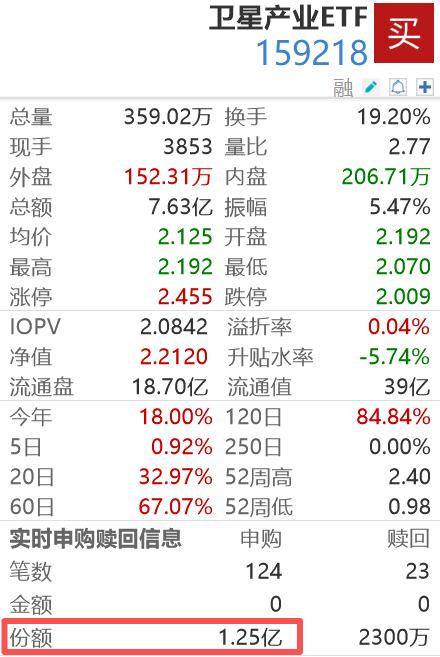
SpaceX+蓝箭IPO双重重磅!两融标的卫星产业ETF(159218)放量大涨超9%逼近涨停!
Sou Hu Cai Jing· 2026-01-23 05:56
Core Viewpoint - The commercial aerospace sector is experiencing significant market momentum, driven by key developments in both domestic and international capital markets [3]. Group 1: Market Performance - As of January 23, the satellite industry ETF (159218) surged by 9.76%, nearing a trading limit, with active trading in constituent stocks such as Zhenlei Technology and Xinke Mobile-U [1]. - The sector exhibited a broad-based rally, indicating strong investor interest and confidence in the commercial aerospace industry [1]. Group 2: Catalysts for Growth - The acceleration of the IPO process for Blue Arrow Aerospace, the first private commercial rocket company in China, has been a significant catalyst, marking a new level of support from the capital market for this emerging industry [3]. - Concurrently, SpaceX received approval to deploy an additional 7,500 second-generation Starlink satellites, showcasing the competitive landscape and ambition of global industry leaders [3]. Group 3: Investment Opportunities - The satellite industry ETF (159218) serves as a convenient investment tool covering the entire industry chain from rocket manufacturing to satellite operation, reflecting concentrated capital allocation towards this historic opportunity [4]. - The high activity and strong performance of the ETF indicate a sustained high level of interest and potential for continued growth in the sector [4].
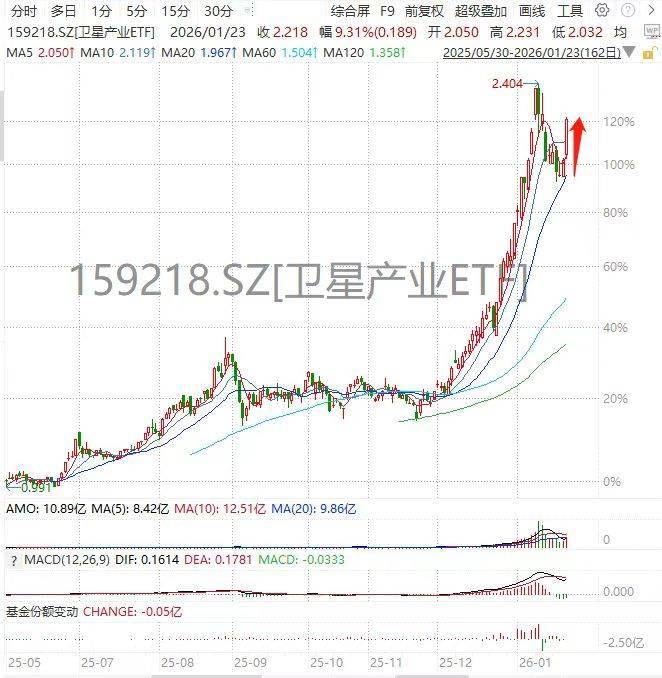
调整不改热度,卫星产业ETF(159218)盘中成交额超4亿!太空淘金还行吗?
Sou Hu Cai Jing· 2026-01-19 04:16
Core Viewpoint - The satellite industry ETF (159218) is experiencing a volatile upward trend, with trading volume exceeding 500 million yuan, indicating strong investor confidence in the long-term potential of the sector despite short-term fluctuations [1]. Group 1: Industry Developments - The commercial aerospace sector received a boost with Beijing Chuanweizhe's successful test of its manned spacecraft, which surpassed key performance indicators, marking a significant technological advancement and contributing to the maturation of the commercial aerospace industry chain [3]. - The National Space Administration has established a Commercial Aerospace Department, and the "2025-2027 High-Quality Safe Development Action Plan" aims to open national research projects and support the development of reusable rockets and smart satellites, indicating ongoing policy support for the industry [3]. - Local governments are also increasing support, with funds such as 4 billion yuan from Hainan and 500 million yuan from Jiuquan being allocated, alongside the accelerated construction of various rocket assembly bases and the implementation of launch subsidies and tax incentives [3]. Group 2: Market Dynamics - The recent adjustments in the commercial aerospace sector are viewed as temporary, with multiple driving factors suggesting that the market is merely taking a "midway break" rather than reaching the end of its growth cycle [3]. - The satellite industry ETF closely tracks the CSI Satellite Industry Index, which is considered the purest index for commercial aerospace, covering the entire industry chain including satellite communication, navigation, remote sensing, and aerospace materials, with the top ten weighted stocks accounting for over 64% of the index [4].


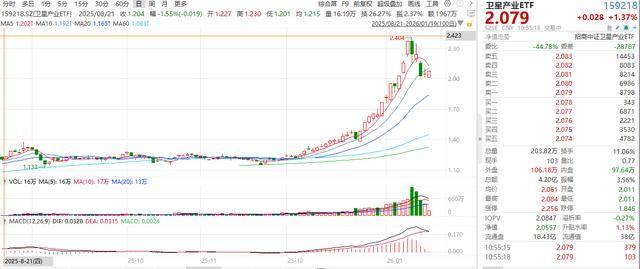
跌出机会?软件龙头ETF(159899)、云计算ETF(159890)逆势吸金,机构:AI应用端价值兑现逻辑未改
Sou Hu Cai Jing· 2026-01-16 06:44
Core Insights - The satellite industry and semiconductor equipment continue to show strong performance, while popular sectors like GEO and AI applications are experiencing a pullback [1] - Significant capital inflow has been observed in software and cloud computing ETFs, indicating investor interest despite recent declines [1] Group 1: Market Performance - The satellite industry ETF (159218) and semiconductor equipment ETF (561980) saw intraday gains of over 1.6% and 2.2% respectively [1] - The software leader ETF (159899) and cloud computing ETF (159890) experienced declines of nearly 2%, but attracted substantial capital inflow, with net inflows of 23 million and 8 million respectively [1] - Over the last four trading days, the software leader ETF (159899) has received over 300 million in net inflows, while the cloud computing ETF (159890) has seen approximately 126 million in net inflows over the last five trading days [1] Group 2: AI and GEO Market Insights - The large model market is expected to reach a size of 206.5 billion by 2029, with a CAGR of 80.7% from 2024 to 2029, driven primarily by large model applications [6] - By 2026, the global GEO market is projected to reach 24 billion, with the domestic market expected to reach 11.1 billion, indicating exponential growth [3] - Chinese consumers exhibit a high trust level in AI applications at 80%, significantly higher than the US (35%) and Europe (40%), particularly in personalized shopping recommendations [3] Group 3: ETF Composition and Strategy - The cloud computing ETF (159890) focuses on key sectors such as servers, data centers, and cloud services, with 65% of its index comprising IT services, horizontal general software, and vertical application software [7] - The software leader ETF (159899) tracks the CSI All-Share Software Index, including leaders in intelligent voice, office collaboration, fintech, and industrial software, with approximately 35% exposure to AI applications [7] - Investors may consider leveraging both cloud computing ETF (159890) and software leader ETF (159899) to comprehensively capture the value of computing infrastructure and AI technology monetization [7]
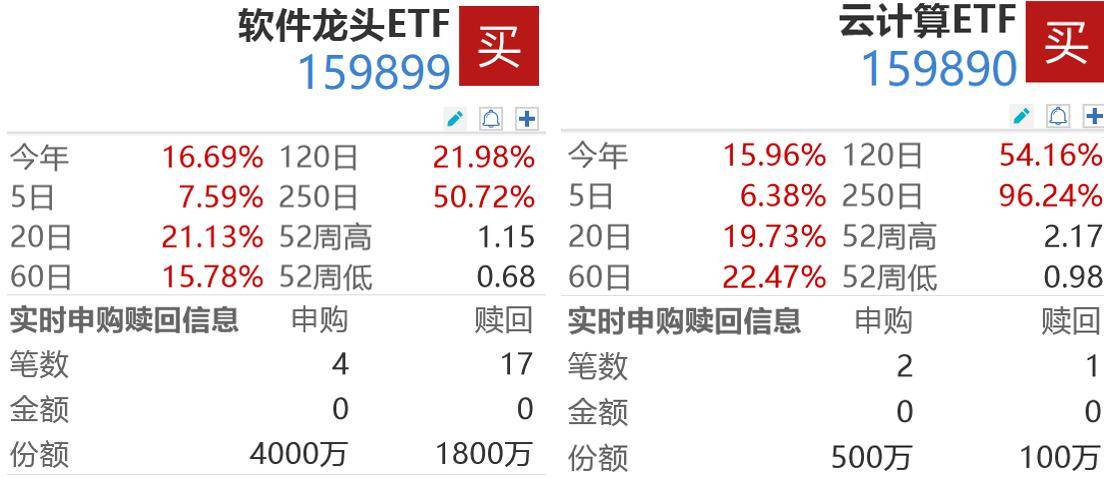
突破百亿天量!卫星产业ETF(159218)8日成交109亿,逾60家机构抢滩万亿太空赛道
Sou Hu Cai Jing· 2026-01-15 02:38
Group 1 - The core viewpoint of the article highlights the unprecedented enthusiasm in the commercial aerospace sector, with the satellite industry ETF (159218) achieving a record trading volume of over 10.941 billion yuan within just 8 trading days in January 2026 [1][3] - On January 14, 2026, the ETF recorded a single-day trading volume of 2.12 billion yuan, leading the market among similar ETFs, indicating strong capital interest and market liquidity [1][3] - The influx of funds is driven by a historic leap in the industry's fundamentals, with over 60 institutions submitting satellite data declarations to the International Telecommunication Union (ITU), marking a significant shift towards market-driven competition involving state-owned enterprises, research institutions, and commercial companies [3] Group 2 - The participation includes major players like China Satellite Network and China Satcom, as well as top research institutions such as Tsinghua University and the Chinese Academy of Sciences, alongside commercial pioneers like Galaxy Space [3] - Many companies are proposing satellite constellations at a scale of "thousands," indicating a transition from top-level design to a new era of market competition characterized by collaboration among state, research, and commercial entities [3] - The low Earth orbit satellite constellation is emerging as a new frontier in strategic competition among major powers, with the industry market space expected to exceed 1 trillion yuan over the next decade as the global declaration window approaches [3]
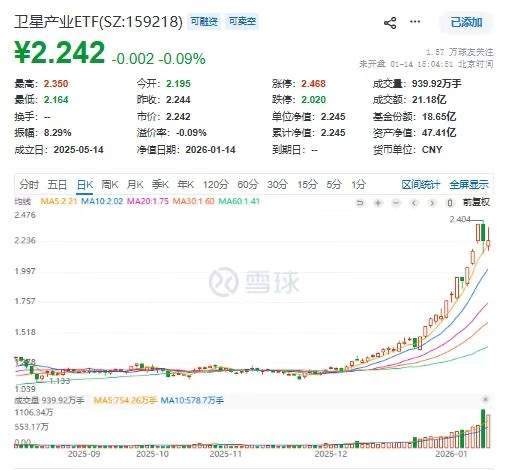
卫星板块一度跌停!为何资金却在疯狂抄底?
Jin Rong Jie· 2026-01-13 03:35
Core Viewpoint - The satellite industry ETF (159218) has experienced a significant decline, with a drop of around 6%, following warnings from the fund manager about the overheating of the sector in the short term [1][3]. Group 1: Market Dynamics - The satellite industry ETF (159218) is facing a correction after a period of rapid growth, indicating that technical indicators have become ineffective due to the recent price surge [3]. - Despite short-term market fluctuations, the underlying drivers of the satellite industry remain robust, supported by government policies and technological advancements [4]. Group 2: Policy Support - The recent public consultation on the "14th Five-Year Plan" for digital economy and infrastructure in Zhejiang Province emphasizes support for state-owned enterprises in low-orbit satellite internet construction and encourages private companies to engage in satellite IoT business [4][5]. Group 3: Technological Advancements - Technological breakthroughs, particularly in reusable rocket technology exemplified by SpaceX's Falcon 9, have significantly reduced launch costs from $62 million to $20 million, a decrease of over 60%, facilitating large-scale satellite deployment [6]. - The development of reusable rockets by companies like China's Blue Arrow Aerospace is further lowering barriers to space activities, allowing for mass production of satellites [6]. Group 4: International Competition - The limited availability of orbital slots and frequency resources has led to intense international competition, with the principle of "first come, first served" driving urgency in satellite launches [7]. - The U.S. Starlink has already secured over 9,000 satellite positions, prompting China to develop its own large-scale constellations like "Thousand Sails Constellation" and "Star Network" to compete for these valuable resources [7]. Group 5: Investment Opportunities - The satellite industry ETF (159218) serves as a practical investment tool, tracking the China Securities Satellite Industry Index, which encompasses a comprehensive range of companies involved in the satellite value chain, from rocket manufacturing to satellite operation and application [8].
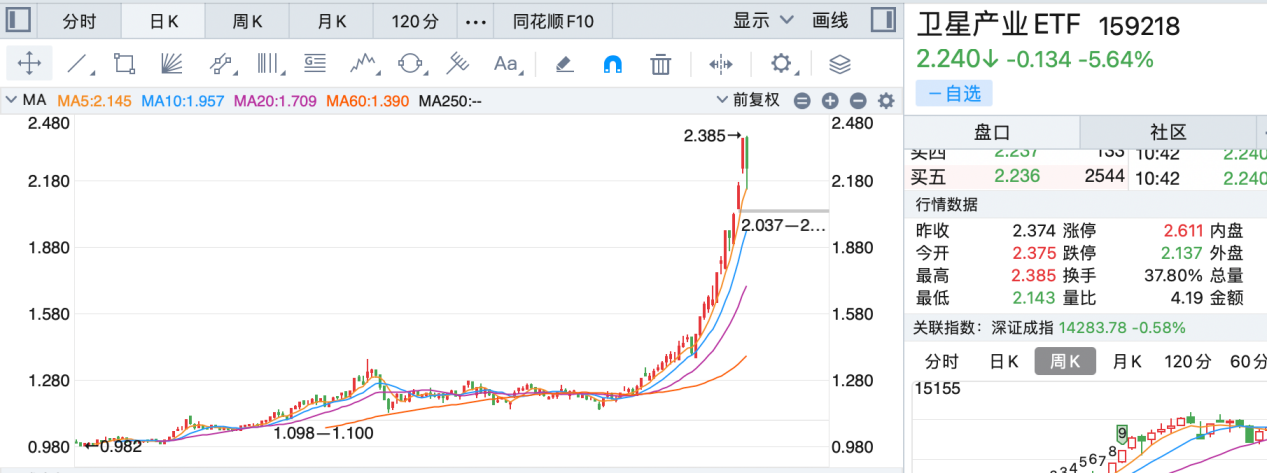
卫星产业大回调,超2亿资金逆势加仓卫星产业ETF(159218)
Jin Rong Jie· 2026-01-13 02:32
Core Viewpoint - The satellite industry is experiencing a correction after a strong upward trend, with the satellite industry ETF (159218) dropping over 9% intraday, while funds are still flowing in significantly, indicating a mixed market sentiment [1] Group 1: Market Performance - The satellite industry ETF (159218) has increased by over 77.69% in the past month, with a net inflow of over 2.3 billion yuan in the last 20 days [1] - As of 10:11 AM, over 200 million yuan has flowed into the satellite industry ETF, showing a notable trend of capital accumulation despite the market correction [1] Group 2: Industry Insights - The satellite industry is in a rapid growth phase, driven by factors such as the frequent launches of reusable rockets, the advancement of commercial rocket IPOs, and the promotion of terminal applications [1] - Upcoming launches include the reusable rocket "Star Cloud No. 1" and the "Vulcan No. 1" rocket from Haiyao Seven, which are expected to further stimulate the industry [1] Group 3: Fund Management Perspective - The fund manager of the satellite industry ETF, Xu Rongman, highlights the significant absolute and relative gains in the sector due to the accumulation of favorable factors, while also cautioning about potential short-term correction risks [1] - The ETF tracks the CSI Satellite Industry Index, with a clear requirement that the combined weight of "satellite manufacturing + launch infrastructure" must not be less than 50%, aligning with the current core phase of industry development [1]
A股行情持续,哪些ETF强势吸金
Sou Hu Cai Jing· 2026-01-12 12:05
Core Viewpoint - The A-share market continues its strong performance at the beginning of the year, with significant trading volumes and a notable increase in various sectors, particularly in commercial aerospace and technology-related ETFs [3][6][10]. Market Performance - As of January 12, the Shanghai Composite Index surpassed 4165 points, with a total trading volume exceeding 3.64 trillion yuan, marking a historical high. The Shanghai index rose by 1.09%, while the Shenzhen Component and ChiNext indices increased by 1.75% and 1.82%, respectively [3]. - Over 4100 stocks in the market saw gains, with 202 stocks hitting the daily limit up [3]. Sector Analysis - The cultural media, military electronics, and IT services sectors all experienced gains exceeding 7%, while real estate, insurance, agricultural chemicals, and oil processing sectors faced declines [3]. - The commercial aerospace sector remains hot, with related ETFs experiencing significant surges. Multiple satellite industry ETFs saw daily gains of over 9% [3][6]. ETF Market Dynamics - A total of 1875 ETFs were analyzed, with 1487 showing increases, indicating a positive market sentiment. Notably, 50 ETFs had daily gains exceeding 9% [6]. - The Morgan Stanley CSI AI ETF led the gains with a 16.59% increase, while other technology-related ETFs also performed strongly [6][7]. Fund Flows - There is a clear divergence in fund flows, with fixed-income ETFs experiencing significant redemptions, particularly in the sci-tech bond category, which accounted for over 60% of the outflows [8]. - Conversely, equity ETFs saw substantial inflows, with satellite communication-related ETFs attracting over 80 billion yuan [9]. Investment Outlook - Analysts suggest that the commercial aerospace sector, despite high valuations, has significant long-term growth potential. The industry is expected to see accelerated development, with dynamic P/E ratios projected to decrease significantly by 2026 and 2027 [12]. - Investment strategies should focus on cyclical sectors, technology innovation, and areas benefiting from domestic demand and consumption recovery, such as entertainment and social services [11].
新增20万颗卫星申请!卫星产业ETF(159218)涨超4%,中金首席刘中玉:卫星制造与发射领域迎来业绩兑现期
Zhong Guo Ji Jin Bao· 2026-01-12 05:55
Core Viewpoint - The satellite industry is experiencing significant growth driven by policy, industry, and capital factors, with the satellite industry ETF (159218) showing strong performance and liquidity [4][12]. Group 1: Market Performance - On January 12, the satellite industry continued its strong upward trend, with notable stocks like Xinke Mobile and Guoji Precision reaching their daily limit [1]. - The satellite industry ETF (159218) saw a 3.8% increase, with over 1.37 billion yuan net inflow in the past five days and a single-day trading volume exceeding 1.2 billion yuan, setting a historical record [1]. - Since its launch, the ETF has achieved a cumulative increase of over 115%, becoming the first commercial aerospace "doubling fund" in the satellite theme sector [1]. Group 2: Industry Dynamics - The satellite industry is entering a phase of accelerated launches and network formation, with multiple catalysts such as reusable rocket launches and advancements in terminal applications [2]. - The ETF tracks the CSI Satellite Industry Index, which mandates that the combined weight of satellite manufacturing and launch sectors must be no less than 50%, aligning with the current core phase of industry development [2]. Group 3: Investment Insights - The satellite sector is becoming a key investment theme for 2026, driven by significant policy support, industry growth, and capital market developments [12]. - The industry is in a growth phase, and static valuations are not advisable; dynamic tracking of industry changes is necessary [5][13]. - The manufacturing and launch capabilities are transitioning towards scalability, supporting the shift from resource competition to global commercialization [6][16]. Group 4: Future Opportunities - By 2026, satellite launch volumes are expected to more than double, with significant revenue and profit growth anticipated [9][13]. - New directions for satellite internet in 2026 include direct connections for mobile phones and vehicles, integration with 6G, and advancements in space computing [10][18]. - The capital market is becoming a battleground for commercial aerospace competition, with major companies preparing for IPOs [8][19]. Group 5: Investment Strategy - Short-term focus should be on manufacturing and launch sectors, while mid-to-long-term strategies should consider application developments [11][19]. - Given the high technical barriers and complexity of research in the satellite industry, investors are advised to participate through index-based tools [20].