汽车出口

Search documents
四部门:严控新车以二手车名义出口
21世纪经济报道· 2025-11-14 12:10
Core Viewpoint - The article discusses the new regulations issued by the Ministry of Commerce, Ministry of Industry and Information Technology, Ministry of Public Security, and General Administration of Customs to strengthen the management of second-hand car exports in China, aiming to ensure healthy and orderly development of the industry [2]. Group 1: Strict Management of Second-Hand Car Exports - New cars exported under the guise of second-hand vehicles will be strictly controlled. From January 1, 2026, vehicles registered for less than 180 days must provide a "Post-Sales Service Confirmation" from the manufacturer, including details about the export country, vehicle information, and service network [2][3]. - Export license applications must be accurately filled out, ensuring that vehicle brand, model, registration date, and transfer registration date match the "Motor Vehicle Registration Certificate." Incomplete applications will not be granted export licenses [2][3]. Group 2: Dynamic Management and Compliance - A dynamic management and exit mechanism for enterprises will be established, focusing on credit evaluation and daily supervision of second-hand car exporters. Companies with dishonest behavior will be required to implement corrective measures before their export license applications are considered [3][4]. - The conditions for applying for export licenses for modified vehicles will be strictly enforced, requiring proof of modification authenticity and compliance with national certification standards [4]. Group 3: Promoting Healthy Development of Second-Hand Car Exports - Efforts will be made to enhance the international operational capabilities of enterprises, encouraging them to explore diversified markets and establish public display and trading markets in key regions [5]. - A comprehensive support system for exports will be developed, promoting collaboration between exporters and manufacturers, as well as logistics and financial service providers, to ensure after-sales service and supply chain efficiency [5].


明年起须提供售后确认书!四部门新规严打“零公里二手车”
第一财经· 2025-11-14 11:45
Core Viewpoint - The article discusses new regulations issued by Chinese authorities to strengthen the management of second-hand car exports, particularly targeting the issue of "zero-kilometer second-hand cars" that are essentially new vehicles being sold as used [3][4]. Group 1: Regulatory Changes - Starting from January 1, 2026, vehicles registered for less than 180 days must submit a "Post-Sales Service Confirmation" from the manufacturer to obtain an export license [3][4]. - The new regulations aim to curb the practice of exporting nearly new cars as second-hand vehicles, which has been a growing trend in the market [4][5]. Group 2: Market Impact - In 2024, 12.7% of the second-hand car market consisted of vehicles registered for less than three months and with mileage under 50 kilometers, indicating a significant presence of "just registered" cars in the market [4]. - The regulations are expected to prevent low-price arbitrage and chaotic competition, thereby stabilizing the overseas pricing system for vehicles [5]. Group 3: Industry Transformation - The new rules will compel companies to enhance their service offerings, including improving overseas maintenance networks and parts supply, shifting the industry focus from price competition to quality and service [5]. - The regulations are anticipated to create a more orderly global competitive environment for Chinese automotive exports, supporting the goal of surpassing ten million units in exports [5][6].

明年起须提供售后确认书!四部门新规严打“零公里二手车”
Di Yi Cai Jing· 2025-11-14 11:20
Core Viewpoint - The new regulations issued by four government departments in China aim to strengthen the management of used car exports, particularly targeting the export of "zero-kilometer used cars" starting from January 1, 2026, which requires a service confirmation letter from the manufacturer for vehicles registered less than 180 days [1][2][3] Group 1: Regulatory Changes - The new policy mandates that vehicles registered for less than 180 days must provide a service confirmation letter from the manufacturer to obtain an export license [1][2] - The confirmation letter must include details such as the destination country, vehicle information, and service network information, and must be stamped by the manufacturer [2][3] - Vehicles that cannot provide the required documentation will not be granted export licenses, and the regulations also standardize the information required for license applications to ensure consistency with vehicle registration certificates [1][6] Group 2: Market Impact - The regulations specifically target the rising trend of exporting "zero-kilometer used cars," which are vehicles that have been registered but have minimal usage, thus maintaining a new car status [2][3] - According to the China Automobile Dealers Association, vehicles registered for less than three months and with mileage under 50 kilometers accounted for 12.7% of the used car market in 2024, indicating a significant prevalence of such vehicles [2] - The new rules are expected to curb low-price arbitrage and chaotic competition in the market, thereby stabilizing the overseas pricing system and enhancing the quality and service focus of the industry [3] Group 3: Compliance and Management - The regulations include a dynamic management and exit mechanism for companies, emphasizing the establishment of a credit evaluation system for used car exporters [7] - Companies with multiple instances of non-compliance will face scrutiny and may be required to implement corrective measures before their export license applications are considered [7] - The regulations also call for stricter conditions for exporting modified vehicles, requiring proof of modification authenticity and compliance with national standards [8] Group 4: Support for Export Development - The government encourages the development of international business capabilities among exporters and supports the establishment of public display and trading markets in key markets [9] - There is a focus on improving the export support system, including after-sales service, parts supply, and technical support, to ensure sustainable development in the used car export sector [9]
四部门:严控新车以二手车名义出口
第一财经· 2025-11-14 10:14
Core Viewpoint - The Ministry of Commerce and three other departments have issued a notice to strengthen the management of second-hand car exports, aiming to regulate the automotive industry and promote healthy development in this sector [1][2]. Group 1: Strengthening Export Management - Strict control over the export of new cars under the guise of second-hand vehicles will be implemented starting January 1, 2026, requiring additional documentation for vehicles registered less than 180 days [1]. - Export license application and issuance will be standardized, ensuring that vehicle information matches the registration certificate, with penalties for non-compliance [1][2]. Group 2: Dynamic Management and Compliance - A dynamic management and exit mechanism for enterprises will be established, focusing on credit evaluation and monitoring of second-hand car exporters to ensure compliance with regulations [2]. - The conditions for applying for export licenses for modified vehicles will be tightened, requiring proof of modification authenticity and compliance with national standards [2]. Group 3: Promoting Healthy Development - Efforts will be made to enhance the international operational capabilities of enterprises, encouraging them to explore diverse markets and establish public display trading markets [3]. - A comprehensive export support system will be developed, facilitating collaboration between exporters and automotive manufacturers, as well as logistics and financial service providers [3].

严控出口!商务部、公安部等4部门联合发布新规
Wind万得· 2025-11-14 09:47
Core Viewpoint - The article discusses the new regulations issued by the Ministry of Commerce, Ministry of Industry and Information Technology, Ministry of Public Security, and General Administration of Customs to strengthen the management of second-hand car exports in China, effective from January 1, 2026 [2][3]. Group 1: Strict Control on Second-hand Car Exports - New cars exported under the guise of second-hand vehicles will be strictly controlled. From January 1, 2026, vehicles registered for less than 180 days must provide a "Post-Sales Service Confirmation" from the manufacturer, detailing export country, vehicle information, and service network [3][4]. - Export licenses will not be issued for vehicles that cannot provide the required documentation [3][4]. Group 2: Export License Application and Issuance - Local commerce departments must guide enterprises to accurately fill out export license application information, ensuring consistency with the "Motor Vehicle Registration Certificate" [4]. - Export licenses will be denied for applications that do not meet the specified requirements, and the Ministry of Commerce will monitor compliance closely [4]. Group 3: Compliance and Dynamic Management - A dynamic management and exit mechanism for enterprises will be established, focusing on credit evaluation and monitoring of second-hand car exporters [4][5]. - Enterprises with dishonest behavior will be required to implement corrective measures, which will be considered in future export license applications [4][5]. Group 4: Strengthening Compliance Review - The conditions for applying for export licenses for modified vehicles will be strictly enforced, requiring proof of modification authenticity [5]. - Export situations and production capabilities of local modified vehicle manufacturers will be assessed and reported to the Ministry of Commerce [5]. Group 5: Promoting Healthy Development of Second-hand Car Exports - Local commerce departments are encouraged to support enterprises in enhancing international business capabilities and exploring diverse markets [6]. - A comprehensive support system for exports will be established, including after-sales service and collaboration with logistics and financial institutions [6].

四部门联合发文:严控新车以二手车名义出口
财联社· 2025-11-14 09:44
Core Viewpoint - The notice issued by the Ministry of Commerce, Ministry of Industry and Information Technology, Ministry of Public Security, and General Administration of Customs aims to strengthen the management of second-hand car exports, particularly by controlling the export of new cars under the guise of second-hand vehicles, effective from January 1, 2026 [1][3]. Group 1: Strengthening Export Management - Strict control over the export of new cars as second-hand vehicles, requiring additional documentation for vehicles registered less than 180 days prior to export [3][4]. - Export license applications must be accurately filled out, ensuring consistency with vehicle registration documents; non-compliance will result in license denial [4]. - Establishment of a dynamic management and exit mechanism for enterprises, focusing on credit evaluation and addressing dishonest practices [4][5]. Group 2: Compliance and Review - Enhanced compliance review for modified vehicles, requiring proof of modification authenticity and adherence to national certification standards [5]. - Monitoring and reporting of local modified vehicle production capabilities and export situations to ensure compliance [5]. Group 3: Promoting Healthy Development - Encouragement for enterprises to enhance international operational capabilities and explore diverse markets through trade promotion platforms [6]. - Development of a comprehensive support system for exports, including after-sales service and collaboration with logistics and financial institutions [6][7]. - Exploration of a dedicated market for second-hand car exports, providing integrated services such as preparation, inspection, customs clearance, and logistics [7].

四部门:严控新车以二手车名义出口
Zheng Quan Shi Bao Wang· 2025-11-14 09:29
人民财讯11月14日电,商务部、工业和信息化部、公安部、海关总署发布进一步加强二手车出口管理工 作的通知。通知提出,严控新车以二手车名义出口。自2026年1月1日起,对申请出口距注册登记日期不 满180天(含180天)的车辆,各地商务主管部门应指导本地企业补充提交该车辆生产企业出具的《售后维 修服务确认书》,内容包括出口国别、车辆信息、提供售后服务的网点信息等并加盖生产企业公章,对 无法提供上述材料的车辆,不予发放出口许可证。对于通知实施日前已办理转让登记待出口手续的车 辆,要指导企业做好合同履约并有序出口。 ...
辽宁大连海关:政策创新围着企业需求转
Ke Ji Ri Bao· 2025-11-13 04:36
Core Insights - The establishment of the Liaoning Free Trade Zone in 2017 has led to significant innovations by Dalian Customs, enhancing operational efficiency and reducing costs for businesses [1][2] - Dalian Customs has implemented over 50 innovative measures, with several being recognized at the national level, contributing to a substantial increase in the region's foreign trade [1][2] Group 1: Innovations and Efficiency - The "cloud series" innovations by Dalian Customs have improved customs clearance efficiency by over 60%, allowing for a fully paperless process [2] - The electronic certification platform has issued over 400,000 certificates, covering 23 categories of products and accounting for over 90% of export certification business [2] - The introduction of electronic import food inspection and quarantine certificates has reduced clearance time by 50% [2] Group 2: Industry-Specific Initiatives - Dalian Customs has pioneered the "bulk commodity + reform" initiative, facilitating the import and export of key commodities like iron ore and liquefied natural gas [3] - The "zero delay" supervision in the semiconductor industry allows for 24-hour rapid flow of high-precision raw materials [3] - The AI-driven vehicle identification system at the Dalian Free Trade Zone has enabled a "second-level registration" process for exported vehicles, significantly streamlining operations [3] Group 3: Cost Savings and Long-term Growth - The new regulatory model for lithium battery packaging has saved companies approximately 130 million yuan by allowing for the reuse of packaging without the need for re-inspection [4] - Customized clothing export growth has been supported by intelligent regulatory models and preferential tax matching under free trade agreements [5] - Dalian Customs aims to continue focusing on strategic enhancements within the free trade zone to drive high-quality foreign trade development in Liaoning [5]
俄罗斯大幅加税,中国汽车出口骤降58%!1辆净赚几万已成过去,有商家暂停对俄业务
Mei Ri Jing Ji Xin Wen· 2025-11-10 00:09
Core Insights - The export of Chinese automobiles to Russia has significantly declined, with a 58% drop in the first nine months of 2025 compared to the previous year, marking a shift in the export landscape where Mexico has overtaken Russia as the top destination for Chinese car exports [4][3][1] - The increase in scrappage taxes and changing market conditions have led to a cautious approach among Chinese exporters, with many considering halting their operations in Russia [2][8][9] Group 1: Export Trends - In the first nine months of 2025, China exported 357,700 vehicles to Russia, a decrease of 58% year-on-year, while exports to Mexico reached 410,700 units, making it the largest market for Chinese cars [4][3] - The shift in export destinations indicates a changing landscape, with Russia dropping from the top position it held for two years [4][3] Group 2: Market Challenges - Factors such as increased import taxes, scrappage taxes, and difficulties in after-sales service are impacting the export business of Chinese cars to Russia [2][8] - The scrappage tax for new imported cars has increased by 70% to 85%, significantly raising costs for exporters [8][7] Group 3: Industry Response - Many Chinese car manufacturers are now focusing on local production and establishing a long-term presence in Russia, moving away from a short-term profit strategy [15][13] - Companies like Great Wall Motors are adopting a localized assembly model to mitigate high import taxes and benefit from local subsidies [15][16] Group 4: Future Strategies - Experts suggest that Chinese car manufacturers need to enhance local production, improve after-sales service, and reshape their brand image to succeed in the Russian market [16][15] - The industry is advised to focus on building a sustainable business model rather than seeking quick profits, indicating a shift towards long-term investment strategies [13][15]
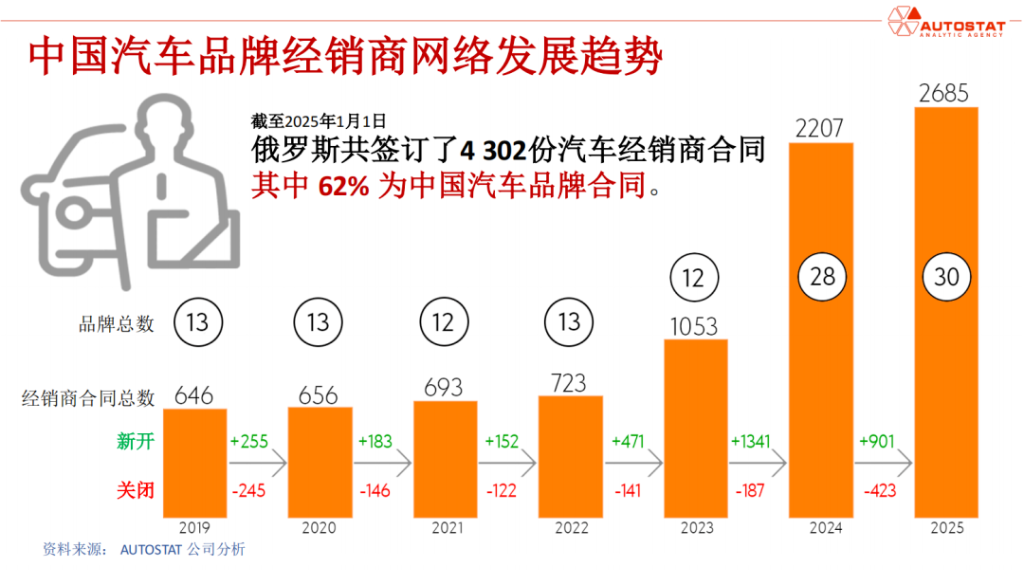
俄罗斯大幅加税,中国汽车出口骤降58%!1辆净赚几万已成过去
Mei Ri Jing Ji Xin Wen· 2025-11-09 22:27
Core Insights - The export of Chinese automobiles to Russia has significantly declined, with a 58% drop in the first nine months of 2025 compared to the previous year, marking a shift in the export landscape where Mexico has overtaken Russia as the top destination for Chinese car exports [4][9][10] - The increase in scrapping taxes and changing economic conditions in Russia have created a challenging environment for Chinese car exporters, leading to a reevaluation of their strategies in the market [3][7][9][10] Export Trends - In the first nine months of 2025, China exported 35.77 million vehicles to Russia, a significant decrease from previous years when Russia was the largest market for Chinese car exports [4][9] - Mexico has become the largest destination for Chinese car exports, with 41.07 million vehicles, followed by the UAE with 36.78 million [4][9] Market Challenges - The scrapping tax for imported vehicles in Russia has increased by 70% to 85%, significantly impacting the cost structure for Chinese exporters [7][9] - Economic factors such as high inflation, increased interest rates, and a depreciating ruble have further suppressed demand for automobiles in Russia [9][10] Industry Response - Many Chinese car manufacturers are reducing their operations in Russia, with some companies halting exports entirely due to the unfavorable market conditions [10][11] - There is a growing recognition among Chinese car manufacturers that a long-term strategy focusing on localization and building a robust after-sales service network is essential for success in the Russian market [19][20] Future Strategies - Chinese automotive companies are shifting from a quick profit model to a more sustainable approach, emphasizing local production and service capabilities [19][20] - Recommendations for success in the Russian market include increasing local production rates, enhancing product development for extreme weather conditions, and improving after-sales service coverage [20]