Semiconductor

Search documents
Qualcomm says UK lawsuit over smartphone chip royalties will be withdrawn
Reuters· 2026-02-17 11:47
Core Viewpoint - Qualcomm announced that a lawsuit in the UK alleging it abused its dominant position to impose inflated royalties on Apple and Samsung will be withdrawn, with no compensation to be paid to consumers [1]. Group 1: Lawsuit Details - The lawsuit was initiated by the British consumers' association Which? on behalf of approximately 29 million consumers who purchased iPhones or Samsung devices since 2015 [1]. - Which? claimed that consumers were entitled to up to £480 million ($652.03 million) in compensation due to inflated royalties charged by Qualcomm [1]. - The lawsuit argued that Qualcomm's "no license, no chips" policy forced manufacturers to pay royalties even if its chips were not used in the devices [1]. Group 2: Qualcomm's Response - Qualcomm stated that the lawsuit mischaracterized its licensing requirements for standard essential patents, which are necessary before manufacturers can purchase chipsets [1]. - Following a trial, Which? concluded that Qualcomm's practices did not infringe competition laws, did not result in inflated royalties, and did not increase mobile phone prices for consumers [1]. - A Qualcomm spokesperson emphasized that the recognition by the class representative reaffirms the legality of Qualcomm's licensing practices, consistent with previous court rulings in the United States [1].


Tower Semiconductor and Scintil Photonics Announce Availability of World's First Heterogeneously Integrated DWDM Lasers for AI Infrastructure
Globenewswire· 2026-02-17 11:00
Core Insights - Tower Semiconductor and Scintil Photonics have announced the availability of the world's first heterogeneously integrated Dense Wavelength Division Multiplexing (DWDM) laser sources for AI infrastructure, utilizing Scintil's SHIP™ technology [1][4] - DWDM lasers are crucial for next-generation AI infrastructure, providing high bandwidth density, ultra-low tail latency, and reduced energy consumption per bit, which are essential for improving GPU utilization and hyperscaler ROI [2][4] Company Developments - Scintil's SHIP™ technology has been validated on Tower's silicon photonics platform, leading to the introduction of LEAF Light™, the first DWDM-optimized intelligent integrated laser source [3][4] - The partnership between Tower Semiconductor and Scintil Photonics is positioned for high-volume hyperscale deployment, ensuring supply continuity and capacity flexibility to meet the demands of hyperscalers [3][4] Market Trends - The market for AI networking is projected to reach $200 billion by 2030, with scale-up networking opportunities increasing as server interconnects transition to multirack Co-Packaged Optics (CPO) [3] - The industry is moving towards optical architectures to overcome limitations of traditional copper bandwidth, which is critical for the performance of GPU/XPU systems [3] Product Features - LEAF Light™ integrates active lasers and silicon photonics on a single chip, making it the first production-ready DWDM laser source that meets the demands of next-generation AI data centers [4] - The technology aims to reduce power consumption, improve utilization, and scale effectively with the evolving requirements of AI models [4]


芯片股退潮:财报揭示业绩分化,谁是AI真龙头?
Sou Hu Cai Jing· 2026-02-17 07:41
Core Viewpoint - The semiconductor sector in A-shares has experienced a significant divergence in performance, with leading companies benefiting from AI and advanced technologies, while traditional low-end chip companies face severe losses and declining stock prices [1][3][5] Group 1: Performance Divergence - As of January 30, 2026, among 115 semiconductor companies in A-shares, 70 are expected to be profitable while 45 are projected to incur losses, indicating a near 50-50 split in performance [3] - Leading companies like SMIC reported a revenue of 67.32 billion yuan for 2025, a 16.5% increase year-on-year, with a net profit of 5.04 billion yuan, up 36.3%, driven by AI chip and automotive electronics businesses [3] - Cambrian Technology forecasts a net profit of 1.85 to 2.15 billion yuan for 2025, with revenue expected to grow by 410.87% to 496.02%, showcasing the explosive growth of AI chip sales [4] Group 2: Characteristics of Leading Companies - Companies such as Haiguang Information and Cambrian Technology are recognized as leaders in AI chip technology, with significant profit growth and high gross margins, attracting institutional investment [4] - These leading firms possess core technologies, real orders, and sustainable profitability, distinguishing them from companies that rely on outdated business models [4][5] Group 3: Struggles of Traditional Companies - Companies like Yandong Microelectronics are projected to incur losses of 340 to 425 million yuan due to plummeting prices in consumer electronics chips and low production capacity utilization [4] - Zhaoxin Technology is expected to report a loss of 110 to 150 million yuan, as traditional chip design continues to decline without adapting to AI needs [5] - Many companies focused on low-end chips have seen revenues drop significantly, with stock prices falling by 60% to 70%, leading to a classification as "zombie stocks" [5] Group 4: Market Dynamics and Investment Strategy - The semiconductor industry has moved past a "universal rise" phase, entering a period of refined competition where only companies with technology, orders, and performance will thrive [6] - The presence of AI capabilities and sustained revenue growth are now critical indicators of a company's potential, while those lacking these attributes are likely to face further declines [6]

消息称台积电将在美追加1000亿美元三期投资,再建4座晶圆厂
Sou Hu Cai Jing· 2026-02-17 03:33
Group 1 - TSMC plans to invest an additional $100 billion in the U.S., increasing its total investment to $1.65 trillion [1] - The number of wafer fabs at TSMC Arizona will increase from 6 to 10 [1] - The investment aims to maintain a long-term duty-free status for wafer products manufactured in Taiwan and shipped to the U.S. [3] Group 2 - Each wafer fab in the TSMC Arizona facility will cover approximately 180 acres (about 72.9 hectares) [3] - TSMC has acquired 2,000 acres of land for the advanced technology park, which is sufficient to accommodate 10 wafer fabs, 2 advanced packaging facilities, and 1 R&D center [3]


Is Sandisk the New Nvidia?
The Motley Fool· 2026-02-16 20:17
Core Viewpoint - Sandisk is positioned to capitalize on the growing demand for AI memory storage, potentially mirroring Nvidia's success in the AI sector [2][9]. Company Evolution - Sandisk has transitioned from a focus on flash drives to becoming a key player in AI data centers, similar to Nvidia's evolution in the GPU market [4][5]. - The company’s enterprise solid-state drives (SSD) and NAND flash memory are becoming essential components in hyperscaler data center infrastructures [5]. Market Dynamics - The total addressable market (TAM) for high-bandwidth memory (HBM) was estimated at $35 billion last year, with expectations of reaching $100 billion by 2028, growing at a compound annual growth rate of 40% [8]. - Sandisk's revenue of $9 billion indicates significant growth potential relative to the expanding AI memory market [9]. Competitive Landscape - The memory storage market is fragmented, with major players including Micron Technology, Samsung, and SK Hynix, positioning Sandisk to leverage its growth potential [7]. - Sandisk is seen as a "pick-and-shovel" opportunity in the AI infrastructure space, benefiting from the overall increase in capital expenditures by major tech companies [11][13]. Future Outlook - As AI workloads increase, the demand for memory storage solutions is expected to rise sharply, making Sandisk a compelling investment for growth [12][13]. - The company is anticipated to grow alongside its chip counterparts in the AI infrastructure era, suggesting a strong investment case [13].


DoorDash to Report Q4 Earnings: What's in Store for the Stock?
ZACKS· 2026-02-16 17:01
Core Insights - DoorDash (DASH) is expected to report its fourth-quarter 2025 results on February 18, with earnings estimated at 58 cents per share, reflecting a year-over-year growth of 75.76% despite a slight decline of one cent over the past 30 days [1] - Revenue estimates for the same quarter are projected at $3.97 billion, indicating a year-over-year increase of 38.17% [1] Performance Expectations - The fourth-quarter performance is anticipated to benefit from strong total orders, higher Marketplace Gross Order Value (GOV), improved logistics efficiency, and increased advertising contributions [3] - Marketplace GOV is expected to range between $28.9 billion and $29.5 billion, with the Zacks Consensus Estimate at $29.22 billion, suggesting a 16.8% year-over-year growth [3] Order Growth and Partnerships - DoorDash's expanding partner base, including notable companies like OpenAI, McDonald's, and Kroger, is expected to enhance total orders growth and broaden service offerings [4] - Total orders in the third quarter of 2025 rose by 21% year-over-year to 776 million, with the fourth-quarter estimate at 888 million, indicating a 14.4% year-over-year growth [4] Revenue Drivers - Growth in various categories such as grocery, alcohol, and home improvement is expected to contribute to revenue growth in the upcoming quarter [5] - The subscription service DashPass achieved record subscriber numbers, enhancing customer loyalty and order frequency [5] User Growth and Competition - Increasing monthly active users in both domestic and international markets are projected to support top-line growth [6] - However, DoorDash faces significant competition in local food delivery logistics, which may impact its top-line growth [6] Earnings Outlook - According to the Zacks model, DoorDash has a positive Earnings ESP of +0.86% and a Zacks Rank of 3, indicating a favorable outlook for an earnings beat [7]


Alphabet Just Gave Nvidia and Broadcom Investors 185 Billion Reasons to Cheer
The Motley Fool· 2026-02-16 07:45
Alphabet's massive capital expenditure plans are great news for computing providers.Listening to other companies' earnings reports outside of the ones you invest in is an important task for investors. You can pick up lots of useful information, especially from the customers of companies that you're invested in.One of the companies to report earnings recently dropped a bombshell that should make Nvidia (NVDA 2.21%) and Broadcom (AVGO 1.87%) investors jump for joy. Alphabet (GOOG 1.10%) (GOOGL 1.06%) told inv ...



1000万激增至9.5亿,谁在注资?
是说芯语· 2026-02-16 00:33
Core Viewpoint - TianSuiXinYuan Technology (Shanghai) Co., Ltd. has significantly increased its registered capital from 10 million to 950 million RMB, marking a 9400% increase, and has attracted several institutional investors, including the National Integrated Circuit Industry Investment Fund Phase III [1][5]. Group 1: Company Overview - TianSuiXinYuan was established on October 10, 2025, as a new holding platform focused on integrating resources in the semiconductor field, primarily investing in semiconductor-related assets [2]. - The company has a strong shareholder lineup, including listed companies and state-owned funds, indicating robust backing [2][3]. Group 2: Shareholder Structure - The current shareholders include Chip Origin Technology, Huaxin Dingxin, Shanghai Guotou Xian Dao, and others, with Chip Origin holding 40% of the shares, followed by Huaxin Dingxin at 31.58% and Shanghai Guotou Xian Dao at 15.79% [3][4]. - The total subscribed capital contributions from the top three shareholders amount to 38 million, 30 million, and 15 million RMB, respectively [4]. Group 3: Investment and Strategic Focus - Huaxin Dingxin, a key new shareholder, is a core investment vehicle under the National Integrated Circuit Industry Investment Fund Phase III, which has a registered capital of 93.093 billion RMB and focuses on critical semiconductor sectors [5]. - The recent capital increase aims to fund the acquisition of shares in ZhiDian Semiconductor, which has been officially consolidated into Chip Origin's financial statements [5][6]. Group 4: Technological Synergy - ZhiDian Semiconductor is recognized as a leading provider of display processing chips and solutions, holding over 160 domestic and international patents, which complements Chip Origin's image processing IP, enhancing its competitive edge in chip design [6].

半导体材料新势力 IPO 辅导启动,聚焦封装核心部件
Sou Hu Cai Jing· 2026-02-15 12:01
Core Viewpoint - Yongzhi Co., Ltd. is positioned as a national-level "little giant" enterprise and a national high-tech enterprise, focusing on the semiconductor chip packaging materials sector, and aims to support the independent and controllable development of the domestic semiconductor industry chain [2]. Group 1: Company Overview - Yongzhi Co., Ltd. was established on October 15, 2007, with a registered capital of 1.133 billion yuan, and is located in Taixing City, Jiangsu Province [1]. - The company specializes in the research, production, and sales of semiconductor packaging materials, particularly lead frames and packaging substrates [2]. Group 2: Product and Technology - Yongzhi's core products include lead frames and packaging substrates, with lead frames being critical materials in semiconductor packaging that provide electrical connections, mechanical support, and thermal management [2]. - The company utilizes advanced high-precision stamping, etching, and metal surface treatment technologies, offering both stamped and etched lead frames primarily for medium to high-power discrete devices [2]. Group 3: Market Position and Partnerships - Yongzhi has established itself as a key supplier for major chip manufacturers such as Silan Micro, China Resources Micro, and BYD Semiconductor, and has close collaborations with global top ten packaging and testing companies [3]. - The company has been recognized as a qualified supplier by ASE, indicating strong market acceptance [3]. Group 4: Intellectual Property and Future Prospects - Yongzhi has obtained a total of 128 patents, including 47 invention patents, showcasing its strong research and development capabilities [3]. - Market participants are optimistic about Yongzhi's successful completion of the guidance acceptance and its potential listing on the capital market, which would mark the beginning of a new sustainable development journey [3].
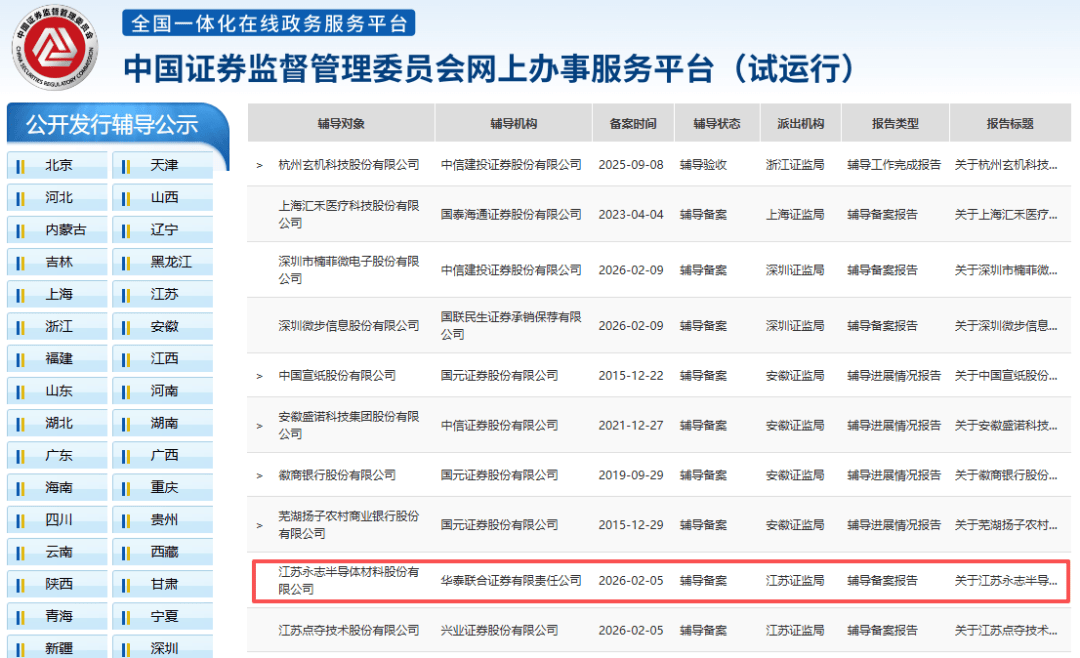
半导体材料新势力 IPO 辅导启动,聚焦封装核心部件
是说芯语· 2026-02-15 11:52
Core Viewpoint - Yongzhi Co., Ltd. is positioned as a national-level specialized and innovative "little giant" enterprise in the semiconductor chip packaging materials sector, focusing on providing high-performance and reliable packaging material solutions to support the independent and controllable development of the domestic semiconductor industry [2]. Group 1: Company Overview - Yongzhi Co., Ltd. was established on October 15, 2007, with a registered capital of 113.33 million yuan, and is located in Taixing City, Jiangsu Province [1]. - The company specializes in the research, production, and sales of semiconductor chip packaging materials, with core products including lead frames and packaging substrates [2]. Group 2: Product and Technology - The lead frame, a key material in semiconductor packaging, plays crucial roles in electrical connection, mechanical support, and thermal management, while the packaging substrate serves as the core connection bridge between bare chips and external circuits [2]. - Yongzhi's lead frame products are categorized into stamped lead frames and etched lead frames, primarily used in medium to high-power discrete devices across various critical sectors such as consumer electronics, industrial control, new energy, and automotive [2]. Group 3: Market Position and Partnerships - Yongzhi has established itself as a significant supplier to renowned chip manufacturers such as Silan Micro, China Resources Micro, and BYD Semiconductor, and has formed close collaborations with global top ten packaging and testing companies [3]. - The company has been recognized as a qualified supplier by ASE, indicating strong market acceptance [3]. Group 4: Intellectual Property and Future Prospects - As of now, Yongzhi has obtained a total of 128 patents, including 47 invention patents, showcasing its robust research and development capabilities that support product innovation and technological breakthroughs [3]. - Market participants express anticipation for Yongzhi to successfully complete its guidance acceptance and enter the capital market, marking the beginning of a new sustainable development journey [3].