
眼科医疗

Search documents
华厦眼科上半年营收利润重回增长 技术创新与服务升级铸华厦品牌
Zheng Quan Shi Bao Wang· 2025-08-25 15:05
Core Insights - The company reported a steady growth in its semi-annual performance for 2025, achieving an operating income of 2.139 billion yuan, a year-on-year increase of 4.31%, and a net profit attributable to shareholders of 282 million yuan, up 6.20% year-on-year, indicating a recovery in revenue and profit after facing temporary challenges [2] - The company's refractive business emerged as a key highlight, with revenue from this segment growing by 13.75% year-on-year to 789 million yuan, driven by continuous innovation in ophthalmic technology and the introduction of high-end equipment [2][3] Innovation and Technology - Since 2025, the company has focused on technological innovation, particularly in refractive and cataract surgery, by introducing cutting-edge diagnostic and treatment technologies [3] - The company has adopted new refractive surgical techniques, including the Zeiss SMILE Pro and Alcon's full-light plastic surgery, enhancing the efficiency and precision of refractive surgeries [3] - The introduction of the world's first 2MHz femtosecond laser equipment and the SMILE Pro technique has significantly improved surgical outcomes, with the Xiamen Eye Center becoming the first hospital in China to perform over a thousand SMILE Pro surgeries [3] AI and Digital Transformation - The company has deepened the application of advanced technologies such as AI and big data in clinical ophthalmology, enhancing its digital capabilities [4] - Collaborations with institutions like Xiamen University have led to the launch of China's first AI self-test tool for dry eye syndrome, showcasing the company's commitment to innovative solutions [4] - The introduction of the Zeiss EQ Workplace digital system has streamlined the management of cataract surgeries, marking a significant step towards intelligent transformation in the industry [4] Talent Development - The company emphasizes the importance of talent development and team building as a core support for service quality, focusing on a collaborative "medical education and research" system [5] - Partnerships with over 40 universities have been established to promote talent cultivation and clinical research, alongside the recruitment of more than 40 full-time ophthalmic medical professionals and over 200 graduates [5] Future Outlook - The company has a clear development plan for 2025-2029, focusing on internal improvements, optimizing service processes, and expanding its medical service network through new constructions and acquisitions [6] - The company aims to explore overseas ophthalmic market investment opportunities, aligning with its vision of "originating from Xiamen, serving China, and reaching the world" [6]

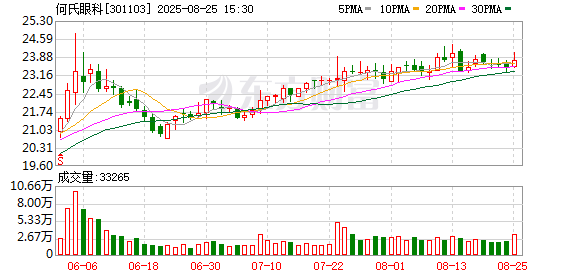
何氏眼科:关于完成工商变更登记并取得换发营业执照的公告
Zheng Quan Ri Bao· 2025-08-25 14:06
(文章来源:证券日报) 证券日报网讯 8月25日晚间,何氏眼科发布公告称,公司于2025年4月23日召开第三届董事会第十次会 议,并于2025年5月22日召开2024年年度股东大会,审议通过了《关于增加经营范围、修订并办理工商 变更登记的议案》。近日,公司完成了工商变更登记手续,并取得了沈阳市市场监督管理局换发的营业 执照。 ...
光正眼科的财务难题:资产负债率居高不下,货币资金仅剩约6076万元
Bei Jing Shang Bao· 2025-08-25 12:22
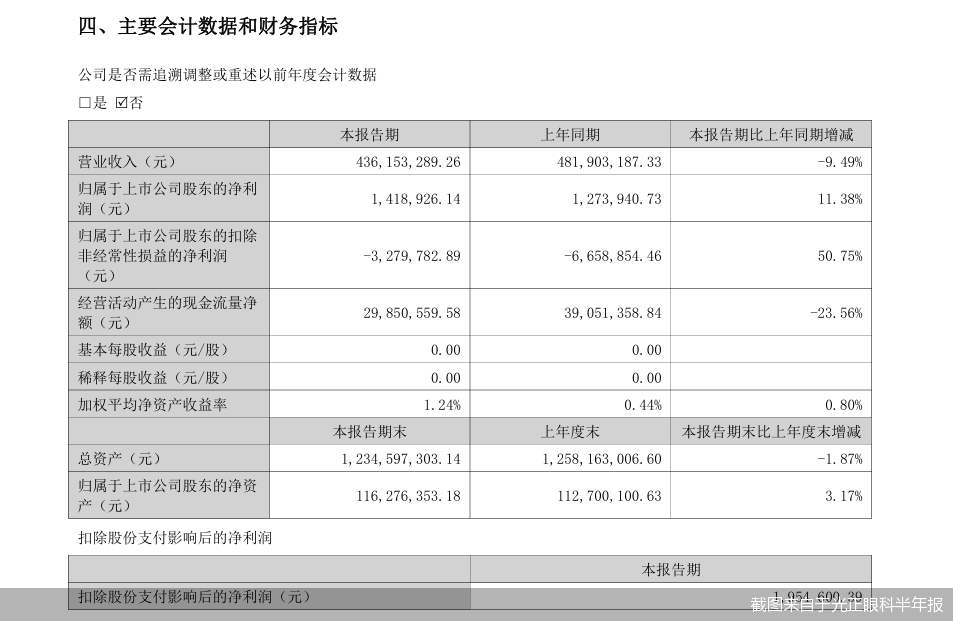
Core Viewpoint - Guangzheng Eye Hospital, originally focused on steel structure business, has transformed into a medical ophthalmology company but is currently facing significant challenges including high debt levels and liquidity issues [1][5][11]. Financial Performance - In the first half of the year, the company reported operating revenue of approximately 436.15 million yuan, a decrease of 9.49% year-on-year [2][3]. - The net profit attributable to shareholders was 1.42 million yuan, an increase of 11.38% compared to the same period last year [2][3]. - The company experienced a significant decline in net profit in the second quarter, with a reported net profit of approximately 845,200 yuan, down 95.77% year-on-year [3][4]. Debt and Liquidity - As of the end of the first half, Guangzheng Eye Hospital's asset-liability ratio reached 90.25%, indicating a high level of debt [5][6]. - The current ratio was reported at 0.367 and the quick ratio at 0.322, both of which are below 1, suggesting potential short-term liquidity issues [6][7]. - The company's cash and cash equivalents decreased to 60.76 million yuan from 67.69 million yuan at the beginning of the period [9]. Revenue Composition - Over 90% of the company's revenue is derived from the medical sector, with approximately 399 million yuan from medical services, accounting for 91.5% of total revenue [4]. - Within the medical sector, cataract and refractive projects contributed 33.82% and 32.71% of revenue, respectively [4]. Asset Management - The company has a significant amount of accounts receivable, totaling 162 million yuan, which constitutes over 40% of current assets [10]. - The goodwill on the balance sheet amounts to 243 million yuan, with a cumulative impairment provision of 37.4 million yuan [10]. Competitive Landscape - The ophthalmology service sector is becoming increasingly competitive, and Guangzheng Eye Hospital needs to enhance its brand influence and resource reserves to differentiate itself from leading institutions [11].

爱尔眼科:公司已完成两期股票回购
Zheng Quan Ri Bao Zhi Sheng· 2025-08-25 12:10
Core Viewpoint - The company is steadily advancing its high-quality development strategy and will dynamically assess funding needs for future planning [1] Group 1 - The company has completed two phases of stock repurchase [1] - Any future repurchase plans will be disclosed in accordance with relevant regulations [1]

何氏科研团队发表近视光学干预研究成果 助力临床选择
Zhong Zheng Wang· 2025-08-25 10:48
Core Insights - A research team from Liaoning He University and Shenyang He Eye Hospital published a study in the international journal "BMJ OPEN OPHTHALMOLOGY" comparing the vision-related quality of life and clinical efficacy of orthokeratology lenses (OK lenses), defocus glasses (DS glasses), and single vision glasses (SVS glasses) for myopic children and adolescents, providing important references for clinical choices in myopia optical interventions [1] Group 1 - The He Eye Hospital has actively responded to the national initiative "Light Project" by collaborating with Liaoning He University and He Eye Industry Group to establish a "365 Myopia Prevention and Control System" that utilizes big data, artificial intelligence, and genetic technologies [1] - This system emphasizes "precision" as a primary principle, customizing personalized plans based on genetic testing and vision examination data, addressing the shortcomings of traditional models [1] - The system covers the entire myopia development cycle, including prevention, early warning, control, and intervention, providing continuous management services [1] Group 2 - The integration of artificial intelligence and genetic diagnosis technologies allows for scientific risk prediction through myopia gene testing, enabling targeted measures to be taken [1] - The trend of early onset myopia is concerning, as high myopia, if not intervened in a timely manner, may lead to severe eye diseases such as retinal detachment [1] - Currently, SVS glasses are widely used due to their safety and affordability, while OK lenses and DS glasses are gradually gaining attention as new methods [1] Group 3 - The research team acknowledged limitations in their study and indicated the need for further research on the differences between various brands of lenses to provide more precise evidence for personalized correction plans [2]
华厦眼科(301267)8月25日主力资金净流入1136.62万元
Sou Hu Cai Jing· 2025-08-25 10:25
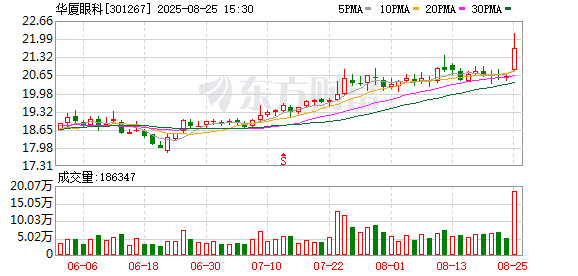
Group 1 - The core viewpoint of the news is that Huaxia Eye Hospital Group has shown positive financial performance with a revenue increase and a rise in net profit for the first half of 2025 [1] - As of August 25, 2025, Huaxia Eye Hospital's stock price closed at 21.63 yuan, reflecting a 5.0% increase with a trading volume of 186,300 hands and a transaction amount of 405 million yuan [1] - The company reported total operating revenue of 2.139 billion yuan, a year-on-year increase of 4.31%, and a net profit attributable to shareholders of 282 million yuan, up 6.20% year-on-year [1] Group 2 - Huaxia Eye Hospital Group has made investments in 78 companies and participated in 15 bidding projects, indicating active engagement in business expansion [2] - The company holds 66 trademark registrations and 38 patents, showcasing its commitment to intellectual property development [2] - Additionally, Huaxia Eye Hospital has obtained 6 administrative licenses, further solidifying its operational capabilities [2]
何氏科研团队发表近视光学干预研究成果
Zheng Quan Ri Bao Wang· 2025-08-25 07:14
Core Viewpoint - The research published in the international ophthalmology journal "BMJ OPEN OPHTHALMOLOGY" evaluates and compares the vision-related quality of life and clinical efficacy of different optical interventions for myopic children and adolescents in China, providing important references for clinical choices in myopia optical intervention [1] Group 1: Industry Context - The prevalence of myopia among children and adolescents in China is increasing, characterized by younger onset and more severe cases, which has raised significant social concerns [1] - The company actively responds to the national initiative "Light Project" by collaborating with various institutions to address myopia prevention and control [1] Group 2: Technological Integration - The establishment of the "365 Myopia Prevention and Control System" incorporates new technologies such as big data, artificial intelligence, and genetics to create personalized intervention plans based on genetic testing and vision examination data [1] - The system covers the entire myopia development cycle, including prevention, early warning, control, and intervention, providing continuous management services [1]
华厦眼科:2025年上半年净利润2.82亿元,同比增长6.20%
Jing Ji Guan Cha Wang· 2025-08-25 04:54
Core Insights - Huaxia Eye Hospital (301267) reported a revenue of 2.139 billion yuan for the first half of 2025, representing a year-on-year growth of 4.31% [1] - The net profit for the same period was 282 million yuan, showing a year-on-year increase of 6.20% [1] - The basic earnings per share (EPS) stood at 0.34 yuan, with a weighted average return on equity (ROE) of 4.80% [1]
何氏科研团队取得近视光学干预研究成果
Zheng Quan Shi Bao Wang· 2025-08-25 02:03
Core Insights - The research published in the international ophthalmology journal "BMJ OPEN OPHTHALMOLOGY" evaluates and compares the effectiveness and quality of life related to vision for children and adolescents wearing orthokeratology lenses (OK lenses), defocus glasses (DS glasses), and single vision glasses (SVS glasses) in China [1][2][3] Group 1: Research Findings - The study involved a cohort of 93 myopic children aged 7 to 17, divided into three groups wearing OK lenses, DS glasses, and SVS glasses, with a follow-up period of one year [1] - The results indicated significant differences in axial length growth among the three groups: the OK lens group showed an increase of only 0.18±0.08 mm, while the DS lens group had 0.27±0.08 mm, and the SVS lens group had 0.36±0.09 mm [2] - The OK lenses were found to control axial growth approximately 33% better than DS glasses and 50% better than SVS glasses, highlighting the advantages of newer lens types in preventing myopia progression [2] Group 2: Quality of Life Assessment - The study assessed quality of life using the internationally recognized "Children's Refractive Error Quality of Life Questionnaire" (PREP), which covers various dimensions such as distance vision, activity ability, and peer evaluation [1] - OK lenses demonstrated superior performance in multiple quality of life indicators, attributed to factors such as not needing to wear glasses during the day, unrestricted movement, reduced appearance anxiety, and clearer vision [2] - However, OK lenses had lower comfort scores compared to single vision glasses and required more complex maintenance, while DS glasses had lower scores in "near vision" due to their optical design [2] Group 3: Practical Implications - The research provides comprehensive insights for parents and doctors, indicating that while OK lenses have overall better performance, they may not be suitable for all children due to the need for strict screening of eye health and potential infection risks from improper maintenance [3] - DS glasses and SVS glasses are suggested to be more appropriate for children in conditions with limited hygiene or those unable to comply with nighttime lens wear [3]
解码银发经济: 在需求迭代中挖机遇 在产业升级中提能级
Zheng Quan Ri Bao· 2025-08-24 22:50
Group 1: Market Potential and Growth - The elderly population in China is expected to exceed 400 million by 2035, indicating a rapid aging process and significant market potential for the silver economy, projected to reach 30 trillion yuan [1] - In 2025, the sales revenue of elderly care services, elderly-friendly household services, and elderly social care services is expected to grow by 40.9%, 14.1%, and 8.8% respectively, significantly outpacing the average growth rate of the service industry [2] - As of now, 49,640 new elderly care-related enterprises have been established in China this year, with a total of 596,100 elderly care enterprises, reflecting strong market recognition of the silver economy sector [1][2] Group 2: Technological Integration - The role of technology, particularly data technology, is becoming increasingly crucial in the elderly care sector, transitioning from an auxiliary tool to a core driving force [3] - Smart monitoring devices, such as health monitoring equipment from Lepu, are being utilized to track vital signs of the elderly, providing real-time data and alerts for medical emergencies [3] Group 3: Policy Support and Capital Investment - Government policies are actively promoting the development of elderly care services, with financial incentives such as construction and operational subsidies for new elderly care institutions [4] - The capital market is increasingly focused on the silver economy, with 56 related enterprises raising 216.43 billion yuan through initial public offerings, and 17 elderly-themed bonds raising 11.82 billion yuan [5][6] Group 4: Consumer Awareness and Market Dynamics - Despite the positive growth trajectory, consumer awareness remains a significant barrier to unlocking the full potential of the silver economy, with many elderly individuals lacking understanding of healthcare products [6] - Companies are adopting experiential marketing and educational initiatives to enhance elderly consumers' understanding of medical products, while local governments are facilitating access to elderly-friendly products through subsidies [7]
