清洁能源

Search documents
溢价41.5%!中东、北美财团提价15.3%收购!美上市企业或退市?
Xin Lang Cai Jing· 2025-10-16 13:01
Core Viewpoint - ReNew Global Energy Plc has become a focal point for international capital, with a consortium proposing a non-binding acquisition offer of $8.15 per share, reflecting a significant increase from previous proposals and sparking discussions about potential delisting and capital strategy [1][2]. Group 1: Acquisition Proposal - The revised acquisition proposal represents a $1.08 increase per share, a 15.3% rise from the initial offer made on December 10, 2024, indicating the consortium's urgency for a successful acquisition [1]. - The offer price shows substantial premiums: 28.5% above the closing price of $6.34 per share prior to the initial proposal and 41.5% above the 30-day volume-weighted average price of $5.76 per share, highlighting the perceived asset value and optimistic future profitability of ReNew [1]. Group 2: Capital Composition - The consortium consists of Middle Eastern capital (Masdar, ADIA), North American long-term investment institutions, and the company's management, creating a synergistic acquisition model of "industrial capital + financial capital + management" [2]. - ADIA, one of the largest sovereign wealth funds globally, focuses on high-stability and high-growth assets, while North American institutions are known for their long-term investment perspective, indicating a strategic interest in ReNew's leading position in India's clean energy market [2]. Group 3: Market Implications - There are speculations regarding ReNew's potential delisting from NASDAQ, which could relieve the company from stringent U.S. regulatory compliance costs but would also eliminate access to U.S. equity financing [2]. - Post-delisting, ReNew may seek to revalue itself in the Indian market, leveraging its status as the second-largest clean energy developer in India to achieve a higher valuation premium, with Middle Eastern capital potentially opening financing avenues in the region [2]. Group 4: Company Background - As the second-largest clean energy developer in India, ReNew's industry position is a key attraction for capital, having gone public via a SPAC merger in August 2021 with an initial valuation of approximately $4.5 billion [3]. - The company's asset scale is expanding, with a project portfolio nearing 20 GW, which serves as a fundamental support for attracting international capital [3]. - ReNew's board is currently working with Rothschild & Co. as financial advisor and Anjarwalla & Khanna as legal advisor to evaluate the proposal, with negotiations ongoing [3].
福建福州:经济社会发展全面转型 绿意盎然
Zhong Guo Fa Zhan Wang· 2025-10-16 07:41
Group 1 - The "Fuzhou Coastal New City Sandy Coast Ecological Disaster Reduction Case" was selected and promoted globally at the first United Nations "Decade of Ocean" Marine Ecological Protection and Restoration Competition [1] - Fuzhou New Area is becoming a hub for entrepreneurship and livability, with significant projects like the second phase of the Intelligent Computing Center and the Tencent Cloud project accelerating construction [1] - The digital infrastructure in Fuzhou accounts for over 50% of the total in Fujian province, with national-level platforms such as the National Health Big Data Center and the National Land Resource Big Data Application Center being established [1] Group 2 - Fujian has implemented the "Implementation Opinions on Strengthening Ecological Environment Control" to enhance the management of ecological protection red lines and strictly control land use [1] - The province's clean energy installed capacity exceeds 65%, with plans to build 300 national-level green factories and 12 national-level green industrial parks [1] - The number of electric vessels built or under construction in Fujian accounts for 34.5% of the national total, and over 98% of new urban buildings are green [1] Group 3 - The "Fujian Province Forest 'Four Libraries' Linked Pilot Area Construction Plan" was introduced to promote the synergistic development of ecological, economic, and social benefits [2] - The total output value of Fujian's forestry industry is projected to reach 812.1 billion yuan by 2024, with over 3.1 billion yuan in provincial-level financial funds allocated this year [2] - Fujian aims to build a green, low-carbon, high-quality development pattern, with 46 provincial-level energy efficiency "leaders" and 10 national-level ones cultivated to date [2]
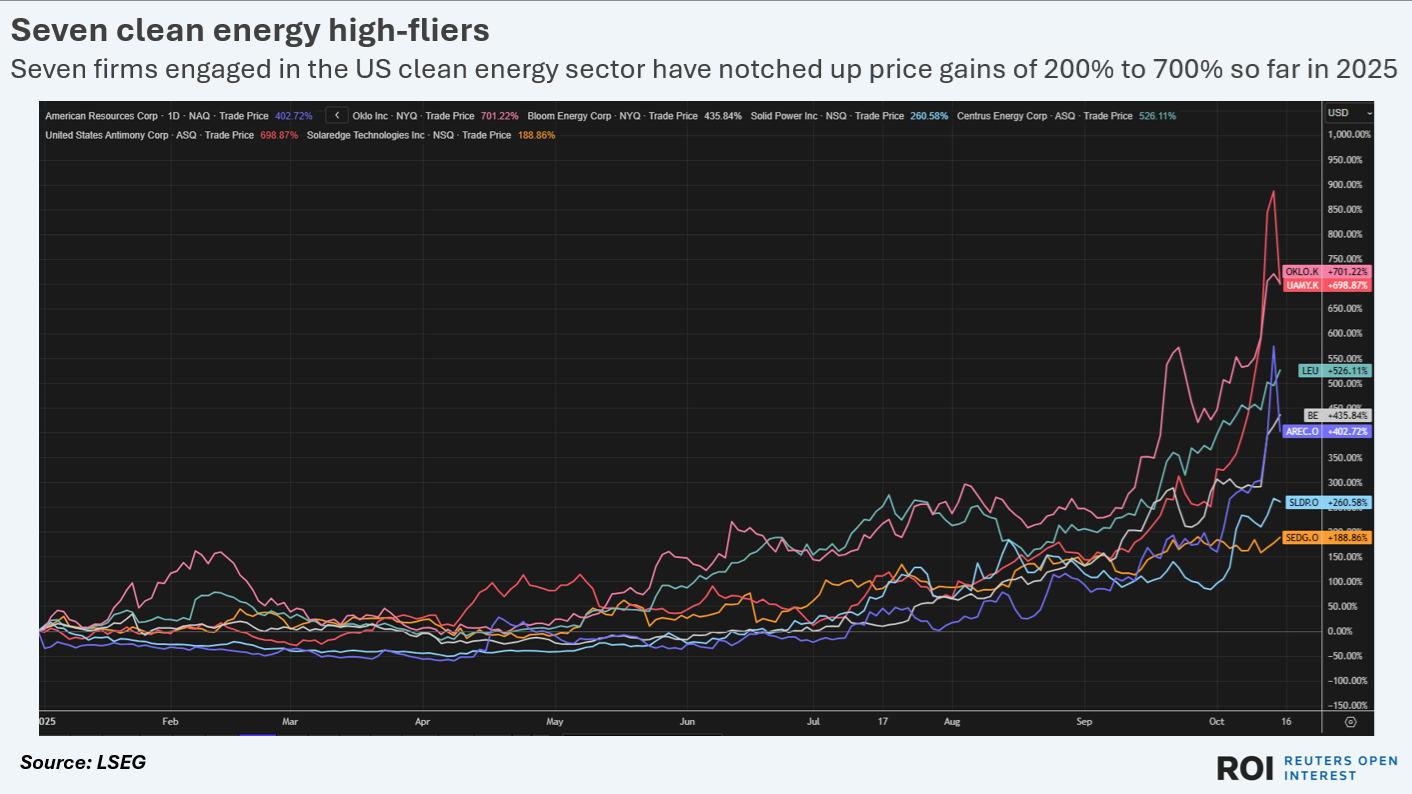
核电、稀土、储能、光伏,盘点美股能源转型“七雄”:今年均迎翻倍牛
Feng Huang Wang· 2025-10-16 07:02
Core Viewpoint - Despite the shift away from clean energy policies under President Trump, several publicly listed clean energy stocks in the U.S. are rebounding strongly, outperforming many traditional energy giants. The challenge lies in identifying which stocks may become long-term winners, as only a few companies are currently profitable, while others rely on potential breakthroughs that may take decades to materialize [1]. Group 1: Nuclear Energy - Centrus Energy and Oklo are two notable companies in the nuclear energy sector, with Centrus's stock rising over 550% in 2025 due to government support for nuclear reactor development. Centrus is the first U.S. company authorized to produce high-assay low-enriched uranium (HALEU), a key fuel for next-generation reactors [4]. - Oklo's stock has surged over 700% this year, driven by the promising prospects of its small reactors as reliable clean energy sources for data centers [4]. - Both companies face challenges in converting potential sales into realized revenue, as the long development cycles of new reactors may deter power companies from waiting for delayed deployments [5]. Group 2: Rare Resources - U.S. Antimony Corp and American Resources Corp have also seen significant stock price increases, with U.S. Antimony's stock rising approximately 690% and American Resources up about 390% in 2025. U.S. Antimony focuses on producing antimony for battery storage systems, while American Resources extracts rare earth elements for high-purity materials used in magnets and batteries [6]. - Both companies are supported by the U.S. government and are positioned to benefit from the growing domestic demand for U.S. suppliers, although they may face challenges in expanding outside the U.S. due to Chinese dominance in the same materials [6]. Group 3: Energy Storage - Bloom Energy, which produces fuel cells for on-site power generation, has seen its stock rise over 400% this year, partly due to a partnership with Brookfield Asset Management [7]. - Solid Power, a manufacturer of solid-state batteries for electric vehicles and energy storage networks, has experienced a stock increase of about 275%, with optimistic sales growth expected in the short to medium term due to demand for grid-level batteries [8]. - Both companies face intense competition from peers with similar technological capabilities and may be impacted by a slowdown in energy storage systems and AI data center construction [9]. Group 4: Solar Energy - SolarEdge Technologies, which produces inverters for optimizing solar panel power conversion, has seen its stock rise approximately 200% in 2025. Although not a U.S. company, SolarEdge has rapidly expanded its U.S. manufacturing base and is expected to benefit from strong demand for domestic solar components as the U.S. grid continues to integrate solar systems [10]. - Overall, despite the diverse roles of these seven stocks in the U.S. clean energy sector, investor interest has surged in 2025, benefiting all of them. Each company possesses unique competitive advantages that may enhance their appeal to investors and allow them to capture market share from tech giants and chip manufacturers in the long term [10].

杨阿维:强基提质激发内生动力
Jing Ji Ri Bao· 2025-10-16 00:09
Core Insights - The economic development of Tibet has achieved historic milestones over the past 60 years, with GDP increasing from 327 million yuan in 1965 to 276.5 billion yuan in 2024, emphasizing the need for high-quality development based on local realities [1] - The core of Tibet's economy lies in its real economy, which has been shaped by its unique geographical and environmental conditions, leading to the establishment of a nine-industry system that includes highland agriculture, clean energy, green industry, digital technology, cultural tourism, modern services, Tibetan medicine, border trade logistics, and general aviation [1] - The real economy serves as a stabilizer for improving livelihoods, a cornerstone for social stability, and a vital link for promoting prosperity in border areas, while also playing a crucial role in poverty alleviation and cultural heritage [2] Industry Development - The focus on enhancing the quality and efficiency of the real economy is essential for sustainable development, as it acts as a guardian of ecological security and a driver for common prosperity [2] - The shift from reliance on policy support to a sustainable market-driven model is underway, with technological innovation and industrial upgrades becoming the core engines for continuous economic health [3] - The development strategy includes fostering local endogenous power through the modernization of highland agriculture, industrialization of clean energy, and integration of culture and tourism, which collectively aim to upgrade the characteristic industrial system [3] Strategic Initiatives - The emphasis on local enterprise growth and the development of the private economy is crucial for stimulating operational vitality [3] - The integration of technology into traditional industries and the innovation of the digital economy are key to enhancing industrial competitiveness [3] - The construction of the South Asia transit hub and the deepening of the Belt and Road Initiative are expected to unlock the potential for openness and connectivity [3]
强基提质激发内生动力
Jing Ji Ri Bao· 2025-10-15 22:12
Core Insights - The economic development of Tibet has achieved historic milestones, with GDP increasing from 327 million in 1965 to 276.5 billion in 2024, emphasizing the need for high-quality development based on local realities [1] Group 1: Economic Structure - The core of Tibet's economy lies in the real economy, which has evolved under harsh natural conditions, forming a unique industrial system comprising nine key sectors: highland特色 agriculture, clean energy, green industry, high-tech digital, cultural tourism, modern services, Tibetan medicine, border trade logistics, and general aviation [1] - These sectors are not only vital for regional economic development but also serve as a foundation for social stability, ethnic unity, and ecological protection [1] Group 2: Role of the Real Economy - The real economy acts as a stabilizer for improving livelihoods, a cornerstone for social stability, and a crucial link for promoting prosperity in border areas [2] - It possesses "green genes," safeguarding ecological security, and is a driving force for common prosperity, supporting poverty alleviation and rural revitalization efforts [2] - The real economy also plays a significant role in the transmission and innovation of ethnic culture, injecting new life and economic value into traditional handicrafts like Thangka, Tibetan carpets, and incense through industrial development [2] Group 3: Internal Development Dynamics - Tibet's development is shifting from reliance on "policy blood transfusions" to a sustainable "market blood production" model, with technological innovation and industrial upgrading as core engines for continuous economic health [3] - The focus is on cultivating local endogenous power through the modernization of highland green agriculture, industrialization of clean energy, and enhancement of cultural tourism [3] - The strategy includes leveraging local enterprises and private sector growth, enhancing industry competitiveness through technology, and optimizing human resource structures via local talent development [3] - This approach aims to effectively connect the "resources-industry-market" chain, promoting high-quality economic development in Tibet [3]
远景能源入选MIT榜单 中国零碳产业园模式全球瞩目
Guan Cha Zhe Wang· 2025-10-15 10:25
Core Insights - The article highlights that Envision Energy has been recognized in the "Top 10 Climate Tech Innovators" by MIT Technology Review for its pioneering achievements in smart wind technology, zero-carbon industrial park models, and digital energy systems [1] Group 1: Zero-Carbon Industrial Park Significance - The zero-carbon industrial park in Ordos is transforming a coal-dependent region into a model for industrial decarbonization, providing a replicable blueprint for global heavy industry decarbonization [1][2] - Envision Energy has evolved from a wind turbine manufacturer to a provider of clean energy solutions, integrating wind, solar, battery storage, and green hydrogen to enable heavy industries to operate entirely on clean energy [2] Group 2: Technological Innovation - The zero-carbon industrial park is not just a geographical concept but a systematic solution that integrates smart IoT technology across the "source, grid, load, and storage" sectors, addressing key challenges in energy reliability and industrial emissions reduction [3] Group 3: Global Expansion Plans - Envision Energy aims to promote the zero-carbon industrial park model globally, with plans for a lithium iron phosphate battery super factory in Spain expected to commence production in 2026, alongside a zero-carbon hydrogen industrial park [4] - The company is also developing the first zero-carbon industrial park in Brazil, focusing on a green fuel value chain centered around bio-jet fuel, contributing to Brazil's green industrial system [4] - These initiatives are in early development stages, but successful implementation could provide a blueprint for decarbonizing heavy industry without sacrificing competitiveness or jobs [4]
【环球财经】巴西美国商会:2025年巴西企业环保投资达482亿雷亚尔
Xin Hua Cai Jing· 2025-10-15 06:10
Core Insights - The report from Amcham Brasil indicates that private sector investments in sustainable development and decarbonization projects in Brazil are projected to reach 48.2 billion reais by 2025, representing a 24.2% increase from the previous year [1] Investment Trends - The annual study "Brazil Environment" has gathered data from 209 companies this year, an increase of 44 companies compared to last year, with a total of 316 projects, marking the highest level since the survey began in 2021 [1] Environmental Impact - The surveyed companies have covered 11.1 million hectares of protected or restored land, generated 23.5 billion kilowatt-hours of clean energy, and produced 4.3 billion liters of biofuels [1] - Additionally, these companies have processed or reused 203 million tons of waste and recycled 36.8 billion liters of water, equivalent to providing water for 670,000 people for a year [1] Carbon Emission Reduction - The initiatives have helped Brazil avoid emissions of 30.58 million tons of CO2 equivalent, with a 15.4% increase in the reduction amount compared to last year [1] - The president of Amcham Brasil, Abrão Neto, emphasized that these results demonstrate the private sector's ongoing commitment to implementing sustainable and decarbonization projects in line with commitments made at previous climate conferences [1]
西藏山南市洛扎县2025招商引资推介会拉萨落幕 签约超30亿元
Xin Hua Wang· 2025-10-15 04:27
Core Insights - The event in Lhasa focused on attracting investment to Luozha County, resulting in two strategic cooperation agreements and four key industry project signings, with a total investment scale of 3.071 billion yuan [1][2] Group 1: Investment and Economic Development - The event showcased Luozha's unique resources and potential in clean energy development, cultural tourism integration, and specialty agricultural development [1] - The clean energy sector benefits from abundant hydropower, wind, and solar resources, facilitating the construction of hydropower stations, wind farms, and photovoltaic power plants [1] - Luozha County aims to create an integrated development model combining "snow mountain sightseeing + intangible cultural heritage experience + specialty agricultural products" [1] Group 2: Strategic Planning and Future Directions - Local officials highlighted Luozha's core advantages in policy support, industrial foundation, and market space for clean energy and cultural tourism resources [2] - The county plans to develop a multi-energy complementary clean energy industry cluster, new business models in cultural tourism consumption, and specialty industrial chains [2] - Future initiatives will focus on resource potential, infrastructure improvement, and service efficiency to promote the "clean energy + cultural tourism" integration development path [2]
清洁能源REITs价值潜力凸显
中国能源报· 2025-10-15 00:07
Core Viewpoint - Clean energy REITs are entering a new stage of "value realization" and "growth potential" as the "dual carbon" goals continue to advance, showcasing strong cash flow and dividend capabilities, along with significant growth potential and green fundraising ability [2][4][10]. Group 1: Performance and Distribution - The first water REIT in China, the "Jia Shi China Electric Power Clean Energy REIT," achieved revenue of 36.31 million yuan and a distributable amount of 30.51 million yuan in the first half of the year, with a cumulative distribution amount of 7.388 million yuan for 2024, accounting for 96.94% of the distributable amount [4]. - The "Hua Xia Tebian Electric Power New Energy REIT," the first new energy public REIT in Xinjiang, reported revenue of 9.798 million yuan and a distributable amount of 1.835 million yuan, with a total distribution of 157.6 million yuan since its listing [4]. - The "Zhong Hang Jing Neng Photovoltaic REIT" achieved revenue of 153 million yuan and a distributable amount of 68 million yuan, with a cumulative increase of 46.68% since its listing, and total dividends of 673 million yuan [5][6]. - The "Zhongxin Jiantou Mingyang Intelligent New Energy REIT" reported revenue of 112.79 million yuan and a distributable amount of 36.72 million yuan, with a cumulative distribution of 235 million yuan since its listing [6]. Group 2: Underlying Asset Operations - The underlying asset of the "Jia Shi China Electric Power Clean Energy REIT" is the Wuyi Bridge Hydropower Station with a total installed capacity of 137,000 kW, which saw an 8.17% increase in electricity generation in the first half of the year [8]. - The "Hua Xia Tebian Electric Power New Energy REIT" operates a 150 MWp photovoltaic project in Xinjiang, achieving 52.7% of its forecasted annual revenue and 51.7% of its forecasted annual electricity generation in the first half of the year [8]. - The "Zhong Hang Jing Neng Photovoltaic REIT" manages two photovoltaic projects with a combined annual generation capacity of approximately 5.1 billion kWh, maintaining stable operations despite external pressures [9]. - The "Zhongxin Jiantou Mingyang Intelligent New Energy REIT" operates two wind power projects with a total capacity of 150 MW, reporting an 8% increase in revenue in the first half of the year [9]. Group 3: Expansion and Asset Integration - The "Zhong Hang Jing Neng Photovoltaic REIT" has received approval for a product change application to expand its asset base by integrating two hydropower projects, potentially doubling its asset scale and enhancing cash flow [11]. - The "Jia Shi China Electric Power Clean Energy REIT" is actively preparing for expansion, aiming to revitalize clean energy assets within the China Electric Power system, which has a total installed capacity of approximately 5 million kW [12]. - The "Hua Xia Tebian Electric Power New Energy REIT" and "Mingyang Intelligent New Energy REIT" are also pursuing expansion strategies, focusing on acquiring additional renewable energy assets to diversify risks and optimize project returns [12].
西班牙经济展现活力与韧性(国际视点)
Ren Min Ri Bao· 2025-10-14 22:12
Economic Performance - Spain's GDP grew by 2.8% year-on-year in Q1 and 2.7% year-on-year in Q2, outperforming the Eurozone average and market expectations, making it one of the best-performing economies in the Eurozone for the first half of the year [1][2] - The GDP growth rate for Spain is projected to reach 3.2% in 2024, with a forecasted range of 2% to 3% for 2025 [2] Tourism Sector - The tourism sector, accounting for approximately 70% of Spain's economy, has seen a significant recovery, with over 66.8 million international visitors in the first eight months of the year, a 3.9% increase from the previous year [2] - In August alone, Spain welcomed over 11.3 million international travelers, with expectations to surpass 100 million for the year [2] - Chinese tourists have notably increased, with 444,000 visitors from China in the first seven months, marking an 11.9% year-on-year growth [2][3] Agriculture and Food Industry - Spain is a major agricultural producer in the EU, being the fourth largest producer and the largest exporter of fruits and vegetables [3] - The export value of fresh fruits and vegetables increased significantly in the first half of the year, with 84% of exports going to the EU market, totaling approximately 5.57 million tons [3] - Spain's agricultural exports to China grew by 24.2% in Q1, highlighting the increasing importance of the Chinese market [3] Structural Transformation - Spain is actively pursuing economic structural transformation, focusing on green and digital transitions to foster new growth drivers [4][7] - The government has committed to investing €20 billion in digital transformation initiatives, including 5G network expansion and data center development [7] Energy Sector - Spain aims to increase the share of renewable energy in total energy consumption to 42% by 2030, supported by the EU recovery fund [6] - The country has seen significant growth in wind and solar energy installations, with over 5 million kilowatts added in the first half of the year [6] Bilateral Cooperation with China - Spain's trade with China reached $50.1 billion in 2024, with a 3.2% year-on-year increase, making China Spain's largest trading partner outside the EU [8] - The cooperation spans various sectors, including agriculture, renewable energy, and technology, contributing to mutual economic benefits [9]