
建筑陶瓷

Search documents
东鹏控股:完成1.07亿元股份回购,用于员工持股或激励
Xin Lang Cai Jing· 2025-11-19 08:42
Core Viewpoint - Dongpeng Holdings announced a plan to repurchase shares worth 100 to 200 million yuan at a price not exceeding 9.08 yuan per share, indicating a strategic move to enhance shareholder value and support employee incentive programs [1] Summary by Sections - **Share Repurchase Plan** - The company intends to repurchase shares amounting to 100 to 200 million yuan [1] - The maximum repurchase price is set at 9.08 yuan per share [1] - **Completion and Details of Repurchase** - As of November 18, 2025, the company completed the repurchase of 17.33 million shares, which represents 1.50% of the total share capital [1] - The total transaction amount for the repurchase reached 107 million yuan, excluding fees [1] - The repurchase period is from January 23, 2025, to October 28, 2025 [1] - **Funding and Purpose** - The funds for the repurchase will come from the company's own funds and special loans, complying with regulations [1] - The repurchased shares will be used for employee stock ownership plans or equity incentives; any unallocated shares will be canceled if not implemented as planned [1]
东鹏控股荣登“双十一”瓷砖品牌销售榜TOP1 建筑陶瓷龙头凭何穿越周期?
Zheng Quan Ri Bao Zhi Sheng· 2025-11-18 04:40
Core Insights - Dongpeng Holdings has achieved significant success in the e-commerce sector, ranking first in the Tmall home decoration "tile brand sales list" and the JD home decoration "wall and floor material brand list," marking five consecutive years of leading the tile industry in new retail [1] Group 1: Financial Performance - In the first three quarters of the year, Dongpeng Holdings reported a revenue of 4.501 billion yuan, with a year-on-year growth of 8.03% in the tile retail channel [1] - The net profit attributable to shareholders for the first three quarters was 349 million yuan, reflecting a year-on-year increase of 13.09%, with a notable 32.91% growth in the third quarter [1] - The net cash flow from operating activities reached 651 million yuan, up 33.19% year-on-year [1] Group 2: Market Position and Strategy - The architectural ceramics industry is currently in a phase of demand contraction and price wars, yet Dongpeng Holdings has managed to grow its market share rapidly [1][2] - The company has opened 196 new stores and upgraded 224 existing ones in the first three quarters, enhancing its brand display and service capabilities [2] - Dongpeng Holdings has focused on "experiential scene-based" transformations and a "online-to-offline" operational model to stimulate consumer demand [2] Group 3: Product Innovation - Dongpeng Holdings has launched several innovative products, including the "Feather Anti-Slip Shield" technology for anti-slip tiles and a smart toilet that meets the highest 5A grade in sanitary ware [5] - The company has established 38 innovation platforms and holds 2,505 patents, making it the ceramic tile enterprise with the most patents in the industry [4] - The introduction of new product lines, such as the premium stone series and eco-friendly products, has contributed to the company's competitive edge [2] Group 4: Industry Standards and Future Outlook - Dongpeng Holdings is a key player in the formulation of the new national standard for ceramic tiles, which will be implemented on December 1, aiming to enhance product quality across the industry [6][7] - The new standard is expected to drive technological advancements and quality upgrades, benefiting companies like Dongpeng that can meet these stringent requirements [6][7] - The architectural ceramics market is projected to stabilize at around 250 billion yuan over the next five years, with a potential increase in market concentration favoring leading companies [3]
001386,拟10派3元
Zheng Quan Shi Bao· 2025-11-15 08:33
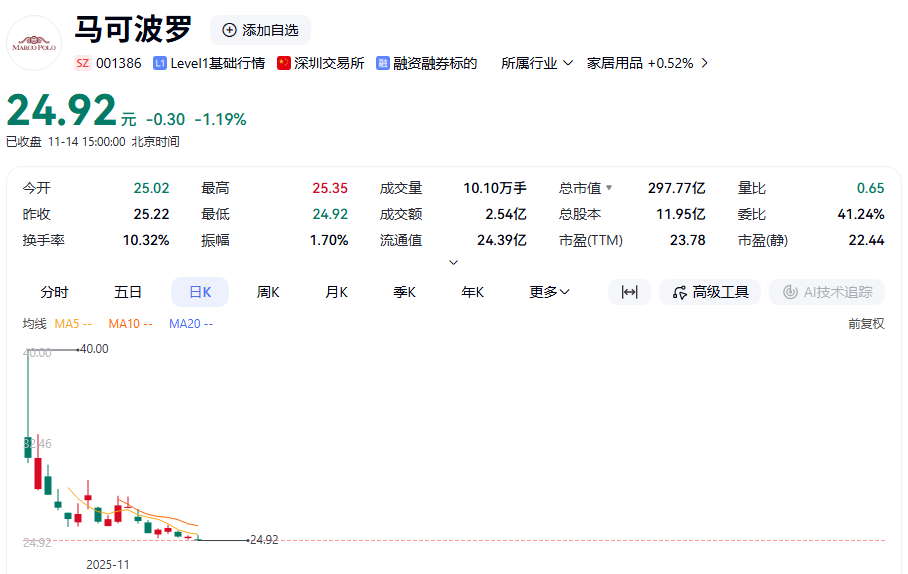
Core Viewpoint - Marco Polo plans to distribute over 358 million yuan in cash dividends shortly after its listing, reflecting strong profitability and cash flow [1][2]. Financial Summary - For the first three quarters of 2025, the company's consolidated net profit attributable to shareholders was 1.062 billion yuan, with the parent company achieving a net profit of 618 million yuan [1]. - As of September 30, 2025, the parent company's distributable profits amounted to 3.817 billion yuan, while the consolidated distributable profits were 7.519 billion yuan [1]. - The proposed dividend distribution is 3.00 yuan per 10 shares, totaling 358 million yuan, based on a share capital of 1.195 billion shares [1]. Company Overview - Marco Polo aims to create the first world-renowned brand for Chinese ceramics, focusing on the research, production, and sales of architectural ceramics [4]. - The company is one of the largest manufacturers and sellers of architectural ceramics in China, owning two major brands: "Marco Polo Tiles" and "Weimei L&D Ceramics" [4]. - Marco Polo operates five production bases located in Dongguan, Qingyuan, Fengcheng, Chongqing, and Tennessee, USA, with a product range that includes glazed and unglazed tiles [4]. Market Performance - The company was listed on October 22, 2025, with an impressive first-day increase of 128.8% [2]. - As of the latest update, the company's stock price is 24.92 yuan per share, resulting in a total market capitalization of 29.777 billion yuan [2].

001386,拟10派3元
证券时报· 2025-11-15 08:27
Core Viewpoint - The company Marco Polo (001386) has announced a profit distribution plan shortly after its IPO, indicating strong financial performance and commitment to shareholder returns [2][3]. Group 1: Profit Distribution Plan - Marco Polo plans to distribute a cash dividend of 3.00 yuan per 10 shares, totaling 358 million yuan, based on its available distributable profits [2][3]. - The company reported a net profit of 1.062 billion yuan for the first three quarters of 2025, with a parent company net profit of 618 million yuan [2]. - As of September 30, 2025, the parent company's distributable profits amounted to 3.817 billion yuan, while the consolidated distributable profits were 7.519 billion yuan [2]. Group 2: Financial Health and Compliance - The company emphasizes its robust profitability and ample cash flow, which supports the proposed dividend distribution [3]. - The profit distribution plan aligns with the company's long-term development needs and complies with relevant laws and regulations [3]. Group 3: Company Overview - Marco Polo is a leading manufacturer and seller of building ceramics in China, with a mission to create a globally recognized brand for Chinese ceramics [6]. - The company operates five production bases in China and the United States, focusing on both glazed and unglazed tiles [6]. - The stock price of Marco Polo surged by 128.8% on its first trading day, currently priced at 24.92 yuan per share, with a total market capitalization of 29.777 billion yuan [4].

马可波罗(001386.SZ):前三季度拟每10股派发现金3元
Ge Long Hui A P P· 2025-11-14 13:03
格隆汇11月14日丨马可波罗(001386.SZ)公布,为了更好地回报股东,在兼顾公司未来业务发展及生产 经营的资金需求的前提下,2025年前三季度公司的利润分配预案为:以截至目前股本1,194,920,000股为 基数,向全体股东每10股派发现金3.00元(含税),现金分红总额358,476,000.00元,本次分配不实施资 本公积转增股本、不分红股,剩余未分配利润留待后续分配。 ...
蒙娜丽莎子公司参投珠海晶瓷 曲线切入半导体领域
Zheng Quan Shi Bao Wang· 2025-11-13 07:51
Group 1 - Zhuhai Jingci Electronic Technology Co., Ltd. underwent a change in investors on November 12, with Zhuhai Hengqin Jingtou Investment Partnership (Limited Partnership) subscribing to 15 million yuan, holding 75% of the shares and becoming the controlling shareholder [1] - The largest contributor to Zhuhai Hengqin Jingtou Investment Partnership is Guangdong Mona Lisa Investment Management Co., Ltd., which holds a 66.67% stake and is a wholly-owned subsidiary of the listed company Mona Lisa [1] - Zhuhai Jingci's business scope includes manufacturing semiconductor discrete devices, specialized equipment for semiconductor devices, and special ceramic products [1] Group 2 - Mona Lisa is primarily engaged in the research, production, and sales of high-quality building ceramic products, and this investment allows it to indirectly enter the semiconductor field [2] - In September, Huigude, a high-tech enterprise in Wuxi, completed a new round of financing with participation from various investment institutions, including Mona Lisa, focusing on the research and production of aluminum nitride ceramic substrates [2] - In October, Quanxin Intelligent Manufacturing Technology Co., Ltd. secured A+ round financing with participation from Mona Lisa and other investment firms, specializing in integrated solutions for intelligent manufacturing and holding over 200 patents [2]
马可波罗上市5天下跌5天,每天都在创新低,追高的已套近50%
Sou Hu Cai Jing· 2025-11-12 17:51
Core Viewpoint - The recent performance of Marco Polo's stock has highlighted significant risks in the new stock investment ecosystem, particularly for retail investors who are increasingly facing losses due to market volatility and poor stock performance [3][8]. Company Summary - Marco Polo's stock was listed on the Shenzhen Stock Exchange on October 22, 2025, with an initial price of 13.75 yuan, and it experienced a first-day surge of 128.80%, closing at 31.46 yuan after reaching a high of 40 yuan [3]. - The stock has seen a dramatic decline, with a drop of over 34% from its peak, leading to significant losses for many investors [1][3]. - The company has a high price-to-earnings ratio of 28.5, which is 56% above the average for the building ceramics industry at 18.2 [3]. - Marco Polo's revenue has decreased from 86.61 billion yuan in 2022 to 73.24 billion yuan in 2024, with a net profit decline from 15.14 billion yuan to 13.37 billion yuan during the same period [5]. - The company has faced substantial bad debt issues, with a bad debt rate increasing from 21.64% in 2021 to 39.61% in 2023, largely due to its reliance on the real estate sector [5]. Industry Summary - The building ceramics industry is under severe pressure, with a 7.2% decline in national real estate development investment and a 5.8% drop in commercial housing sales area from January to August 2025 [3]. - The overall production of tiles in the first half of 2025 decreased by 4.3%, and the industry's operating rate was only 65% [3]. - The A-share market has seen a significant increase in the new stock issuance rate, with a 44% rate of new stock failures in 2025, up from 15% in 2024 [3][6]. - A report from the China Securities Association indicates that 68% of investors who participated in new stock first-day trading experienced losses, with 41% suffering losses exceeding 25% [8].
“十四五” 马可波罗控股科技创新和绿色发展再添新篇
Yang Guang Wang· 2025-11-12 09:59
Core Viewpoint - Marco Polo Holdings Co., Ltd. is recognized for its commitment to high-quality development and green innovation during the 14th Five-Year Plan period, particularly through its environmentally friendly building ceramics technology [1][3]. Group 1: Technological Innovation - The project "Research and Industrialization of Key Technologies for Environmentally Friendly Building Ceramics Green Low-Carbon Manufacturing" developed by Marco Polo Holdings was included in the "14th Five-Year Plan Advanced Technological Innovation Achievements" [1][3]. - The project focuses on key technologies for applying biomass energy in the ceramic industry and incorporates distributed photovoltaic power generation, effectively achieving energy conservation and emission reduction in building ceramics manufacturing [3]. Group 2: Industry Recognition - Inclusion in the "14th Five-Year Plan Advanced Technological Innovation Achievements" and the "2025 Edition of the Directory of Advanced Technologies for Energy Conservation and Carbon Reduction in Key Areas of Light Industry" signifies recognition of Marco Polo Holdings' long-term commitment to green development and low-carbon technology innovation [5]. Group 3: Future Commitment - Marco Polo Holdings plans to continue increasing its research and development efforts, actively promoting green manufacturing technology innovation and practical applications to contribute to high-quality, low-carbon development and the construction of a beautiful China [5].
蒙娜丽莎股价涨5.01%,工银瑞信基金旗下1只基金重仓,持有512.09万股浮盈赚取394.31万元
Xin Lang Cai Jing· 2025-11-12 02:15
Group 1 - Mona Lisa's stock increased by 5.01%, reaching 16.14 CNY per share, with a trading volume of 55.54 million CNY and a turnover rate of 1.65%, resulting in a total market capitalization of 6.598 billion CNY [1] - The company, established on October 20, 1998, and listed on December 19, 2017, specializes in the research, production, and sales of high-quality building ceramic products. The revenue composition includes glazed porcelain tiles (81.58%), ceramic slabs and thin ceramic tiles (12.00%), non-porcelain glazed tiles (3.69%), and other products [1] Group 2 - ICBC Credit Suisse Fund's "ICBC Strategic Transformation Stock A" (000991) reduced its holdings by 676,900 shares in the third quarter, now holding 5.1209 million shares, which accounts for 2.4% of the circulating shares. The estimated floating profit today is approximately 3.9431 million CNY [2] - The fund was established on February 16, 2015, with a latest scale of 1.903 billion CNY. Year-to-date returns are 10.98%, ranking 3615 out of 4216 in its category, while the one-year return is 4.17%, ranking 3444 out of 3937 [2] Group 3 - The fund manager of "ICBC Strategic Transformation Stock A" is Du Yang, who has been in the position for 10 years and 273 days. The total asset scale of the fund is 12.123 billion CNY, with the best return during his tenure being 285.3% and the worst being -37.97% [3] Group 4 - "ICBC Strategic Transformation Stock A" holds 5.1209 million shares of Mona Lisa, representing 4.49% of the fund's net value, making it the sixth-largest holding. The estimated floating profit today is approximately 3.9431 million CNY [4]
马可波罗募资16.43亿缩水超34% 上市8天即“变卦”五大项目集体延期
Chang Jiang Shang Bao· 2025-11-09 23:25
Core Viewpoint - Marco Polo, known as the "first tile stock," has announced significant delays in its five major projects, now expected to reach operational status by December 2027, which were initially scheduled to be completed before the company's IPO [1][10]. Group 1: Project Delays and Adjustments - The company has postponed the completion dates of its five major projects, which were originally set to be operational by March 2025 and March 2024, respectively, now pushed to December 2027 [10]. - The adjustments in project timelines were not disclosed in the prospectus prior to the IPO, raising concerns about transparency [11]. - The company cited macroeconomic conditions and strategic planning changes as reasons for the delays, indicating a cautious approach to investment project timelines [10]. Group 2: Fundraising and Financial Performance - Marco Polo reduced its fundraising target multiple times, from an initial 40.18 billion yuan to 16.43 billion yuan at the time of the IPO, representing a decrease of over 34% [5][6]. - The actual net proceeds from the IPO were 15.6 billion yuan after deducting issuance costs [5]. - The company's revenue and net profit have been on a downward trend from 2021 to 2024, with a reported revenue of 49.38 billion yuan in the first nine months of 2025, a year-on-year decline of 10.2% [11].