
水资源管理

Search documents
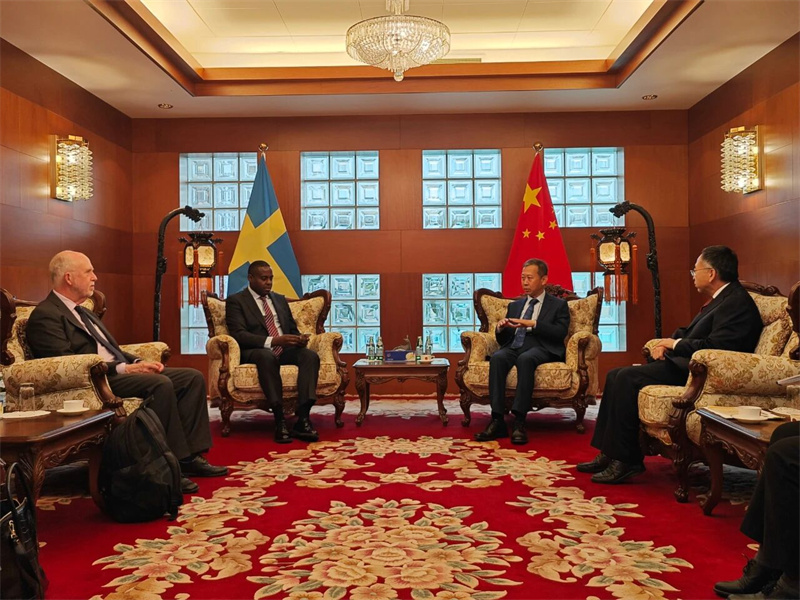
中国驻瑞典大使崔爱民会见国际水伙伴关系组织首席执行官西马拉布维
人民网-国际频道 原创稿· 2025-08-28 03:21
Group 1 - The meeting between China's Ambassador to Sweden, Cui Aimin, and CEO of the International Water Partnership, Alex Simarabwe, focused on enhancing international cooperation in the water resources sector [1][3] - China emphasizes the importance of ecological civilization and is accelerating efforts in water resource protection and sustainable utilization, achieving significant results in water-saving technology and watershed management [3] - The International Water Partnership is encouraged to leverage its influence to promote international dialogue and cooperation in water resource management, contributing to effective global water utilization and environmental governance [3] Group 2 - Simarabwe praised China's achievements in water governance and expressed willingness to deepen practical cooperation in the water resources sector to promote global green development [3]

【汉中】首单水权交易协议签订
Shan Xi Ri Bao· 2025-08-26 23:51
Core Viewpoint - The first water rights transaction in Hanzhong City has been successfully executed, marking a significant step towards the market-oriented allocation of water resources in the region [1][2] Group 1: Water Rights Transaction - Hanzhong Pharmaceutical Group signed a water rights transaction agreement for 40,000 cubic meters with Hanzhong Vocational Technical College, utilizing saved water resources from efficiency improvements [1] - The water quantity involved in this transaction is not newly generated but is a result of water-saving measures implemented by Hanzhong Pharmaceutical Group [1] Group 2: Market Mechanism and Benefits - The transaction opens a market channel for the transfer of water resources between regions, industries, and users, effectively alleviating the supply-demand contradiction in regional water resources [2] - The transaction serves as a practical model for achieving the water resource management goal of "strictly controlling increments and revitalizing stock" [2] - It encourages other water users to undertake water-saving modifications and improve water efficiency, fostering a culture of water conservation across society [2]
超过3亿非洲人无法获得清洁饮用水 首届非洲水投资峰会呼吁—— 携手合作 将水资源转化为“驱动力”(国际视点)
Ren Min Ri Bao· 2025-08-26 21:51
Core Points - The first Africa Water Investment Summit was held in Cape Town, South Africa, aiming to promote investment in water resources and sanitation facilities across Africa [1] - The summit gathered around 2,000 representatives from various governments, international organizations, and the private sector to discuss investment projects and financing methods [1][2] - South African President Ramaphosa emphasized the importance of water accessibility and called for collaboration to transform water resources into drivers of economic transformation and innovation [1][2] Investment Plans - The summit committed to expanding investment scale, improving governance, and enhancing accountability in the water sector [2] - A global water investment outlook committee was announced to upgrade the Africa Water Investment Program into a global platform, aiming to coordinate fragmented water investments [2] - The Africa Water Investment Program aims to mobilize $30 billion by 2030 for cross-border water resource management and improving access to clean drinking water and sanitation [2] National Initiatives - African Union member states are integrating the Africa Water Investment Program's indicators into national policies and investment frameworks [3] - Zambia launched its "Zambia Water Investment Program" in 2022, targeting $5.7 billion in funding by 2030 for urban and rural water supply and irrigation projects [3] Water Governance Challenges - Over 300 million Africans lack access to clean drinking water, and over 700 million lack adequate sanitation facilities [4] - Sub-Saharan Africa loses 5% of its GDP annually due to water scarcity, pollution, and poor sanitation [4] - South Africa's National Water Resource Strategy emphasizes sustainable water management and equitable distribution in response to climate change [4] Funding Gaps - Africa invests between $10 billion to $19 billion annually in water governance, but an additional $30 billion is needed each year to meet sustainable development goals [5] - The Africa Water Investment Program calls for reforms in water governance systems and mobilization of domestic and global financing to fill the funding gap [5] Role of Chinese Enterprises - Chinese companies are actively participating in Africa's water governance, implementing various projects to improve water access [6] - Notable projects include the Lesotho Highlands Water Project and rural well-drilling initiatives in Senegal, which significantly enhance water supply for local populations [6][7] - The collaboration between China and Africa in water governance is seen as having vast potential to address water scarcity and improve public health [7]

中游水管理公司WaterBridge(WBI.US)申请上市 为美国IPO市场“添把火”
Zhi Tong Cai Jing· 2025-08-23 02:18
Group 1 - WaterBridge Infrastructure submitted its IPO application, indicating a warming trend in the U.S. IPO market [1] - The company plans to list on the NYSE and NYSE Texas under the ticker "WBI," with JPMorgan and Barclays as lead underwriters [1] - The proceeds from the IPO will be used to repay debt and for other purposes [1] - The company reported revenue of $374.9 million and a net loss of $38 million for the six months ending June 30 [1] Group 2 - WaterBridge's infrastructure network includes approximately 2,500 miles of pipelines and 196 produced water treatment facilities [2] - The company primarily serves large oil and gas companies such as BPX Energy, Chevron, Devon Energy, and EOG Resources [2] - WaterBridge is part of the investment portfolio of private equity and infrastructure investment firm Five Point and Singapore's sovereign wealth fund GIC [2] - The IPO comes over a year after another Five Point-backed company, LandBridge, successfully listed on the NYSE, with LandBridge's stock price more than doubling since its IPO [2]
“守好源头活水,日子更有奔头”(家乡的山水能生金)
Ren Min Ri Bao· 2025-08-21 22:13
Core Viewpoint - Fujian Province's Yongtai County is leveraging digital tools to enhance water resource monitoring and protection, develop a "water economy," and explore mechanisms for converting the ecological value of water resources, thereby promoting ecological improvement and water industry development [1][7]. Group 1: Water Resource Management - Yongtai County has an average annual surface water resource of over 20 billion cubic meters, primarily from the Dazhang River [1]. - The county has implemented a river and lake property management service since 2019, involving social forces in river governance to improve management efficiency [2]. - A digital platform allows for full-process management of river sections, with 260 river segments under this management, achieving a water quality standard of Class II for major river basins [3]. Group 2: Economic Development through Water Resources - The "One Gate and Three Lines" project has resolved water supply shortages for 5.8 million people, with Yongtai County being a key water source [4]. - The project has supplied over 500 million tons of water, with expected ecological compensation income exceeding 100 million yuan annually for Yongtai County [5]. - Yongtai County is attracting eco-friendly enterprises, enhancing water industry output, with local mineral water production exceeding 150,000 tons and annual sales surpassing 10 million yuan [6]. Group 3: Future Directions - Yongtai County aims to continue exploring mechanisms for converting the ecological value of water resources, further improving water ecology and developing the water industry to enhance both ecological and economic value [7].
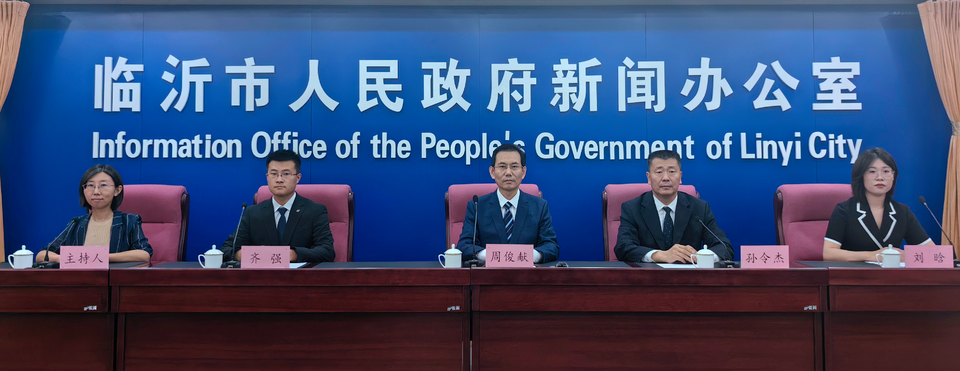
节水成效显著,2024年临沂市用水总量18.13亿立方米
Qi Lu Wan Bao Wang· 2025-08-15 03:17
Core Insights - The total water consumption in Linyi City for 2024 is projected to be 1.813 billion cubic meters, which is below the control target of 1.883 billion cubic meters set for the 14th Five-Year Plan period [1] - The water usage per ten thousand GDP is 27.55 cubic meters, and the water usage per ten thousand industrial added value is 10.83 cubic meters, representing decreases of 16.52% and 21.58% respectively compared to 2020 [1] - The unconventional water utilization reached 103 million cubic meters, achieving annual control targets of no less than 12% and 7% [1] Water Management Policies - Linyi City has established a "stock + increment" dual control model by improving six normative documents, including the "Water Conservation Supervision and Inspection Measures" and "Water Rights Trading Implementation Measures" [3] - The city has set a water usage plan for 5,054 households and completed water-saving evaluation reviews for 40 construction projects, with a 100% coverage rate for the progressive pricing system for non-residential water usage [3] Agricultural and Industrial Water Conservation - In the agricultural sector, water price reforms have been completed for 4.553 million acres, enhancing the efficiency of water supply in irrigation areas [3] - In the industrial sector, 152 water-saving technical transformation projects have been implemented, fostering benchmark enterprises recognized as provincial water efficiency "leaders" [3] Urban Water Efficiency Initiatives - The urban sector has reduced the leakage rate in the central urban area to 8.48% through pipeline leakage management, and daily water consumption in schools has decreased by 49,000 tons due to water-saving renovations [3] - Linyi City has completed 202 water rights transactions, with a total trading volume of nearly 50 million cubic meters, ranking among the top three in the province [3] Public Awareness and Future Plans - The city has launched various activities for water conservation awareness, including "World Water Day" and "China Water Week," and all 12 districts have established water-saving societies [4] - Future plans include deepening comprehensive agricultural water price reforms and aiming to establish a smart water-saving management system by the end of 2025 to support green, low-carbon, and high-quality development [4]
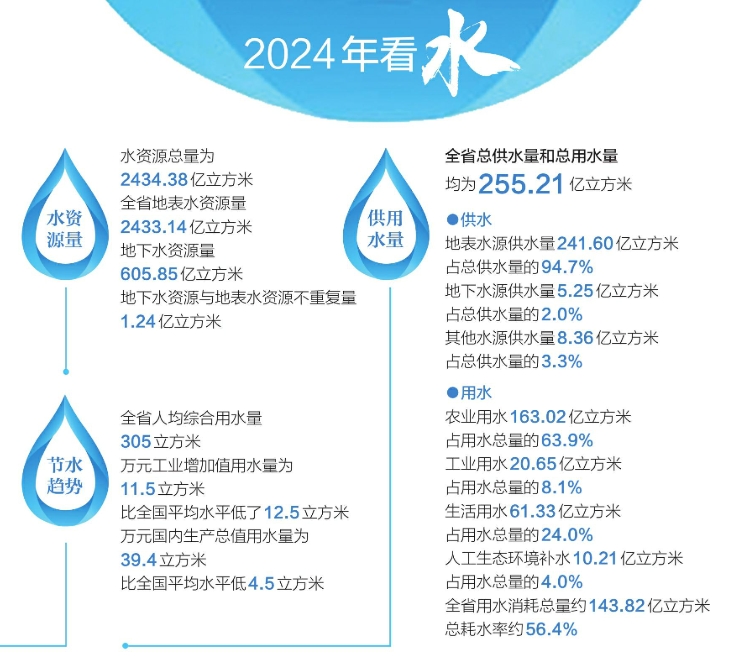
《四川省水资源公报2024》正式发布,近5年来总用水量持续增加,但用水效率、节水成效愈发凸显 去年全省水资源总量为2434.38亿立方米
Si Chuan Ri Bao· 2025-08-14 00:14
Core Insights - The 2024 Sichuan Water Resources Bulletin indicates a total water resource volume of 2,434.38 billion cubic meters, which is 5.1% lower than the multi-year average but 12.3% higher than in 2023 [1] Water Supply and Usage - Total water supply and usage in Sichuan for 2024 is 255.21 billion cubic meters, with surface water accounting for 94.7% of the supply [2] - Agricultural water usage is 163.02 billion cubic meters, making up 63.9% of total usage, while industrial and domestic water usages are 20.65 billion cubic meters (8.1%) and 61.33 billion cubic meters (24.0%) respectively [2] Trends in Water Usage - Over the past five years, total water usage in Sichuan has increased by 18.35 billion cubic meters [2] - Domestic water usage has risen from 53.57 billion cubic meters in 2020 to 61.33 billion cubic meters in 2024, while ecological environment water usage has increased from 5.89 billion cubic meters to 10.21 billion cubic meters [3] Agricultural Water Efficiency - Agricultural water usage has fluctuated, increasing from 153.88 billion cubic meters in 2020 to 163.02 billion cubic meters in 2024, with a peak in 2022 due to severe drought conditions [3] - The effective utilization coefficient of irrigation water in agriculture has improved from 0.484 in 2020 to 0.509 in 2024, indicating enhanced water management and efficiency [6] Industrial Water Usage - Industrial water usage has decreased from 23.52 billion cubic meters in 2020 to 20.65 billion cubic meters in 2024, while industrial added value has increased from 13,428.7 billion yuan to 17,884.0 billion yuan [5] - The water usage per unit of industrial added value in Sichuan is 11.5 cubic meters per 10,000 yuan, which is 6.5 cubic meters lower than in 2020 and significantly below the national average of 24.0 cubic meters [5]
天津深层地下水水位6年累计回升11.8米
Ren Min Ri Bao· 2025-08-11 00:33
Core Viewpoint - Tianjin has successfully reduced the average ground subsidence in the plain area from 20 millimeters to 1 millimeter through comprehensive groundwater management strategies, including a significant increase in deep groundwater levels and a reduction in extraction volume [1]. Group 1: Groundwater Management Achievements - From 2018 to 2024, the deep groundwater level in Tianjin has risen continuously for six years, with a total increase of 11.8 meters [1]. - The extraction volume of deep groundwater has decreased from 150 million cubic meters to 42 million cubic meters [1]. - The average ground subsidence in the plain area has been reduced to 1 millimeter [1]. Group 2: Water Conservation Initiatives - Various sectors are being promoted to save water, including agriculture, industry, and urban areas, with specific measures to enhance efficiency and reduce waste [2]. - The water consumption per unit of GDP has decreased to 17.75 cubic meters, while the water consumption per unit of industrial added value has dropped to 8.1 cubic meters [2]. - A total of 10.1 thousand deep groundwater wells have been shut down, and management practices have been implemented to prevent illegal water usage [2]. Group 3: Water Source Management - The city has effectively expanded the surface water supply range, converting water sources for 286.8 million rural residents and 35 million acres of farmland [2]. - Annual water source guarantees for agriculture in areas of deep groundwater over-extraction exceed 1 billion cubic meters through various water source management strategies [2]. - The delineation of groundwater prohibition and restriction zones has been reinforced, with no new deep groundwater extraction permitted in these areas [2].
东营市创建特色“水源置换、价水分离”水权交易新模式
Qi Lu Wan Bao Wang· 2025-08-09 02:39
Core Viewpoint - Dongying City is actively implementing a market-oriented water rights trading mechanism to address water resource constraints and promote high-quality development through innovative reforms [3][4]. Group 1: Water Rights Trading Mechanism - Dongying City has introduced a "water source replacement and price water separation" model to facilitate water rights trading, effectively addressing the shortage of Yellow River water indicators while utilizing available Yangtze River water [3]. - The city successfully completed the first national transaction of 5 million cubic meters of water between the Yangtze and Yellow Rivers, certified by the China Water Rights Exchange, marking a significant achievement in regional water rights trading [3]. Group 2: Regulatory Framework and Risk Management - A comprehensive regulatory framework has been established, including the issuance of the "Dongying City Water Rights Trading Management Implementation Measures (Trial)" to clarify trading principles, types, procedures, and supervision [4]. - The city has implemented a closed-loop regulatory model that includes strict pre-trading assessments, standardized in-trading reviews, and post-trading follow-ups to ensure transaction safety and flexibility [4]. Group 3: Achievements and Future Plans - Dongying City has engaged in 1.99 billion cubic meters of water trading over three years with the Shandong Provincial Water Diversion Project, contributing to the successful management of Yellow River water resource overload [4]. - The city plans to continue enhancing the water rights trading reform, aligning with the water needs of key industries and major projects to optimize water resource allocation [4].
阿布扎比工商会成员大幅增长
Shang Wu Bu Wang Zhan· 2025-08-08 12:38
Core Insights - The membership of the Abu Dhabi Chamber of Commerce increased by 4.9% year-on-year in the first half of 2025, surpassing 158,000, indicating the resilience of Abu Dhabi's business environment and the deepening of its diversified economic structure [1] Industry Growth - Emerging sectors such as agriculture, arts, and information and communication technology showed significant membership growth, with agriculture witnessing a remarkable increase of 21%, reflecting a focus on innovation and sustainable development [1] - Traditional industries like construction, manufacturing, and finance also maintained steady growth [1] - The water resource management sector grew by 9% due to increased environmental awareness, while education, real estate, and logistics sectors demonstrated positive development momentum [1] Private Sector Role - The private sector is identified as the core driver of Abu Dhabi's rapid development, with the Chamber of Commerce providing support through innovative services and strategic partnerships to promote economic diversification and future-oriented industry development [1] Economic Transformation - Abu Dhabi is accelerating the construction of a new economic system centered on knowledge, technology, and sustainability, enhancing its global competitiveness [1]