
葡萄酒

Search documents
有酒商6年生意少了一半,他们在沉闷的葡萄酒市场寻找新机会
Di Yi Cai Jing· 2026-02-04 09:37
葡萄酒行业2025年触底未见反弹,但新机会已经在孕育。 近日,国内葡萄酒龙头企业张裕公布了2025年业绩预告,净利润同比大幅下滑75%到82%,这一数据令 业内震动。 龙头企业尚且如此,也在一定程度上折射出国内葡萄酒行业的尴尬——在反复探底数年之后,行业仍未 找到反弹的支点。 不过记者注意到,在经历深刻反思后,国内葡萄酒消费的新增长正在萌芽。 酒商哀叹6年生意少了一半 接到记者电话时,北京酒商李亮正在赶往酒局的路上。他告诉记者,进入腊月初十(1月28日)之后, 原本不温不火的酒水市场才突然有了一点春节旺季的感觉。 趁着行业热度回升,近几天李亮每天都安排得满满当当,晚上尤其忙碌,各种酒局应接不暇。他打算多 见客户,争取在春节前多销售一些葡萄酒。 新增长正在萌芽 葡萄酒行业已深度调整多年,却迟迟未能走出周期。过去几年中,行业内部虽然对以往在消费者认知、 行业推广、品牌建设等方面存在的问题进行了反复而深刻地反思,但大多数酒企依然沿着原有惯性前 行。但在2025年,越来越多葡萄酒企业开始拿起望远镜,寻找新大陆。 近日,新崛起的葡萄酒企业代表西鸽集团公布了2025年业务进展,全年销售收入实现超过10%的增长。 同时,西 ...

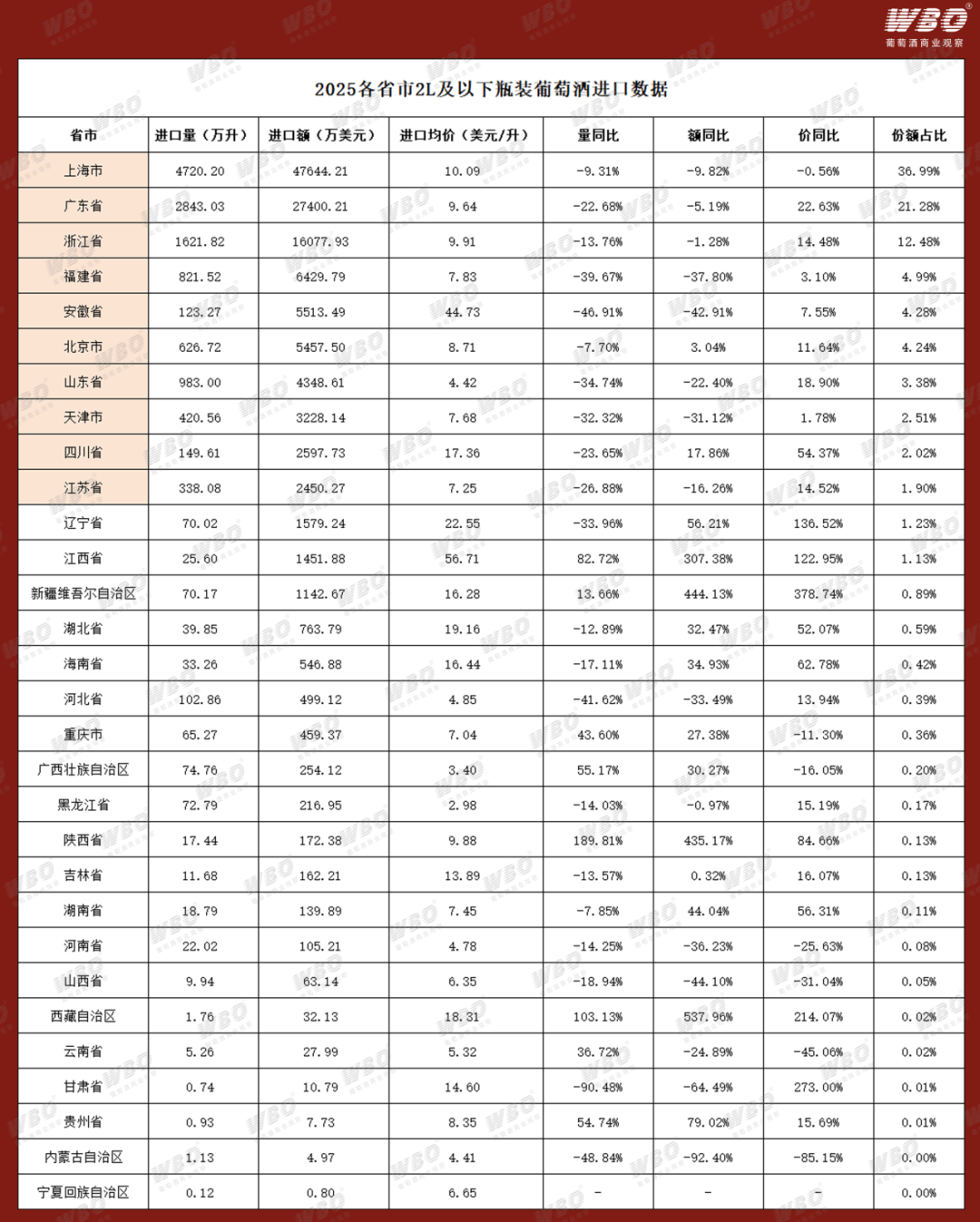
2025年各地葡萄酒进口状况:上海较稳定,安徽、福建暴跌
Xin Lang Cai Jing· 2026-02-03 12:47
Core Insights - The 2025 wine import data reveals a decline in the import volume and value of bottled wines across most provinces, with notable growth in some central and western regions [1][2]. Group 1: Bottled Wine Imports - Shanghai remains the top importer of bottled wine with an import value of $47.64 million, accounting for 36.99% of the national share, despite a decline of over 9% in both volume and value compared to 2024 [2][3]. - The top five provinces for bottled wine imports in 2025 are Shanghai, Guangdong, Zhejiang, Fujian, and Anhui, with most experiencing a decrease in import volume and value [1][2]. - In Shanghai, the import structure is dominated by Australia (33.29%) and France (31.55%), with both countries showing significant market presence [2][3]. Group 2: Regional Performance - Guangdong and Zhejiang provinces have similar import structures, primarily dominated by French and Australian wines, but both saw double-digit declines in import values for other major sources [3][4]. - Fujian province's import value dropped to $6.43 million, representing only 4.99% of the national share, with a significant decline in Chilean wine imports [5][6]. - Anhui province's imports are highly concentrated, with 97.83% coming from Australia, reflecting a unique market dynamic [7]. Group 3: Sparkling Wine Market - Shanghai leads the sparkling wine market with an import value of $31.67 million, holding a 48.80% market share, although the import volume decreased by 25.96% [18]. - The sparkling wine market shows distinct regional characteristics, with France dominating high-end segments while Italy and Spain are gaining traction in mid-range price points [18]. Group 4: Bulk Wine Imports - Shandong province dominates the bulk wine market with a 75.78% share, although its import volume decreased by 32.83% in 2025 [10][11]. - The import structure for bulk wine is shifting, with Australia increasing its share to 70.33%, while Chilean wine imports have significantly declined [15][13].

加州一知名酒庄关闭!及时止损好过一亏再亏
Sou Hu Cai Jing· 2026-02-03 10:39
Core Insights - Arista Winery, a renowned winery in California known for its Pinot Noir and Chardonnay, is facing closure due to personal decisions made by the founding family [2] - The winery will cease production after the 2024 vintage, marking the end of its operations [2] Company Background - The McWilliams family acquired a vineyard in Sonoma County in 1996 and founded Arista Winery in 2002, moving to a cooler climate in the Russian River Valley, ideal for Pinot Noir [4] - The winery gained popularity following the release of the film "Sideways" in 2004, which boosted global interest in Pinot Noir [4] Operational Changes - In 2012, Mark and Ben McWilliams took over daily operations, focusing on small-batch production, which enhanced the winery's reputation [6] - The family decided to sell the physical property while retaining brand rights, aiming to maximize financial returns for their parents [6] Financial Decisions - The winery's property was sold for $25.35 million to Chris Underwood in February 2025, with plans to continue operating the brand without the real estate [8] - The McWilliams brothers noted stagnation in business growth and rising costs, leading to their decision to halt investments in the winery [8] Industry Context - The wine industry is currently experiencing a historic downturn, prompting the McWilliams brothers to reconsider their operational strategy [10] - The brothers have expressed that maintaining operations would either lead to significant debt or require relinquishing decision-making power, both of which are unacceptable to them [10] Future Plans - The winery will release its 2023 vintage and the final 2024 vintage, after which operations will cease [12] - The McWilliams brothers reflect on their journey, acknowledging the challenges faced by small businesses in the wine industry during this transitional period [12]

推倒“关税高墙”,欧盟赶上印度葡萄酒市场的“黄金十年”
Sou Hu Cai Jing· 2026-02-02 11:10
Core Insights - India and the European Union have signed a landmark trade agreement after nearly two decades of negotiations, which will halve tariffs on European products including wine, spirits, and beer, and further reduce them over time [2][3] Group 1: Tariff Reductions - The agreement will significantly lower tariffs on EU wine exports to India, with high-end wine tariffs dropping from 150% to 20% and mid-range wine tariffs decreasing to 30% [3] - Spirits, including vodka, rum, gin, and whiskey, will see tariffs reduced to 40%, while beer tariffs will be cut to 50% [3] - These tax reductions will be implemented in phases over seven years, expected to reshape the competitive landscape of the Indian wine market, where domestic producers currently hold 60% to 70% market share [3][7] Group 2: Market Dynamics - The EU will also eliminate tariffs on 90% of Indian goods at the agreement's initiation, expanding zero-tariff coverage to 93% of goods within seven years [5] - The Indian wine market is projected to experience a "golden decade," with an expected compound annual growth rate of 14.7% to 17.41% until 2033 [7] - The market size for Indian wine is estimated to range from $22.9 million to $78.37 million in 2024, potentially reaching $2.66 billion by 2033 [8] Group 3: Consumer Trends - The primary drivers of market growth include a young population (600 million over the legal drinking age) and accelerating urbanization [10] - Women now represent over 30% of wine consumers in major cities, with increasing demand for high-end wines [10] - Red wine leads the market with a 49% share, favored for pairing with spicy Indian cuisine, while rosé wine is the fastest-growing category, particularly in coastal cities like Mumbai and Goa [10] Group 4: Competitive Landscape - The top three domestic producers in India are Sula Vineyards, Fratelli Vineyards, and Grover Zampa Vineyards [7] - The agreement is expected to increase the market share of imported wines, particularly from Australia, France, and Italy, as tariffs decrease [11] - Successful market entry for global wine producers will depend on competitive pricing, consumer education, and strong distribution networks, especially in hotels and restaurants [13]

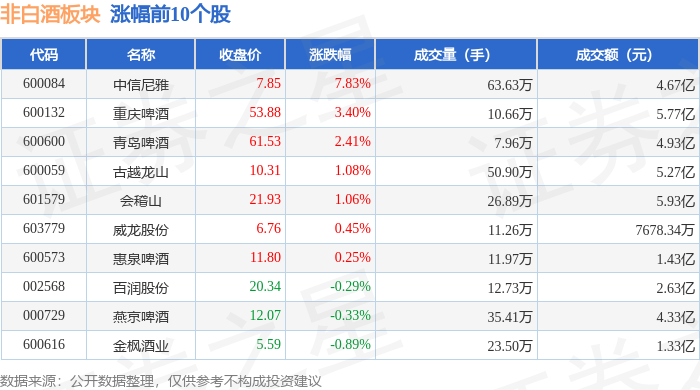
非白酒板块2月2日涨0.96%,中信尼雅领涨,主力资金净流出5108.94万元
Zheng Xing Xing Ye Ri Bao· 2026-02-02 09:15
Group 1 - The non-white liquor sector increased by 0.96% compared to the previous trading day, with CITIC Niyah leading the gains [1] - The Shanghai Composite Index closed at 4015.75, down 2.48%, while the Shenzhen Component Index closed at 13824.35, down 2.69% [1] - Key stocks in the non-white liquor sector showed varied performance, with CITIC Niyah closing at 7.85, up 7.83%, and Chongqing Beer at 53.88, up 3.40% [1] Group 2 - The non-white liquor sector experienced a net outflow of 51.09 million yuan from institutional investors, while retail investors saw a net outflow of 7.08 million yuan [2] - The main capital flow data indicates that Kuaijishan had a net inflow of 22.89 million yuan from institutional investors, while CITIC Niyah had a net outflow of 4.01 million yuan [3] - Retail investors showed a significant net outflow in several stocks, including Baorun Co., which had a net outflow of 22.42 million yuan [3]


莫迪迎来强援,敲定史上最大自贸协定,不只为了对付特朗普
Sou Hu Cai Jing· 2026-02-02 03:23
Core Viewpoint - The recent trade agreement between India and the European Union (EU) is a significant geopolitical move aimed at reducing dependence on the US and China, creating a vast free trade area covering approximately 2 billion people and a quarter of global GDP [1][3]. Group 1: Agreement Details - The agreement includes substantial tariff reductions, such as India's reduction of wine tariffs from 150% to about 20% and olive oil tariffs to zero within five years, while the EU will provide greater access to the Indian automotive market [3]. - The agreement's implementation requires approval from the European Parliament and the Indian Cabinet, which may take up to six months [3]. Group 2: Strategic Implications - The trade deal is seen as a response to external pressures, particularly from the US, and reflects a desire for India and the EU to strengthen their economic ties and reduce reliance on China and the US [3][4]. - The agreement is viewed as a potential catalyst for India's manufacturing and service sectors, aiming to attract European investment and technology [1][3]. Group 3: Challenges and Considerations - The depth of market openness remains uncertain, particularly in sensitive areas like agriculture and digital trade, where substantial concessions from both sides are still unclear [4]. - India's investment environment poses long-term challenges, including regulatory volatility and infrastructure weaknesses, which may deter EU businesses from establishing efficient supply chains in India [6][7]. - The EU's trade policies, which emphasize high standards related to environmental and labor rights, could create non-tariff barriers for Indian exports, potentially leading to trade friction [9]. - There exists a strategic tension between India's desire for autonomy and the EU's expectation for India to be a reliable partner in supply chain diversification, complicating the agreement's implementation [9][11]. - India's manufacturing sector heavily relies on imports from China, particularly for critical components, which complicates the transition to EU-based supply chains [11]. Group 4: Overall Assessment - The India-EU trade agreement represents a significant geopolitical strategy that may help both parties expand market access and mitigate unilateral pressures from the US, while signaling a move towards trade diversification [11]. - However, it is overly optimistic to view this agreement as a comprehensive solution for restructuring global supply chains or achieving a complete decoupling from China and the US; it is more of a selective cooperation framework rather than a full economic integration blueprint [11].

莫高股份2026年2月2日跌停分析
Xin Lang Cai Jing· 2026-02-02 02:08
Group 1 - The core issue is that Mogao Co., Ltd. has hit the daily limit down, with a price of 5.29 yuan, reflecting a decline of 5.67% and a total market value of 1.708 billion yuan [1] - The company is facing significant operational challenges, with a projected loss of 100 to 120 million yuan for 2025, a revenue drop of approximately 40% to below 300 million yuan, and multiple subsidiaries reporting continuous losses [2] - The company is at risk of being delisted, having reached the warning threshold for delisting, which could severely damage its reputation and lead to a sell-off by investors [2] Group 2 - The industry environment is unfavorable, particularly for the company's main businesses in wine and pharmaceuticals, which are under pressure from deep industry adjustments [2] - Market confidence has been significantly shaken due to a sharp decline in net profit for the third quarter of 2025 and a pessimistic outlook for future performance, leading to noticeable capital outflows [2]

农业种植+葡萄酒+中字头+AMC,2天2板!2天上涨21%!还有机会吗?
Sou Hu Cai Jing· 2026-01-30 15:42
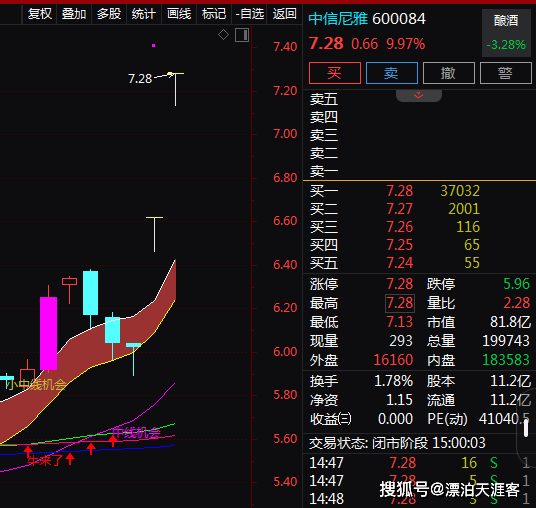
Core Viewpoint - The stock of CITIC Niyah (600084) has recently experienced a significant increase due to strong performance in the agriculture and wine sectors, as well as its status as a state-owned enterprise and involvement in asset management companies (AMC) [3][4]. Group 1: Company Overview - CITIC Niyah (600084) is a leading large-scale listed company in China engaged in grape planting, processing, and trading [2]. - The company holds domestic brands such as Niyah and Xiyu, benefiting from ecological advantages in Xinjiang's small production areas [3]. Group 2: Recent Stock Performance - The stock has seen a price increase of 21% over two trading days, with a bullish trend indicated by moving averages and MACD showing potential for further upward movement [4]. - The stock is currently in a strong market position, with a trading volume indicating active investor interest [4]. Group 3: Market Drivers - The agriculture sector is experiencing a strong rally, positively impacting related stocks, including CITIC Niyah [3]. - The wine sector is also active, contributing to the stock's upward momentum due to the company's strong market presence [3]. - The stock benefits from being a state-owned enterprise, which is currently favored in the market, enhancing its attractiveness to investors [3]. - The company's involvement with AMC, specifically holding 100 million yuan in Xinjiang Jin Investment Asset Management Co., adds to its financial stability and growth potential [3].
莫高股份(600543.SH)发预亏,预计2025年年度净亏损1亿元至1.2亿元
智通财经网· 2026-01-30 14:52
Core Viewpoint - Mogao Co., Ltd. (600543.SH) has announced a projected net loss of 100 million to 120 million yuan for the fiscal year 2025 [1] Financial Performance - The company expects a net loss attributable to shareholders of the parent company between 100 million yuan and 120 million yuan for 2025 [1] - If the audited total profit, net profit, or net profit after deducting non-recurring gains and losses is negative and the operating revenue is below 300 million yuan, the company's stock will face delisting risk warning from the Shanghai Stock Exchange after the 2025 annual report is disclosed [1]
莫高股份:2025年全年预计净亏损10000万元—12000万元
2 1 Shi Ji Jing Ji Bao Dao· 2026-01-30 11:23
Core Viewpoint - Mogao Co., Ltd. has announced a projected net loss for the year 2025, estimating a net profit attributable to shareholders of approximately -120 million to -100 million yuan, and a net profit excluding non-recurring gains and losses of approximately -103 million to -83 million yuan [1] Industry Summary - The domestic wine industry is undergoing a deep adjustment, with both production and consumption of wine continuing to decline, leading to lower-than-expected sales for the company [1] - The cough medicine sector is experiencing a decrease in market demand, resulting in a decline in both volume and price for the company's main product, Compound Licorice Tablets, which has negatively impacted profitability [1] - The biodegradable materials sector, while supported by national policies as an emerging industry, faces challenges due to an incomplete upstream and downstream industrial chain and pressure on product prices, leading to a decrease in the production and sales volume of PBAT compared to the previous year [1] Financial Impact - Based on the current operational status and future forecasts, the company anticipates recognizing impairment losses on certain fixed assets, inventory, and accounts receivable for the year 2025, which will affect the net profit by approximately 36 million yuan [1] - Additionally, the company plans to scrap certain productive biological assets in 2025, further impacting the financial results [1]