Display Panels

Search documents
英特尔:与京东方共同开发创新显示技术
Xin Lang Cai Jing· 2025-10-29 06:25
Core Viewpoint - Intel and BOE are collaborating to develop AI-based energy-saving solutions for laptop display screens, aiming to balance energy efficiency and visual quality while extending battery life and ensuring excellent visual experience [1] Group 1 - The new technology is expected to be implemented in OEM products using Intel platforms by 2026 [1]


Q3’25 国内TFT-LCD面板厂平均稼动率高于预期,Q4'25 预计低于80%
CINNO Research· 2025-10-28 08:29
Core Insights - The average utilization rate of domestic TFT-LCD panel manufacturers in China for Q3 2025 exceeded expectations, while the forecast for Q4 2025 is expected to be below 80% [2]. Group 1: Production Capacity - The latest production capacity lists for China's G4.5 to G6 LCD panel production lines are provided [3]. - The latest production capacity lists for China's G8.5 to G11 LCD panel production lines are included [3]. Group 2: Utilization Rates - The average utilization rate statistics for China's LCD production lines in Q3 2025 are detailed [3]. - The utilization rate statistics for LTPS LCD panel production lines in Q3 2025 are presented [3]. - The utilization rate statistics for BOE (京东方) LCD panel production lines in Q3 2025 are reported [3]. - The utilization rate statistics for CSOT (华星光电) LCD panel production lines in Q3 2025 are included [3]. - The utilization rate statistics for TM (天马) LCD panel production lines in Q3 2025 are provided [3]. - The utilization rate statistics for HK C (惠科) LCD panel production lines in Q3 2025 are detailed [3]. - The utilization rate statistics for CHOT (咸阳彩虹) LCD panel production lines in Q3 2025 are included [3]. Group 3: Future Predictions - The forecast for global and domestic LCD panel manufacturers' utilization rates for Q4 2025 is discussed [3].

TCL华星、京东方、天马等面板厂卡位Micro LED车载显示
WitsView睿智显示· 2025-10-27 10:10
Core Viewpoint - The article discusses the evolution of Head-up Display (HUD) technology in smart cockpits, highlighting the increasing interest in Micro LED technology due to its high brightness and contrast, which meets the growing demands of automotive displays [2][3][4]. Group 1: Evolution of HUD Technology - HUD technology originated in military aircraft to provide pilots with critical information without looking down [3]. - The introduction of HUD in the automotive sector faced challenges due to high manufacturing costs and limited product maturity [3]. - Recent advancements in smart cockpits and ADAS have increased the need for HUDs to display various information, making them essential for safety and information access [3][4]. - The evolution of HUDs includes transitions from traditional C-HUD to W-HUD, AR-HUD, and P-HUD, with increasing requirements for brightness, contrast, and reliability [3][4]. Group 2: Micro LED Technology - Micro LED technology is characterized by high brightness, contrast, and transparency, making it suitable for AR-HUD and P-HUD applications in vehicles [4]. - The demand for Micro LED HUDs is driven by the need for better integration of virtual and real information in automotive settings [4]. Group 3: Panel Manufacturers' Involvement - Major panel manufacturers such as TCL, BOE, and others are rapidly entering the Micro LED HUD market, launching new products and technologies [5][15]. - The competition among panel manufacturers is intensifying as they aim to establish a foothold in the emerging HUD technology market [5][15]. Group 4: Product Highlights - TCL has introduced a 10.25-inch Micro LED HUD with a brightness of 20,000 nits in 2023 and plans to launch a 14.3-inch version by 2025 [6][7]. - BOE has launched a 6.2-inch RGB Micro LED HUD with a brightness of 30,000 nits and a monochrome version with a peak brightness of 300,000 nits [8]. - Other manufacturers like Deepinma and Innolux are also developing high-brightness Micro LED HUD products, emphasizing high resolution and contrast [10][13]. Group 5: Market Dynamics and Financial Performance - The automotive display market is seen as a stable and profitable sector compared to the volatile consumer electronics market, with high reliability and long certification cycles [15][16]. - Deepinma reported a revenue of 17.475 billion yuan in the first half of the year, with a 27% growth in automotive display revenue [16][17]. - BOE's automotive display business achieved a revenue of 6.245 billion HKD, reflecting a 9% increase year-on-year [16][17]. Group 6: Strategic Shifts in the Panel Industry - The panel industry is transitioning from traditional LCD technologies to advanced solutions like Micro LED, driven by the need for higher value-added products [18][20]. - The restructuring of the automotive supply chain allows panel manufacturers to engage directly with automakers, enhancing their competitive position [19][20]. - Manufacturers are investing in Micro LED production lines to prepare for future market demands [21]. Group 7: Future Outlook - Micro LED HUDs are expected to first appear in high-end vehicles before becoming more accessible in mid-range models as technology matures and costs decrease [22]. - The article emphasizes the importance of overcoming technical challenges in the Micro LED industry, such as high costs and yield rates, to succeed in the automotive display market [22].



CINNO Research:四季度手机面板市场延续高稼动率运行态势 不同技术路线走势持续分化
Zhi Tong Cai Jing· 2025-10-23 08:24
Core Insights - The mobile panel market is expected to maintain high operating rates in Q4 due to the upcoming domestic "Double Eleven" and international "Black Friday" promotional seasons [1] - Different technology routes are showing divergent trends, with a-Si panels stable but under price pressure, LTPS panels benefiting from demand in automotive and laptops/tablets, and flexible AMOLED panels entering a price decline phase amid capacity expansion and project competition [1] a-Si Panels - Despite stable demand for a-Si panels, the combination of declining costs for core components like driver ICs and brand pressure on prices is leading to intensified competition, resulting in a slight expected decrease in module prices [1] LTPS Panels - LTPS production lines are operating at high rates due to growth in automotive displays and new iterations of laptops/tablets, leading to tight supply. However, demand in the smartphone sector remains weak, resulting in a structural balance in supply and demand, with prices expected to remain stable in October [1] AMOLED Panels - Demand for rigid AMOLED panels continues to shrink due to competition from flexible alternatives, with prices stabilizing at low levels. Flexible AMOLED panels are experiencing a "stable volume, declining price" trend, with major manufacturers operating at high capacity. To achieve full capacity targets for Q4 and prepare for next year's capacity, manufacturers are actively competing for orders and making price concessions, leading to a continued decline in flexible AMOLED panel prices [1]

10月手机面板行情:技术路线分化加剧,柔性AMOLED量稳价跌
CINNO Research· 2025-10-23 08:05
Core Viewpoint - The smartphone display panel market is experiencing high operating rates in Q4, with distinct trends emerging across different technology routes as the domestic "Double Eleven" and international "Black Friday" promotional seasons approach [2][3]. Group 1: Market Trends - The a-Si panel market is stable due to resilient low-end demand, but prices are under pressure [3]. - LTPS production lines are operating at high rates supported by demand from automotive displays and new iterations of laptops and tablets, although smartphone demand remains weak [3]. - Flexible AMOLED panels are entering a price decline phase due to capacity expansion and competitive bidding among manufacturers, leading to a structural adjustment characterized by stable volume but falling prices [3]. Group 2: Price Predictions - a-Si module prices are expected to continue a slight decline through October and November 2025 [4]. - LTPS panel prices are anticipated to remain stable [4]. - Rigid AMOLED panel prices are expected to stabilize in the short term, while flexible AMOLED panel prices will continue to decline [4].

总投资约295亿元 TCL华星t8项目正式开工
Zhong Guo Jin Rong Xin Xi Wang· 2025-10-21 13:38
Core Insights - The TCL Huaxing T8 project officially commenced in Guangzhou with a total investment of approximately RMB 29.5 billion [1] - The T8 project is the world's first mass production G8.6 generation printed OLED production line, designed to process about 22,500 glass substrates per month [1] - The products will initially target medium-sized applications such as monitors, laptops, and tablets, with plans to expand into higher value-added display applications in the future [1] Company Developments - TCL Huaxing's CEO Zhao Jun stated that the T8 project will accelerate the establishment of a cluster of upstream and downstream enterprises related to key materials, core equipment, and components for printed OLEDs [1] - The T8 project will create a comprehensive industrial ecosystem covering "materials-equipment-panels-terminals" [1] - The T8 project will synergize with existing T9 and T11 production lines in Guangzhou, as well as current lines in Shenzhen and Huizhou, enhancing the efficiency from material research and development to complete machine manufacturing [1]
最新面板价格趋势(2025年10月)
TrendForce集邦· 2025-10-20 09:03
Core Insights - The article discusses the price trends of various display panels as reported by TrendForce, indicating a slight decrease in prices for certain television and laptop panels in October 2025, while monitor panel prices remained stable [2][6]. Price Trends by Application - **Television Panels**: - 65-inch TV panel average price is $171, down by $2 or 1.2% from the previous month, with a range of $165 to $174 [6]. - 55-inch TV panel average price is $123, down by $1 or 0.8%, with a range of $117 to $126 [6]. - 43-inch TV panel average price is $64, with a range of $62 to $66 [7]. - 32-inch TV panel average price is $35, with a range of $34 to $36 [8]. - **Monitor Panels**: - 27-inch IPS panel average price is $63, with a range of $57.6 to $65.8 [10]. - 23.8-inch IPS panel average price is $49.9, with a range of $47.1 to $51.4 [11]. - **Laptop Panels**: - 17.3-inch TN panel average price is $38.2, down by $0.1 or 0.3%, with a range of $37.6 to $39.7 [12]. - 15.6-inch Value IPS panel average price is $40.2, down by $0.1 or 0.2%, with a range of $38.5 to $41.8 [12]. - 14.0-inch TN panel price has stabilized at $26.9 since July 2024, with a range of $26.4 to $28.1 [12]. - 11.6-inch TN panel price has also stabilized at $25.1 since July 2024, with a range of $24.2 to $26.5 [12].

群智咨询:全球LCD TV面板市场进入良性利润循环周期 关注电视面板“四大锚点”
智通财经网· 2025-10-14 06:17
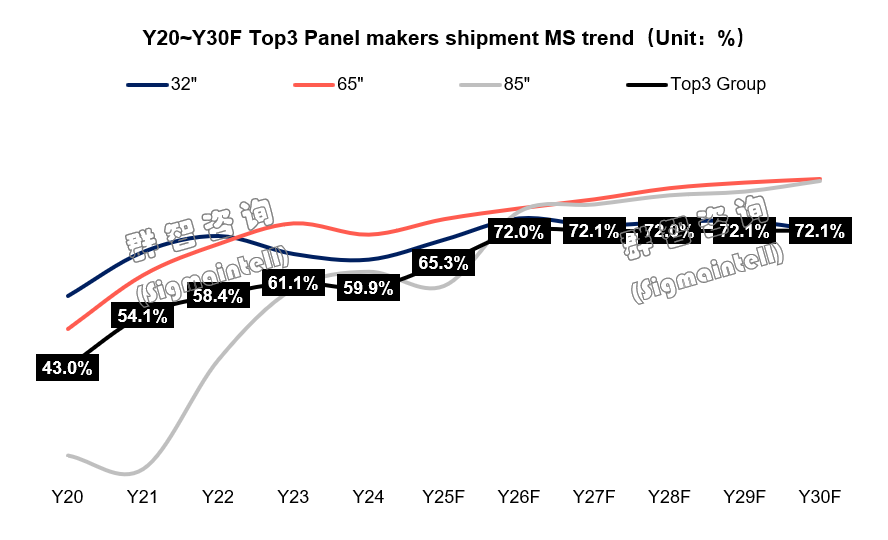
Core Insights - The global LCD TV panel market is entering a positive profit cycle as manufacturers shift from "production-driven sales" to "sales-driven production" [1] Group 1: Market Dynamics - The market share of leading manufacturers is expected to stabilize above 70% starting in 2026, establishing a foundation for steady operations in the TV panel market [2] - The concentration of LCD TV panel production capacity in mainland China has led to a competitive landscape dominated by BOE and TCL CSOT [2] - By 2025, TCL CSOT's market share is projected to increase from 20% to 24%, while BOE's share is expected to rise from 26% to 32% by 2026, resulting in a combined market share of approximately 72% for the top three manufacturers [2] Group 2: Cost Competitiveness - The depreciation completion rate for TV panels is anticipated to exceed 50% by 2026, enhancing cost competitiveness for mainstream sizes over the next three years [4] - The G8.5 production lines will complete depreciation by 2025, leading to cost advantages for 32-inch and 55-inch panels [5] - The G10.5 production lines will enter a rapid depreciation phase from 2025 to 2029, significantly improving the cost competitiveness of key products like 43-inch, 65-inch, and 75-inch panels [5] Group 3: Size Trends - The transition to larger sizes in the TV panel market faces challenges, with average size growth expected to stagnate in 2025 due to demand exhaustion and competitive pressures [7] - Despite the challenges, the completion of G8.6 and G10.5 depreciation is expected to enhance the cost competitiveness of large-size panels, driving growth in the segment [8] - The average size of LCD TV panels has surpassed 51 inches, making further growth more difficult [7] Group 4: Production Efficiency - A production utilization rate of 84% ± 3% is identified as the optimal range for maintaining profits in G10.5 production lines, balancing depreciation and profit [9] - The current production strategy of "demand-driven production" is crucial for sustained profitability, but it may lead to imbalances in profit distribution across the supply chain [9] - Upstream panel manufacturers are currently enjoying good profit levels, while downstream brand manufacturers face significant losses due to external pressures [9] Group 5: Strategic Recommendations - The industry should focus on high concentration, accelerated depreciation, large-size trends, and stable production strategies to achieve "long-termism" [10] - Panel manufacturers are encouraged to collaborate with downstream brands to explore stable demand for large sizes and optimize product structure and production efficiency [10] - A balanced approach to production control is necessary to ensure equitable profit distribution across the industry chain, promoting healthy development of the TV industry [10]
CINNO Research:控产成效显现 10月面板价格有望逐步趋稳
Zhi Tong Cai Jing· 2025-10-10 12:05
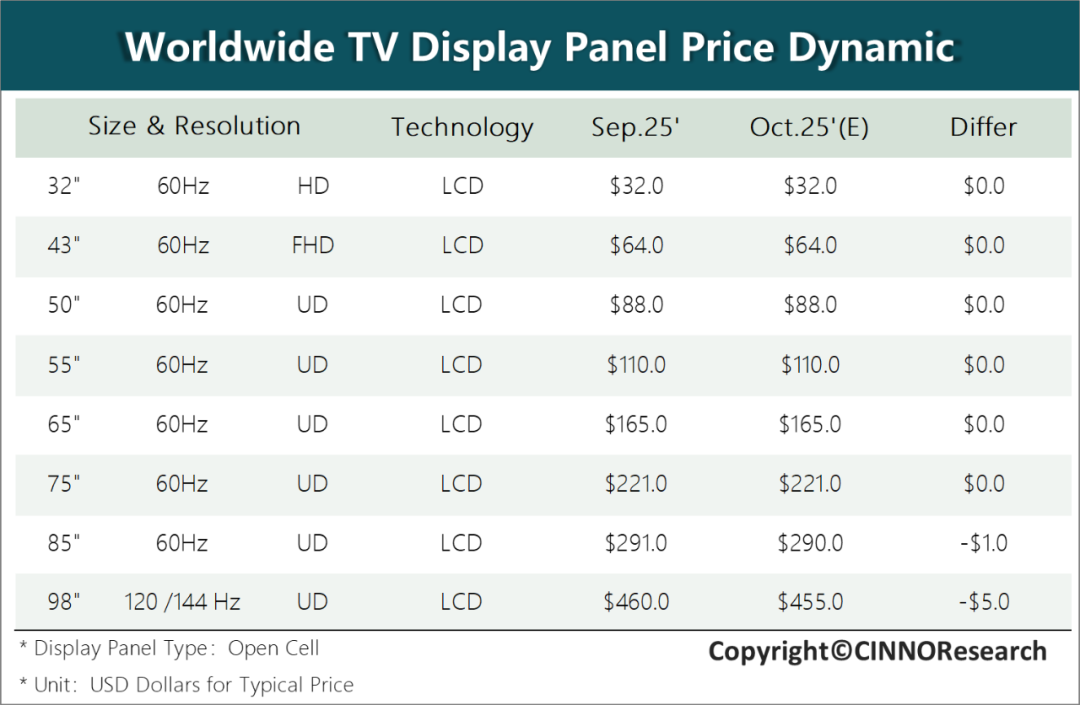
Core Viewpoint - In September, brand manufacturers continued to stock up for the fourth quarter peak season, maintaining high demand for panels, leading to a stabilization in LCD TV panel prices as they approached a bottoming out phase [1][3]. Demand Side Summary - Brand manufacturers increased procurement significantly in the third quarter to prepare for the year-end peak season, resulting in sustained high demand for panels [3]. - The demand for LCD TV panels is expected to slow down as the stocking phase comes to an end, but promotional events like "Double Eleven" and "Black Friday" will provide some support for demand in October [1][3]. - The overall demand in October is projected to be stable, with most panel prices remaining flat compared to September, except for larger sizes which may face slight declines [4]. Supply Side Summary - In the third quarter, TV brands increased their orders, leading to an average production capacity utilization rate of high-generation lines rising to 82%, a nearly three percentage point increase [4]. - To respond to the anticipated demand adjustment, most panel manufacturers are expected to reduce their production capacity to below 80% in October [4]. - The price stability of LCD TV panels in October is supported by the manufacturers' production control strategies and the overall demand remaining stable [4].
韩媒:LGD 65英寸OLED电视面板成本预计将快降至500美元以下
WitsView睿智显示· 2025-10-10 07:28
Core Viewpoint - The competition between South Korea and China in high-end television display technology is intensifying, with a focus on the development of Organic Light Emitting Diode (OLED) technology and cost optimization by LG Display [2] Summary by Relevant Sections OLED Technology Development - LG Display is expected to reduce the production cost of 65-inch OLED TV panels to below $500 (approximately 3,650 RMB) soon [2] - In 2024, LG Display aims to lower the OLED TV panel cost from $1,000 in 2020 to around $600 through improved yield rates and production line optimization [2] - By 2026, LG Display plans to further reduce costs through design innovations, including changes to the Display Driver IC (DDI) structure [2] Market Position and Profitability - LG Display has been continuously expanding its OLED production capacity and stabilizing yield rates, leading to a consistent decrease in OLED costs [2] - Industry analysts predict that this trend could enable LG Display to achieve an annual operating profit exceeding 1 trillion KRW (approximately 5.2 billion RMB) in its OLED business [2] - The cost advantage and mature supply chain of OLED TVs are expected to maintain their dominant position in the high-end television market for the next one to two years [2]