
半导体显示面板

Search documents
惠科IPO注册生效!
WitsView睿智显示· 2026-03-15 11:54
Core Viewpoint - The article discusses the approval of Huike Co., Ltd.'s IPO registration by the China Securities Regulatory Commission, highlighting the company's plans to raise approximately 8.5 billion yuan for various projects and operational needs [2][4]. Group 1: IPO Details - Huike plans to raise around 8.5 billion yuan, with funds allocated for projects including 2.5 billion yuan for OLED R&D upgrades, 3 billion yuan for Oxide R&D and industrialization, 2 billion yuan for Mini LED smart manufacturing, and 1 billion yuan for working capital and bank loan repayment [4]. - The approval for the IPO is valid for 12 months from the date of registration, and the company must report any significant events to the Shenzhen Stock Exchange before the issuance is completed [4]. Group 2: Business Performance - For the period from January to September 2025, Huike reported revenue of 29.238 billion yuan, a slight decrease of 0.36% year-on-year, attributed to increased IT panel sales offsetting declines in TV panel sales [5]. - The company anticipates revenue of 9.762 to 10.362 billion yuan for the first quarter of 2026, representing a year-on-year growth of 0.68% to 6.87%, while net profit attributable to shareholders is expected to decline by 14.81% to 7.57% [5].


年营收超400亿!半导体显示巨头惠科股份上会在即
梧桐树下V· 2026-03-03 02:09
Core Viewpoint - The article highlights the upcoming IPO of Huike Co., Ltd., a leading player in the large-size LCD panel industry, aiming to raise 8.5 billion yuan to enhance its R&D in new display technologies and capacity upgrades, setting the stage for a new growth cycle [1]. Group 1: Company Overview - Huike Co., Ltd. has over 20 years of experience in the display industry and ranks third globally in TV panel shipment area for 2024, with a leading position in the shipment area of LCD TV panels sized 85 inches and above [1]. - The company has established a vertical integration strategy, covering the entire production process from panel manufacturing to smart display terminal products, making it one of the most vertically integrated companies in China's display industry [2]. Group 2: Market Position and Partnerships - Huike has formed deep partnerships with over 3,000 global brands, including Samsung and LG, with long-term supply agreements in place [4]. - The company has a stable international revenue share of around 50%, with operations extending to regions like Hong Kong, Singapore, and the United States [4]. Group 3: Industry Landscape - The global semiconductor display industry is dominated by manufacturers from mainland China, Taiwan, South Korea, and Japan, with Chinese manufacturers holding approximately 70% of the global LCD capacity [5]. - Huike, along with BOE and TCL Huaxing, forms the top tier of global large-size LCD panel manufacturers, with significant market shares in various panel categories [5]. Group 4: Demand and Growth Drivers - The demand for semiconductor display panels is expected to grow due to the increasing diversification of end-user products and the emergence of new application scenarios, such as automotive displays and smart retail [6][7]. - The global semiconductor display panel industry is projected to grow from $100.3 billion in 2022 to $120.2 billion by 2027, driven by advancements in 5G, IoT, and AI technologies [6]. Group 5: Financial Performance - Huike's revenue is expected to grow from 26.965 billion yuan in 2022 to 40.871 billion yuan by 2025, reflecting a steady increase in scale [11]. - The company's gross margin has improved significantly, with the main business gross margin rising from -1.5% in 2022 to 21.24% in the first half of 2025, indicating a strong recovery in profitability [13][14]. Group 6: R&D and Technological Innovation - Huike is committed to technological innovation, with over 2,000 R&D personnel and a cumulative R&D investment of 4.171 billion yuan from 2022 to 2024 [17]. - The company has achieved breakthroughs in various new display technologies, including Oxide and Mini LED, and is actively pursuing the development of OLED technology [18]. Group 7: IPO Fund Utilization - The IPO proceeds of 8.5 billion yuan will be allocated to projects focused on OLED R&D, Oxide technology, Mini-LED manufacturing, and to supplement working capital and repay bank loans [19][20]. - The investment projects align with industry trends and aim to strengthen Huike's market position in high-performance panel products [20]. Group 8: Strategic Alignment with National Goals - Huike's strategy aligns with China's goal of transitioning from a "display power" to a "display strong power," responding to national policies that support strategic emerging industries [21]. - The successful implementation of the IPO projects is expected to enhance Huike's technological innovation and solidify its leading position in the display industry [21].

惠科股份IPO:带病闯关之下重重质疑,资本运作无法遮掩短板困境
Sou Hu Cai Jing· 2026-02-27 17:41
Core Viewpoint - Huike Co., Ltd. is facing significant challenges in its IPO attempt, including severe financial instability, high debt levels, and governance issues, raising concerns about its long-term sustainability and operational viability [2][12][19]. Financial Performance - The company's revenue fluctuated dramatically, with figures of 26.965 billion yuan in 2022, 35.824 billion yuan in 2023, and projected revenues of 40.282 billion yuan in 2024, while net profit swung from a loss of 1.421 billion yuan in 2022 to a profit of 2.582 billion yuan in 2023 [3][4]. - In the first half of 2025, the company reported a revenue of 18.997 billion yuan, with a net profit of 221.856 million yuan, indicating a recovery from previous losses [4][18]. Debt and Financial Risks - As of June 2025, the total liabilities reached 69.153 billion yuan, with interest-bearing debt at 42.709 billion yuan, resulting in a debt-to-asset ratio of 66.99% [12][14]. - The company is burdened with a 12.927 billion yuan buyback obligation, which poses a significant financial risk if the IPO fails [12][16]. Governance and Compliance Issues - The company exhibits high ownership concentration, with the controlling shareholder holding 52.31% of voting rights, leading to potential conflicts of interest and governance challenges [19][21]. - Historical issues of shareholding representation and lack of independent oversight raise concerns about the integrity of financial disclosures and compliance with regulatory standards [19][23]. Market Position and Competitive Landscape - Huike Co., Ltd. holds a 13% market share in the global TV panel market, but faces intense competition from industry leaders like BOE and TCL, which dominate over 60% of the market [34][35]. - The company’s reliance on low-end LCD technology is increasingly problematic as the industry shifts towards OLED and Mini-LED technologies, which it has not adequately invested in [26][36]. Research and Development - R&D expenditures have declined, with a ratio of R&D spending to revenue dropping from 5.31% in 2022 to 3.23% in the first half of 2025, significantly below industry averages [24][25]. - The company’s technological capabilities are limited, with 99.73% of its revenue coming from a-Si TFT-LCD products, lacking diversification into higher-end technologies [25][26]. Legal and Regulatory Challenges - The company is embroiled in a significant patent infringement lawsuit in the U.S., which could severely impact its ability to operate in the North American market, where it derives 38% of its overseas revenue [29][31]. - The ongoing legal issues, combined with high dependency on imported materials, expose the company to additional risks related to supply chain disruptions and tariff impacts [33][29].

惠科IPO上会在即 拟募资85亿元布局OLED/Mini-LED等项目
Sou Hu Cai Jing· 2026-02-27 11:10
Group 1 - The core point of the article is that Huike Co., Ltd. is set to undergo a crucial IPO review meeting on March 3, 2026, as part of its plan to issue approximately 730 million to 1.16 billion shares, aiming to raise around 8.5 billion RMB [1][2] - Huike's IPO application was accepted on June 30, 2025, and it entered the inquiry phase on July 11, 2025, indicating significant progress towards its listing [1] - The funds raised from the IPO are intended for projects including the upgrade of new OLED research and development in Changsha, the industrialization of Oxide technology, and the Mini-LED smart manufacturing project in Mianyang, as well as for working capital and repaying bank loans [1] Group 2 - The LCD panel industry is experiencing intensified competition, with Huike maintaining a leading position in several segments of the global TV panel market [2] - Challenges to Huike's future growth include cyclical fluctuations in the industry and concentrated production capacity among leading companies [2] - To enhance long-term competitiveness, Huike plans to expand its product line and technical capabilities by venturing into new technology areas such as OLED and Mini-LED [2]
募资85亿元,惠科IPO即将上会
WitsView睿智显示· 2026-02-26 03:58
Core Viewpoint - Huike Co., Ltd. is approaching a critical milestone in its IPO process, with a planned fundraising of approximately 8.5 billion yuan for various projects, including OLED and Mini LED technology advancements [1][4][14]. Group 1: IPO and Fundraising - The Shenzhen Stock Exchange will hold a review meeting for Huike's IPO on March 3, 2026, marking a significant step in the company's public offering process [1]. - Huike aims to raise around 8.5 billion yuan, which will be allocated to projects such as the new OLED R&D upgrade in Changsha, Oxide R&D and industrialization, Mini LED smart manufacturing in Mianyang, and to supplement working capital and repay bank loans [4][6][14]. Group 2: Project Details - The total investment for the projects includes 303.11 million yuan for the Changsha new OLED R&D upgrade, 300 million yuan for the Changsha Oxide project, and 254.46 million yuan for the Mianyang Mini LED project, with a total project investment of approximately 957.58 million yuan [6]. - The Changsha new OLED project focuses on the development of OLED materials and devices, while the Mianyang Mini LED project has already commenced construction [6][14]. Group 3: Financial Performance - From 2022 to June 30, 2025, Huike's revenue increased from 26.97 billion yuan to 40.28 billion yuan, with net profits fluctuating from a loss of 1.42 billion yuan to a profit of 3.32 billion yuan [7]. - For the first quarter of 2026, Huike expects revenue between 9.76 billion and 10.36 billion yuan, representing a year-on-year growth of 0.68% to 6.87%, while net profit is projected to decline by 14.81% to 7.57% [8]. Group 4: Industry Trends - The display industry is witnessing a surge in IPO activities, with several companies, including Huike, accelerating their public offerings to capitalize on market opportunities [9][14]. - The trend indicates that the Hong Kong Stock Exchange is becoming a significant destination for display industry companies, reflecting a growing acceptance of high-tech firms and their financing needs [13]. Group 5: Future Outlook - The ongoing IPO actions of Huike and other companies in the display sector signify not just fundraising efforts but also the rapid development and promising future of OLED, Mini LED, and Micro OLED technologies [17]. - As technology and market conditions mature, the capital market is expected to play a crucial role in driving upgrades in the display industry [17].

惠科股份主板IPO3月3日上会
Bei Jing Shang Bao· 2026-02-25 11:03
Core Viewpoint - Huike Co., Ltd. is set to undergo its main board IPO review on March 3, aiming to raise approximately 8.5 billion yuan for various projects and working capital [1] Company Overview - Huike Co., Ltd. specializes in the research, development, manufacturing, and sales of semiconductor display panels and smart display terminals [1] IPO Details - The IPO application was accepted on June 30, 2025, and entered the inquiry stage on July 11 of the same year [1] - The company plans to use the raised funds for the following projects: - R&D upgrade project for new OLED in Changsha - R&D and industrialization project for Oxide in Changsha - Mini-LED smart manufacturing project in Mianyang - Supplementing working capital and repaying bank loans [1]
技术硬件与设备行业2025年信用回顾与2026年展望
新世纪评级· 2026-02-11 01:17
Investment Rating - The technology hardware and equipment industry is rated as stable for 2025 and 2026 [1] Core Insights - The technology hardware and equipment industry is experiencing a slow recovery driven by inventory replenishment cycles and AI technology, despite overall pressure from weak global economic growth since 2025. There is significant differentiation among sub-industries, with strong demand for data center equipment driven by computing power, while traditional telecom equipment shows sluggish growth [2][3] - The Chinese government has established a policy framework to support the industry, focusing on short-term growth stabilization, medium-term supply chain strengthening, and long-term innovation promotion, primarily through domestic substitution to overcome high-end equipment and material bottlenecks [2] - The industry is expected to benefit from the deepening of digital China initiatives and the industrialization of cutting-edge technologies like AI, entering a structurally growth-driven cycle. However, geopolitical disturbances and rapid technological iterations may lead to uneven recovery across the industry [5] Summary by Sections Industry Overview - The electronic information manufacturing industry is closely tied to global economic conditions, showing signs of recovery since 2024 due to inventory replenishment and AI-driven demand. It is a core industry in China's economic structure transformation and upgrade [7][8] - In 2024, the added value of China's electronic information manufacturing industry grew by 11.8%, outperforming overall industrial and high-tech manufacturing growth rates [8] Financial Performance - Sample companies in the technology hardware and equipment industry reported positive revenue growth year-on-year in 2025, aligning with industry recovery trends. However, high R&D investments and asset impairment losses have pressured net profits, while EBITDA showed year-on-year growth, indicating profit resilience [3] - The debt scale and liability ratios of sample companies have increased, with a decline in the EBITDA coverage ratio for rigid debt, although interest coverage has improved due to lower financing costs [3] Sub-Industry Insights Communication Equipment - The communication equipment sector is experiencing growth opportunities driven by AI and industrial interconnectivity, with significant demand for data center equipment but slow growth in traditional telecom network equipment. The market is highly competitive and concentrated [24][27] - The deployment of high-speed optical modules and data center switches is expected to grow significantly, while traditional telecom equipment investments are declining as operators shift focus to computing power networks [28] Computers and Peripheral Devices - The global PC and server markets are stable, with Chinese manufacturers gaining market share due to domestic substitution. The AI PC segment is becoming a core growth driver, with AI PC shipments expected to increase significantly [37][38] - The global server market is experiencing robust growth driven by AI computing demand, with significant revenue increases expected in the coming years [42] Electronic Devices, Instruments, and Components - The electronic devices, instruments, and components sector is seeing overall recovery driven by AI innovation and domestic supply chain localization. Key areas of growth include computing power chips and advanced packaging [48][49] - The semiconductor industry is entering an upward trend, with significant sales growth expected in both global and Chinese markets [56]



财经深一度丨从外贸万亿大省看韧性与活力
Ren Min Ri Bao· 2026-02-09 05:30
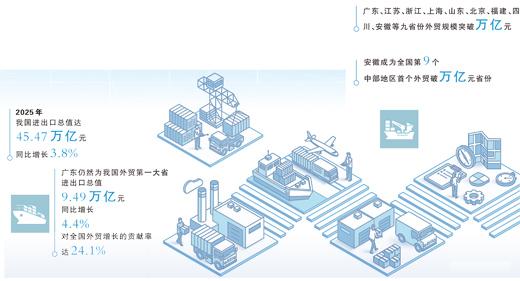
Core Insights - In 2025, China's total import and export value of goods reached 45.47 trillion yuan, a year-on-year increase of 3.8%, maintaining its position as the world's largest goods trading nation [1] - The resilience and vitality of the Chinese economy are reflected in the foreign trade "report card" [1] Group 1: Trade Performance and Contributions - Guangdong province led the nation in foreign trade for 40 consecutive years, with an import and export scale of 9.49 trillion yuan in 2025 [2] - High-tech product exports from Guangdong surpassed 1 trillion yuan for the first time, reaching 1.14 trillion yuan [2] - The combined import and export value of seven provinces and cities, including Guangdong, Jiangsu, and Zhejiang, reached 34.11 trillion yuan, contributing over half of China's foreign trade growth [3] Group 2: Market Diversification and International Cooperation - Chinese foreign trade enterprises are diversifying international market layouts to mitigate risks from single market fluctuations [4] - Guangdong's trade with ASEAN, the EU, and Hong Kong each exceeded 1 trillion yuan, while trade with Belt and Road countries reached 3.66 trillion yuan, growing by 5% [4] - Zhejiang's trade with ASEAN surpassed that with the EU for the first time, with a growth of 16.5% [5] Group 3: New Business Models and Innovations - The rise of new business models, such as cross-border e-commerce and market procurement, is enhancing the competitiveness of small and medium-sized enterprises [7][8] - Shanghai's service trade reached over 250 billion USD in 2025, accounting for nearly 30% of the national total, driven by digital technology and knowledge-intensive services [7] - Jiangsu's cross-border e-commerce platform is expected to boost exports by 35% for small and medium-sized enterprises [7] Group 4: Systemic Transformation and Future Outlook - China's foreign trade development is characterized by systemic changes in industrial upgrades, market diversification, and business model innovations [8] - The "Guangdong Goods Go Global" initiative aims to support foreign trade enterprises in expanding markets and strengthening industries [8] - Experts believe that China's trade innovation will inject more certainty into global economic development [8]
从外贸万亿大省看韧性与活力
Ren Min Ri Bao· 2026-02-09 02:17
Core Viewpoint - In 2025, China's total import and export value of goods reached 45.47 trillion yuan, a year-on-year increase of 3.8%, maintaining its position as the world's largest trading nation in goods [1] Group 1: Trade Performance and Contributions - Various provinces leveraged their geographical advantages and resource endowments to contribute to the steady development of China's imports and exports [1] - Guangdong province led the nation in import and export scale for 40 consecutive years, reaching 9.49 trillion yuan in 2025, with high-tech product exports surpassing 1 trillion yuan for the first time, totaling 1.14 trillion yuan [2] - In 2025, the combined import and export value of Guangdong, Jiangsu, Zhejiang, Shanghai, Shandong, Beijing, and Fujian reached 34.11 trillion yuan, contributing over half of China's foreign trade growth [3] Group 2: Market Diversification and New Opportunities - Chinese foreign trade enterprises are deepening cooperation in traditional markets while expanding into emerging markets, effectively diversifying market risks [4] - Guangdong's trade with ASEAN, the EU, and Hong Kong each exceeded 1 trillion yuan in 2025, while trade with Belt and Road countries reached 3.66 trillion yuan, growing by 5% [6] - Zhejiang's trade with ASEAN surpassed that with the EU for the first time, reaching 8690.7 billion yuan, a growth of 16.5% [6] Group 3: New Business Models and Innovations - The digital transformation and logistics upgrades have enabled more enterprises to participate in global competition, breaking traditional trade time and space limitations [8] - Shanghai's service trade reached over 250 billion USD in 2025, accounting for nearly 30% of the national total, with a focus on digital technology and knowledge-intensive services [8] - Jiangsu's cross-border e-commerce platform has driven a 35% increase in exports for small and medium-sized enterprises [8] Group 4: Systemic Changes in Foreign Trade - China's high-quality foreign trade development is characterized by systemic changes in industrial upgrades, market diversification, and business model innovations [9] - The "Guangdong Goods Go Global" initiative aims to assist foreign trade enterprises in expanding markets, strengthening industries, and building brands [9] - Experts emphasize the need to accelerate the development of new business models such as cross-border e-commerce and overseas warehouses to explore new trade spaces [9]
从外贸万亿大省看韧性与活力(财经深一度)
Ren Min Ri Bao· 2026-02-08 22:07
Core Insights - In 2025, China's total import and export value of goods reached 45.47 trillion yuan, a year-on-year increase of 3.8%, maintaining its position as the world's largest trading nation [1] - The growth in foreign trade reflects the resilience and vitality of the Chinese economy, with provinces leveraging their geographical advantages and resource endowments to contribute to steady development [1] Group 1: Trade Performance and Contributions - Guangdong province led the nation in foreign trade for 40 consecutive years, with an import and export scale of 9.49 trillion yuan in 2025, showcasing a shift from traditional light industrial products to high-tech and high-end equipment [1] - Jiangsu province's export of electromechanical products exceeded 70% of its total exports in 2025, indicating a trend towards cluster-based upgrades in foreign trade [1] - Zhejiang's foreign trade reached 5.55 trillion yuan in 2025, with a strong emphasis on digital transformation, as evidenced by the Yiwu Global Digital Trade Center [2] Group 2: Market Diversification and New Opportunities - Chinese foreign trade enterprises are diversifying their international market layouts to mitigate risks associated with single markets, with Guangdong's trade with ASEAN, EU, and Hong Kong each surpassing 1 trillion yuan [3][4] - The first China-Europe freight train from the Guangdong-Hong Kong-Macao Greater Bay Area successfully reached Poland, carrying key electronic products, highlighting the shift from product output to industrial capability output [3] - Zhejiang's trade with ASEAN surpassed that with the EU for the first time, reflecting strong adaptability in emerging markets [4] Group 3: New Business Models and Innovations - The rise of new business models such as cross-border e-commerce and market procurement is providing new pathways for small and medium-sized enterprises to engage in global trade [6][7] - Shanghai's service trade reached over 250 billion USD in 2025, with a focus on high-end services and digital technology, maintaining its position as a national leader [6] - Jiangsu's cross-border e-commerce platform is driving a 35% increase in exports for small and medium-sized enterprises, showcasing the synergy between e-commerce and supply chain finance [6] Group 4: Systemic Changes and Future Outlook - China's foreign trade development is characterized by systematic changes, including industrial upgrades, market diversification, and innovative business models, despite complex external environments [7] - The "Guangdong Goods Go Global" initiative aims to support foreign trade enterprises in expanding markets and strengthening industries [7] - Experts suggest that China's trade innovation will inject more certainty into global economic development, with a focus on expanding partnerships and enhancing trade resilience [7]