
天然气

Search documents
“跳楼机”般的天气,如何影响2026经济?
吴晓波频道· 2026-01-20 00:30
Core Viewpoint - The article discusses the impact of the La Niña phenomenon on global weather patterns and its subsequent effects on various industries, including agriculture, energy, and consumer goods, highlighting the interconnectedness of climate events and economic conditions [3][7]. Group 1: La Niña Phenomenon - La Niña is characterized by a significant cooling of sea surface temperatures in the central and eastern Pacific Ocean, which can disrupt global weather patterns and has been identified as a contributing factor to recent extreme weather events in China [9][10]. - The current La Niña state, which began in October 2025, is expected to last until early 2026 but may not develop into a full event, leading to complex weather impacts such as "south drought, north flood" patterns [10][11]. Group 2: Agricultural Impact - The La Niña phenomenon is expected to disrupt food supply chains, with a notable decline in crop yields in the Southern Hemisphere, including an over 11% drop in corn production and a downward adjustment in soybean yields, which will affect global agricultural prices [10][11]. - As the largest importer of soybeans, China may face increased pork and poultry prices due to rising feed costs, leading to inflationary pressures in the meat market [10]. Group 3: Energy Sector Effects - The onset of cold weather has increased coal consumption in power generation, with a reported 12% rise in daily coal usage in October 2025, while natural gas demand is projected to grow significantly due to colder winter conditions [11][13]. - The fluctuations in energy demand and supply could lead to increased prices for electricity and heating, impacting both consumers and industries reliant on stable energy costs [11][13]. Group 4: Consumer Market Trends - The La Niña phenomenon has spurred a surge in demand for winter clothing and heating appliances, with sales of down jackets and electric heating products seeing significant year-on-year increases of 46% and over 200%, respectively [32]. - Consumer preferences are shifting towards products that offer enhanced functionality and design, with a notable rise in demand for high-tech materials and products tailored for specific winter needs [33][34]. Group 5: Climate Adaptation Strategies - China is enhancing its climate response strategies, integrating weather monitoring and emergency preparedness into macroeconomic governance, with a focus on building a climate-resilient society by 2035 [22][27]. - The shift from reactive to proactive disaster management in agriculture includes advanced techniques such as smart seedling cultivation and water-saving irrigation methods to mitigate the impacts of extreme weather [28][29].


今日国际国内财经新闻精华摘要|2026年1月20日
Xin Lang Cai Jing· 2026-01-20 00:13
一、国际新闻 国际市场方面,美国天然气期货价格出现显著上涨,截至2026年1月20日7:37,涨幅已超16.00%,现报 3.600美元/百万英热,而在此前的7:00,其涨幅曾达到15.00%,价格为3.576美元/百万英热。 贵金属市场同样表现活跃,纽约期金突破4680美元/盎司,日内涨幅1.83%,现货白银日内涨5%,现报 94.58美元/盎司。 企业动态方面,OpenAI首席财务官萨拉・弗莱尔发布博客文章称,公司2025年年化营收已突破200亿美 元,较2024年的60亿美元大幅增长,营收增长与算力规模扩张密切相关,其算力规模已从2024年的0.6 吉瓦提升至2025年的1.9吉瓦,同时周活跃用户与日活跃用户数量持续刷新历史峰值。 此外,OpenAI计划于2026年推出首款硬件设备。 安全提醒方面,中国驻阿富汗使馆再次提醒中国公民暂勿前往阿富汗,已在阿公民和企业应遵守当地法 律法规,尊重宗教习俗,密切关注安全形势,加强安保措施,减少前往人员密集场所。 市场动态方面,白银连续主力合约日内涨5%,现报23376.00元。 政策与机构方面,欧元集团选定克罗地亚的武伊契奇担任下一任欧洲央行副行长。 德国政府19 ...
中国做好最坏准备,美国砍石油进口一条腿,另一条也岌岌可危
Sou Hu Cai Jing· 2026-01-19 22:44
Core Viewpoint - The article emphasizes the precarious state of energy security, highlighting the heavy reliance on imported oil and the vulnerabilities associated with global supply routes, particularly in critical maritime chokepoints like the Malacca Strait and the Strait of Hormuz [1][3][9]. Group 1: Energy Dependency and Vulnerabilities - The country relies on over 70% of its oil imports, creating a significant risk if supply routes are disrupted [3]. - The Malacca Strait is identified as a crucial chokepoint for oil imports, with 80% of oil from the Middle East and Africa passing through it [3]. - The potential for geopolitical tensions in regions like the Red Sea and the Strait of Hormuz poses a threat to energy supply, with significant increases in shipping costs due to rerouting [7][9]. Group 2: Strategic Initiatives for Energy Security - The construction of the China-Myanmar oil and gas pipeline aims to bypass the Malacca Strait, providing an alternative route for energy imports [6]. - The partnership with Russia through the East Route Natural Gas Pipeline is a strategic move to secure energy supply directly from a neighboring country, reducing vulnerability to maritime disruptions [13]. - The development of ultra-high voltage power transmission technology allows for efficient energy transfer from renewable sources in the northwest to industrial consumers in the southeast, enhancing energy independence [15]. Group 3: Long-term Energy Strategy - The push for electric vehicles is framed as a critical component of reducing dependence on imported oil, thereby mitigating risks associated with energy supply disruptions [16]. - The article suggests that achieving energy independence is essential for national stability and economic security, as it directly impacts everyday life and industrial operations [22][24]. - The ongoing efforts to secure energy resources and develop alternative energy infrastructure are portrayed as a strategic chess game against global powers, emphasizing the importance of proactive measures in energy policy [18][21].
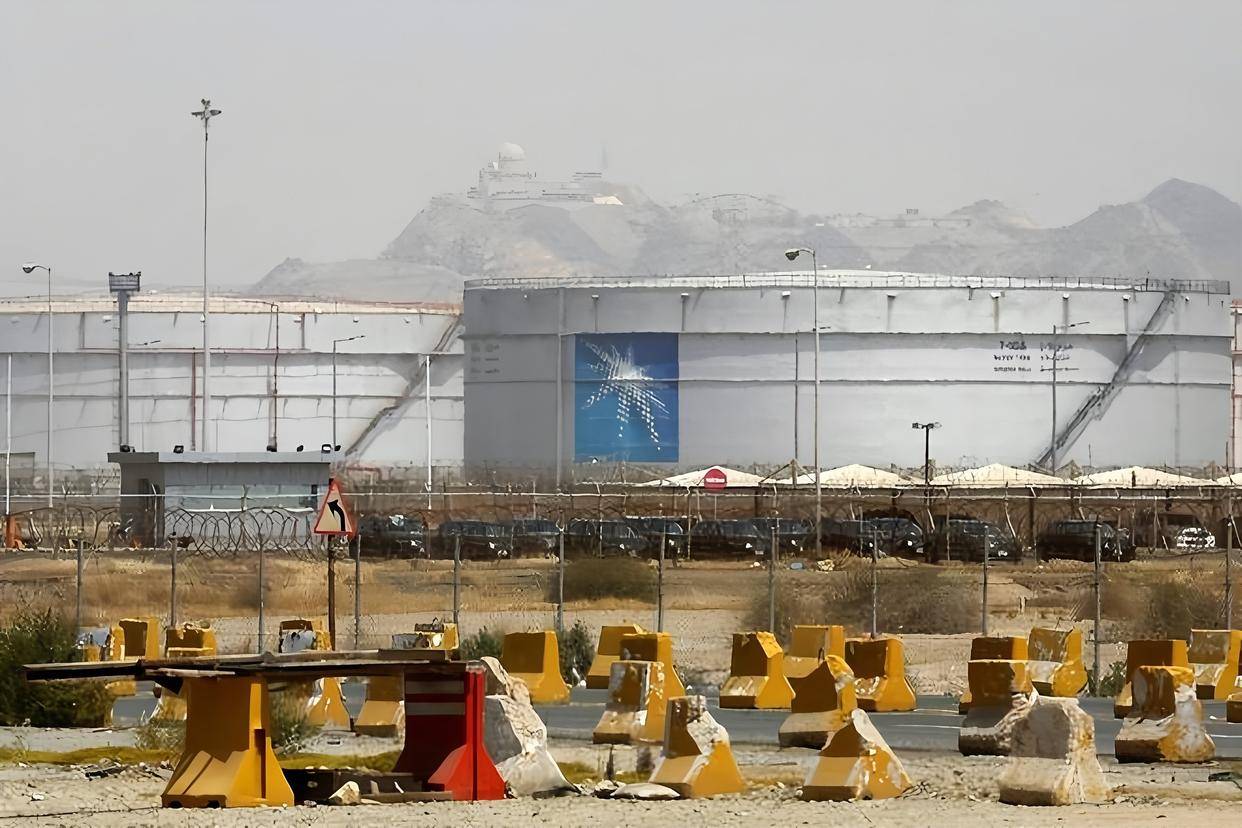
昆仑能源(00135):回购彰显发展信心,成长潜力值得期待
Shenwan Hongyuan Securities· 2026-01-19 14:26
Investment Rating - The report maintains a "Buy" rating for Kunlun Energy [2][7] Core Views - The company plans to repurchase up to 86.59 million shares, representing about 1% of its total issued share capital, demonstrating confidence in its development [7] - The company has sufficient cash resources, with cash on hand amounting to 29.479 billion RMB as of 1H25, which is adequate to cover the repurchase costs [7] - The Fujian Fuzhou LNG receiving station, with a capacity of 3 million tons per year, is expected to commence operations in 2027, providing stable revenue through a bridge fee model [7] - The company is well-positioned to benefit from the dual carbon and dual control policies, with a significant portion of its gas sales coming from price-sensitive industrial customers [7] - The report forecasts net profits for 2025-2027 to be 5.980 billion, 6.254 billion, and 6.573 billion RMB respectively, with EPS projected at 0.69, 0.72, and 0.76 RMB per share [7] Financial Data and Profit Forecast - Revenue projections for 2023 to 2027 are as follows: 177.354 billion, 187.046 billion, 193.901 billion, 204.563 billion, and 213.881 billion RMB, with corresponding growth rates of 3.15%, 5.46%, 3.66%, 5.50%, and 4.55% [6][8] - Net profit estimates for the same period are: 5.682 billion, 5.960 billion, 5.980 billion, 6.254 billion, and 6.573 billion RMB, with growth rates of 8.68%, 4.89%, 0.33%, 4.59%, and 5.10% [6][8] - The company’s price-to-earnings ratio (P/E) is projected to decrease from 10.4 in 2023 to 9.0 in 2027, indicating potential for upward price elasticity [6][8]

申万公用环保周报:2025年用电平稳增长,三产及居民贡献增量过半-20260119
Shenwan Hongyuan Securities· 2026-01-19 14:07
Investment Rating - The report maintains a positive outlook on the power and gas sectors, recommending various companies within these industries for investment opportunities [1]. Core Insights - The report highlights that China's total electricity consumption is projected to exceed 10 trillion kWh in 2025, reaching 10.4 trillion kWh, with a year-on-year growth of 5% [7][8]. - The growth in electricity consumption is driven primarily by the secondary and tertiary industries, which together contribute nearly 80% of the total increase in electricity demand [8]. - The report notes significant growth in electricity consumption from high-end manufacturing, digital economy, and new infrastructure projects, such as charging stations and 5G base stations, which are expected to see growth rates exceeding 30% [8]. Summary by Sections 1. Electricity Sector - In 2025, the total electricity consumption is expected to reach 10.4 trillion kWh, with a 5% year-on-year increase. The first, second, and third industries, along with urban and rural residential electricity consumption, are projected to grow by 9.9%, 3.7%, 8.2%, and 6.3% respectively [7][9]. - The second industry remains the largest consumer of electricity, contributing 48% to the growth, while the third industry contributes 31% [9][13]. - The report recommends investments in coal-fired power companies like Guodian Power and Inner Mongolia Huadian, as well as large hydropower companies such as Yangtze Power and State Power Investment [15][16]. 2. Gas Sector - The report indicates that colder temperatures are expected to increase heating demand, leading to a rebound in gas prices across Europe and Asia. As of January 16, the Henry Hub spot price was $3.06/mmBtu, with a weekly increase of 6.77% [17][24]. - The report highlights that European gas prices have surged due to low inventory levels and increased heating demand, with the TTF spot price reaching €38.10/MWh, up 31.38% week-on-week [17][24]. - Recommendations include investing in integrated gas companies like Kunlun Energy and New Hope Energy, as well as gas trading companies like New Hope and New Energy [38]. 3. Market Performance - The report notes that the public utility, power, and environmental sectors outperformed the Shanghai and Shenzhen 300 index during the week of January 12 to January 16, 2026 [40]. 4. Company and Industry Dynamics - Recent initiatives in various provinces aim to enhance green energy and environmental standards, including the establishment of green mining standards in Guangxi and guidelines for industrial microgrid construction [46][47]. - The report also mentions significant corporate announcements, including mergers and acquisitions in the energy sector, which may impact market dynamics [50].




国家统计局:2025年1—12月份规上工业原煤产量48.3亿吨 同比增长1.2%
Shang Hai Zheng Quan Bao· 2026-01-19 13:25
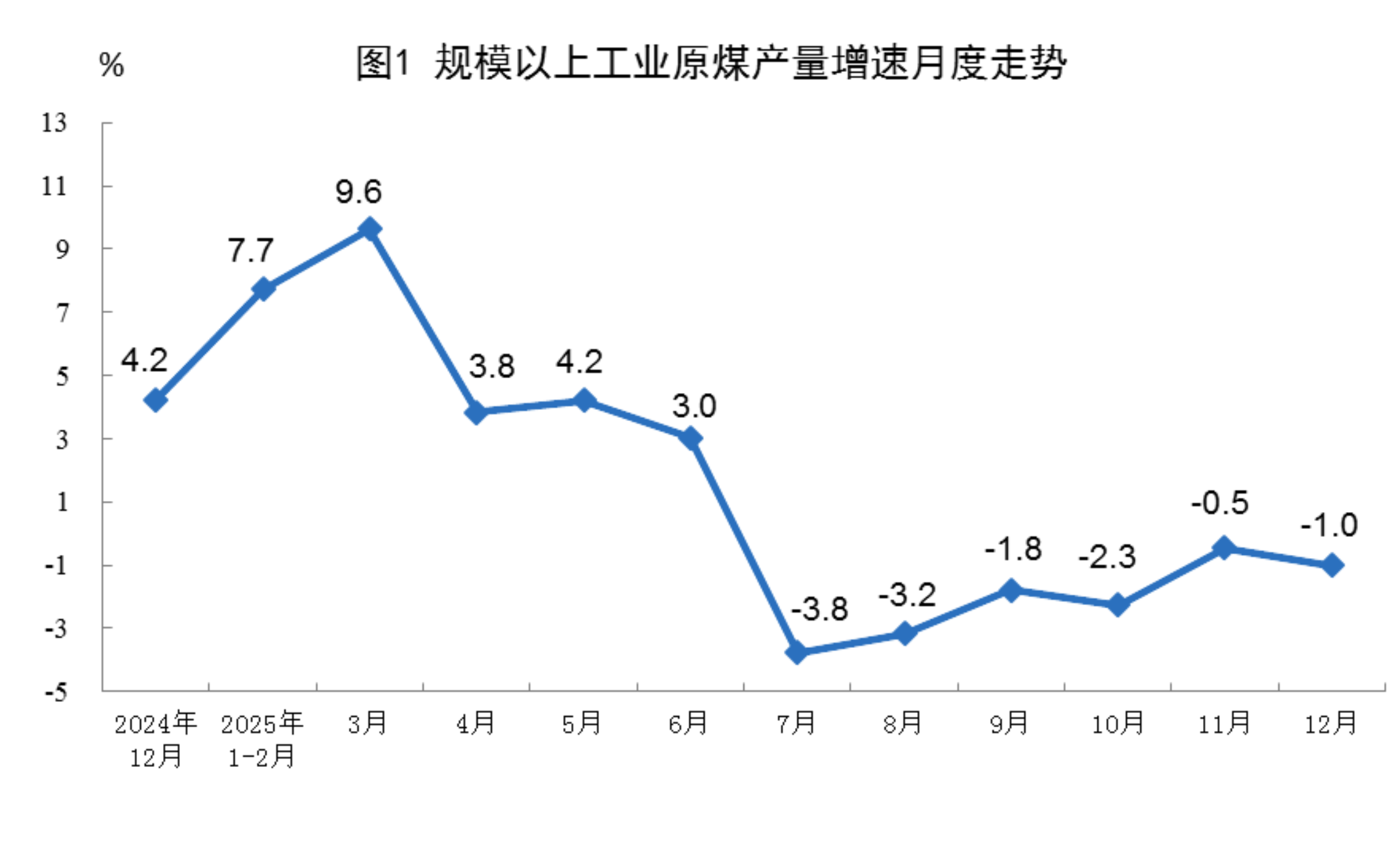
Group 1: Production of Coal, Oil, and Natural Gas - The production of raw coal in December was 440 million tons, a year-on-year decrease of 1.0%, with an average daily output of 14.1 million tons. For the entire year, the production was 4.83 billion tons, an increase of 1.2% year-on-year [1][3] - The production of crude oil in December was 17.8 million tons, a year-on-year decrease of 0.6%, with an average daily output of 5.74 million tons. For the year, the total production was 216.05 million tons, an increase of 1.5% year-on-year [3] - Natural gas production in December reached 23 billion cubic meters, a year-on-year increase of 5.1%, with an average daily output of 740 million cubic meters. The total production for the year was 261.9 billion cubic meters, an increase of 6.2% year-on-year [8] Group 2: Electricity Production - The electricity generation in December was 858.6 billion kilowatt-hours, a year-on-year increase of 0.1%, with an average daily generation of 27.7 billion kilowatt-hours. The total generation for the year was 9,715.9 billion kilowatt-hours, an increase of 2.2% year-on-year [10] - In December, the decline in thermal power generation narrowed to a year-on-year decrease of 3.2%, while hydropower, nuclear power, wind power, and solar power saw varying growth rates, with solar power increasing by 18.2% year-on-year [11]
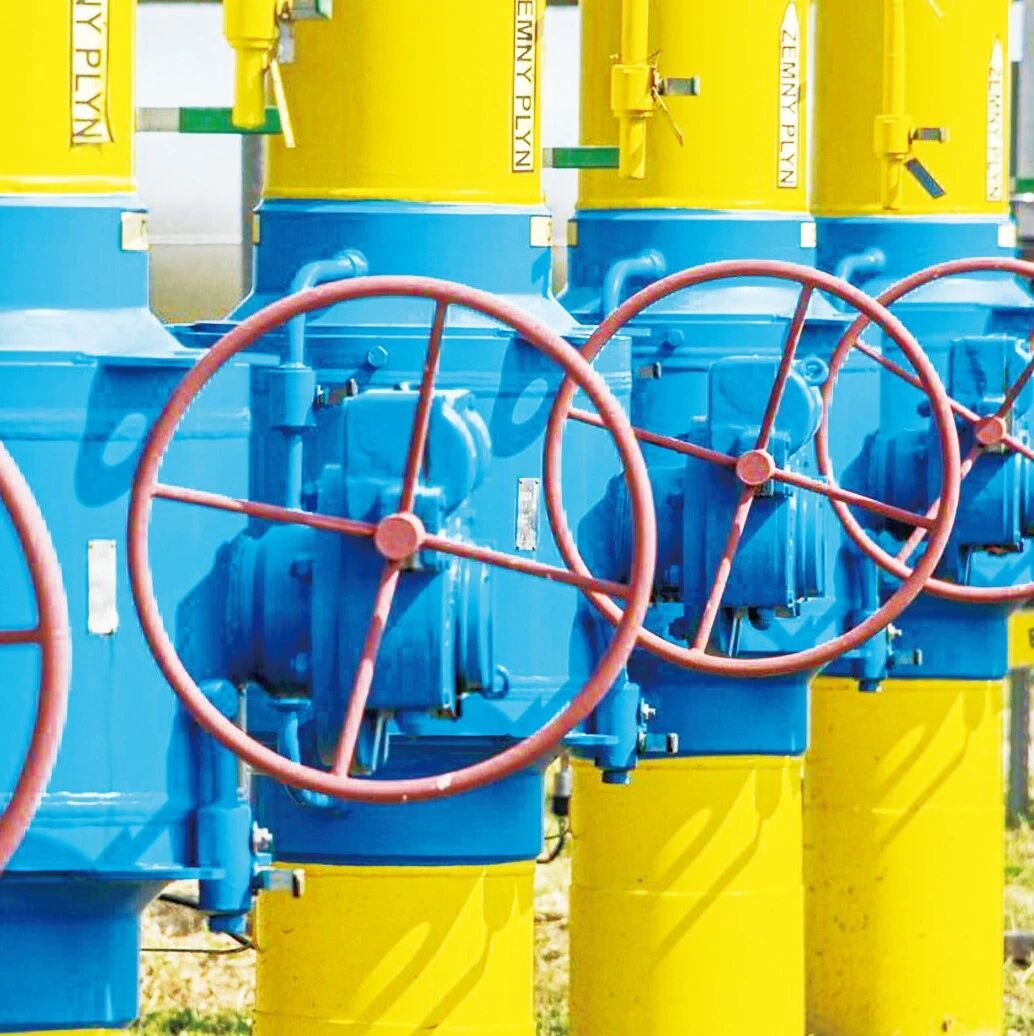
陕天然气:公司当前的核心战略是持续巩固和扩大在天然气长输管道领域的领先优势
Zheng Quan Ri Bao Wang· 2026-01-19 11:44
Core Viewpoint - Shaanxi Natural Gas (002267) emphasizes the importance of extending oil's role in seizing opportunities in the renewable energy market and enhancing market competitiveness [1] Group 1: Company Strategy - The company's current core strategy is to continuously consolidate and expand its leading position in the natural gas long-distance pipeline sector [1] - The company will closely monitor trends in the green and low-carbon transition within the energy industry and the dynamics of related enterprises [1] Group 2: Industry Focus - Natural gas continues to play a critical role in the energy transition [1] - While focusing on its main business, the company will maintain strategic research in emerging fields such as renewable energy [1]

欧盟能源“去俄化”难掩自身困境
中国能源报· 2026-01-19 08:54
Core Viewpoint - The EU's process of "de-Russification" in energy is slowing down, leading to a multifaceted crisis in politics, economy, and society across Europe [1][2]. Group 1: Energy Dependency and Policy Decisions - The EU has set a deadline to completely eliminate Russian oil and gas imports by the end of 2027, with specific bans on LNG and pipeline gas imports coming into effect in 2026 [2]. - Despite the EU's commitment to reduce dependency on Russian energy, the reliance on Russian LNG has actually increased, with significant volumes still being processed at EU ports [5][6]. - The EU's internal divisions are evident, as some member states oppose a one-size-fits-all approach to energy policy, fearing it threatens their energy security [3][11]. Group 2: Economic Impact and Trade Losses - Since the onset of the Russia-Ukraine conflict, EU sanctions have resulted in export losses to Russia amounting to €48 billion, with a 65% drop in exports from €730 million in 2021 to €250 million in 2025 [4]. - Germany has experienced the most significant decline in exports to Russia, down 73.6%, while Poland and France also saw substantial decreases [4]. Group 3: Energy Supply and Market Dynamics - In 2025, Russian pipeline gas exports to Europe fell by 44% compared to 2018, marking the lowest level since the 1970s, while Russian LNG exports have filled some of the gaps [6]. - The Yamal LNG project has become a crucial supplier, with 76.1% of its exports reaching EU ports in 2025, generating approximately €7.2 billion in revenue for Russia [6][7]. - France emerged as the largest importer of Russian LNG in 2025, followed by Belgium and Spain, which still received significant volumes despite a decrease [7]. Group 4: Energy Shortages and Social Consequences - As of early January 2026, European gas storage levels were critically low at 59.9%, with Germany and the Netherlands facing even lower rates, raising concerns about heating shortages during extreme winter weather [10]. - The rising energy costs have led to increased financial burdens on households, with average energy expenses for a German family rising from €4,120 in 2021 to €5,407 [11]. - The ongoing energy crisis is eroding social cohesion in Europe, with public dissatisfaction growing towards both EU policies and national governments, potentially leading to long-term structural impacts [11].
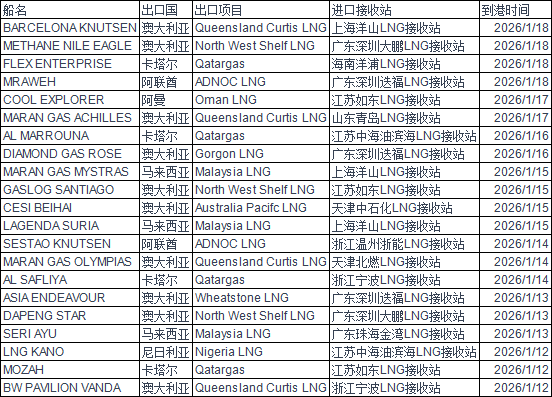
E-Gas系统:1月12日-1月18日当周中国LNG进口量约142万吨
Xin Hua Cai Jing· 2026-01-19 06:45
Core Insights - The article reports that China imported a total of approximately 1.42 million tons of LNG from January 12 to January 18, 2023, which is a decrease from the previous week's import of 1.88 million tons [1][5]. Group 1: LNG Import Data - During the week of January 12 to January 18, China imported LNG from six countries, with Australia being the largest supplier, providing 10 vessels and approximately 700,000 tons, accounting for about 49% of the total imports [5]. - The LNG receiving stations in China received a total of 21 vessels during this period, with the highest volume of 250,000 tons arriving at the Jiangsu Rudong LNG receiving station [5]. - For the upcoming week of January 19 to January 25, it is predicted that China will import approximately 1.09 million tons of LNG through 14 vessels [5]. Group 2: E-Gas System Overview - The E-Gas system, developed by the China Economic Information Service in collaboration with the Shanghai Petroleum and Natural Gas Exchange Center, focuses on providing comprehensive information services for the natural gas industry [6]. - The system integrates extensive industry data resources and offers features such as real-time statistics on LNG international trade and queries on domestic port vessel traffic [6].
关注!有地区煤改气后取暖贵用不起,记者实地探访
Xin Lang Cai Jing· 2026-01-19 04:45
【关注!#有地区煤改气后取暖贵用不起#,记者实地探访】#人民日报记者探访煤改气后取暖贵# 近 来,我国北方一些地区农村"煤改气"后,有读者网友反映,用气价格高,导致出现有的村民"取不起 暖""为了省钱宁可受冻"等现象。记者实地探访,多方提出跨区域生态补偿、加强农村房屋节能改造、 因地制宜配置多元化清洁能源等建议↓↓↓(人民日报)#金价波动# (来源:中工网) ...