
汽车销售

Search documents
中国汽车流通协会:今年上半年超三成经销商完成销量目标
Bei Jing Shang Bao· 2025-08-18 09:34
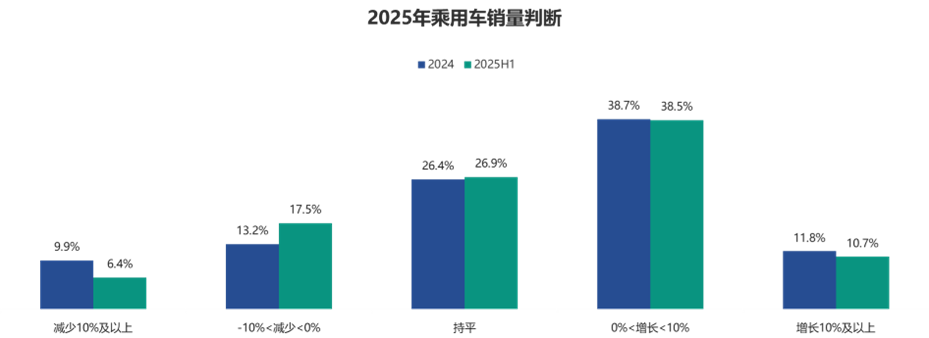
北京商报讯(记者 刘晓梦)8月18日,中国汽车流通协会发布《2025年上半年全国汽车经销商生存状况 调查报告》显示,今年上半年,完成销售目标的经销商占比为30.3%,目标完成率低于70%的经销商占 比为29%。 ...
正通汽车(01728.HK)拟8月28日举行董事会会议批准中期业绩
Ge Long Hui· 2025-08-18 09:09
Core Viewpoint - Zhengtong Automobile (01728.HK) has announced a board meeting scheduled for August 28, 2025, to consider and approve the interim results for the six months ending June 30, 2025, and to discuss the potential payment of an interim dividend, among other matters [1] Summary by Relevant Sections - **Company Performance** - The board meeting will address the interim performance results for the first half of 2025 [1] - **Dividend Consideration** - The company will consider the payment of an interim dividend during the board meeting [1] - **Other Matters** - Additional matters will also be discussed during the board meeting [1]
中国汽车流通协会:2025年上半年新车销售持续承压 汽车经销商亏损面扩大
智通财经网· 2025-08-18 08:44
Core Insights - The overall survival status of automotive dealers in China has worsened in the first half of 2025, with a significant increase in the proportion of dealers reporting losses [8] - The automotive market is experiencing intense competition, leading to a situation where sales increase does not translate into revenue or profit growth [1][8] - Dealers express dissatisfaction with manufacturers due to reduced rewards for achieving basic targets, contributing to a decline in overall satisfaction [3][22] Group 1: Dealer Performance and Satisfaction - The overall satisfaction score of automotive dealers has dropped to 64.7, a significant decline from the end of 2024, primarily due to multiple operational pressures [3] - Only 30.3% of dealers achieved their sales targets in the first half of 2025, with 29.0% of dealers failing to meet 70% of their targets [4] - The proportion of dealers reporting losses has risen to 52.6%, while only 29.9% reported profits [8] Group 2: Financial Performance and Challenges - New car sales continue to show negative gross margin contributions of -22.3%, while after-sales and financial insurance contribute 63.8% and 36.2% respectively [14] - The financial penetration rate for new car sales has decreased from 69.1% in 2024 to 62.8% in the first half of 2025, indicating a downward trend [20] - A significant 74.4% of dealers are experiencing price inversion, with 43.6% reporting price inversions exceeding 15%, which severely impacts cash flow [23] Group 3: Comparison Between Traditional and New Energy Brands - New energy independent brand dealers show better operational conditions compared to traditional fuel vehicle brands, with 42.9% reporting profits compared to 25.6% for traditional brands [11] - The gross margin contributions for new energy independent brand dealers are 16.8% for new cars, 54.0% for after-sales, and 17.0% for financial insurance, indicating a more favorable performance [17]

云南尚驰商贸有限公司成立 注册资本100万人民币
Sou Hu Cai Jing· 2025-08-16 08:20
Group 1 - Yunnan Shangchi Trading Co., Ltd. has been established with a registered capital of 1 million RMB [1] - The legal representative of the company is Luo Yanqing [1] - The business scope includes manufacturing and retail of automotive parts, sales of new energy vehicles, and various automotive services [1] Group 2 - The company is involved in the sales of automotive accessories, tires, and battery components [1] - It also provides services such as vehicle appraisal, towing, and small vehicle rental [1] - The company is permitted to operate independently within the scope of its business license, excluding projects that require approval [1]
湖北璟珩专用汽车销售有限公司成立 注册资本30万人民币
Sou Hu Cai Jing· 2025-08-16 03:21
Core Viewpoint - A new company, Hubei Jinghang Special Automobile Sales Co., Ltd., has been established with a registered capital of 300,000 RMB, focusing on various automotive and mechanical sales and services [1] Company Summary - The company is registered under the legal representative Wang Wei [1] - The registered capital is 300,000 RMB [1] - The business scope includes wholesale of auto parts, automobile sales, new energy vehicle sales, and various mechanical equipment sales [1] Industry Summary - The company operates in the automotive sector, specifically in the sales of new energy vehicles and automotive accessories [1] - It also engages in mechanical equipment leasing and sales, indicating a diversified approach within the automotive and machinery industries [1] - The range of services includes import and export activities, market marketing planning, and construction engineering services, reflecting a broad operational scope [1]
7月零售强劲难改信心下滑 美国消费者前景仍存不确定性
智通财经网· 2025-08-15 16:01
Group 1 - In July, U.S. retail sales showed broad growth, with a month-over-month increase of 0.5%, surpassing market expectations, and June's data revised up to a 0.9% increase [1] - Nine out of thirteen major retail categories experienced growth, with auto sales recording the largest increase since March [1] - Online retail and general merchandise stores performed well, benefiting from promotional events by Amazon, Walmart, and Target [1] Group 2 - Despite the positive retail sales report, consumer confidence unexpectedly declined in early August, raising concerns about the sustainability of retail sales momentum [2] - Economists suggest a higher likelihood of softening consumer spending in the second half of the year due to tariff uncertainties and recent employment data [2] - The July retail sales report indicated a 0.5% increase in the "control group" sales, which is used to calculate GDP, with significant growth in categories like furniture and sports goods, although some of this increase may reflect inflation [2] Group 3 - Economists noted that while July retail sales benefited from strong online shopping and auto sales, consumers reduced spending on dining and beverages, indicating a shift towards essential goods amid slowing disposable income growth [3] - Inflation data showed that businesses passed on tariff costs to consumers less than expected, but wholesale profit margins increased significantly, suggesting future direct impacts of tariffs on consumers [3] - Additionally, U.S. industrial production declined in July, indicating weakness in manufacturing output [3]
多地暂停汽车置换补贴,青海、贵州等省市政策集中调整
Jing Ji Guan Cha Bao· 2025-08-15 13:16
Core Viewpoint - Multiple regions in China have recently suspended their automobile replacement subsidy policies, indicating a significant shift in government support for the automotive industry [1] Group 1: Policy Changes - Qinghai Province announced the suspension of automobile replacement subsidies effective from August 15, 2025, citing the need for orderly implementation and optimization of the application system [1] - Hohhot City suspended its automobile replacement subsidies starting from August 10, 2023, followed by Bayannur City, which implemented the same measure from August 11, 2023 [1] - Guizhou Province was the earliest to act, halting automobile replacement activities from August 6, 2023, due to a platform system upgrade [1] - Quanzhou City in Fujian Province will suspend subsidy applications starting from August 17, 2023, to comply with the latest national policy requirements [1]
世纪联合控股(01959.HK)预期中期综合除税后亏损大幅收窄69%
Ge Long Hui· 2025-08-15 10:03
Core Viewpoint - Century Union Holdings (01959.HK) expects a revenue of approximately RMB 454.2 million for the six months ending June 30, 2025, down from RMB 738.0 million in the same period last year [1] Group Summary - The company anticipates a consolidated after-tax net loss of about RMB 16.2 million for the current period, significantly narrowing from a loss of approximately RMB 52.4 million in the same period last year, representing a 69% reduction [1] - The board attributes the expected reduction in consolidated after-tax net loss to several factors, including a decline in new car sales due to macroeconomic impacts, which led to decreased revenue, and a continued intense price war in the automotive market that affected gross margins [1] - Improvements in new car inventory structure and new car gross margin, along with a reduction in administrative expenses, contributed to the significant narrowing of the consolidated after-tax net loss compared to the same period last year [1]
世纪联合控股(01959)发盈警 预期上半年税后净亏损1620万元 大幅收窄69%
智通财经网· 2025-08-15 09:54
Core Viewpoint - Century United Holdings (01959) expects a revenue of approximately RMB 454 million for the six months ending June 30, 2025, a decrease from RMB 738 million for the same period last year [1] Financial Performance - The company anticipates a consolidated after-tax net loss of approximately RMB 16.2 million for the current period, significantly narrowing from a loss of about RMB 52.4 million in the same period last year, representing a reduction of 69% [1] - The expected reduction in after-tax net loss is attributed to improvements in new vehicle inventory structure and gross margin, as well as a decrease in administrative expenses, despite a decline in new car sales and ongoing price wars in the automotive market [1]
盈峰环境在海南成立环境科技公司,含汽车销售业务
Qi Cha Cha· 2025-08-15 09:25
Core Insights - Yingfeng Environment has established a new environmental technology company in Hainan, which includes automotive sales as part of its business operations [1] Company Summary - The newly formed company, Hainan Demei Yinghe Environmental Technology Co., Ltd., has a registered capital of 10 million yuan [1] - The company is indirectly wholly owned by Yingfeng Environment (stock code: 000967) [1] - The business scope of the new company includes sales of environmental protection equipment, waste treatment equipment, automotive sales, and sales of new energy vehicles [1]
