
汽车销售

Search documents
广汇宝信:宝马将会于8月中旬左右陆续撤销本集团经销网点销售宝马汽车的授权
Zhi Tong Cai Jing· 2025-08-12 08:53
Core Viewpoint - Guanghui Baoxin (01293) announced that its upstream supplier, BMW Brilliance Automotive Ltd. and BMW (China) Automotive Trade Ltd. (collectively referred to as "BMW"), informed the company that due to non-compliance with certain commercial terms in the BMW Dealer Agreement, BMW will gradually revoke the authorization for Guanghui Baoxin's dealerships to sell BMW vehicles around mid-August 2025 [1] Financial Impact - The total revenue generated from BMW dealership outlets accounted for 40% and 43% of Guanghui Baoxin's total revenue for the fiscal year ending December 31, 2023, and the six months ending June 30, 2024, respectively [1] Operational Strategy - The board of directors believes that the revocation will have a certain impact on the company's operations and financial condition. However, the company will strive to maintain its existing automotive brand authorizations and will strategically transform to adjust its brand structure in line with market development demands and trends [1]
成都姝宜源汽车销售经营部(个人独资)成立 注册资本1万人民币
Sou Hu Cai Jing· 2025-08-12 08:13
Core Viewpoint - Chengdu Shuyiyuan Automobile Sales Operation Department has been established as a sole proprietorship, indicating a potential growth in the automotive sales sector in Chengdu [1] Company Summary - The legal representative of the newly established company is Deng Yuanshu [1] - The registered capital of the company is 10,000 RMB [1] - The business scope includes general projects such as automobile sales, wholesale of auto parts, sales of automotive decorative products, sales of new energy vehicles, retail of auto parts, leasing services (excluding licensed leasing services), and internet sales (excluding sales of goods requiring licenses) [1]
成都仁诚宜汽车销售经营部(个人独资)成立 注册资本1万人民币
Sou Hu Cai Jing· 2025-08-12 08:13
Core Viewpoint - Chengdu Renchengyi Automobile Sales Operation Department has been established as a sole proprietorship, indicating a potential growth in the automotive sales sector in Chengdu [1] Company Summary - The legal representative of the newly established company is Zhang Heng [1] - The registered capital of the company is 10,000 RMB [1] - The business scope includes general projects such as automobile sales, wholesale of auto parts, sales of automotive decorative products, sales of new energy vehicles, retail of auto parts, leasing services (excluding licensed leasing services), and internet sales (excluding goods requiring licenses) [1]
深圳市澍福汽车科技有限公司成立 注册资本100万人民币
Sou Hu Cai Jing· 2025-08-12 06:13
Company Overview - Shenzhen Shufu Automotive Technology Co., Ltd. has recently been established with a registered capital of 1 million RMB [1] - The legal representative of the company is Yao Shuangyan [1] Business Scope - The company engages in a wide range of activities including technology services, development, consulting, and promotion [1] - It also provides information consulting services (excluding licensed information consulting), network technology services, and sales of automotive decorative products and parts [1] - Additional services include vehicle sales, micro-car rental, electric bicycle sales, and second-hand car trading [1] - The company is involved in various sectors such as food sales (only pre-packaged food), navigation terminal sales, and social economic consulting [1] - It offers services related to property management, event organization, human resources, and advertising [1] - The company operates electric vehicle charging infrastructure and provides vehicle repair and maintenance services [1] Licensing and Regulatory Compliance - The company has licensed operations including network taxi services, passenger transport, and residential interior decoration [1] - It is required to obtain approval from relevant authorities for certain business activities [1]
恒指收升47点,全日波幅较小
Guodu Securities Hongkong· 2025-08-12 02:20
Group 1: Market Overview - The Hang Seng Index rose by 47 points or 0.19%, closing at 24,906, with a trading range of 193 points during the day [3][4] - The trading volume for the day was 20.09 billion HKD, with a net inflow of 38 million HKD from northbound trading [3] - The performance of blue-chip stocks was mixed, with 50 out of 85 stocks rising, including notable gains from 中升控股 (2.8%) and 药明康德 (2.4%) [4] Group 2: Macroeconomic and Industry Dynamics - The business sentiment index for small and medium enterprises in Hong Kong improved slightly from 41.6 in June to 42.1 in July, indicating a recovery trend [7] - The real estate sector showed notable improvement, with its index rising from 44.2 to 46.2, while the commercial services sector also saw an increase [7] - In the automotive industry, July saw a 27.4% year-on-year increase in new energy vehicle sales, accounting for 48.7% of total vehicle sales [9] Group 3: Company News - 复星医药 announced a licensing agreement with Expedition for the global development of a respiratory disease treatment, with potential payments totaling up to 6.45 billion USD [12] - 华南城 has been ordered to liquidate by the Hong Kong High Court due to outstanding debts related to its bonds [13] - 金蝶国际 reported a narrowed loss of 97.73 million RMB for the first half of the year, with revenue increasing by 11.24% to 3.192 billion RMB [14]
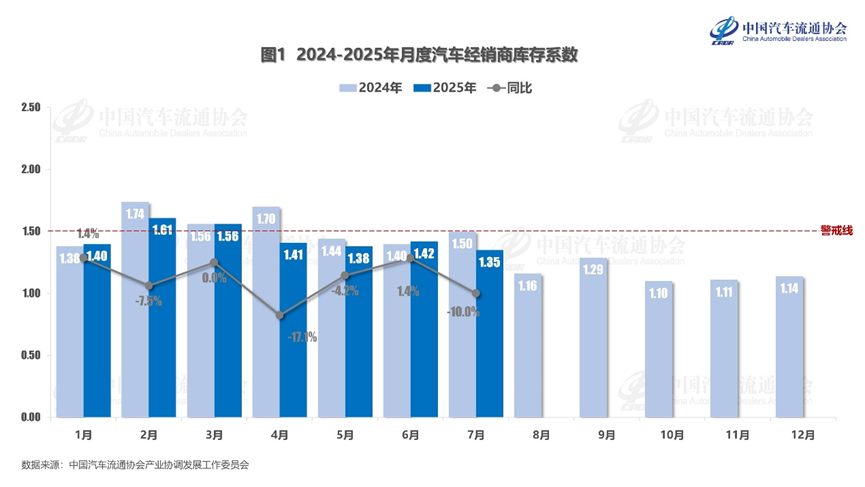
今年7月汽车经销商综合库存系数为1.35
Bei Jing Shang Bao· 2025-08-11 11:43
Core Insights - The China Automobile Dealers Association reported that the comprehensive inventory coefficient for automobile dealers in July was 1.35, indicating a decrease of 4.9% month-on-month and a decrease of 10% year-on-year [1] Summary by Category - **Inventory Levels** - The comprehensive inventory coefficient for automobile dealers is 1.35 [1] - There was a month-on-month decrease of 4.9% in the inventory coefficient [1] - Year-on-year, the inventory coefficient decreased by 10% [1]
小鹏汽车成立北京鹏荻销售公司 注册资本500万元
Jin Rong Jie· 2025-08-11 09:31
观点网讯:8月11日,小鹏汽车成立北京鹏荻汽车销售服务有限公司,注册资本500万元人民币。 该公司法定代表人为韩键,经营范围覆盖新能源汽车整车销售、汽车销售及新能源汽车电附件销售等业 务。 股东信息显示,该公司由北京小鹏汽车销售服务有限公司全资持股。 免责声明:本文内容与数据由观点根据公开信息整理,不构成投资建议,使用前请核实。 本文源自:观点网 ...
中国汽车流通协会:7月份汽车经销商库存系数为1.35
Mei Ri Jing Ji Xin Wen· 2025-08-11 09:16
Group 1 - The core viewpoint of the article is that the inventory levels of automotive dealers in China are currently below the warning line but above the reasonable range, indicating a cautious market environment [1] Group 2 - In July, the comprehensive inventory coefficient for automotive dealers was reported at 1.35, which represents a month-on-month decrease of 4.9% and a year-on-year decrease of 10.0% [1]
中国汽车流通协会:7月份汽车经销商综合库存系数为1.35 环比下降4.9%
智通财经网· 2025-08-11 08:49
智通财经APP获悉,中国汽车流通协会发布的2025年7月份"汽车经销商库存"调查结果显示,7月份汽车经销商综合库存系 数为1.35,环比下降4.9%,同比下降10.0%,库存水平处于警戒线以下,但高于合理区间。综合预计,7月份乘用车终端销 量182.6万辆,以此测算,7月末汽车经销商库存总量大致在247万辆左右。 一、7月份库存系数同比、环比下降 高端豪华&进口品牌库存系数为1.56,环比上升13.0%;合资品牌库存系数为1.29,环比上升2.4%;自主品牌库存系数为 1.34,环比下降10.7%。 三、7月份库存深度最高的品牌 7月整体汽车市场进入传统淡季,相对平稳。尽管国家第三批690亿元以旧换新补贴资金及时下发,但地方财政兑付普遍存 在15-25天迟滞,叠加汽车金融返佣比例下调,显著加剧了消费者持币观望情绪。进入下旬,全国多地因主汛期连续降雨抑 制出行需求,经销商在6月冲量后补库动能减弱,共同推动库存水平较6月末小幅回落。 值得注意的是,财政部、税务总局7月17日发布《关于调整超豪华小汽车消费税政策的公告》,将超豪华小汽车消费税征收 门槛从"每辆零售价格(不含增值税)130万元下调为90万元",但因覆盖 ...

小鹏在北京新设鹏荻汽车销售服务公司
Zheng Quan Shi Bao Wang· 2025-08-11 08:18
人民财讯8月11日电,企查查APP显示,近日,北京鹏荻汽车销售服务有限公司成立,法定代表人为韩 键,注册资本500万元,经营范围包括新能源汽车整车销售、汽车销售、新能源汽车电附件销售等。企 查查股权穿透显示,该公司由北京小鹏汽车销售服务有限公司全资持股。 ...
