
渔业

Search documents
开创国际股价涨10.02%,诺安基金旗下1只基金位居十大流通股东,持有127.24万股浮盈赚取153.96万元
Xin Lang Cai Jing· 2025-11-17 01:55
Group 1 - The core point of the article highlights the significant increase in the stock price of Kaichuang International, which rose by 10.02% to reach 13.29 CNY per share, with a total market capitalization of 3.202 billion CNY [1] - Kaichuang International, established on October 11, 1993, and listed on June 19, 1997, operates in the integrated industry structure of marine resources, including marine fishing, food processing, maritime transportation, and fish trade [1] - The main revenue composition of Kaichuang International includes tuna sales (36.82%), canned goods (34.38%), fish fillet processing (11.87%), fish trade (11.47%), other fish species (5.10%), maritime transportation (0.23%), and other (0.13%) [1] Group 2 - From the perspective of the top circulating shareholders, the Noan Multi-Strategy Mixed A fund entered the top ten shareholders of Kaichuang International in the third quarter, holding 1.2724 million shares, which is 0.53% of the circulating shares [2] - The Noan Multi-Strategy Mixed A fund has achieved a year-to-date return of 77.77%, ranking 177 out of 8213 in its category, and a one-year return of 76.76%, ranking 126 out of 8130 [2] - The fund manager of Noan Multi-Strategy Mixed A is Kong Xianzheng, who has been in the position for nearly five years, with the best fund return during his tenure being 93.84% [3]

中水渔业股价涨10.03%,招商基金旗下1只基金位居十大流通股东,持有155.68万股浮盈赚取146.34万元
Xin Lang Cai Jing· 2025-11-17 01:53
Group 1 - The core point of the news is that Zhongshui Fisheries has seen a significant stock price increase of 10.03% on November 17, reaching 10.31 yuan per share, with a total market capitalization of 3.772 billion yuan and a cumulative increase of 13.71% over the past six days [1] - Zhongshui Fisheries is primarily engaged in deep-sea fishing and ship repair, with its main business revenue composition being: fishing services 36.88%, retail and processing trade 20.73%, squid 16.99%, tuna 15.92%, other catches 9.39%, and others 0.09% [1] Group 2 - Among the top ten circulating shareholders of Zhongshui Fisheries, a fund under China Merchants Fund has entered the list, holding 1.5568 million shares, which accounts for 0.43% of the circulating shares [2] - The fund, China Merchants Quantitative Selected Stock Initiation A (001917), has achieved a year-to-date return of 39.7% and a one-year return of 39.8%, ranking 962 out of 4216 and 629 out of 3956 respectively [2] - The fund manager, Wang Ping, has a tenure of 15 years and 153 days, with the fund's total asset scale at 21.247 billion yuan and a best return of 274.97% during his tenure [2]

2025水产品大会在威海开幕
Da Zhong Ri Bao· 2025-11-16 01:14
Core Viewpoint - The 2025 Aquatic Products Conference opened in Weihai, focusing on market changes and development trends in the aquatic industry [1] Group 1: Conference Details - The conference lasts for two days and includes one plenary session, fourteen parallel sessions, and thematic seminars [1] - Key topics include macroeconomic ecological construction, green transformation, international trade challenges, innovative production and sales models, brand strategy upgrades, and industry chain responsibility practices [1] Group 2: Strategic Cooperation - The China Aquatic Products Circulation and Processing Association signed a strategic cooperation framework agreement with the Weihai Municipal Government to jointly build a high-quality development demonstration zone for modern fisheries [1] - The cooperation will focus on six areas over the next three years, including industrial upgrading and technology transformation, as well as the establishment of industry standards and norms [1] Group 3: Industry Achievements - The province is a major marine province, with the total output value of the fishery economy ranking first in the country [1] - The province has cultivated 75 new aquatic species, accounting for 25% of the national total, and built 71 national-level marine ranches, representing 38% of the national total [1] - Weihai has maintained the highest aquatic product output among prefecture-level cities for over 30 years, showcasing distinctive advantages in marine ranch construction, deep-sea fishing, and aquatic product processing [1]
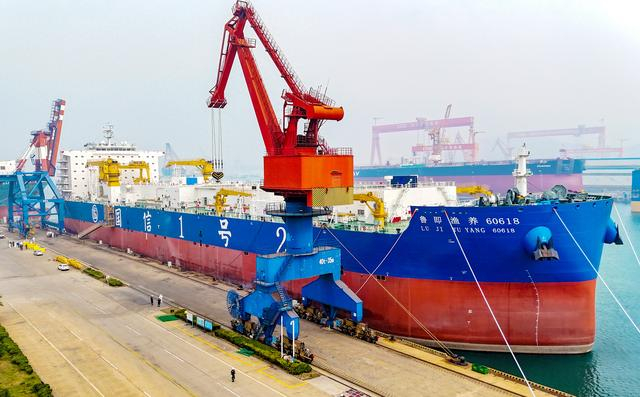
15万吨级智慧渔业养殖工船“国信1号2-2”在青岛交付
Xin Lang Cai Jing· 2025-11-15 09:17
Core Insights - The delivery of the 150,000-ton smart fishery breeding vessel "Guoxin 1 Hao 2-2" marks a significant advancement in the aquaculture industry, enhancing operational capabilities in feeding and water collection systems [1] - The vessel will conduct year-round continuous breeding trials for salmon and trout, establishing a comprehensive industry chain from seedling cultivation to marketing [1] Group 1 - The investment and construction of the vessel were undertaken by Qingdao Guoxin Group, indicating strong corporate involvement in the development of smart aquaculture solutions [1] - The vessel is named "Lu Ji Yu Yang 60618," reflecting its operational focus on fish farming [1] - The upgraded core systems of the vessel are expected to improve efficiency and productivity in aquaculture operations [1]
15万吨级智慧渔业养殖工船“国信1号2-2”在青岛交付#
Xin Hua She· 2025-11-15 09:08
Core Viewpoint - The delivery of the smart fishery breeding vessel "Guoxin 1 Hao 2-2" marks a significant advancement in the aquaculture industry, focusing on continuous breeding experiments for salmon and trout, and aims to establish a complete industry chain from seedling to marketing [1]. Group 1 - The vessel has a capacity of 150,000 tons and was constructed by Qingdao Beihai Shipbuilding Co., a subsidiary of China Shipbuilding Group [1]. - The upgraded core systems of the vessel include feeding and water intake, enhancing operational efficiency [1]. - The vessel is named "Lu Ji Yu Yang 60618" and is set to conduct year-round breeding trials [1].


我省多措并举推动“老旧小木”渔船整改
Liao Ning Ri Bao· 2025-11-15 01:02
Core Viewpoint - The provincial government is implementing measures to enhance fishing safety by focusing on the renovation of old wooden fishing boats, aiming for comprehensive upgrades by 2028 to improve safety standards and operational efficiency [1][2]. Group 1: Policy and Implementation - The province emphasizes a "market-oriented, government-guided" approach, with a goal to fully renovate old wooden fishing boats by 2028, enhancing safety and modernizing equipment [1]. - Financial incentives include a 30% subsidy on the cost of boat renovations, with a tiered reduction policy for interest and fees to encourage early participation from fishermen [1]. Group 2: Financial Support - A comprehensive financial support system is being established, including policy loans, personalized commercial loans, insurance, and guarantees, with the aim of providing extensive financial backing for boat renovations [2]. - Current loan rates for agricultural development have been reduced to 2.85%, with efforts to extend loan terms up to 20 years, while other banks offer loans with rates around 3% for terms up to 10 years [2]. Group 3: Standardization and Cost Reduction - The province is actively promoting the approval of standardized boat types, with 11 types already passing initial reviews, focusing on safety, functionality, and ecological management [2]. - To reduce production costs, the provincial authorities are collaborating with local steel companies to facilitate joint procurement of materials for boat construction [2]. Group 4: Project Progress - As of November 6, two fishing boat renovation projects in Dalian, with a total investment of 8.9 billion, have secured 7 billion in loans, aiming to renovate 892 boats and construct 372 new ones [3]. - The provincial government plans to continue advancing standardization, financial policy implementation, and approval processes, deploying teams to address fiscal policy and subsidy issues on-site [3].
天马科技:多举措促进公司内在价值与市场价值共同成长
Zheng Quan Ri Bao Wang· 2025-11-14 14:11
Group 1 - The core viewpoint of the article is that the stock price of Tianma Technology (603668) is influenced by multiple factors including macroeconomic conditions, policies, industry trends, market conditions, sector hotspots, and investor preferences, leading to uncertainty in the secondary market [1] - The company is focused on enhancing its core competitiveness, improving operational management quality, increasing the quality of information disclosure, and strengthening communication with investors to promote the growth of its intrinsic value alongside market value [1]

聚焦大湾区农交会|“媒体+”解码粤东地标:潮客文化孕育产业珍馐
Nan Fang Nong Cun Bao· 2025-11-14 11:04
Core Viewpoint - The article highlights the upcoming 2025 Greater Bay Area Agricultural Products Trade Fair and Specialty Products Expo, showcasing the unique agricultural products from the five cities of Eastern Guangdong, aiming to tap into the trillion-dollar consumption market of the Bay Area [12][13]. Group 1: Agricultural Products and Industry Development - The five cities of Eastern Guangdong (Shantou, Shanwei, Chaozhou, Jieyang, Meizhou) are known for their unique geographical features and rich agricultural products, including the famous Meizhou pomelo and Chaozhou Phoenix tea [15][19][30]. - Meizhou has become the largest pomelo production area in Guangdong, with a planting area of 650,000 mu and an annual output accounting for 20% of the national total, generating an industry value exceeding 8.9 billion yuan [20][26][27]. - Chaozhou's Phoenix tea has been recognized as a national specialty product, with an annual output value exceeding 1.8 billion yuan and a planting area of 117,600 mu [30]. - The bamboo shoots from Jieyang are also notable, with a planting area of 52,300 mu and an annual output value surpassing 1.5 billion yuan [33]. Group 2: Industry Upgrading and Technological Innovation - The Shantou city has developed a complete industrial chain for the "Lion Head Goose," with an annual output exceeding 8 million geese and a total industry value of over 4.5 billion yuan [37]. - The traditional food products from the Hakka culture, such as Hakka salt-baked chicken and pickled vegetables, are experiencing industrial upgrades through standardized production [64]. - The integration of technology in traditional fisheries is evident, with the establishment of breeding bases and smart farming platforms in Shantou and Shanwei, enhancing productivity and sustainability [56][57]. Group 3: Market Expansion and Brand Development - The upcoming trade fair is expected to facilitate the transition of local products from "regional specialties" to "industry landmarks," providing a platform for technological empowerment, brand building, and industry chain extension [68][69]. - The event will attract over 1,000 core buyers and feature a "supply-demand matching area" to enhance market penetration and brand influence for Eastern Guangdong agricultural products [73]. - The fair has already achieved significant exposure, with over 10 million interactions and connections to a media matrix of over 100 million users, indicating strong market interest [71].

天马科技(603668.SH)10月鳗鱼出池约1732.99吨
智通财经网· 2025-11-14 09:16
Core Viewpoint - Tianma Technology (603668.SH) reported its eel output and sales figures for October 2025, indicating a significant volume of both external sales and self-use, with varying price ranges for different specifications of eels [1] Group 1: Eel Output and Sales - In October 2025, the company produced approximately 1,732.99 tons of eels, with external sales accounting for about 680.47 tons and self-use for approximately 1,052.52 tons [1] - The specifications of the eels produced in October mainly ranged from 1P to 5P, with sales prices between 55,000 yuan/ton and 100,000 yuan/ton [1] - From January to October 2025, the total eel output reached approximately 15,218.73 tons, with external sales of about 8,478.82 tons and self-use of around 6,739.90 tons [1] Group 2: Price Trends - The sales price range for eels from January to October 2025 varied between 50,000 yuan/ton and 130,000 yuan/ton, reflecting a broader price spectrum compared to October alone [1]
天马科技(603668.SH):1-10月公司鳗鱼累计出池约15218.73吨
Ge Long Hui· 2025-11-14 09:11
Core Viewpoint - The company, Tianma Technology, reported its eel output for October 2025, indicating a significant production and sales performance in the eel industry [1] Group 1: October 2025 Eel Output - In October 2025, the company reported an eel output of approximately 1,732.99 tons, with external sales accounting for about 680.47 tons and self-use for approximately 1,052.52 tons [1] - The main specifications of the eels produced in October were between 1P-5P, with sales prices ranging from 55,000 yuan/ton to 100,000 yuan/ton [1] Group 2: Cumulative Output for January to October 2025 - From January to October 2025, the company’s cumulative eel output reached approximately 15,218.73 tons, with external sales of about 8,478.82 tons and self-use of approximately 6,739.90 tons [1] - The specifications for the cumulative output during this period were also primarily in the 1P-5P range, with sales prices varying from 50,000 yuan/ton to 130,000 yuan/ton [1]