
有色金属冶炼和压延加工业

Search documents
电工合金: 向不特定对象发行可转换公司债券方案的论证分析报告
Zheng Quan Zhi Xing· 2025-08-29 18:13
Core Viewpoint - Jiangyin Electric Alloy Co., Ltd. plans to issue convertible bonds to raise up to 545 million yuan for projects including the production of high-performance copper and copper alloy materials and to supplement working capital and repay bank loans [1][22]. Group 1: Issuance Details - The company intends to issue convertible bonds convertible into A-shares listed on the Shenzhen Stock Exchange [1]. - The total amount to be raised is expected to not exceed 545 million yuan, which will be used for a project with an annual production capacity of 35,000 tons of high-performance copper and copper alloy materials and for working capital [1][22]. Group 2: Necessity of Issuance - Traditional bank loans are limited in amount and can lead to high financial costs, which may reduce profitability and shareholder returns [2]. - The issuance of convertible bonds provides an option for conversion into shares, combining both equity and debt characteristics, and typically has a lower coupon rate, significantly reducing financing costs [2]. Group 3: Target Investors - The issuance will prioritize existing shareholders, who have the right to waive their subscription rights, with the remaining bonds offered to institutional investors and other qualified investors [3][4]. Group 4: Pricing and Valuation - The initial conversion price will not be lower than the average trading price of the company's shares over the last 20 trading days prior to the announcement [5][7]. - The pricing method and procedures for the issuance comply with relevant regulations and are deemed reasonable [8][7]. Group 5: Use of Proceeds - The funds raised will be strictly used for the specified projects and cannot be redirected for loss compensation or non-productive expenditures [9][14]. - The projects align with national industrial policies and are expected to enhance the company's core competitiveness and sustainable development [9][22]. Group 6: Compliance and Governance - The company has established a sound organizational structure and complies with the relevant laws and regulations, ensuring proper governance and operational efficiency [10][11]. - The financial reports for the last three years have received unqualified audit opinions, indicating compliance with accounting standards [12]. Group 7: Impact on Shareholder Rights - The issuance may dilute immediate returns for existing shareholders, but the company plans to implement measures to mitigate this risk and enhance shareholder value [24][25]. - The issuance plan has undergone careful consideration by the board and will be subject to a fair vote by shareholders [23][24]. Group 8: Conclusion - The issuance of convertible bonds is deemed necessary and feasible, with a fair and reasonable plan that aligns with the company's strategic goals and benefits all shareholders [24][25].

电工合金: 向不特定对象发行可转换公司债券预案
Zheng Quan Zhi Xing· 2025-08-29 18:13
Core Viewpoint - Jiangyin Electric Alloy Co., Ltd. plans to issue convertible bonds to unspecified investors, with a total fundraising amount not exceeding 545 million yuan, aimed at enhancing operational capacity and financial stability [6][19]. Group 1: Issuance Overview - The type of securities to be issued is convertible bonds, which can be converted into company stock and will be listed on the Shenzhen Stock Exchange's Growth Enterprise Market [6]. - The total amount of funds to be raised through this issuance is capped at 545 million yuan, with each bond having a face value of 100 yuan [6]. - The maturity period for the convertible bonds is set at six years from the date of issuance [6]. - The interest payment for the bonds will occur annually, with the principal and final interest due at maturity [7][8]. Group 2: Financial Use of Proceeds - The proceeds from the bond issuance will be allocated to projects including the production of high-performance copper and copper alloy materials, as well as replenishing working capital and repaying bank loans [19]. - The total investment for the production project is estimated at 642.77 million yuan, with 545 million yuan expected to be funded through the bond issuance [19]. Group 3: Financial Information - The company reported a total asset value of approximately 1.999 billion yuan as of June 30, 2025, with current assets amounting to about 1.699 billion yuan [21][22]. - The company’s current liabilities stood at approximately 808 million yuan, indicating a significant portion of its financial obligations [22]. - The company has shown a steady increase in cash and cash equivalents, with 276.29 million yuan reported as of June 30, 2025 [21].
电工合金: 向不特定对象发行可转换公司债券募集资金使用可行性分析报告
Zheng Quan Zhi Xing· 2025-08-29 18:13
Fundraising Plan - The company plans to issue convertible bonds to raise up to RMB 545 million, with the net proceeds allocated to specific projects after deducting issuance costs [1][2] - If the raised funds are insufficient for project needs, the company will use self-raised funds and replace them once the proceeds are available [2] Investment Projects - The primary project involves the construction of a facility in Xiamen to produce 35,000 tons of high-performance copper and copper alloy materials, with a total investment of RMB 485.77 million, of which RMB 388 million will come from the raised funds [2][3] - The project aims to alleviate production capacity bottlenecks and enhance order acceptance capabilities, addressing the growing demand for copper products in the local market [3][4] Market Demand and Strategic Positioning - The demand for high-quality copper products is driven by the growth of the power distribution and renewable energy sectors in Xiamen, where local supply currently relies on distant suppliers [4] - The company aims to establish a local factory to reduce logistics costs and improve response times to customer needs, thereby integrating better into the local supply chain [4] Industry Growth Opportunities - The global data center market is projected to grow from USD 187.14 billion in 2024 to USD 546.99 billion by 2031, with a CAGR of 16.8% from 2025 to 2031, indicating a significant opportunity for copper products [5] - The new energy vehicle industry in China is expected to see production increase from 1.366 million units in 2020 to 12.888 million units in 2024, with a CAGR of approximately 75.26%, further driving demand for copper materials [6] Company Strengths - The company has a strong technical foundation and management experience, recognized as a provincial engineering research center, which supports its project implementation [7] - Established relationships with major international and domestic clients enhance the company's market position and brand influence [7][8] Financial Implications - The issuance of convertible bonds will improve the company's financial structure, reduce financial costs, and enhance liquidity, supporting sustainable growth [10][11] - The project is expected to generate continuous cash flow and improve profitability, benefiting both the company and its investors [11][12]
中金岭南: 关于2025年度向特定对象发行A股股票申请获得深圳证券交易所受理的公告
Zheng Quan Zhi Xing· 2025-08-29 17:47
Group 1 - The company, Shenzhen Zhongjin Lingnan Nonfemet Company Limited, has received acceptance from the Shenzhen Stock Exchange for its application to issue A-shares to specific investors [1] - The application documents submitted by the company were found to be complete by the Shenzhen Stock Exchange, which decided to accept the application [1] - The issuance of A-shares is subject to approval by the Shenzhen Stock Exchange and registration by the China Securities Regulatory Commission, indicating uncertainty regarding the final approval and timeline [1]

中金岭南: 深圳市中金岭南有色金属股份有限公司2025年度向特定对象发行A股股票募集说明书(申报稿)
Zheng Quan Zhi Xing· 2025-08-29 17:47
Core Viewpoint - Shenzhen Zhongjin Lingnan Nonfemet Co., Ltd. plans to issue A-shares to specific investors to raise funds for working capital and repay bank loans, with a share price set at 3.74 yuan per share, subject to adjustments based on certain conditions [1][2]. Company Overview - The company is engaged in the production and processing of non-ferrous metals, primarily focusing on lead, zinc, and copper [5]. - As of March 31, 2025, the total number of shares is 3,737,596,125, with a significant portion held by Guangdong Guangsheng Holding Group, which controls 35.72% of the shares [5]. Financial Information - The company reported total revenues of 55.44 billion yuan and 65.65 billion yuan for the previous two years, with net profits of 1.17 billion yuan and 642.62 million yuan respectively [2]. - The proposed cash dividend is 0.87 yuan per 10 shares, totaling approximately 325.17 million yuan [1]. Share Issuance Details - The issuance will involve a maximum of 409,836,065 shares, accounting for 10.97% of the total shares before the issuance [1]. - The final number of shares issued will depend on the approval from the China Securities Regulatory Commission [1]. Industry Context - The company operates in the non-ferrous metal smelting and processing industry, which is capital-intensive and subject to macroeconomic fluctuations [2][5]. - The industry is regulated by various government bodies, including the National Development and Reform Commission and the Ministry of Industry and Information Technology [5][6]. Risk Factors - The company faces risks related to inventory management, as it has significant inventory levels that could lead to liquidity issues if market prices fluctuate [2]. - There is a reliance on mineral resources, with potential discrepancies between estimated and actual reserves impacting operations [2].
创新新材: 华泰联合证券有限责任公司关于创新新材料科技股份有限公司募投项目结项并将节余募集资金永久补充流动资金及注销募集资金专户的核查意见
Zheng Quan Zhi Xing· 2025-08-29 16:51
Core Viewpoint - The company, Innovation New Materials Technology Co., Ltd., is undergoing a significant asset sale and capital raising process, which includes the acquisition of 100% equity in Shandong Innovation Metal Technology Co., Ltd. and the issuance of shares to specific investors [1][2]. Fundraising Overview - The company raised a total of approximately RMB 1.5 billion by issuing 332,594,235 shares at a price of RMB 4.51 per share, with all funds received by August 14, 2023 [2][3]. - The funds raised will be managed in a dedicated account, with agreements signed with several banks to ensure proper oversight [3][4]. Fund Utilization - As of August 15, 2025, the company has utilized RMB 583.48 million for the "Annual Production of 120,000 Tons of Lightweight High-Strength Aluminum Alloy Materials Project (Phase II)" and has a remaining balance of RMB 210.70 million in the fundraising account [6][7]. - The company has also approved the temporary use of up to RMB 470 million of idle funds to supplement working capital, with a commitment to return these funds to the dedicated account within a specified timeframe [7][10]. Reasons for Fund Surplus - The surplus in funds is attributed to effective cost control in equipment procurement and construction, interest income generated during the fund's storage period, and the timing of certain contractual payments [8][9]. - The company plans to use the surplus funds for daily operations and business development, enhancing the efficiency of fund utilization [9][10]. Impact of Fund Surplus on Company - The decision to permanently supplement working capital with surplus funds is expected to improve liquidity, reduce financial costs, and enhance operational efficiency without negatively impacting business operations [10][11]. - The company has adhered to regulatory requirements throughout the process, ensuring that the interests of shareholders are protected [11].

豫光金铅: 河南豫光金铅股份有限公司2025年半年度报告
Zheng Quan Zhi Xing· 2025-08-29 16:41
Core Viewpoint - Henan Yuguang Gold & Lead Co., Ltd. reported significant growth in revenue and profit for the first half of 2025, driven by increased production and favorable market conditions for metals [2][8]. Financial Performance - The company's operating income for the first half of 2025 was approximately CNY 22.44 billion, a year-on-year increase of 18.93% compared to CNY 18.87 billion in the same period of 2024 [2][8]. - Total profit reached CNY 626.41 million, up 17.27% from CNY 534.16 million in the previous year [2][8]. - Net profit attributable to shareholders was CNY 484.65 million, reflecting a 15.12% increase from CNY 421.01 million [2][8]. - The company's total assets increased by 10.59% to CNY 19.47 billion from CNY 17.61 billion at the end of the previous year [2][8]. Production and Sales - The production of lead products reached 331,277.18 tons, a 14.64% increase from 288,970.63 tons in the first half of 2024 [8]. - Sales of lead products were 315,314.46 tons, up 10.08% from 286,430.55 tons [8]. - The company experienced a decrease in the production of cathode copper and gold, with cathode copper production down 5.03% and gold production down 14.84% [8]. Industry Context - The company operates in the non-ferrous metal smelting and rolling processing industry, focusing on the production and sale of lead ingots, cathode copper, gold, and silver [3][4]. - The lead price showed significant volatility in the first half of 2025, with the average LME three-month lead price decreasing by 0.9% year-on-year [3][4]. - Copper prices exhibited a "N" shaped trend, with the average LME three-month copper price increasing by 2.42% year-on-year to USD 9,445.4 per ton [3][4]. - Precious metals saw strong price increases, with COMEX gold rising by 25.52% and domestic gold prices increasing by 24.50% by the end of June 2025 [3][4]. Business Model and Strategy - The company emphasizes a circular economy model, integrating primary and recycled lead production to enhance resource efficiency and sustainability [5][6]. - The production process includes comprehensive recovery of by-products such as gold, silver, zinc, and sulfuric acid, contributing to overall profitability [5][6]. - The company has established a differentiated management model to optimize production scheduling and improve operational efficiency [9][10]. Competitive Advantages - The company leads in domestic lead smelting technology, with its processes recognized as industry benchmarks for energy efficiency [12]. - A skilled workforce with over 210 technical professionals supports the company's innovation and market adaptability [12]. - The company maintains strong market relationships with major battery manufacturers and raw material suppliers, enhancing its competitive position [12].

电工合金(300697.SZ):拟发行可转债募资不超5.45亿元 用于年产3.5万吨高性能铜及铜合金材料生产制造项目等
Ge Long Hui A P P· 2025-08-29 15:23
Group 1 - The company, Electric Alloy (300697.SZ), announced a plan to issue convertible bonds to unspecified investors, aiming to raise a total of no more than 545 million yuan (including principal) [1] - The net proceeds from the bond issuance, after deducting issuance costs, are intended for a project to produce 35,000 tons of high-performance copper and copper alloy materials, as well as to supplement working capital and repay bank loans [1]
静海区多家企业入围2025中国民营企业500强榜单
Sou Hu Cai Jing· 2025-08-29 10:30
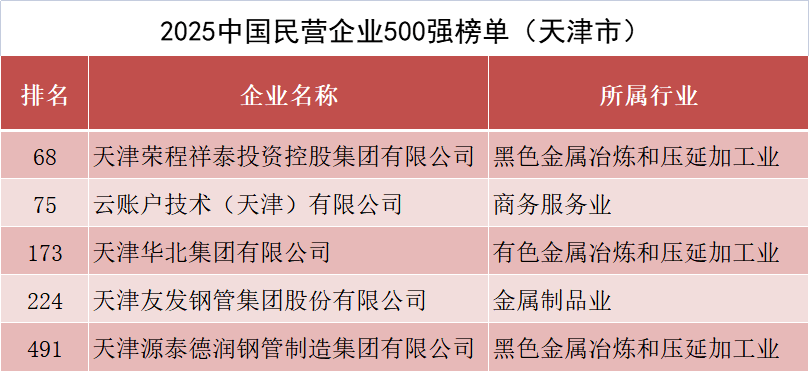
Group 1 - The "2025 China Top 500 Private Enterprises" report indicates that the threshold for entry has increased to 27.023 billion yuan, with total revenue reaching 4.305 trillion yuan, an average of 861.02 million yuan per enterprise, reflecting a growth of 2.72% year-on-year [1] - Total assets of the top 500 private enterprises amount to 51.15 trillion yuan, with an average of 1.023 billion yuan per enterprise, showing a growth of 2.62% [1] - The net profit of these enterprises is 1.8 trillion yuan, averaging 360.5 million yuan per enterprise, which represents a growth of 6.48% [1] Group 2 - In the Jinghai District, two private enterprises, Tianjin Youfa Steel Pipe Group Co., Ltd. and Tianjin Yuantai Derun Steel Pipe Manufacturing Group Co., Ltd., made it to the "2025 China Top 500 Private Enterprises" list [1] - The same two companies, along with Tianjin Baolai Steel Co., Ltd., Aima Technology Group Co., Ltd., and Tianjin New Energy Recycling Resources Co., Ltd., are included in the "2025 China Top 500 Private Manufacturing Enterprises" list [1] - The private enterprises in Jinghai District are showing strong growth and diversification, particularly in core sectors such as steel pipe manufacturing, new energy, and technology equipment [2] Group 3 - Tianjin Youfa Steel Pipe Group Co., Ltd. has maintained its position as an industry leader for three consecutive years [2] - Aima Technology Group Co., Ltd. is increasing its market share in the electric vehicle sector [2] - Tianjin New Energy Recycling Resources Co., Ltd. is playing a demonstrative role in the green and low-carbon transition [2] Group 4 - The rankings of Tianjin enterprises in the "2025 China Top 500 Private Enterprises" include Tianjin Rongcheng Xiangtai Investment Holding Group Co., Ltd. at 68th, Yunzhang Account Technology (Tianjin) Co., Ltd. at 75th, and others [3] - In the "2025 China Top 500 Private Manufacturing Enterprises," Tianjin Rongcheng Xiangtai Investment Holding Group Co., Ltd. ranks 49th, followed by Tianjin Youfa Steel Pipe Group Co., Ltd. at 162nd [4]


嘉元科技:上半年营收同比增长63.55% 重点布局高频高速电路铜箔等高端应用产品
Zhong Zheng Wang· 2025-08-29 07:44
Core Viewpoint - The company, Jia Yuan Technology, reported significant growth in its financial performance for the first half of 2025, driven by increased sales orders, higher capacity utilization, and reduced production costs [1][2] Financial Performance - The company achieved operating revenue of 3.963 billion yuan, a year-on-year increase of 63.55% [1] - Net profit attributable to shareholders was 36.7541 million yuan, marking a turnaround from a loss in the previous year [1] - Basic earnings per share reached 0.09 yuan, compared to -0.25 yuan in the same period last year [1] Production and Capacity - The company's production capacity for copper foil exceeded 130,000 tons by the end of the reporting period [1] - Copper foil production was approximately 41,400 tons, reflecting a year-on-year growth of 72.46% [1] - Copper foil sales reached 40,700 tons, with a year-on-year increase of 63.01% and a capacity utilization rate exceeding 90% [1] Research and Development - R&D investment for the first half of 2025 amounted to 190 million yuan, representing a year-on-year increase of 40.82% [2] - The company has expanded its product matrix in the lithium battery copper foil sector, achieving stable mass supply of ultra-thin copper foils [2] - Notable advancements in solid-state battery technology have been made, with products like high specific surface area copper foil and special alloy copper foil being supplied to multiple enterprises [2] Strategic Focus - The company's development strategy in the PCB copper sector emphasizes high-end and differentiated products, targeting high-frequency, high-speed circuit copper foil, HDI copper foil, and special functional copper foil [1] - The company is actively exploring overseas markets while optimizing its product structure to increase the proportion of high-value-added products [1]
