军事装备制造

Search documents
乌克兰称无人机袭击俄防空导弹工厂
news flash· 2025-07-01 12:52
Core Viewpoint - Ukraine has conducted a drone strike on a Russian military factory producing air defense systems, indicating an escalation in the conflict between Ukraine and Russia [1] Group 1: Incident Details - The drone strike targeted a military factory located in Izhevsk, Udmurt Republic, approximately 1300 kilometers (808 miles) from the Ukrainian border [1] - The factory is also responsible for the production of attack drones [1] Group 2: Casualties and Impact - The attack resulted in 3 fatalities and 35 injuries, as confirmed by the governor of the Udmurt region, Alexander Brechlov [1] - Specific details regarding the exact location of the attack were not disclosed [1]
美国批准向澳大利亚出售20亿美元军事装备
news flash· 2025-06-17 00:14
Core Viewpoint - The U.S. has approved a potential agreement to sell military equipment to Australia valued at approximately $2 billion, which includes parts for fighter jets [1] Group 1: Military Equipment Sale - The agreement includes equipment and services for Boeing F/A-18F Super Hornet fighter jets and EA-18G Growler electronic attack aircraft, which are capable of disrupting and deceiving various military electronic systems [1] - The U.S. Defense Security Cooperation Agency has submitted the necessary certification documents to Congress for the potential sale [1] - Boeing is identified as the primary contractor for the proposed sale [1]
乌无人机袭击俄纵深区域的无人机生产基地
news flash· 2025-06-16 21:55
Core Viewpoint - The ongoing drone warfare between Ukraine and Russia has intensified, with Ukraine targeting critical Russian military infrastructure, including drone production facilities [1] Group 1: Military Actions - On June 15, Ukrainian forces launched a drone attack on a Russian drone production base located in Tatarstan, aiming to weaken Russia's capability to produce attack drones [1] - The same day, the Russian Ministry of Defense reported that Russian forces conducted a coordinated strike using air and sea-based precision weapons against a fuel supply facility in Ukraine's Poltava region, which supports Ukrainian military operations in the Donbas area [1] Group 2: Strategic Implications - The increase in drone attacks by Ukraine signifies a strategic shift in the conflict, focusing on disrupting Russian military production capabilities [1] - The targeting of deep Russian military assets indicates a potential escalation in the conflict, as both sides adapt their strategies to leverage drone technology [1]
以色列国防军:过去一小时内拦截了伊朗发射的大部分导弹。
news flash· 2025-06-15 14:02
Group 1 - The Israeli Defense Forces intercepted most of the missiles launched by Iran in the past hour [1]
伊朗:击落以色列F-35战机,俘获飞行员,发射第四、第五轮导弹
第一财经· 2025-06-14 02:37
Core Viewpoint - The article discusses the recent military escalation between Iran and Israel, highlighting the downing of Israeli F-35 fighter jets by Iranian defense systems and the ongoing retaliatory strikes from both sides [3][5]. Group 1: Military Engagement - Iranian media reported that on June 13, Iranian defense systems shot down two Israeli F-35 fighter jets and captured one pilot [3]. - The Israeli military has not confirmed the loss of its F-35 jets [4]. - Following the downing of the jets, Israel conducted large-scale airstrikes on multiple Iranian locations, targeting nuclear facilities and military sites, resulting in significant casualties [5]. Group 2: Retaliatory Actions - In response to Israeli airstrikes, Iran launched multiple rounds of missile attacks against Israel, with reports indicating that the Israeli military intercepted many of these missiles [6]. - As of June 14, Israel had experienced four rounds of missile attacks from Iran, with the first three rounds reportedly involving around 100 to 200 missiles [6]. - Israeli citizens were instructed to remain in shelters due to the ongoing missile threats, indicating a heightened state of alert across the country [5].


加拿大总理卡尼:加拿大将在本财政年度增加国防支出,以达到北约2%的GDP目标。加拿大将购买新潜艇、飞机、舰船、武装车辆和火炮,以及新的雷达系统和无人机。
news flash· 2025-06-09 14:10
Group 1 - The core point of the article is that Canada will increase its defense spending in the current fiscal year to meet NATO's target of 2% of GDP [1] - Canada plans to purchase new submarines, aircraft, ships, armored vehicles, artillery, radar systems, and drones as part of this defense spending increase [1]
重磅!欧洲真的要闹大了!
Sou Hu Cai Jing· 2025-06-04 07:47
Group 1 - The UK government plans to significantly expand its nuclear-powered submarine fleet and modernize its defense industry, with an investment of up to £145.6 billion for nuclear warhead production and the construction of 12 new nuclear submarines [1] - The ongoing Russia-Ukraine war has deeply impacted the UK, highlighting the need for sufficient military equipment to support modern military conflicts [1] - Germany's decision to lift restrictions on missile range for Ukraine could lead to direct conflict with Russia, as it allows Ukraine to target Moscow, which is a critical threshold for Russian President Putin [3][4] Group 2 - The potential for a direct conflict between Germany and Russia could escalate the situation in Europe, drawing in other nations and increasing the risk of a broader war [3][8] - The UK is aware of the threats posed by Russia and has announced a return to a state of military readiness in response to recent developments [4] - The current geopolitical climate presents a unique opportunity for European nations to address the Russian threat, with the possibility of a united Europe emerging from the conflict [5][7]

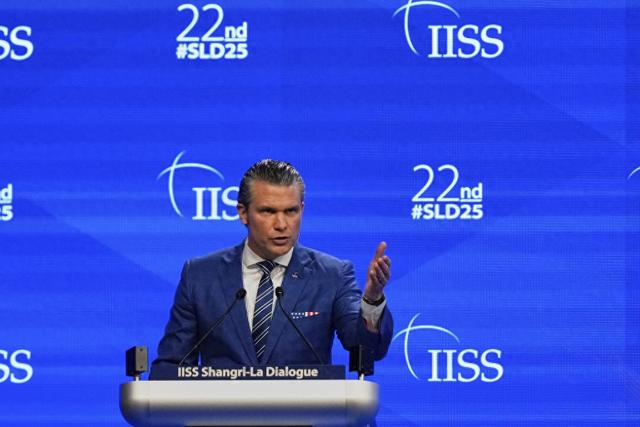
香格里拉对话|美国防长:国防预算将达到1万亿美元,重振美军威慑力
Xin Lang Cai Jing· 2025-05-31 04:33
Group 1 - The 22nd Shangri-La Dialogue is being held in Singapore from May 30 to June 1, with over 550 representatives from defense and security agencies from more than 40 countries attending [1] - U.S. Secretary of Defense Lloyd Austin emphasized the need to reshape military spirit, rebuild the military, and restore deterrence during his speech [3] - The U.S. defense budget for fiscal year 2026 is projected to reach $1 trillion, including funding for the Iron Dome defense system, the sixth-generation fighter F-47, the new stealth bomber B-21, and new submarines and destroyers [3] Group 2 - Austin criticized the Biden administration's previous four years, stating that the world has seen a weak America, and pledged to restore deterrence [3] - The Trump administration's efforts to rapidly rebuild the U.S. military were highlighted, with a commitment to wisely use every dollar to enhance lethality and readiness [3] - Concerns were raised by Forbes regarding the effectiveness of increasing nuclear weapons and costly unproven missile defense systems in addressing America's most pressing security challenges [4] Group 3 - Chinese defense officials criticized the U.S. for advancing the deployment of space-based weapons systems, claiming it violates the Outer Space Treaty and exacerbates the arms race [4] - The Chinese government urged the U.S. to halt its military expansion in outer space to maintain global strategic stability [4]
本轮巴以冲突爆发以来 美已向以提供超9万吨军事物资
news flash· 2025-05-28 16:08
Core Points - The U.S. has provided over 90,000 tons of military supplies to Israel since the outbreak of the latest Israel-Palestine conflict in October 2023 [1] - The supplies include armored vehicles, ammunition, personal protective equipment, and medical supplies, deemed essential for the operational capabilities of the Israel Defense Forces [1] - The Biden administration initiated significant military support for Israel, which has continued under the Trump administration, including a recent announcement of $7.4 billion worth of weapons [1] Summary by Category Military Support - The U.S. has dispatched 800 flights and 140 naval shipments to deliver military supplies to Israel [1] - The military supplies are considered a "key element" for the ongoing operations of the Israel Defense Forces [1] Government Actions - The Biden administration has been proactive in providing military assistance to Israel since the conflict escalated [1] - The Trump administration has also maintained support for Israel, including lifting restrictions on the export of heavy bombs [1]
业绩不振,并购前夕,北方长龙被多家外资机构买入!
IPO日报· 2025-05-27 09:04
Core Viewpoint - The recent revision of the "Major Asset Restructuring Management Measures for Listed Companies" by the China Securities Regulatory Commission has intensified the merger and acquisition (M&A) activities among listed companies, with many companies announcing acquisition plans despite facing operational challenges [1][4]. Group 1: Company Overview - Northern Long Dragon New Materials Technology Co., Ltd. (301357.SZ) plans to acquire a controlling stake in Henan Zhongsheng Composite Materials Co., Ltd. through a combination of issuing A-shares and cash payments [1]. - Henan Zhongsheng, established in 2019 with a registered capital of 30 million yuan, specializes in the research, design, and production of fiberglass and polyurethane pultrusion molds [2]. - Northern Long Dragon focuses on military equipment, particularly in the research and development of non-metal composite materials for military vehicle applications [3]. Group 2: Financial Performance - Northern Long Dragon's financial performance has been declining, with revenues of 259.86 million yuan in 2020, dropping to 107.74 million yuan in 2024, and net profits decreasing from 93.16 million yuan in 2020 to a loss of 10.89 million yuan in 2024 [6]. - In the first quarter of 2025, the company reported a revenue of 20.57 million yuan, a year-on-year decline of 16.86%, and a net loss of 5.07 million yuan, a significant drop of 244.16% compared to the previous year [7]. Group 3: Market Sentiment - Despite the declining performance, several foreign institutions have increased their stakes in Northern Long Dragon, indicating a potential positive outlook. Notable investors include J.P. Morgan Securities PLC and Morgan Stanley, among others [8]. - The interest from foreign investors raises questions about whether they have insider knowledge regarding the upcoming acquisition, as they have entered the top ten shareholders list during a period of financial struggle for the company [8].