算力产业

Search documents
算力专题:全球算力十大趋势2026
Sou Hu Cai Jing· 2026-01-05 14:15
Core Insights - Computing power has become the core engine driving the digital economy and intelligent transformation, with global computing power scaling exponentially and countries elevating it to a national strategy [12][18][22] - AI large models are evolving into the "operating system" of the intelligent world, accelerating penetration across various industries and driving explosive growth in computing power demand [12][34] - The computing power supply system is being upgraded to meet the complex task processing requirements of intelligent agents, leading to a significant market expansion [12][16] Group 1: Trends in Computing Power - Global computing power is experiencing rapid growth, becoming a strategic high ground in global technology competition [15][18] - AI is accelerating its entry into various industries, with large models becoming the foundational platform for the intelligent world [15][34] - The transition from traditional CPU-centric computing architecture to diverse and collaborative architectures is underway [15][17] Group 2: Infrastructure and Ecosystem - Supernodes are emerging as the new foundation for computing power, marking the entry into the supernode era for intelligent computing centers [15][17] - The integration of computing power and networks is progressing, enabling "on-demand" computing power access [15][17] - An open-source ecosystem is becoming the core of the computing power landscape, facilitating innovation and collaboration across the industry [15][16] Group 3: Energy and Sustainability - Intelligent computing centers are evolving towards high-density, liquid-cooled, and clustered configurations, addressing energy consumption challenges [15][17] - The direct supply of green electricity is becoming a key factor in solving energy consumption issues [15][17] Group 4: Quantum Computing - Quantum computing is entering a critical engineering phase, with the next 1-2 years expected to be a key window for technological breakthroughs and commercialization [15][17]


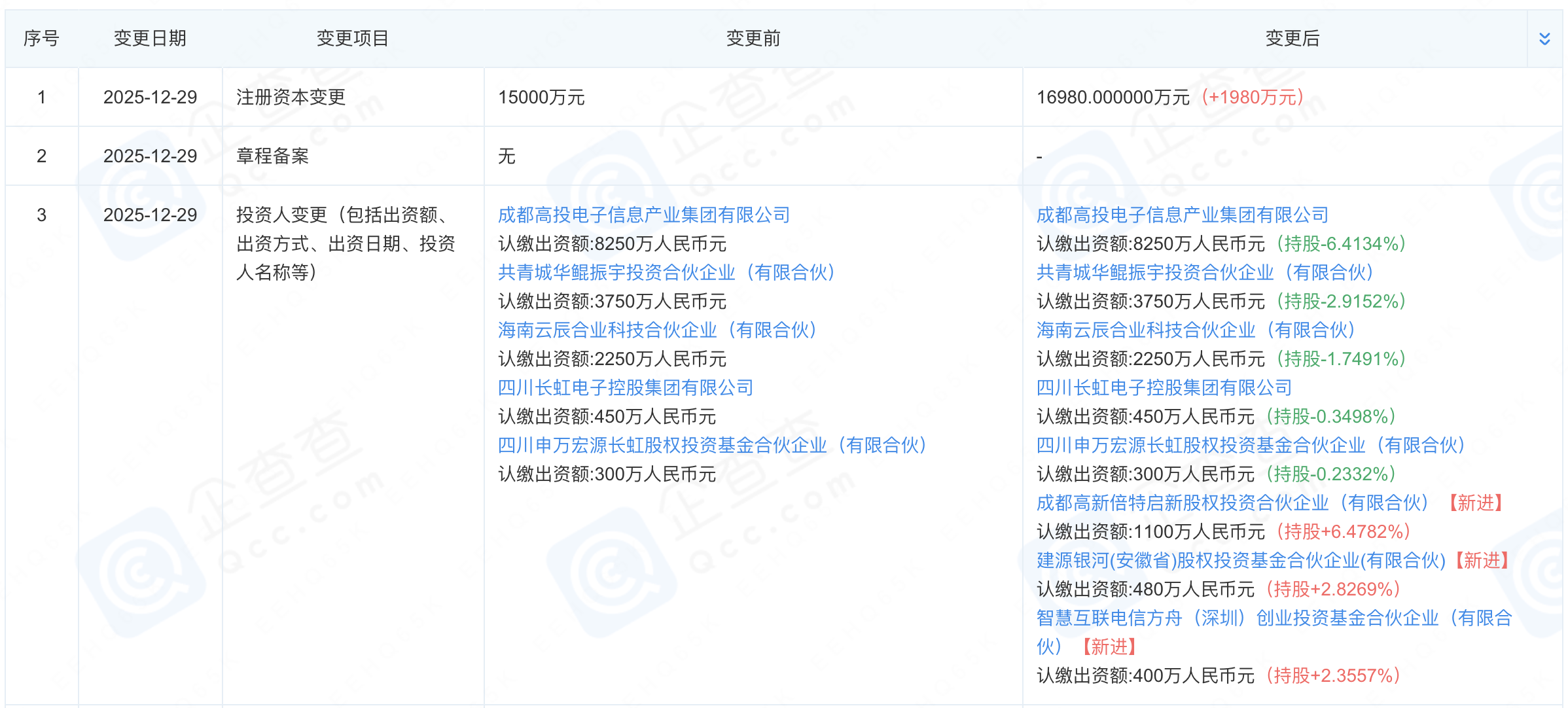
华鲲振宇完成增资扩股新增3名股东 成都高投集团旗下公司参与
Zheng Quan Shi Bao Wang· 2025-12-30 06:29
Core Viewpoint - Sichuan Huakun Zhenyu Intelligent Technology Co., Ltd. has completed its capital increase and share expansion, introducing three new shareholders and increasing its registered capital from 150 million to 169 million RMB, reflecting a growth of 19.8 million RMB [1][7]. Group 1: Shareholder Changes - The new shareholders include Chengdu High-tech Beite Qixin Equity Investment Partnership (Limited Partnership) holding 6.48%, Jianyuan Galaxy (Anhui) Equity Investment Fund Partnership (Limited Partnership) holding 2.83%, and Zhihui Hulian Telecom Ark (Shenzhen) Venture Capital Fund Partnership (Limited Partnership) holding 2.26% [1]. - Chengdu High-tech Investment Group, the largest shareholder, holds 48.59% of Huakun Zhenyu [2]. Group 2: Financial Performance - Huakun Zhenyu has shown rapid growth in revenue, achieving 3.424 billion RMB in 2022, 8 billion RMB in 2023, and projected to reach 12.639 billion RMB in 2024, with net profits of 43.644 million RMB, 141.611 million RMB, and 153 million RMB respectively [9]. - The company is expected to exceed 15 billion RMB in revenue for the current year, following a successful A-round financing of 400 million RMB [9]. Group 3: Company Background and Future Plans - Established in 2020, Huakun Zhenyu is a leading player in the domestic Xinchuang industry and the largest computing power enterprise in Southwest China, focusing on products based on Huawei's "Kunpeng + Ascend" processors [7]. - The recent capital increase aims to support the company's ongoing development in operations, finance, securities, and new product lines, enhancing economic value and social benefits for stakeholders [7].
算力为“翼”叠加创新举措激活数字经济活力 为各行业创新发展筑牢更稳底座
Yang Shi Wang· 2025-12-30 01:57
Core Viewpoint - Inner Mongolia is emerging as a crucial hub for the national "East Data West Computing" initiative, leveraging its green energy advantages, computing power clusters, and industrial synergy to support innovation in various sectors, particularly artificial intelligence in the Beijing-Tianjin-Hebei region [1]. Group 1: Infrastructure and Development - Inner Mongolia's Hohhot New Area has established itself as a key player in the digital economy, with a focus on building digital infrastructure and fostering data industry development [12]. - The computing power infrastructure in Inner Mongolia has seen a significant leap, with total computing power increasing from less than 20,000 PetaFLOPS to 237,000 PetaFLOPS, with over 92% being intelligent computing [14]. - The region has built over 30 high-quality data sets and is hosting 31 well-known large model training and inference projects, with total parameters exceeding one trillion [15]. Group 2: Industry and Economic Impact - The Hohhot New Area has attracted 50 large data centers, 12 projects with over one trillion in general large models, and over 700 data service enterprises, forming a complete industrial chain [9]. - Inner Mongolia's data centers utilize over 80% green electricity, benefiting from the region's cool climate and abundant wind and solar energy resources [14]. - The region aims to transform its economy from a reliance on resource output to a high-quality digital economy, integrating digital and physical economic development [17]. Group 3: Technological Advancements - A self-developed smart cultural tourism model is being optimized, which can generate intelligent designs from text descriptions, potentially becoming Inner Mongolia's first approved large model [3]. - An esports cloud platform is being developed to support national esports events, providing reliable cloud services for participants from across the country [6]. - The low-latency computing power advantage is a key factor attracting enterprises to the Hohhot New Area, with data transmission times to key nodes being as low as 4.2 milliseconds [7][11].
让算力成为贵州核心竞争力
Xin Lang Cai Jing· 2025-12-28 22:35
Core Insights - Guizhou is transforming into a "digital highland" by leveraging its leading computing power, which is becoming a key indicator of economic and social development in the digital economy era [1][2] - The province has achieved a fundamental leap in its digital economy during the 14th Five-Year Plan period, with an annual growth rate of 16.2% in the intelligent industry, reflecting strategic optimization of computing power structure [2] - The collaboration between Guizhou and Shenzhen exemplifies a successful model of resource synergy, enhancing the efficiency of computing power utilization and supporting technological innovation in the Greater Bay Area [3][4] Industry Development - Guizhou's computing power capacity is projected to reach 150 EFLOPS, with over 97% of its computing power now being intelligent computing, positioning it as one of the strongest regions in the country for intelligent computing capabilities [2] - The province is actively promoting the integration of computing power into the real economy, leading to rapid growth in the digital industry and significant revenue increases in software and information technology services [2] - Guizhou is not only focusing on resource output but is also advancing the market-oriented allocation of data elements, creating a new ecosystem for data value extraction and enhancing the scale of the computing power market [4] Strategic Initiatives - The "East Data West Computing" initiative is being implemented to facilitate regional coordination and development in the digital age, showcasing a new logic for regional collaboration [1][2] - Guizhou has introduced policies such as the "computing power voucher" to lower the barriers for enterprises, enabling efficient cross-province resource matching and fostering a collaborative path of "Eastern demand + Western supply" [3][4] - The province's efforts in data collaboration and application innovation are expected to provide solid support for optimizing and reorganizing industrial and innovation chains across a broader scope [4]
内蒙古呼和浩特——产业三维发展显效应
Jing Ji Ri Bao· 2025-12-28 22:06
Core Viewpoint - Hohhot City in Inner Mongolia is advancing a modern industrial system by promoting the coordinated development of six industrial clusters, including green agricultural and livestock product processing, new energy, new materials, biomedicine, next-generation information technology, and modern equipment manufacturing, aiming for high-end, intelligent, and green transformation of industries [1][3] Industrial Development - Hohhot has established a comprehensive industrial ecological network through chain integration, regional collaboration, and innovation-driven strategies, fostering a three-dimensional development model of "traditional industry upgrade + emerging industry breakthrough + future industry cultivation" [1] - The city has signed 18 low-altitude equipment manufacturing projects with a total investment of 7.59 billion, expecting to produce an additional output value of 103 million by the end of the year [3] Drone Industry - The company Zhongyi Low-altitude Technology (Inner Mongolia) has been operational since July 2024, producing multi-rotor drones for various applications, including agricultural protection [1][2] - Hohhot has favorable conditions for drone applications and a solid industrial and talent foundation, which positions the city well for low-altitude economic development [2] Talent Development - The Inner Mongolia AI Model Innovation Space has signed contracts with 10 companies and is preparing for 20 more, focusing on AI model technology research and talent cultivation [2][3] - The Inner Mongolia Zhongguancun Zhiku Technology Co., Ltd. aims to train over 10,000 university students in practical training within five years to support the digital economy in Hohhot [2] Industrial Performance - From January to September 2025, Hohhot achieved an industrial output value of 187.46 billion, with a cumulative growth rate of 2.6%, accounting for 94.5% of the city's total industrial output [4]
(经济观察)中国加快算力基础设施互联互通
Zhong Guo Xin Wen Wang· 2025-12-27 13:04
Core Insights - The article discusses the importance of computing power interconnectivity and the computing power internet as a solution to make computing resources as accessible as water and electricity, highlighting China's efforts to establish a robust computing resource circulation system [1] Group 1: Computing Power Demand and Development - Global demand for computing power driven by artificial intelligence (AI) is growing exponentially, shifting competition from technology to ecosystem collaboration [1] - China ranks second globally in total computing power and intelligent computing power, but faces challenges such as uneven distribution and scheduling issues that need to be addressed through interconnectivity [2] Group 2: Achievements and Future Directions - Significant progress has been made in China's computing power interconnectivity, with a framework established that includes standardization, facility interconnection, and scenario empowerment [2] - The national computing power internet service platform is set to launch in 2024, facilitating unified access and service calls across key regions like Beijing, Shanghai, Sichuan, and Hubei [2] - The opening of the "Hong Kong-Guangzhou" data express line and the launch of the Sichuan hub node are key developments in enhancing regional computing power scheduling [2] Group 3: Application and Market Expansion - The value of computing interconnectivity will ultimately be realized through application scenarios, with AI leading enterprise-level demand and emerging consumer applications like cloud gaming and cloud computing driving service consumption [2] - China Everbright Bank has successfully utilized computing power to support over 120 algorithm models and 840 application scenarios, significantly improving efficiency in generating comprehensive corporate research reports [3] Group 4: Future Focus Areas - Continued focus on key areas is essential for China's computing power interconnectivity, with an emphasis on coordination, rule standardization, technological advancements, and deepening application scenarios [3] - The computing power internet has begun to be applied in fields such as AI, scientific computing, and cloud computing, with a need for further exploration to build a comprehensive computing power internet system [3]
AI时代的动力源—中国算力链
Zhong Guo Zheng Quan Bao· 2025-12-21 20:12
Core Insights - The article emphasizes the rapid advancements in AI and computing power, particularly highlighting China's growing capabilities in the global computing ecosystem, driven by a complete industrial chain and technological innovation [1][2][9] Group 1: AI Model Developments - Google's new model, Gemini 3 Pro, showcases significant breakthroughs in complex reasoning and cross-modal understanding, indicating a new era of general intelligence potential [1] - The emergence of large-scale models, particularly those with trillions of parameters, has created unprecedented demands for computing power, necessitating advancements across the entire computing system [2] Group 2: Computing Infrastructure - China's computing infrastructure has evolved from reliance on imported equipment to developing a complete industrial capability, including chips, key components, and software ecosystems [2] - Innovations in optical modules and PCBs have positioned Chinese companies as global competitors, with significant advancements in high-speed data transmission and low-power consumption [3][4] Group 3: Chip Development - Domestic AI chips have made substantial progress in product iteration and commercial applications, forming a diverse product matrix that meets the demands of large model training [5] - The latest generation of domestic training chips achieves hundreds of TFLOPS in FP16 computing power, supporting distributed training for models with hundreds of billions of parameters [5] Group 4: Software Ecosystem - The software ecosystem for domestic AI chips has transitioned from initial development to a more refined state, enhancing usability and compatibility with major frameworks like PyTorch and TensorFlow [6] Group 5: Industry Collaboration - China's computing industry benefits from efficient collaboration across various segments, from chip design to data center deployment, creating a robust local supply chain [7] - Customized solutions for diverse AI workloads are being developed, optimizing performance for specific applications [7] Group 6: Data Center Innovations - China's experience in building large-scale data centers emphasizes green and intelligent transformations, significantly reducing carbon footprints through innovative technologies [7][8] - The integration of AI in data center operations enhances efficiency and reliability, supporting stable computing services [8] Group 7: Future Trends - The development of China's computing chain is expected to focus on deep optimization through hardware-software collaboration, an open ecosystem, and sustainable practices in line with carbon neutrality goals [8][9] - The rapid evolution of AI, supported by upgraded computing infrastructure, positions China as a key player in the global computing landscape, presenting significant investment opportunities [9]

海光终止合并中科曙光 国产算力产业协作未歇
Zhong Guo Jing Ying Bao· 2025-12-20 14:31
Core Viewpoint - The merger between Haiguang Information and Zhongke Shuguang has been officially terminated due to the large scale of the transaction, involvement of multiple parties, and significant changes in the market environment since the initial planning phase [1][3][4]. Group 1: Merger Details - The merger was initially announced in late May, with plans for Haiguang Information to acquire Zhongke Shuguang through a share swap, potentially exceeding a transaction scale of 100 billion yuan [3]. - The proposed share swap ratio was set at 0.5525:1, with Haiguang's share price at 143.46 yuan and Zhongke's at 79.26 yuan, leading to a total asset transaction value of 1159.67 billion yuan [3][4]. - Following the announcement, both companies experienced significant stock price increases, with Haiguang reaching a peak of 277.98 yuan and Zhongke hitting 128.12 yuan, resulting in a combined market value exceeding 650 billion yuan [4]. Group 2: Market Environment and Challenges - The termination of the merger is attributed to the complexities of integrating large-scale assets and the rapid technological evolution in the computing power industry, which may have led to missed opportunities [4][5]. - The market environment has changed dramatically, with intensified competition from companies like Huawei and Cambrian, and new policies promoting diverse and heterogeneous computing power integration [5][6]. - The independent growth potential for leading companies in the sector has increased, suggesting that the benefits of merging may not outweigh the need for agility in responding to market demands [6]. Group 3: Future Collaboration and Industry Trends - Despite the merger's termination, both companies are expected to maintain long-term collaborative relationships, focusing on their respective strengths in high-end CPU and DCU chip design [1][7]. - The domestic AI model training and inference market is projected to drive significant demand for accelerated servers, with the market expected to reach approximately 16 billion USD by mid-2025, reflecting over 100% year-on-year growth [2][7]. - The collaboration landscape in the domestic computing power industry is evolving, with companies exploring various cooperative models to build a self-sufficient ecosystem, driven by policy incentives and market demands [7][8].


算力“上天” 安徽迈入“五算合一”时代
Zhong Guo Jing Ying Bao· 2025-12-19 18:36
Core Viewpoint - The integration of computing power into industrial development is becoming crucial, shifting its value from resource supply to practical application, with the establishment of a comprehensive computing power scheduling platform in Anhui Province marking a significant advancement in this field [1][2]. Group 1: Computing Power Integration - The Anhui Provincial Computing Power Scheduling Platform is the first in the country to integrate general computing, intelligent computing, supercomputing, and quantum computing, achieving a "five-computing fusion" system with the addition of space-based computing [2][3]. - The platform enables a full-chain integration of "space-based observation - data reception - computing power scheduling - information extraction - scene service" at the provincial level, positioning Anhui as a leader in resource coordination and data value activation [2][3]. Group 2: Applications and Innovations - The integration of space-based computing allows for various satellite remote sensing services, including archival imaging and programmed shooting, with applications in agriculture monitoring, environmental protection, emergency command, and land planning [3][4]. - Six innovative application scenarios driven by the fusion of satellite data and computing power were showcased, covering areas such as forestry fire prevention, agricultural supervision, urban safety, and water resource monitoring [7]. Group 3: Infrastructure Development - By the end of 2025, Anhui Province is expected to have seven data center projects operational, with a total of 15,000 standard racks and intelligent computing resources reaching 31,000 P, accounting for over 70% of the provincial total [4]. - Since its launch in May 2024, the platform has aggregated various computing powers, including 639.2 P of general computing, 41,493.6 P of intelligent computing, 33.3 P of supercomputing, 2,070 bits of quantum computing, and 1.1 P of space-based computing, with a total transaction amount exceeding 400 million yuan [4]. Group 4: Strategic Vision - The collaboration between the Anhui Provincial Computing Power Scheduling Platform and the China Academy of Space Technology aims to address industry pain points and enhance the application of satellite data, creating a robust ecosystem for technological, industrial, and research synergy [6][8]. - The strategic positioning of Wuhu City as a key player in the space information industry is emphasized, leveraging its advantages as a node city in the "East Data West Computing" initiative to gather industrial elements and plan for future developments [6].
多省份陆续公布地方版“十五五”规划建议 产业结构向“新”向“智”高质量发展
Yang Shi Wang· 2025-12-19 08:27
Core Insights - The "14th Five-Year Plan" emphasizes accelerating high-level technological self-reliance and the integration of technological and industrial innovation [1] - Various provinces are unveiling local versions of the "14th Five-Year Plan," focusing on cultivating new productive forces and detailed industrial innovation [1] Group 1: Strategic Focus Areas - Multiple regions are prioritizing cutting-edge fields such as artificial intelligence, quantum technology, and biomanufacturing, with significant projects being planned [1] - Beijing aims to cultivate a leading global AI industry ecosystem, focusing on high-end chips and foundational software [1] - Zhejiang is working to develop emerging pillar industries, accelerating clusters in AI, aerospace, and biomedicine [1] - Guangdong plans to create a high-tech, high-growth, large-scale industrial cluster around "AI + Robotics," with Shenzhen's "Robot Valley" already established as a complete ecosystem [1][4] Group 2: Policy and Industry Support - The Greater Bay Area has developed differentiated policy matrices, with Shenzhen focusing on "complete machines + chips" and Guangzhou on "robots + application scenarios," supported by provincial demonstration industry funds [6] - The integration of these policies is expected to comprehensively support industrial development [6] Group 3: Resource Allocation and Competitive Advantage - Regions are targeting national strategic needs to form differentiated competitive advantages, such as Inner Mongolia's goal to become the largest rare earth materials base and Guizhou's focus on computing power industries [8] - Hainan is enhancing its innovation capabilities in sectors like seed industry, deep-sea, and aerospace [8] Group 4: Comprehensive Development Framework - There is a consensus on building a full-chain development system from basic research to technology breakthroughs and industrial clustering to foster new productive forces and promote high-quality industrial chain development [11] - Shandong is implementing a ten-year action plan to increase investment in basic research, while Jiangsu is pushing for breakthroughs in key technologies in integrated circuits and biomanufacturing [11] Group 5: Economic Transition and Future Roadmap - The "14th Five-Year Plan" period is seen as a critical five years for achieving socialist modernization, with the development of emerging industries being the foundation for high-quality economic growth and the transformation of old and new driving forces [13] - Future development roadmaps are becoming clearer, indicating a significant trend towards the transformation of industrial structures to be more "new" and "intelligent" [13]