
黑色

Search documents
【财经分析】5月中国大宗商品价格指数环比上涨 化工价格指数止跌反弹
Xin Hua Cai Jing· 2025-06-05 04:29
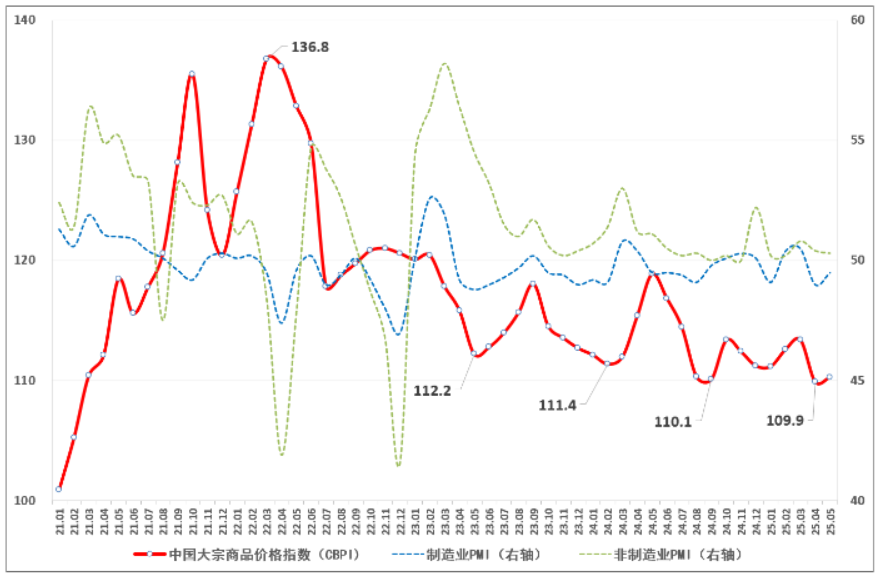
Core Insights - The May 2023 China Commodity Price Index (CCPI) stands at 110.3 points, reflecting a month-on-month increase of 0.3% but a year-on-year decrease of 7.2% [1][3] - The index indicates a stabilization trend in commodity prices, with specific sectors showing varied performance, such as a slight increase in non-ferrous metal prices and a rebound in chemical prices [1][6] Price Index Summary - The non-ferrous price index rose to 127.7 points, up 0.9% month-on-month but down 5.2% year-on-year [3][4] - The agricultural product price index increased to 98.2 points, with a month-on-month rise of 0.5% and a year-on-year increase of 2% [3][4] - The chemical price index rebounded to 102.8 points, up 0.5% month-on-month but down 13.7% year-on-year [3][4] - The black metal price index fell to 78.7 points, down 0.8% month-on-month and down 11.4% year-on-year [3][4] - The energy price index decreased to 96.3 points, down 2.1% month-on-month and down 14.9% year-on-year [3][4] - The mineral price index dropped to 75.6 points, down 2.2% month-on-month and down 8.3% year-on-year [3][4] Commodity Price Movements - Among 50 monitored commodities, 32 (64%) saw price declines while 17 (34%) experienced price increases [4][6] - The top three commodities with price increases were PTA (up 9.5%), ethylene glycol (up 4.6%), and corn (up 4.3%) [4][6] - The largest price declines were observed in industrial silicon (down 10.2%), lithium carbonate (down 10%), and soybean meal (down 9.9%) [4][6] Market Analysis - Analysts attribute the rise in non-ferrous prices to improved demand expectations due to easing US-China tariff policies [5][6] - The agricultural price index's increase is linked to stable downstream consumer demand, with corn prices rising due to increased market demand and short-term supply constraints [6][7] - The overall market sentiment remains cautious due to persistent external uncertainties and insufficient effective demand in certain sectors [1][7]


5月大宗商品价格指数微涨,信心初现
Huan Qiu Wang· 2025-06-05 02:49
Group 1 - The core viewpoint is that there is a mixed performance in the prices of major commodities in China, with some sectors showing recovery while others continue to decline [1][2][3] - In May, the China Commodity Price Index was reported at 110.3 points, reflecting a month-on-month increase of 0.3%, indicating a slight recovery in the market [3] - Among 50 monitored commodities, 17 showed a month-on-month price increase, with the non-ferrous price index at 127.7 points, up 0.9%, and the chemical price index rebounding by 0.5% [1] Group 2 - Agricultural product prices have risen for five consecutive months, demonstrating resilience in the agricultural sector and its role in stabilizing supply and prices [1] - Conversely, black, mineral, and energy price indices continue to decline, highlighting persistent issues of insufficient effective demand in certain industries [1] - Experts suggest that to solidify economic recovery, the government should increase public investment in infrastructure and services to boost market demand and enterprise orders [2]
【金融工程】股指期货深度贴水,小盘调整压力上升——市场环境因子跟踪周报(2025.06.04)
华宝财富魔方· 2025-06-04 10:33
Investment Insights - The report indicates an increase in the risk of "herding" behavior in the market, suggesting a cautious approach until the risk is released [3][4] - Current market focus remains on defensive sectors such as banking, pharmaceuticals, nuclear power, and new consumption themes, with a recommendation to wait for adjustment pressure to ease before making further investments [4] Stock Market Analysis - In the past week, small-cap growth stocks outperformed, while volatility in both large and small-cap styles increased, indicating instability in market styles [6] - The dispersion of excess returns among industry indices has decreased to a near one-year low, with a slight decline in the proportion of rising constituent stocks [6] - Market activity showed a slight increase in volatility, but turnover rates continued to decline, particularly in the Shanghai Stock Exchange 50, which reached historically low turnover levels [6] Commodity Market Overview - The commodity market displayed divergent trends, with energy and black metal sectors maintaining their momentum, while precious metals and non-ferrous metals showed upward trends [15] - The basis momentum for the black metal sector increased, while agricultural products remained at a low basis momentum [15] - Volatility was high in the energy sector, while other sectors experienced low-level fluctuations [15] Options Market Insights - Implied volatility for the Shanghai Stock Exchange 50 and CSI 1000 showed no significant trend before the Dragon Boat Festival, with long-term contracts experiencing a relative increase in implied volatility compared to short-term contracts [20] - The skew of put options relative to call options for the CSI 1000 maintained an advantage, with a noticeable increase in open interest, indicating market expectations of potential adjustments in small-cap stocks [20] Convertible Bond Market Trends - The convertible bond market saw a slight rebound, with the premium rate for bonds convertible at 100 yuan recovering, although the proportion of low-premium convertible bonds increased slightly [23] - Market transaction volume remained stable, and credit spreads significantly narrowed [23]

市场环境因子跟踪周报(2025.05.30):股指期货深度贴水,小盘调整压力上升-20250604
HWABAO SECURITIES· 2025-06-04 08:13
Quantitative Factors and Models Summary Quantitative Factors and Construction Methods 1. **Factor Name**: Market Style Factor **Construction Idea**: This factor tracks the market's preference for small-cap versus large-cap stocks and growth versus value stocks over the observed period **Construction Process**: - The factor is divided into two dimensions: size (small-cap vs. large-cap) and style (growth vs. value) - The factor measures the relative performance of small-cap stocks compared to large-cap stocks and growth stocks compared to value stocks - Observations include the directional bias (e.g., small-cap preference) and the volatility of these style preferences **Evaluation**: The factor indicates a market preference for small-cap and growth stocks, but with increased volatility, suggesting instability in market style trends [11][12] 2. **Factor Name**: Market Structure Factor **Construction Idea**: This factor evaluates the dispersion and concentration of returns across industries and stocks to assess market structure dynamics **Construction Process**: - Industry excess return dispersion is calculated to measure the spread of returns across different sectors - Metrics such as the proportion of rising constituent stocks and the turnover concentration of the top 100 stocks and top 5 industries are tracked - Changes in these metrics are used to infer market structure stability and concentration trends **Evaluation**: The factor shows a decline in industry return dispersion and a slight increase in stock and industry concentration, indicating a more concentrated market structure [11][12] 3. **Factor Name**: Market Activity Factor **Construction Idea**: This factor measures market activity through volatility and turnover rates **Construction Process**: - Index volatility is calculated to assess market fluctuations - Turnover rates, particularly for indices like the SSE 50, are tracked to gauge trading activity - Observations include changes in these metrics over time **Evaluation**: The factor reveals a slight increase in market volatility but a continued decline in turnover rates, especially for the SSE 50, indicating reduced market activity [11][12] 4. **Factor Name**: Commodity Market Factors **Construction Idea**: These factors analyze trends, momentum, volatility, and liquidity in commodity markets **Construction Process**: - **Trend Strength**: Tracks the continuation of trends in sectors like energy and metals - **Basis Momentum**: Measures the momentum of basis changes, with specific focus on sectors like agriculture and metals - **Volatility**: Assesses the level of price fluctuations in different commodity sectors - **Liquidity**: Evaluates the trading activity and ease of transactions in commodity markets **Evaluation**: The factors highlight strong trends in energy and metals, low basis momentum in agriculture, high volatility in energy, and strong liquidity in energy and metals [23][27] 5. **Factor Name**: Option Market Factors **Construction Idea**: These factors assess market sentiment and risk expectations through option pricing metrics **Construction Process**: - **Implied Volatility**: Tracks the implied volatility of options on indices like SSE 50 and CSI 1000 - **Skewness**: Measures the relative pricing of put options versus call options to infer market sentiment - **Open Interest**: Monitors changes in open interest to gauge market positioning **Evaluation**: The factors suggest stable short-term sentiment but highlight potential downside risks for small-cap stocks based on skewness and rising open interest in put options [33][34] 6. **Factor Name**: Convertible Bond Market Factors **Construction Idea**: These factors analyze valuation and liquidity dynamics in the convertible bond market **Construction Process**: - **Valuation Metrics**: Tracks metrics like the premium rate of bonds near par value and the proportion of low-premium bonds - **Liquidity Metrics**: Monitors trading volume and credit spreads **Evaluation**: The factors indicate a slight recovery in valuation metrics but a rise in low-premium bonds, with stable trading volumes and narrowing credit spreads [35][37] Factor Backtesting Results 1. **Market Style Factor**: - Small-cap preference observed - Growth style preference observed - Increased volatility in both dimensions [11][12] 2. **Market Structure Factor**: - Industry return dispersion decreased - Stock and industry concentration slightly increased [11][12] 3. **Market Activity Factor**: - Market volatility slightly increased - Turnover rates decreased, especially for SSE 50 [11][12] 4. **Commodity Market Factors**: - Strong trends in energy and metals - Low basis momentum in agriculture - High volatility in energy - Strong liquidity in energy and metals [23][27] 5. **Option Market Factors**: - Stable implied volatility for SSE 50 and CSI 1000 - Skewness favors put options for CSI 1000 - Rising open interest in put options for CSI 1000 [33][34] 6. **Convertible Bond Market Factors**: - Premium rates near par value slightly recovered - Proportion of low-premium bonds increased - Trading volumes stable - Credit spreads narrowed [35][37]
市场环境因子跟踪周报(2025.05.23):市场缩圈,小盘调整风险增加-20250528
HWABAO SECURITIES· 2025-05-28 13:13
- The report tracks various market environment factors, including stock market factors, commodity market factors, options market factors, and convertible bond market factors[1][3][6] Stock Market Factors 1. **Factor Name**: Market Style - **Construction Idea**: The factor tracks the performance of different market styles, such as large-cap vs. small-cap and value vs. growth[10] - **Construction Process**: The factor is constructed by analyzing the performance and volatility of different market styles. For example, the large-cap style is compared to the small-cap style, and the value style is compared to the growth style[10] - **Evaluation**: The large-cap value style is currently dominant, with increased volatility in both large-cap vs. small-cap and value vs. growth styles[10][12] 2. **Factor Name**: Market Structure - **Construction Idea**: The factor examines the structure of the market by analyzing industry index excess return dispersion, component stock rise ratio, and industry rotation speed[10] - **Construction Process**: The factor is constructed by measuring the dispersion of excess returns among industry indices, the proportion of rising component stocks, and the speed of industry rotation[10] - **Evaluation**: The dispersion of industry index excess returns and the proportion of rising component stocks have decreased, while the speed of industry rotation has also decreased[10][12] 3. **Factor Name**: Market Activity - **Construction Idea**: The factor tracks market activity by analyzing market volatility and turnover rate[11] - **Construction Process**: The factor is constructed by measuring the volatility and turnover rate of the market[11] - **Evaluation**: Market volatility remains low, and the turnover rate continues to decline[11][12] Commodity Market Factors 1. **Factor Name**: Trend Strength - **Construction Idea**: The factor tracks the strength of trends in different commodity sectors[25] - **Construction Process**: The factor is constructed by analyzing the trend strength in sectors such as energy, metals, and agriculture[25] - **Evaluation**: The energy and metals sectors show strong trends, while the trend strength in the precious metals sector is rising[25][29] 2. **Factor Name**: Basis Momentum - **Construction Idea**: The factor tracks the momentum of the basis in different commodity sectors[25] - **Construction Process**: The factor is constructed by measuring the basis momentum in sectors such as energy, metals, and agriculture[25] - **Evaluation**: Except for the agricultural sector, which has low basis momentum, other sectors have high basis momentum[25][29] 3. **Factor Name**: Volatility - **Construction Idea**: The factor tracks the volatility levels in different commodity sectors[25] - **Construction Process**: The factor is constructed by measuring the volatility levels in sectors such as energy, metals, and agriculture[25] - **Evaluation**: The energy sector has high volatility, while the metals and agricultural sectors have low volatility[25][29] 4. **Factor Name**: Liquidity - **Construction Idea**: The factor tracks the liquidity levels in different commodity sectors[25] - **Construction Process**: The factor is constructed by measuring the liquidity levels in sectors such as energy, metals, and agriculture[25] - **Evaluation**: Liquidity levels have decreased across all sectors[25][29] Options Market Factors 1. **Factor Name**: Implied Volatility - **Construction Idea**: The factor tracks the implied volatility levels of different options[35] - **Construction Process**: The factor is constructed by measuring the implied volatility levels of options on indices such as the SSE 50 and CSI 1000[35] - **Evaluation**: Implied volatility levels for both the SSE 50 and CSI 1000 options are rising[35] 2. **Factor Name**: Skewness - **Construction Idea**: The factor tracks the skewness of different options[35] - **Construction Process**: The factor is constructed by measuring the skewness of call and put options on indices such as the SSE 50 and CSI 1000[35] - **Evaluation**: The skewness of both call and put options on the SSE 50 has decreased, while the skewness of put options on the CSI 1000 remains higher than that of call options[35] Convertible Bond Market Factors 1. **Factor Name**: Valuation - **Construction Idea**: The factor tracks the valuation levels of convertible bonds[36] - **Construction Process**: The factor is constructed by measuring the premium rates of convertible bonds[36] - **Evaluation**: The premium rates of convertible bonds have slightly decreased, and the market activity has weakened[36] Factor Backtesting Results 1. **Market Style Factor**: Large-cap value style is dominant, with increased volatility in both large-cap vs. small-cap and value vs. growth styles[10][12] 2. **Market Structure Factor**: Decreased dispersion of industry index excess returns, decreased proportion of rising component stocks, and decreased speed of industry rotation[10][12] 3. **Market Activity Factor**: Low market volatility and declining turnover rate[11][12] 4. **Trend Strength Factor**: Strong trends in the energy and metals sectors, rising trend strength in the precious metals sector[25][29] 5. **Basis Momentum Factor**: High basis momentum in all sectors except agriculture[25][29] 6. **Volatility Factor**: High volatility in the energy sector, low volatility in the metals and agricultural sectors[25][29] 7. **Liquidity Factor**: Decreased liquidity levels across all sectors[25][29] 8. **Implied Volatility Factor**: Rising implied volatility levels for both SSE 50 and CSI 1000 options[35] 9. **Skewness Factor**: Decreased skewness for both call and put options on the SSE 50, higher skewness for put options on the CSI 1000 compared to call options[35] 10. **Valuation Factor**: Slightly decreased premium rates for convertible bonds, weakened market activity[36]
商品反弹之后的交易线索
对冲研投· 2025-05-21 11:42
Core Viewpoint - The article discusses the rebound in the commodity market following the Geneva joint statement between China and the U.S., driven by demand recovery expectations and supply contractions in certain products [1]. Group 1: Demand Marginal Tracking - The demand increase in the 90-day tariff suspension period is attributed to the shipment of previously delayed orders and U.S. companies' potential actions to "rush imports and transshipments" [2]. - The recent rise in U.S. shipping prices indicates an increase in orders, which will sustain strong demand in the near term [2]. - For complex goods, the delivery process may not see significant growth in demand during the tariff suspension, while shorter delivery cycle products like textiles and toys may show increased purchasing by U.S. companies [4][5]. Group 2: Profit and Supply Decision Adjustments - Short-term supply changes have a greater impact on price elasticity, with maintenance and operational issues in PX and PTA providing upward momentum for chemical products [9]. - The actual pace of production recovery is constrained by large manufacturers' maintenance plans and strategic supply adjustments, which create price support independent of demand [10]. - Despite potential for rapid production increases in the upstream supply chain, the lack of significant demand growth and previous low-profit periods may limit the willingness of leading manufacturers to increase output [13]. Group 3: Trade Policy Uncertainty - The uncertainty surrounding U.S. trade policy remains a significant risk, with a potential increase in tariffs by 54% if no agreement is reached within 90 days [16]. - The U.S. fiscal issues may necessitate a focus on revenue generation and spending cuts, complicating trade negotiations and potentially leading to higher retail prices that suppress consumer demand [16]. - The Federal Reserve's monetary policy adjustments in response to economic conditions may also impact inflation expectations and commodity prices [17]. Group 4: Sector-Specific Insights - Precious metals may experience short-term price corrections due to tariff and geopolitical tensions but are expected to return to their roles as a store of value in the medium term [23]. - Non-ferrous metals may face short-term demand limitations due to U.S. procurement decisions during the tariff suspension, but medium-term trends will be influenced by Federal Reserve policies [23]. - The energy sector faces supply and demand pressures, with OPEC's production increases and limited demand support affecting price stability [23].

2025年期货市场研究报告
Hua Tai Qi Huo· 2025-05-15 04:30
Import and Export Overview - The import volume of the equipment manufacturing industry has increased, with the Guangdong-Hong Kong-Macao Greater Bay Area's import and export value reaching 2.85 trillion yuan, a growth of 5.4% in the first four months of the year, accounting for 96.4% of Guangdong's total import and export value[1] - Exports of "new three items" and motorcycles increased by over 40%, while imports of semiconductor manufacturing equipment, computers and components, and certain consumer goods grew rapidly[1] Monetary Policy and Financial Services - As of the end of April, the broad money supply (M2) stood at 325.17 trillion yuan, reflecting a year-on-year increase of 8%[1] - The balance of domestic and foreign currency loans reached 269.54 trillion yuan, with a year-on-year growth of 6.8%[1] - The balance of RMB loans was 265.7 trillion yuan, up 7.2% year-on-year, with an increase of 1.006 trillion yuan in RMB loans over the first four months[1] Industry Trends - In the upstream sector, international oil prices have continued to rise following the tariff war, while aluminum prices have recently rebounded[2] - The chemical industry is experiencing a seasonal decline in PX operating rates, while polyester operating rates remain high[3] - In the downstream sector, real estate sales in second and third-tier cities are declining, and domestic flight frequencies have decreased compared to the same period last year[4] Market Pricing and Risks - The credit spread across all industries has recently narrowed slightly[5] - Potential risks include unexpected economic policies and global geopolitical conflicts[5]
【金融工程】节前市场波动降低,节后风格或将转向——市场环境因子跟踪周报(2025.05.07)
华宝财富魔方· 2025-05-07 09:37
Market Overview - The market showed an increase in cautious sentiment before the long holiday, with broad market indices experiencing a decline, while small-cap stocks stabilized and recovered [4][2]. - The week before the May Day holiday saw a balanced performance between large-cap and small-cap styles, as well as between value and growth styles, with a continued decrease in style volatility [6][2]. Market Structure - The excess return dispersion of industry indices slightly decreased, and the proportion of rising constituent stocks also saw a decline, indicating a slowdown in industry rotation [6][2]. - The trading concentration decreased, with the proportion of trading volume from the top 100 stocks rebounding from a low level, while the top five industries' trading volume proportion continued to decline [6][2]. Market Activity - Market volatility continued to decrease due to the upcoming holiday, and turnover rates also saw a reduction [7][2]. Commodity Market - There was a divergence in trend strength among commodity sectors, with energy and black metals maintaining strong trends, while non-ferrous and agricultural products showed weaker trends, and precious metals experienced a significant decline in trend strength [18][17]. - The non-ferrous sector had the highest basis momentum, while the black sector saw a rapid decline [18][17]. - Volatility across all sectors remained high, and liquidity was stable across the board [18][17]. Options Market - Implied volatility levels for the Shanghai Stock Exchange 50 and CSI 1000 indices increased, indicating some speculative sentiment in the market before the holiday [23][3]. - The skew of call options for the CSI 1000 improved, while the skew for the Shanghai Stock Exchange 50 saw a notable decline, suggesting a market expectation of small-cap stocks performing better post-holiday [23][3]. Convertible Bond Market - The valuation level of the convertible bond market slightly increased, remaining above the historical median for the past year, with a small rebound in the number of convertible bonds with low conversion premiums [27][3]. - Overall trading volume in the convertible bond market continued to recover [27][3].

市场环境因子跟踪周报(2025.04.30):节前市场波动降低,节后风格或将转向-20250507
HWABAO SECURITIES· 2025-05-07 09:12
Quantitative Factors and Construction Methods 1. Factor Name: Market Style Factors - **Construction Idea**: The market style factors track the balance and volatility between different market styles, such as large-cap vs. small-cap and value vs. growth[11][13] - **Construction Process**: - **Style Balance**: Measure the relative performance of large-cap vs. small-cap stocks and value vs. growth stocks to determine the market's style preference[11] - **Style Volatility**: Calculate the fluctuations in the relative performance of these styles over time to assess the stability of the market's style preference[11] - **Evaluation**: The market style factors showed a balanced preference between large-cap and small-cap stocks, as well as between value and growth stocks. Additionally, the volatility of these styles continued to decline, indicating a more stable market environment[11][13] 2. Factor Name: Market Structure Factors - **Construction Idea**: These factors analyze the dispersion of returns, sector rotation, and trading concentration to understand the structural dynamics of the market[11][13] - **Construction Process**: - **Return Dispersion**: Measure the excess return dispersion across industry indices to evaluate the variability in sector performance[11] - **Sector Rotation**: Assess the speed of sector rotation by tracking changes in sector leadership over time[11] - **Trading Concentration**: Calculate the proportion of trading volume concentrated in the top 100 stocks and the top 5 industries to gauge market concentration[11] - **Evaluation**: The market structure factors indicated a decline in return dispersion, slower sector rotation, and reduced trading concentration, suggesting a more evenly distributed market environment[11][13] 3. Factor Name: Market Activity Factors - **Construction Idea**: These factors measure the overall activity and liquidity of the market through volatility and turnover rates[12][13] - **Construction Process**: - **Volatility**: Calculate the index-level volatility to assess market stability[12] - **Turnover Rate**: Measure the turnover rate of the market to evaluate trading activity[12] - **Evaluation**: The market activity factors showed a decline in both volatility and turnover rates, reflecting reduced market activity, likely influenced by the holiday period[12][13] 4. Factor Name: Commodity Market Factors - **Construction Idea**: These factors analyze the performance, momentum, and liquidity of various commodity sectors[27][30] - **Construction Process**: - **Trend Strength**: Measure the strength of price trends in different commodity sectors, such as energy, metals, and agriculture[27] - **Basis Momentum**: Calculate the basis momentum, particularly for the metals sector, to assess the relative strength of futures prices compared to spot prices[27][30] - **Volatility**: Track the volatility levels across commodity sectors to evaluate risk[27][30] - **Liquidity**: Measure the liquidity of commodity sectors to assess trading ease[27][30] - **Evaluation**: The commodity market factors showed mixed performance, with strong trends in energy and metals, weaker trends in agriculture, and high volatility across sectors. Liquidity remained stable overall[27][30] 5. Factor Name: Options Market Factors - **Construction Idea**: These factors analyze the implied volatility and skewness of options to infer market sentiment and expectations[35] - **Construction Process**: - **Implied Volatility**: Measure the implied volatility levels of options on major indices, such as the SSE 50 and CSI 1000, to gauge market uncertainty[35] - **Skewness**: Analyze the skewness of call and put options to understand market expectations for upward or downward movements[35] - **Evaluation**: The options market factors indicated a divergence in sentiment, with increased optimism for small-cap stocks (CSI 1000) and reduced optimism for large-cap stocks (SSE 50). This suggests a potential shift in market preference post-holiday[35] 6. Factor Name: Convertible Bond Market Factors - **Construction Idea**: These factors evaluate the valuation and trading activity of the convertible bond market[38] - **Construction Process**: - **Valuation**: Measure the average conversion premium of convertible bonds to assess their relative attractiveness[38] - **Trading Activity**: Track the trading volume and turnover in the convertible bond market to evaluate market interest[38] - **Evaluation**: The convertible bond market factors showed a slight increase in valuation, with trading activity continuing to recover, indicating improving market sentiment[38] --- Factor Backtesting Results 1. Market Style Factors - **Style Balance**: Balanced between large-cap and small-cap, as well as value and growth[11][13] - **Style Volatility**: Continued decline in volatility, indicating stability[11][13] 2. Market Structure Factors - **Return Dispersion**: Declined, indicating less variability in sector performance[11][13] - **Sector Rotation**: Slowed down, suggesting reduced changes in sector leadership[11][13] - **Trading Concentration**: Decreased, reflecting a more evenly distributed market[11][13] 3. Market Activity Factors - **Volatility**: Declined, indicating reduced market risk[12][13] - **Turnover Rate**: Decreased, reflecting lower trading activity[12][13] 4. Commodity Market Factors - **Trend Strength**: Strong in energy and metals, weak in agriculture[27][30] - **Basis Momentum**: Highest in metals, declined in other sectors[27][30] - **Volatility**: High across all sectors[27][30] - **Liquidity**: Stable overall[27][30] 5. Options Market Factors - **Implied Volatility**: Increased for both SSE 50 and CSI 1000, indicating higher uncertainty[35] - **Skewness**: Positive for CSI 1000 (small-cap optimism), negative for SSE 50 (large-cap caution)[35] 6. Convertible Bond Market Factors - **Valuation**: Slight increase in average conversion premium[38] - **Trading Activity**: Continued recovery in trading volume[38]
大宗商品周度报告:流动性和需求均承压,商品短期或震荡偏弱运行-20250428
Guo Tou Qi Huo· 2025-04-28 11:13
大宗商品周度报告 2025年4月28日 黑色方面,钢材、铁矿石在前期强势上涨后出现调整,成材库存去化节奏减 慢,铁矿石盘面情绪同步转弱,双焦受原料补库力度减弱影响也震荡偏弱。政策 面稳增长预期依然存在支撑,但短期现实需求与宏观情绪脱节,导致黑色板块波 动加大。 能源方面,市场对全球经济放缓及需求疲软的担忧升温,同时美国成品油库 存回升、美联储偏鹰预期抑制了油价上行空间。尽管中东局势仍有不稳定因素, 但避险支撑逐步减弱,油价上行动能不足。天然气价格继续承压,受库存高企及 气温回暖影响,供需宽松格局未改。短期来看,能源板块情绪趋于谨慎,关注 OPEC+后续减产动态以及全球经济数据对需求端预期的进一步调整。 化工方面,聚酯产业链品种如PTA、乙二醇在成本支撑减弱下震荡回落,甲 醇、PVC等基础化工品亦受制于内需疲软和出口承压,盘面持续承压。尽管国 内稳增长政策仍在推进,但短期现实需求接力不足,化工板块陷入成本支撑减弱 与终端需求乏力共振的调整阶段。节后市场关注点将转向下游复工节奏、库存变 化及国际油价的指引作用。 农产品方面,油脂油料板块走高,受外盘反弹、供需预期改善及资金情绪回 暖带动。畜禽板块表现偏弱,消费提振 ...