Financial Leasing

Search documents
招银金租因租赁物违规等被罚80万 今年已有8家金租公司被罚共690万
2 1 Shi Ji Jing Ji Bao Dao· 2025-06-12 08:58
Group 1 - The National Financial Regulatory Administration's Shanghai Bureau has imposed penalties on China Merchants Jinling Financial Leasing Co., Ltd. for violations related to leasing public assets and conducting illegal leaseback transactions [1] - The company was fined 800,000 yuan for using public assets as leasing objects and conducting illegal leaseback business, while a senior manager was fined 50,000 yuan and warned [1] - The regulatory framework prohibits financial leasing companies from using public assets, incomplete ownership properties, or properties with ownership defects as leasing objects [1][2] Group 2 - In 2023, the National Financial Regulatory Administration has issued 14 penalties in the financial leasing sector, totaling 6.9 million yuan, affecting 8 leasing companies and 6 related individuals [2] - Xiamen Financial Leasing Co., Ltd. was fined 2.4 million yuan for inadequate management of shareholder equity and improper leasing asset management [2] - Guangdong Yuecai Financial Leasing Co., Ltd. faced a total penalty of 1.3 million yuan for imprudent financing practices and misuse of leasing funds [2][3] Group 3 - Tibet Financial Leasing Co., Ltd. had its financial license revoked due to serious violations including fabricating false transactions and failing to maintain prudent operational practices [3]
预见2025:《2025年中国融资租赁行业全景图谱》(附市场现状、竞争格局和发展趋势等)
Qian Zhan Wang· 2025-06-11 02:13
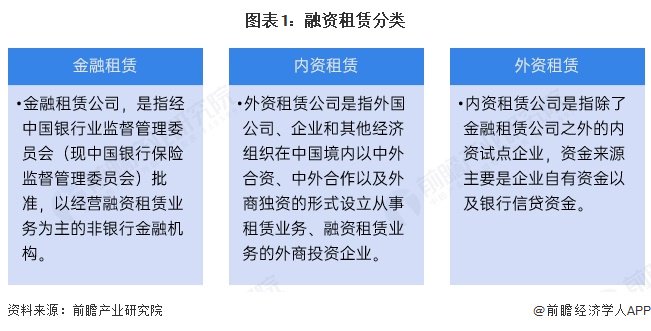
Industry Overview - The financing leasing industry is defined as a non-bank financial form where the lessor purchases the selected leased object from a third party at the request of the lessee and enters into a lease contract to rent it to the lessee for a fee [1] - Financing leasing can be categorized based on the nature of the enterprise into financial leasing, domestic leasing, and foreign leasing [2] Industry Chain Analysis - The industry chain involves three main parties: suppliers, lessors, and lessees. The upstream includes suppliers and banks providing financial support, the midstream consists of financing leasing companies, and the downstream lessees are primarily in sectors like aviation, construction, printing, medical, and automotive leasing [3] Industry Development History - The financing leasing business in China began around 1980, transitioning through various phases including initial growth, adjustment, and regulation. From 2011 to 2017, the industry experienced rapid growth, but since 2018, the number of enterprises has stabilized, and the total balance of leasing contracts has slightly declined, indicating a period of adjustment [7] Policy Background - The National Financial Regulatory Administration is the main regulatory body overseeing the financing leasing industry, responsible for formulating and implementing operational and regulatory rules. Recent government policies have focused on supporting green financing, equipment financing, and financing for small and medium-sized enterprises [10][12] Current Industry Status - The total balance of financing leasing contracts has been declining since 2019, with an estimated balance of approximately 54,600 billion RMB by the end of 2024, reflecting a decrease of about 1,800 billion RMB or 3.2% from 2023 [13] - Financial leasing continues to dominate the market, accounting for 43.0% of the total contract balance, while domestic leasing holds 35.5% and foreign leasing 17.3% as of mid-2024 [14] - The number of financing leasing enterprises is approximately 8,671, showing a stable trend overall [16] - Foreign leasing enterprises remain a significant force, but their proportion has slightly decreased, with domestic leasing enterprises increasing from 2.86% in 2016 to 5.19% by mid-2024 [17] Market Scale and Competition - The financing leasing market in China has shown stable demand, with a projected scale exceeding 30 trillion RMB in 2024. Major players include companies like Far East Horizon, China Merchants Jinling, and Industrial Bank Leasing [25] - The competitive landscape is characterized by a multi-tiered structure, with high-end markets predominantly led by international brands [21] Future Development Trends - The financing leasing industry is expected to evolve towards greater standardization, greening, digitization, and concentration, adapting to policy and market changes to promote sustainable growth [27][28] - Despite a slowdown in overall development since 2024, the market demand remains stable, with an anticipated annual growth rate of around 5% over the next six years [31]

天津金融监管局:1至4月航运保险已提供风险保障8552.05亿元
2 1 Shi Ji Jing Ji Bao Dao· 2025-06-10 09:15
Core Viewpoint - The Tianjin Financial Regulatory Bureau is promoting "blue finance" to support sustainable marine economic development and enhance the integration of port, industry, and city in Tianjin, aiming to build a world-class smart and green hub port [1] Group 1: Blue Finance Initiatives - The Tianjin Bureau is guiding financial institutions to align with international standards to improve blue finance services for the marine economy and port-city integration [2] - A loan service and management information sharing mechanism for key projects in port-city integration has been established, with a loan balance of 32.674 billion yuan as of the end of Q1 [2] - Shipping insurance has been expanded to support foreign trade, with a total risk coverage of 855.205 billion yuan and claims paid amounting to 21.3 million yuan from January to April [2] Group 2: Financial Leasing and Support - Financial leasing companies are being encouraged to support local shipping industry development, with a water transport equipment asset balance of 152.311 billion yuan, reflecting a 2.14% increase since the beginning of the year [3] - Innovative service models are being developed, such as a collaboration mechanism among banks, insurance, and leasing to support cross-border leasing with financing of nearly 200 million USD [4] Group 3: Environmental and Risk Management - The Tianjin Bank has introduced eco-environmental oriented development loans totaling 515 million yuan to address funding needs for ecological protection [4] - Special war insurance has been provided for ocean-going vessels registered in Tianjin Port, offering 28 million USD in war risk coverage to mitigate financial impacts from extreme events [5] Group 4: Strategic Development - Financial leasing is facilitating the implementation of national strategies like "national ships, national manufacturing," with a notable project involving a 3.5 billion yuan leasing agreement for three large container ships [6]
【最全】2025年融资租赁行业上市公司全方位对比(附业务布局汇总、业绩对比、业务规划等)
Qian Zhan Wang· 2025-05-31 07:10
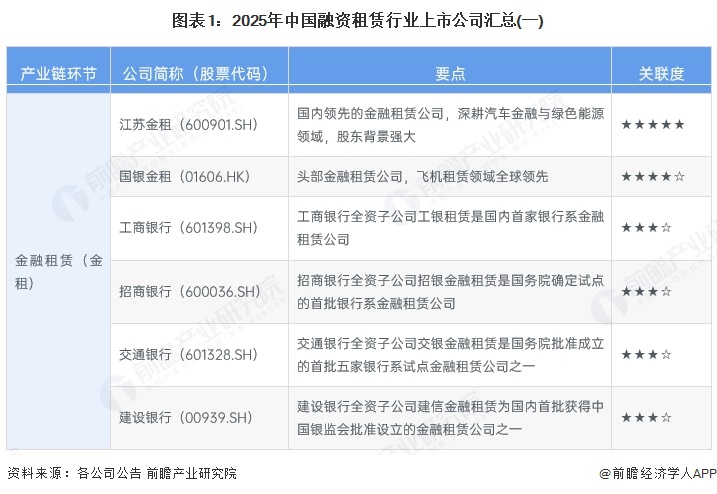
Summary of Key Points Core Viewpoint - The financing leasing industry in China has seen significant growth, with over 20 listed companies, primarily concentrated in the Hong Kong market due to its more flexible listing environment compared to mainland China [1]. Group 1: Overview of Listed Companies - The majority of financing leasing companies are listed in Hong Kong, where the listing requirements are relatively lower, attracting many firms to seek financing through this market [1]. - Only two financing leasing companies, Bohai Leasing and Jiangsu Jinzu, have successfully listed in the A-share market due to stricter regulations [1]. Group 2: Company Profiles and Business Layout - Jiangsu Jinzu (600901.SH) is a leading financial leasing company focusing on automotive finance and green energy, backed by strong shareholders [2]. - Guoyin Jinzu (01606.HK) is a top financial leasing company, globally leading in aircraft leasing [2]. - Bohai Leasing (000415.SZ) is a global leader in aircraft and container leasing, with a significant asset scale [5]. - China Aircraft Leasing (01848.HK) is the largest independent aircraft leasing company in China and the first listed in Asia [5]. - Far East Horizon (03360.HK) is a comprehensive financing leasing leader covering multiple sectors including healthcare and education [5]. Group 3: Financial Performance and Business Metrics - The revenue of Bohai Leasing for 2024 is projected at 384.31 billion, while Far East Horizon is expected to generate 377.49 billion [6]. - Guoyin Jinzu anticipates a revenue of 120.92 billion with a net profit margin of 15.88% for 2024 [14]. - Jiangsu Jinzu's revenue is projected at 39.59 billion with a net profit margin of 56.25% [14]. - The financing leasing business of China Aircraft Leasing is expected to generate 43.50 billion (HKD) with a net profit margin of 7.49% [14]. Group 4: Future Business Plans and Strategies - Jiangsu Jinzu plans to deepen its equipment leasing business and expand its customer base among small and medium enterprises [17]. - Guoyin Jinzu aims to focus on digital transformation and expand its vehicle retail financial services [17]. - Bohai Leasing intends to optimize its business structure and explore new areas such as green leasing [17]. - Far East Horizon will continue to deepen its presence in healthcare, education, and infrastructure sectors [17]. - China Aircraft Leasing plans to enhance its aircraft leasing capabilities and explore new business models [17]. Group 5: Industry Trends and Developments - The financing leasing industry is increasingly focusing on technology empowerment and digital transformation to support the real economy and green development [15]. - Companies are expected to enhance risk management and compliance to improve their core competitiveness and market influence [15].


【前瞻分析】2025年中国融资租赁行业上市公司业务布局情况分析
Sou Hu Cai Jing· 2025-05-29 10:41
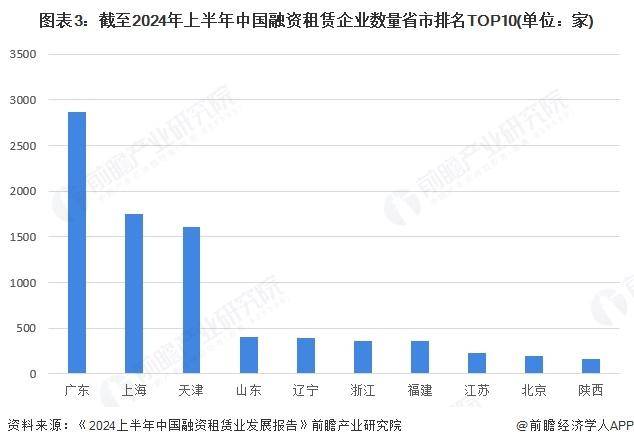
Group 1 - The core viewpoint of the news highlights the growth and restructuring trends in China's financing leasing industry, emphasizing the importance of mergers and acquisitions for enhancing market competitiveness and resource optimization [3][5][6] - As of the first half of 2024, Guangdong, Shanghai, and Tianjin lead the country in the number of financing leasing companies, with 2869, 1749, and 1603 companies respectively, indicating a concentrated market presence in these regions [1][6] - The financing leasing market in Guangdong is supported by favorable government policies, strong industrial foundations, and abundant financial resources, contributing to its high-quality development and significant role in the Greater Bay Area [6][9] Group 2 - The financing leasing industry is experiencing a trend of horizontal integration through mergers and acquisitions, aimed at increasing market share and enhancing competitiveness [3][5] - Notable transactions include the acquisition of 100% equity of Shanghai Huaxin Yichou Aircraft Leasing Co., Ltd. by AVIC Materials for 137.28 million RMB, reflecting strategic alignment and resource integration [5] - In 2024, the financing leasing market in Guangdong primarily focuses on urban investment, automotive, IT, aviation transport, and wind power generation, with urban investment alone exceeding 20 billion RMB [9][10]
【前瞻分析】2025-2030年中国融资租赁行业企业数量及行业融资
Sou Hu Cai Jing· 2025-05-29 10:41
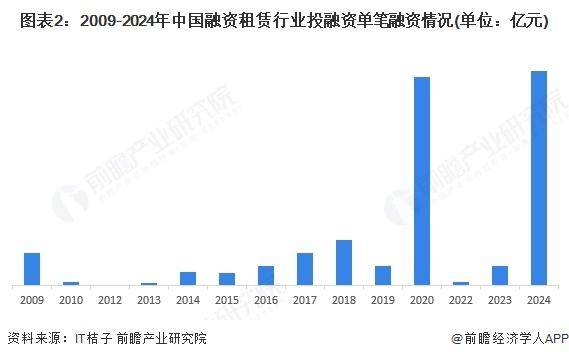
Group 1 - The financing leasing industry in China has entered a stage of steady development, with single financing amounts showing a volatile growth trend from 2009 to 2024, particularly increasing significantly in 2020 and 2024, indicating stronger support from the capital market for the industry [1] - The main financing sectors within the leasing industry include enterprise services, healthcare, and automotive sectors, with funding sources categorized into internal and external financing [3] - The number of companies in the Chinese financing leasing market remains relatively stable at around 70, significantly lower than that in the commercial leasing market, due to high entry barriers requiring financial licenses and strict regulatory compliance [5] Group 2 - The competitive landscape of the financing leasing market is relatively concentrated, with the top ten companies accounting for a significant portion of the market share, driven by high entry barriers and the need for strong capital and risk management capabilities [6] - Key investment events in the financing leasing industry from 2018 to 2024 highlight strategic investments, with notable amounts such as 5.06 billion RMB for Guojin Financing Leasing and 21.325 billion RMB for GAC Leasing [4]
新规实施七个月 谁还在“最低门槛”之外
Jin Rong Shi Bao· 2025-05-29 09:38
Core Points - The newly revised "Regulations on the Management of Financial Leasing Companies" will take effect on November 1, 2024, and aims to enhance risk resistance and ensure the sustainable operation of enterprises [1] - The minimum registered capital for financial leasing companies is set at 1 billion RMB or equivalent freely convertible currency, with a requirement for major shareholders to hold at least 51% of the total equity, up from the previous 30% [1] - The regulations are intended for both newly established and existing financial leasing companies, providing guidance for compliance and risk management [1] Group 1 - Financial leasing companies are currently experiencing a "capital increase wave" to solidify their capital strength and compliance foundation in response to the new regulations [2] - Companies such as Hubei Jinzu and Jiangsu Jinzu have successfully completed capital increases and adjustments in shareholding structure, with Hubei Jinzu's registered capital rising from 4 billion RMB to 4.333 billion RMB and Jiangsu Jinzu's from 4.245 billion RMB to 5.793 billion RMB [2] - Other companies like Zhejiang Yinjin and CITIC Jinzu are also accelerating their capital increase processes, with CITIC Jinzu potentially increasing its registered capital from 4 billion RMB to 10 billion RMB [3] Group 2 - Some financial leasing companies still do not meet the minimum registered capital requirement of 1 billion RMB, with four companies reported to have insufficient capital [4] - Companies such as Zhongmei Kegong Jinzu and Jilin Jiuyin Jinzu have registered capitals of 980 million RMB and 525 million RMB, respectively, indicating a need for capital restructuring [4] - Smaller financial leasing companies, while having registered capital above 1 billion RMB, may still not meet the 51% shareholding requirement for major shareholders, highlighting ongoing compliance challenges [5]
京津冀协同发展十周年:天津金融业增加值增长84.5%,持续推动租赁保理及标志区项目发展
2 1 Shi Ji Jing Ji Bao Dao· 2025-05-17 06:56
Core Viewpoint - Tianjin is advancing as a financial innovation operation demonstration zone, leveraging its strategic position in the Beijing-Tianjin-Hebei coordinated development plan to enhance its financial sector's capabilities and contributions to the local economy [1][2]. Financial Sector Growth - Since June 2015, Tianjin's financial industry has seen significant growth, with deposits and loans surpassing 3 trillion and 4 trillion yuan respectively. The financial value added increased from 139 billion yuan in 2014 to 256.5 billion yuan in 2024, marking an 84.5% growth. The financial sector's contribution to the city's GDP rose from 8.8% in 2014 to 14.2% in 2024 [1]. Innovation in Leasing and Factoring - Tianjin has established itself as a national leasing innovation demonstration zone and a hub for commercial factoring, with financing leasing and commercial factoring assets reaching over 2.3 trillion yuan and 300 billion yuan respectively by the end of 2024. The city has introduced various innovative business models, including bonded leasing and green leasing, and has seen a 15% year-on-year growth in leasing services for small and micro enterprises [2][3]. Future Development Plans - The city plans to focus on developing world-class leasing centers in aircraft, shipping, and offshore trade, while promoting green leasing initiatives. The aim is to enhance the scale of green leasing assets and support the transition to a low-carbon economy [3]. Financial Innovation Zones - In 2023, Tianjin's government outlined plans to create four financial aggregation zones based on regional characteristics, including a financial historical and cultural zone, a financial development vitality zone, a leasing innovation demonstration zone, and an industrial financial development zone [4]. Progress on Key Projects - Ongoing projects include the establishment of a financial display center in the financial historical and cultural zone, a technology and green finance focus in the financial development vitality zone, and the development of the largest aircraft leasing company headquarters in the leasing innovation demonstration zone. By 2025, the city aims to identify and promote 11 key projects to drive high-quality regional development [5].
2025年广东省融资租赁市场分析:发展环境优越,企业数量位居全国首位【组图】
Qian Zhan Wang· 2025-05-16 07:47
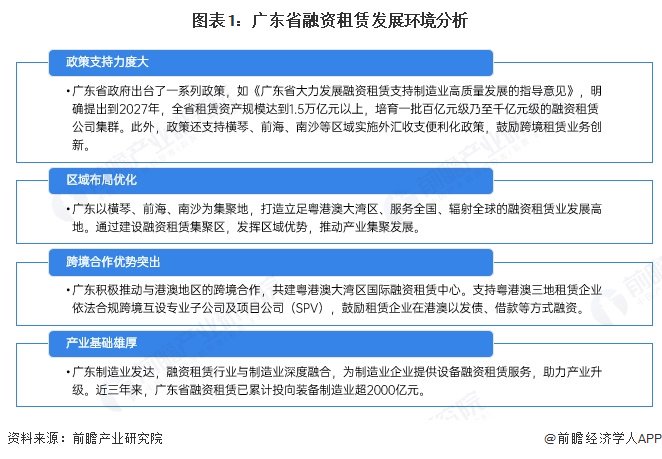
Core Insights - The financing leasing market in Guangdong Province benefits from strong government support, optimized regional layout, cross-border cooperation advantages, robust industrial foundation, abundant financial resources, innovative and diversified development models, and comprehensive talent and organizational guarantees, contributing to its high-quality development and significant role in the Guangdong-Hong Kong-Macao Greater Bay Area and nationwide [1] Group 1: Market Overview - As of June 2024, Guangdong Province has 2,869 financing leasing companies, accounting for 33.09% of the national total, making it the only province with a share exceeding 30% [4] - The financing leasing market in Guangdong has a high market concentration, with leading companies including Guoyin Financial Leasing, China Communications Leasing (Guangzhou), and Far East Horizon (Guangzhou) [9] Group 2: Investment Scale - The total investment scale of financing leasing in Guangdong Province for 2024 is projected to be 221.072 billion yuan, representing a year-on-year decrease of 17.21% [5] - The primary investment areas for 2024 include urban investment, automotive, IT, air transportation, and wind power generation, with urban investment exceeding 20 billion yuan [6]
降准落地:1万亿长期资金注入市场 实体经济与消费市场双受益
Yang Shi Wang· 2025-05-15 09:03
Group 1 - The People's Bank of China has implemented a 0.5 percentage point reduction in the reserve requirement ratio, marking the first such reduction in 2023, which is expected to release approximately 1 trillion yuan in long-term liquidity into the market [1][4][6] - The reserve requirement ratio for auto finance companies and financial leasing companies has been reduced from 5% to 0%, significantly enhancing their ability to provide credit in specific sectors [1][8] - The reduction in reserve requirements allows banks to increase the amount of loans they can issue, thereby supporting consumption, foreign trade, technological innovation, and small and micro enterprises [6][8] Group 2 - The released funds from the reserve requirement reduction can be utilized for loans and investments, and it is anticipated to lower loan interest rates, particularly benefiting small and micro enterprises [6][8] - The reduction will enable auto finance companies to offer more favorable loan terms to consumers, making it easier for individuals to finance vehicle purchases [8] - Financial leasing companies can allocate the released funds towards sectors such as equipment manufacturing, new infrastructure construction, and clean energy [8]